
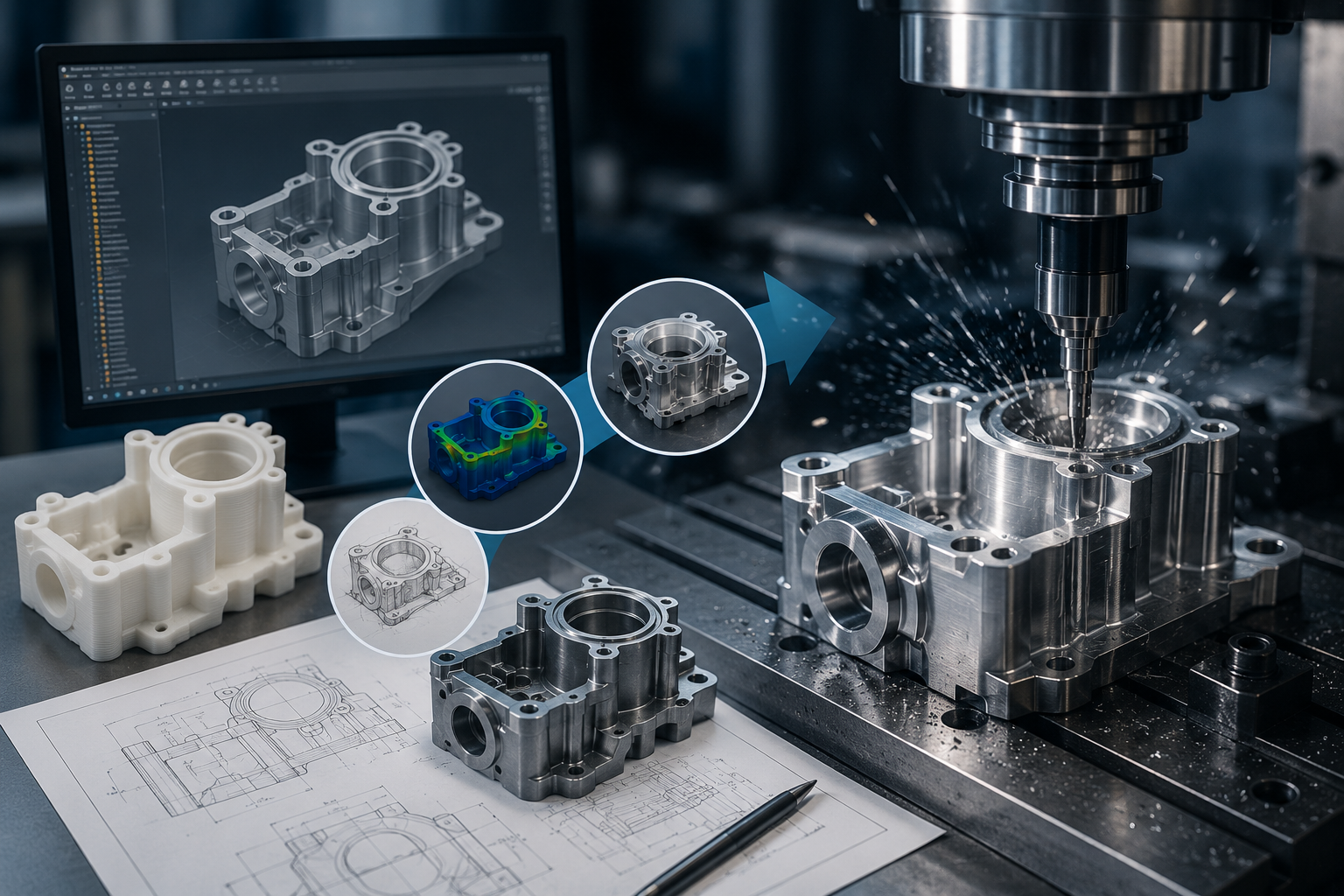
From Rapid Prototypes to Production-Ready Precision Components
Bringing a new product to market requires speed, accuracy, testing, and reliable manufacturing. However, traditional manufacturing processes can slow development when they require expensive tooling or lengthy setup. CNC machining provides manufacturers with a faster and more flexible way to turn digital designs into functional components.
At Polymach365, we provide CNC machining and prototype manufacturing solutions in Canada for businesses developing custom components and new products. CNC milling, CNC turning, and 5-axis machining can help shorten development cycles, simplify design changes, and support the transition from prototype to production.
Therefore, CNC machining can play an important role in helping Canadian manufacturers improve product development efficiency while maintaining precision and quality.
What Is CNC Machining in Product Development?
CNC machining is a subtractive manufacturing process. Computer-controlled equipment removes material from a solid workpiece to produce the required geometry.
Manufacturers can machine parts directly from CAD models using processes such as:
- CNC milling
- CNC turning
- 5-axis CNC machining
- Drilling and tapping
- Precision machining
- Custom CNC machining
Unlike processes that require dedicated production molds, CNC machining can often begin with standard material stock and a validated design. As a result, engineers can produce prototypes and custom parts without waiting for production tooling.
Why Speed Matters in Product Development
Modern product development involves much more than creating a design. Engineers must prototype, test, modify, validate, and prepare components for production.
Delays during any stage can increase development costs and extend time-to-market.
Therefore, manufacturers need processes that allow them to move efficiently through the development cycle.
CNC machining helps because engineers can quickly manufacture physical parts, evaluate them, modify the CAD model, and produce another iteration when necessary.
1. CNC Machining Enables Faster Functional Prototyping
A digital model cannot always reveal how a component will perform in the real world. Physical prototypes allow engineers to test actual fit, function, strength, and assembly.
CNC machining is particularly useful for functional prototype manufacturing because it can produce parts from engineering-grade materials.
For example, prototypes can be manufactured from:
Metals
- Aluminum
- Stainless steel
- Carbon steel
- Brass
- Copper
- Titanium
- Tool steel
Engineering Plastics
- ABS
- Nylon
- Delrin/Acetal
- Polycarbonate
- PEEK
- PTFE
Consequently, engineers can evaluate prototypes using materials that may closely represent the intended production component.
2. Design Changes Can Be Implemented Quickly
Product development rarely ends with the first prototype.
Engineers may discover that a hole needs repositioning, a wall needs additional thickness, or an assembly feature requires modification.
With CNC machining, engineers can update the CAD model and revise the machining program rather than creating an entirely new mold.
Therefore, design iterations can be easier to implement during early product development.
This flexibility is particularly valuable for startups, engineering teams, and manufacturers developing innovative products.
3. CNC Machining Supports High-Precision Product Validation
A prototype must accurately represent the intended design if engineers want meaningful test results.
Modern CNC machining provides high dimensional accuracy and repeatability. Therefore, manufacturers can use machined prototypes to evaluate critical dimensions, mating components, mechanical performance, and assembly requirements.
Precision machining is especially valuable when developing components with:
- Tight tolerances
- Precision holes
- Complex surfaces
- Critical mating features
- Threaded features
- Multi-component assemblies
As a result, potential design problems can be identified before a project reaches larger-scale manufacturing.
4. No Dedicated Mold Is Required for CNC Prototypes
One major advantage of CNC machining during product development is the ability to manufacture many components without first producing a dedicated mold.
Injection molding can be highly efficient for high-volume plastic production. However, mold design and tooling require an upfront investment and additional development time.
For early-stage prototypes, manufacturers may not yet be ready to commit to tooling.
CNC machining allows teams to validate their designs first. Once the product is finalized, they can decide whether CNC production, injection molding, or another process offers the best long-term solution.
5. CNC Machining Helps Reduce Development Risk
Finding a design problem after mass production begins can become expensive.
Therefore, manufacturers should identify potential issues as early as possible.
CNC prototypes can help engineers evaluate:
- Dimensional accuracy
- Mechanical performance
- Component fit
- Assembly compatibility
- Material behaviour
- Product functionality
- Design feasibility
Consequently, manufacturers can make informed improvements before committing to full-scale production.
6. 5-Axis CNC Machining Accelerates Complex Part Development
Complex components can require machining from several angles. Conventional machining may require multiple setups to access different surfaces.
However, 5-axis CNC machining allows the cutting tool to approach the workpiece from multiple directions.
This capability can provide several advantages:
- Fewer setups
- Better access to complex geometries
- Improved consistency
- Reduced repositioning
- Efficient machining of intricate components
- Excellent surface quality
Therefore, 5-axis machining can be particularly effective for developing sophisticated engineering components.
7. CNC Machining Bridges Prototype and Low-Volume Production
Product development does not always move directly from one prototype to mass production.
Manufacturers may first require 10, 50, 100, or several hundred parts for:
- Field testing
- Engineering validation
- Customer evaluation
- Pilot production
- Market testing
- Pre-production assembly
CNC machining can support this transition because the same general manufacturing approach used for prototypes can also produce low-volume batches.
As a result, businesses can scale production gradually while managing inventory and financial risk.
8. Design for Manufacturability Can Improve Development Efficiency
A component may look perfect in CAD but still contain features that make manufacturing unnecessarily difficult.
Design for Manufacturability (DFM) helps identify these issues before production.
DFM reviews may examine factors such as:
- Internal corner radii
- Hole depth
- Wall thickness
- Tool accessibility
- Tolerance requirements
- Material selection
- Part orientation
- Surface finish
For example, unnecessarily tight tolerances may increase machining and inspection requirements. Likewise, deep cavities or inaccessible features can require additional operations.
Therefore, early DFM feedback can reduce unnecessary complexity and support a smoother transition into manufacturing.
9. CNC Machining Provides Broad Material Flexibility
Material selection can significantly influence product performance.
During development, engineers may need to compare different materials based on strength, weight, corrosion resistance, thermal performance, or cost.
CNC machining supports a broad range of metals and engineering plastics. Consequently, manufacturers can create several prototype versions and evaluate which material works best for the final application.
This flexibility makes CNC machining valuable for product development across many industries.
10. CNC Machining Can Improve Time-to-Market
Ultimately, faster product development can create a competitive advantage.
By combining rapid prototype manufacturing, straightforward design revisions, precision machining, and scalable low-volume production, CNC machining can shorten the path between concept and production.
A typical development workflow may look like:
CAD Design → DFM Review → CNC Prototype → Testing → Design Improvement → Final Validation → Low-Volume Production → Scaled Manufacturing
Because manufacturers can identify and correct problems earlier, they may avoid costly changes later in the development process.
CNC Machining vs 3D Printing for Product Development
Both CNC machining and 3D printing can contribute to rapid product development.
| Factor | CNC Machining | 3D Printing |
|---|---|---|
| Manufacturing Method | Subtractive | Additive |
| Functional Metal Parts | Excellent | Process-dependent |
| Engineering Plastics | Excellent | Excellent |
| Complex Internal Geometry | Limited by tool access | Excellent |
| Surface Finish | Generally excellent | Often requires finishing |
| Tight Tolerances | Excellent | Process-dependent |
| Design Iteration | Fast | Very fast |
| Low-Volume Production | Excellent | Application-dependent |
Therefore, 3D printing may be ideal for early concept models and highly complex geometries, while CNC machining is often preferred when functional performance, production-grade materials, or tighter dimensional control are important.
Industries That Benefit From CNC Product Development
CNC machining supports product development across a wide range of Canadian industries.
Automotive
Manufacturers use CNC machining for custom brackets, housings, fixtures, mechanical components, and prototype parts.
Aerospace
Complex geometries and demanding dimensional requirements make precision CNC machining valuable for aerospace development.
Industrial Equipment
Machine builders require custom components, replacement parts, fixtures, and automation components.
Robotics and Automation
CNC machining can produce precision housings, mounting components, shafts, brackets, and structural parts.
Electronics
Manufacturers can develop precision enclosures, heat-management components, and custom housings.
Mold and Tooling
CNC technology supports mold components, inserts, tooling, fixtures, and related precision components.
How Polymach365 Supports Product Development in Canada
Polymach365 provides manufacturing solutions designed to support projects from initial prototypes through production.
Our capabilities include prototype manufacturing, CNC milling, CNC turning, 5-axis CNC machining, custom CNC machining, low-volume production, precision mold components, injection mold design, and manufacturing support.
Therefore, customers can work with one manufacturing partner as their project progresses through different development stages.
Moreover, engineering-focused manufacturing support can help businesses select suitable processes, materials, and production strategies based on their application.
Benefits of Choosing Polymach365
Working with Polymach365 can provide manufacturers with several important advantages:
- Precision CNC machining capabilities
- Rapid prototype manufacturing
- Custom CNC milling and turning
- 5-axis machining for complex components
- Flexible low-volume manufacturing
- Engineering and DFM support
- Multiple material options
- Quality-focused manufacturing
- Prototype-to-production support
- Manufacturing solutions for Canadian businesses
Most importantly, the goal is not simply to machine a component. Instead, the manufacturing process should help move your overall product development project forward efficiently.
From Prototype to Production with Polymach365
Successful product development requires the right process at every stage.
During early development, manufacturers may need prototypes for fit and functional testing. Next, they may require improved versions for engineering validation. Afterward, low-volume production can support market testing or pilot manufacturing.
Finally, once the product and production strategy are validated, manufacturing can scale according to demand.
Polymach365 supports this journey with rapid prototyping, precision CNC machining, custom manufacturing, mold components, and injection mold solutions.
Therefore, manufacturers can develop products with greater flexibility while maintaining a clear path toward production.
Final Thoughts
CNC machining accelerates product development by giving engineers a flexible way to transform CAD designs into precise, functional components. It supports rapid design iterations, production-grade materials, engineering validation, low-volume manufacturing, and complex part development.
Furthermore, CNC machining can reduce the risks associated with moving an untested design directly into high-volume production.
For Canadian manufacturers looking to shorten development cycles, improve component quality, and move efficiently from prototype to production, CNC machining can be an effective manufacturing strategy.
Start Your CNC Machining Project with Polymach365
Have a new product, prototype, or custom component ready for manufacturing?
Send your CAD drawings and project requirements to Polymach365 for manufacturing review. Our team can help you evaluate your CNC machining requirements and determine an appropriate path from prototype development to production.