High-Precision Custom Manufacturing for Demanding Industrial Applications
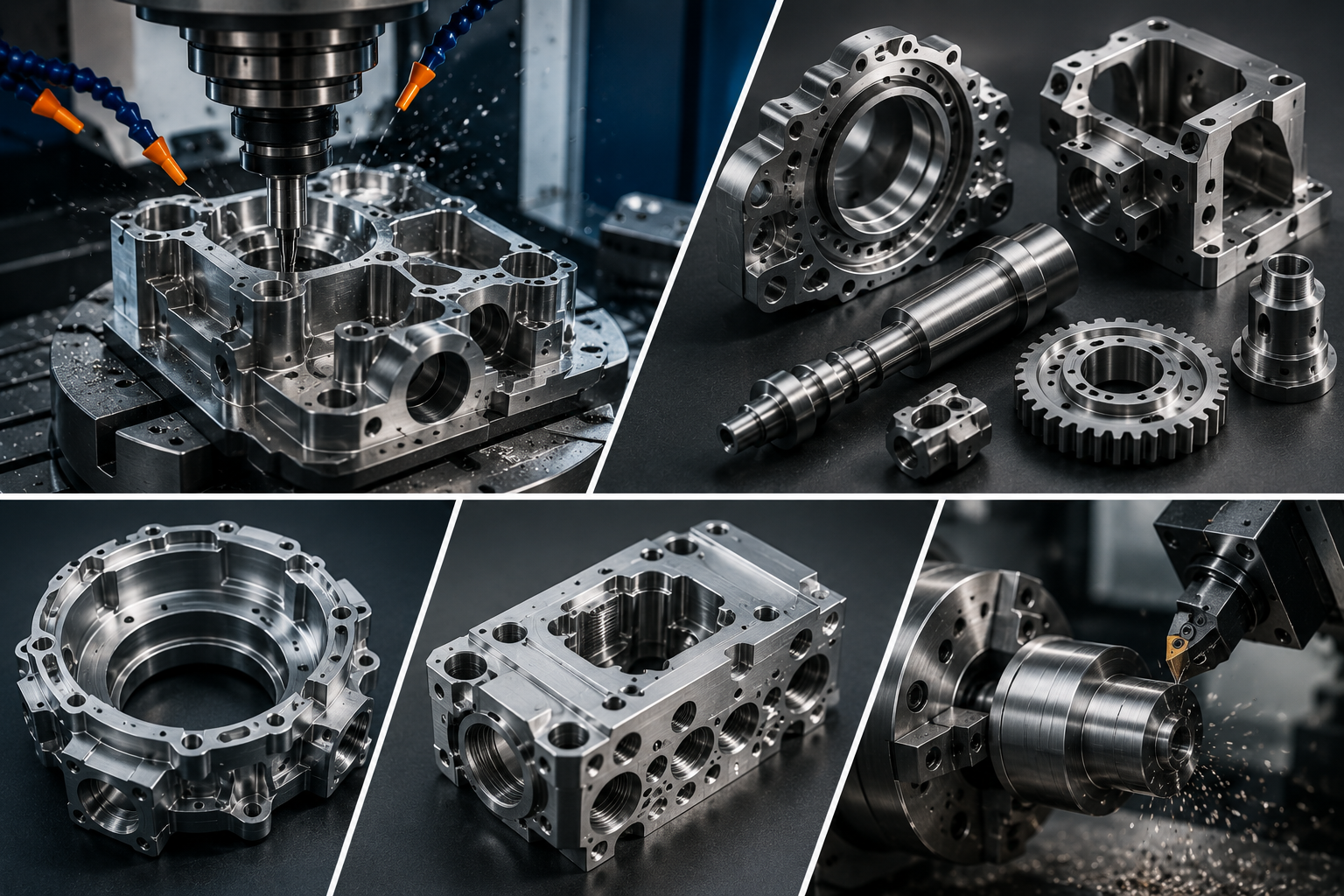
Modern industrial equipment depends on components that deliver accuracy, durability, and consistent performance. However, standard off-the-shelf parts cannot always meet specialized engineering requirements. Therefore, manufacturers often require custom CNC machining solutions for components with complex geometries, tight tolerances, demanding materials, or application-specific features.
At Polymach365, we provide custom CNC machining solutions for complex industrial components, supporting manufacturers with precision CNC milling, CNC turning, 5-axis machining, prototype manufacturing, and low-volume production. From a single custom prototype to repeat production batches, our manufacturing approach focuses on accuracy, manufacturability, and reliable quality.
Moreover, CNC machining provides the flexibility to manufacture intricate metal and plastic parts directly from CAD designs. As a result, engineers can develop specialized components without compromising their functional requirements.
What Is Custom CNC Machining?
Custom CNC machining is a computer-controlled manufacturing process used to produce components according to specific drawings, CAD models, tolerances, materials, and performance requirements.
Unlike standard components, custom CNC parts are manufactured for a particular product, machine, assembly, or industrial application.
Depending on the component, manufacturing may involve:
- CNC milling
- CNC turning
- 3-axis machining
- 4-axis machining
- 5-axis CNC machining
- Drilling and tapping
- Precision boring
- Thread machining
- Secondary finishing
Therefore, CNC machining provides engineers with considerable flexibility when standard components cannot satisfy project requirements.
Why Complex Industrial Components Require Precision Machining
Industrial components often operate under challenging conditions. For example, parts may experience high loads, vibration, repeated motion, heat, pressure, or continuous operation.
Consequently, dimensional errors can affect assembly, equipment performance, and component life.
Precision CNC machining helps manufacturers maintain critical features such as:
✔ Hole positions
✔ Flatness
✔ Concentricity
✔ Parallelism
✔ Thread dimensions
✔ Mating surfaces
✔ Complex profiles
✔ Critical dimensions
As a result, properly machined components can integrate more reliably into complex industrial assemblies.
Our Custom CNC Machining Capabilities
Polymach365 supports different manufacturing requirements through multiple CNC machining processes.
CNC Milling Services
CNC milling uses rotating cutting tools to remove material from a stationary workpiece.
It is suitable for manufacturing:
- Machine brackets
- Mounting plates
- Housings
- Fixtures
- Tooling
- Mold inserts
- Equipment components
- Complex mechanical parts
Moreover, CNC milling allows manufacturers to create pockets, holes, slots, contours, and precision surfaces within a single manufacturing workflow.
CNC Turning Services
CNC turning is ideal for producing rotational and cylindrical components.
Common CNC-turned industrial parts include:
- Shafts
- Pins
- Bushings
- Sleeves
- Rollers
- Couplings
- Spacers
- Threaded components
Because the workpiece rotates during machining, CNC turning can provide excellent concentricity and dimensional consistency for rotational components.
5-Axis CNC Machining for Complex Components
Some industrial parts contain features that are difficult to access with conventional 3-axis machining.
Therefore, 5-axis CNC machining can provide an effective solution for complex geometries.
The cutting tool can approach the component from multiple directions. Consequently, manufacturers can machine several surfaces with fewer setups.
Key Benefits of 5-Axis Machining
✔ Fewer machining setups
✔ Improved access to complex features
✔ Better positional consistency
✔ Reduced repositioning
✔ Efficient complex-part manufacturing
✔ High-quality surface finishes
As a result, 5-axis CNC machining is valuable for sophisticated industrial components where geometry and precision are critical.
Types of Complex Industrial Components We Can Support
Custom CNC machining can be used for a wide range of industrial applications.
Precision Housings
Machined housings can include mounting holes, bearing locations, internal cavities, and precision mating surfaces.
Shafts and Rotational Components
Custom shafts require accurate diameters, shoulders, threads, grooves, and bearing surfaces.
Jigs and Fixtures
Manufacturing fixtures help improve positioning, assembly, inspection, and repeatability.
Machine Components
Custom plates, brackets, blocks, supports, adapters, and structural components can be manufactured according to specific equipment requirements.
Mold Components
Core pins, cavity inserts, mold inserts, and other precision components require controlled dimensions and high-quality surfaces.
Automation Components
Robotics and automated equipment often require custom mounts, grippers, brackets, housings, and mechanical interfaces.
Therefore, custom CNC machining can support both new equipment development and existing industrial systems.
CNC Machining for Tight-Tolerance Components
Not every feature requires the same level of precision.
However, bearing locations, mating surfaces, alignment features, and assembly interfaces may require tighter tolerances.
Achieving these requirements may involve:
- Appropriate machine selection
- Stable workholding
- Suitable cutting tools
- Controlled machining parameters
- Dimensional inspection
- Proper material selection
Therefore, clearly identifying critical tolerances on engineering drawings helps manufacturers focus precision where it matters most.
This approach can also prevent unnecessary machining costs caused by applying extremely tight tolerances to non-critical features.
Materials for Custom CNC Machining
Material selection affects strength, weight, corrosion resistance, machinability, temperature performance, and manufacturing cost.
Polymach365 supports a range of commonly used engineering materials.
Metals
Aluminum
Aluminum provides excellent machinability and a strong strength-to-weight ratio. Therefore, it is widely used for housings, fixtures, brackets, and machine components.
Stainless Steel
Stainless steel provides strength and corrosion resistance. Consequently, it suits demanding industrial environments.
Carbon Steel
Carbon steel offers strength and durability for structural and mechanical applications.
Tool Steel
Tool steels are commonly selected for tooling, molds, dies, and wear-resistant components.
Brass and Copper
These materials provide useful electrical, thermal, and corrosion-resistant properties for specialized applications.
Titanium
Titanium combines strength, corrosion resistance, and low weight. However, it requires careful machining because of its material characteristics.
Engineering Plastics
Depending on project requirements, components may also be machined from:
- ABS
- Nylon
- Delrin/Acetal
- Polycarbonate
- PEEK
- PTFE
Therefore, customers can select materials according to the mechanical and environmental requirements of the finished component.
Prototype Manufacturing for Complex CNC Parts
Manufacturing a prototype before committing to production can reduce development risk.
A CNC-machined prototype allows engineers to evaluate:
✔ Fit
✔ Function
✔ Assembly
✔ Dimensional accuracy
✔ Material performance
✔ Mechanical behaviour
If modifications are required, engineers can update the CAD model before producing additional components.
Consequently, CNC prototyping provides a practical path from design validation to production.
Low-Volume CNC Production
Many industrial projects do not require mass production.
For example, specialized machinery manufacturers may require only 10, 50, 100, or several hundred custom components.
CNC machining is particularly suitable for these requirements because it does not require dedicated production molds for most parts.
Therefore, low-volume CNC production can help businesses reduce:
- Upfront tooling investment
- Excess inventory
- Storage requirements
- Production risk
- Obsolescence
Moreover, manufacturers can adjust future batches when engineering changes occur.
Design for Manufacturability for Complex Components
Complexity does not always improve component performance.
Sometimes, a small design change can make a part considerably easier and more economical to manufacture.
Therefore, Design for Manufacturability (DFM) should be considered before machining begins.
DFM Review May Consider:
✔ Internal corner radii
✔ Deep pockets
✔ Thin walls
✔ Tool accessibility
✔ Hole depth
✔ Thread requirements
✔ Tolerances
✔ Material selection
✔ Number of setups
✔ Surface finish requirements
For example, increasing an internal corner radius may allow a larger cutting tool to be used. Consequently, machining time may decrease.
DFM can therefore improve both manufacturing efficiency and overall project economics.
Surface Finishing for Custom CNC Components
Machining is not always the final production stage.
Depending on the application, CNC components may require secondary surface treatments.
Common options can include:
- Anodizing
- Powder coating
- Polishing
- Bead blasting
- Passivation
- Painting
- Plating
- Heat treatment
The appropriate finish depends on material, appearance, corrosion resistance, wear requirements, and operating environment.
Therefore, surface finishing should be considered during the design and quotation stages rather than after machining is completed.
Quality Control for Complex CNC Components
Quality inspection is particularly important when components contain critical dimensions or mating features.
Inspection may include:
- Dimensional measurement
- CMM inspection where required
- Visual inspection
- Thread verification
- Surface inspection
- Drawing comparison
- Final quality checks
Furthermore, customers should provide detailed technical drawings when specific tolerances, threads, surface finishes, or inspection requirements are critical.
As a result, manufacturing and inspection teams can clearly understand the acceptance requirements.
Industries That Use Custom CNC Machining
Custom CNC machining supports a broad range of industries.
Automotive
Precision brackets, housings, fixtures, shafts, tooling, and custom components.
Aerospace
Complex lightweight components with demanding dimensional requirements.
Industrial Machinery
Machine components, replacement parts, fixtures, mounting systems, and specialized equipment parts.
Robotics and Automation
Robot mounts, grippers, shafts, housings, adapters, and automation components.
Energy
Custom mechanical components for equipment used in demanding operating environments.
Electronics
Precision housings, heat-management components, mounting plates, and mechanical enclosures.
Mold and Tooling
Mold inserts, core pins, cavity components, tooling, fixtures, and custom mold parts.
Consequently, custom CNC machining provides manufacturers with a versatile solution for many engineering applications.
Custom CNC Machining vs Standard Parts
Standard components are often the best choice when they meet the application’s requirements. However, they may not work for specialized machinery or unique product designs.
Custom CNC machining becomes valuable when you need:
✔ Unique geometry
✔ Specific materials
✔ Tight tolerances
✔ Non-standard dimensions
✔ Special mounting features
✔ Complex mating surfaces
✔ Prototype quantities
✔ Low-volume production
Therefore, manufacturers can design components around their equipment requirements instead of redesigning equipment around available standard parts.
Our Custom CNC Machining Process
At Polymach365, we follow a structured manufacturing workflow.
Step 1: Submit Your CAD Files
Provide your CAD model, technical drawings, material, quantity, and project requirements.
Step 2: Engineering and DFM Review
The design is reviewed for manufacturability, machining strategy, and critical requirements.
Step 3: Manufacturing Planning
Suitable CNC processes, tools, setups, and inspection requirements are determined.
Step 4: Precision CNC Machining
The components are manufactured using the appropriate milling, turning, or multi-axis process.
Step 5: Quality Inspection
Critical dimensions and required specifications are verified.
Step 6: Finishing and Delivery
Where required, components receive secondary finishing before final delivery.
Because each project follows a defined process, customers gain better visibility from design submission through finished production.
Why Choose Polymach365 for Custom CNC Machining?
Polymach365 provides manufacturing support for businesses that require more than standard machined components.
Our Capabilities Include
✔ Custom CNC Machining Solutions
✔ CNC Milling Services
✔ CNC Turning Services
✔ 5-Axis CNC Machining
✔ High-Precision Machining
✔ Rapid Prototyping
✔ Prototype Manufacturing
✔ Low-Volume Production
✔ Precision Mold Components
✔ Injection Mold Design
✔ Engineering and DFM Support
✔ Quality Inspection
Moreover, our manufacturing approach supports projects from early prototypes through repeat production.
Therefore, customers can work with a manufacturing partner that understands both product development and production requirements.
Custom CNC Machining Solutions in Canada
Canadian manufacturers operate in competitive industries where equipment reliability, production efficiency, and component quality matter.
Whether you are developing new machinery, improving an existing assembly, replacing a specialized component, or preparing a product for production, custom CNC machining can provide the flexibility needed to meet specific engineering requirements.
At Polymach365, we support customers across Canada with custom machining solutions for prototypes, complex industrial components, mold parts, and production requirements.
Furthermore, our combination of CNC milling, turning, multi-axis machining, and engineering support allows us to address a wide range of manufacturing challenges.
Final Thoughts
Complex industrial components require more than basic machining. They demand careful manufacturing planning, appropriate materials, precision equipment, experienced engineering, and effective quality control.
Custom CNC machining solutions provide manufacturers with the flexibility to create components that meet unique dimensional, functional, and production requirements.
From precision housings and shafts to automation parts, fixtures, mold components, and complex multi-axis parts, CNC machining supports demanding industrial applications.
At Polymach365, our goal is to help manufacturers transform complex CAD designs into accurate, production-ready components.
Start Your Custom CNC Machining Project
Have a complex industrial component ready for manufacturing?
Submit your CAD file and technical requirements to Polymach365 for an engineering review and CNC machining quote. Our team can help evaluate manufacturability, material options, production quantities, and the appropriate machining strategy for your project.