A Complete Guide to Selecting the Best Prototyping Method for Your Product
Choosing the right prototype manufacturing process is an important step in successful product development. A prototype allows engineers, designers, and manufacturers to evaluate a product before committing to full-scale production. However, CNC machining, 3D printing, and prototype injection molding each offer different advantages.
Therefore, the best process depends on your product design, material, dimensional accuracy, quantity, budget, testing requirements, and future production goals.
At Polymach365, we support businesses with prototype manufacturing services in Canada, including CNC machining, rapid prototyping, 5-axis machining, low-volume production, and injection mold solutions. By selecting the appropriate manufacturing method early, businesses can reduce development risks, control costs, and move products toward production more efficiently.
This guide explains how to choose the right prototype manufacturing process for your next project.
What Is Prototype Manufacturing?
Prototype manufacturing is the process of creating a physical version of a product or component before full production begins.
Depending on the development stage, a prototype may be used to evaluate:
- Product appearance
- Dimensions
- Fit and assembly
- Mechanical performance
- Material behaviour
- Design feasibility
- User experience
- Manufacturing requirements
Therefore, prototypes provide valuable information that digital models alone may not reveal.
Moreover, engineers can identify design problems early and make improvements before investing in expensive production tooling.
Why Choosing the Right Prototyping Process Matters
Not every prototype serves the same purpose.
For example, an early concept model may only need to demonstrate size and appearance. However, a functional engineering prototype may need production-grade materials, tight tolerances, and mechanical strength.
Choosing the wrong manufacturing process can result in unnecessary expenses, inaccurate testing, or longer development cycles.
The right process can help you:
✔ Reduce development costs
✔ Identify design problems earlier
✔ Improve product functionality
✔ Test suitable materials
✔ Accelerate design iterations
✔ Validate assembly requirements
✔ Prepare efficiently for production
Consequently, manufacturers should define the purpose of the prototype before choosing how to manufacture it.
Main Prototype Manufacturing Processes
Several manufacturing technologies can be used for prototyping. However, three approaches are particularly common.
1. CNC Machining
CNC machining is a subtractive manufacturing process in which computer-controlled cutting tools remove material from a solid workpiece.
Common processes include:
- CNC milling
- CNC turning
- 3-axis machining
- 5-axis CNC machining
- Drilling
- Tapping
Because CNC machining works with production-grade metals and engineering plastics, it is particularly suitable for functional prototypes.
Advantages of CNC Machining
✔ Excellent dimensional accuracy
✔ High-quality surface finishes
✔ Production-grade materials
✔ Suitable for tight tolerances
✔ Strong functional prototypes
✔ Easy transition to low-volume production
Therefore, CNC machining is an excellent choice when prototype performance needs to closely represent the final component.
2. 3D Printing
3D printing builds components layer by layer from a digital model. As a result, it can create complex shapes without many of the tooling-access restrictions associated with subtractive machining.
Common additive processes include:
- FDM
- SLA
- SLS
- MJF
- Metal additive manufacturing
Advantages of 3D Printing
✔ Fast design iterations
✔ Complex geometries
✔ Minimal tooling requirements
✔ Internal channels and structures
✔ Suitable for concept models
✔ Cost-effective for many one-off prototypes
Therefore, 3D printing is often ideal during the early stages of product development.
However, the dimensional accuracy, surface quality, and mechanical properties depend heavily on the printing process and material selected.
3. Prototype Injection Molding
Prototype injection molding is useful when developers need molded plastic components that closely represent future production parts.
The process requires a mold, although prototype tooling may use simpler or more economical approaches than long-life production molds.
Advantages
✔ Production-like plastic components
✔ Consistent repeatability
✔ Suitable for larger prototype quantities
✔ Realistic material testing
✔ Useful before mass production
Therefore, prototype injection molding can provide a valuable bridge between initial prototypes and high-volume plastic manufacturing.
CNC Machining vs 3D Printing vs Injection Molding
The following comparison can help you understand which process may suit your project.
| Factor | CNC Machining | 3D Printing | Prototype Injection Molding |
|---|---|---|---|
| Best Use | Functional prototypes | Concept & complex prototypes | Production-like plastic parts |
| Initial Tooling | Low | Very Low | Higher |
| Material Range | Metals & plastics | Process-dependent | Thermoplastics |
| Accuracy | Excellent | Process-dependent | Excellent |
| Surface Finish | Excellent | May require finishing | Excellent |
| Design Changes | Easy | Very Easy | More difficult |
| Low Quantities | Excellent | Excellent | Less economical |
| Larger Quantities | Good | Application-dependent | Excellent |
| Production Simulation | Excellent | Moderate | Excellent |
Therefore, there is no single process that is best for every prototype.
1. Define the Purpose of Your Prototype
Before selecting a manufacturing process, determine exactly what you want to learn from the prototype.
Ask questions such as:
- Is the prototype only for visual evaluation?
- Does it need to fit into an assembly?
- Will it undergo mechanical testing?
- Does it need to withstand real operating conditions?
- Is surface appearance important?
- Does the prototype need production-grade material?
For visual concept models, 3D printing may be sufficient.
However, if you need to evaluate mechanical strength, dimensional accuracy, or functional performance, CNC machining may provide a more realistic prototype.
2. Consider Material Requirements
Material selection is another major factor.
CNC machining can process a broad range of engineering materials.
Metals
- Aluminum
- Stainless Steel
- Carbon Steel
- Tool Steel
- Brass
- Copper
- Titanium
Engineering Plastics
- ABS
- Nylon
- Delrin/Acetal
- Polycarbonate
- PEEK
- PTFE
Therefore, CNC machining can be particularly useful when your prototype must use the same or a similar material as the final production component.
Meanwhile, 3D printing provides a different range of polymers, resins, powders, and metals depending on the additive process.
3. Evaluate Dimensional Accuracy and Tolerances
Some prototypes require only approximate dimensions. Others need precise mating surfaces, bearing locations, threaded features, or critical hole positions.
For applications requiring tight dimensional control, precision CNC machining is often a strong option.
However, specifying unnecessarily tight tolerances can increase manufacturing costs.
Therefore, engineering drawings should clearly identify which dimensions are critical and which can use standard manufacturing tolerances.
This approach improves both manufacturing efficiency and cost control.
4. Consider Part Geometry and Complexity
Geometry can determine which manufacturing process is practical.
3D printing performs particularly well when parts contain:
- Internal channels
- Lattice structures
- Organic shapes
- Highly complex internal features
CNC machining, meanwhile, performs well for components requiring:
- Precision holes
- Flat surfaces
- Threads
- Pockets
- Shafts
- Complex external profiles
- High-quality mating surfaces
Furthermore, 5-axis CNC machining expands machining capability by allowing tools to approach the component from multiple directions.
Consequently, even sophisticated industrial prototypes can often be manufactured with fewer setups.
5. Determine How Many Prototypes You Need
Quantity strongly influences process selection.
One or a Few Parts
3D printing or CNC machining can both be effective.
Small Prototype Batch
CNC machining may provide excellent repeatability for functional components.
Larger Plastic Prototype Quantities
Prototype injection molding may become more economical once quantities justify the tooling investment.
Therefore, you should consider both your immediate prototype quantity and future production requirements.
6. Consider Your Development Timeline
Speed is often critical during product development.
If you need an early visual model quickly, 3D printing may provide a fast solution.
However, if you need a functional component made from production-grade material, CNC machining can provide a direct route from CAD design to a machined prototype.
Furthermore, CNC machining makes design changes relatively straightforward because manufacturers can update the machining program rather than build entirely new production tooling.
As a result, CNC machining can support multiple engineering iterations efficiently.
7. Evaluate Surface Finish Requirements
Surface quality may be important for both functional and cosmetic reasons.
CNC machining typically provides a high-quality machined finish directly from the manufacturing process.
Additional finishes may include:
- Anodizing
- Polishing
- Bead blasting
- Powder coating
- Passivation
- Painting
- Plating
3D-printed parts, however, may show visible layer lines depending on the technology used. Therefore, additional post-processing may be required for cosmetic prototypes.
Injection-molded prototypes can provide production-like surface textures when the mold is prepared accordingly.
8. Consider Your Prototype Budget
Prototype cost depends on much more than the manufacturing method.
Important cost factors include:
✔ Material
✔ Part dimensions
✔ Geometry
✔ Quantity
✔ Tolerances
✔ Machining time
✔ Surface finish
✔ Inspection requirements
✔ Tooling requirements
For a single complex concept model, 3D printing may provide excellent value.
Meanwhile, CNC machining may be more suitable when functional testing and production-grade materials justify the additional machining requirements.
Prototype injection molding generally involves greater upfront tooling costs. However, its cost per part can become more attractive as quantities increase.
Therefore, manufacturers should compare the total project value, not simply the initial prototype price.
9. Think About the Final Manufacturing Process
Your prototype strategy should consider what happens after testing.
If your final components will be CNC machined, using CNC prototypes can provide valuable manufacturing insight early in development.
Likewise, if your final product will be injection molded, prototype molding can help validate production materials and molded-part behaviour.
A common development path may look like:
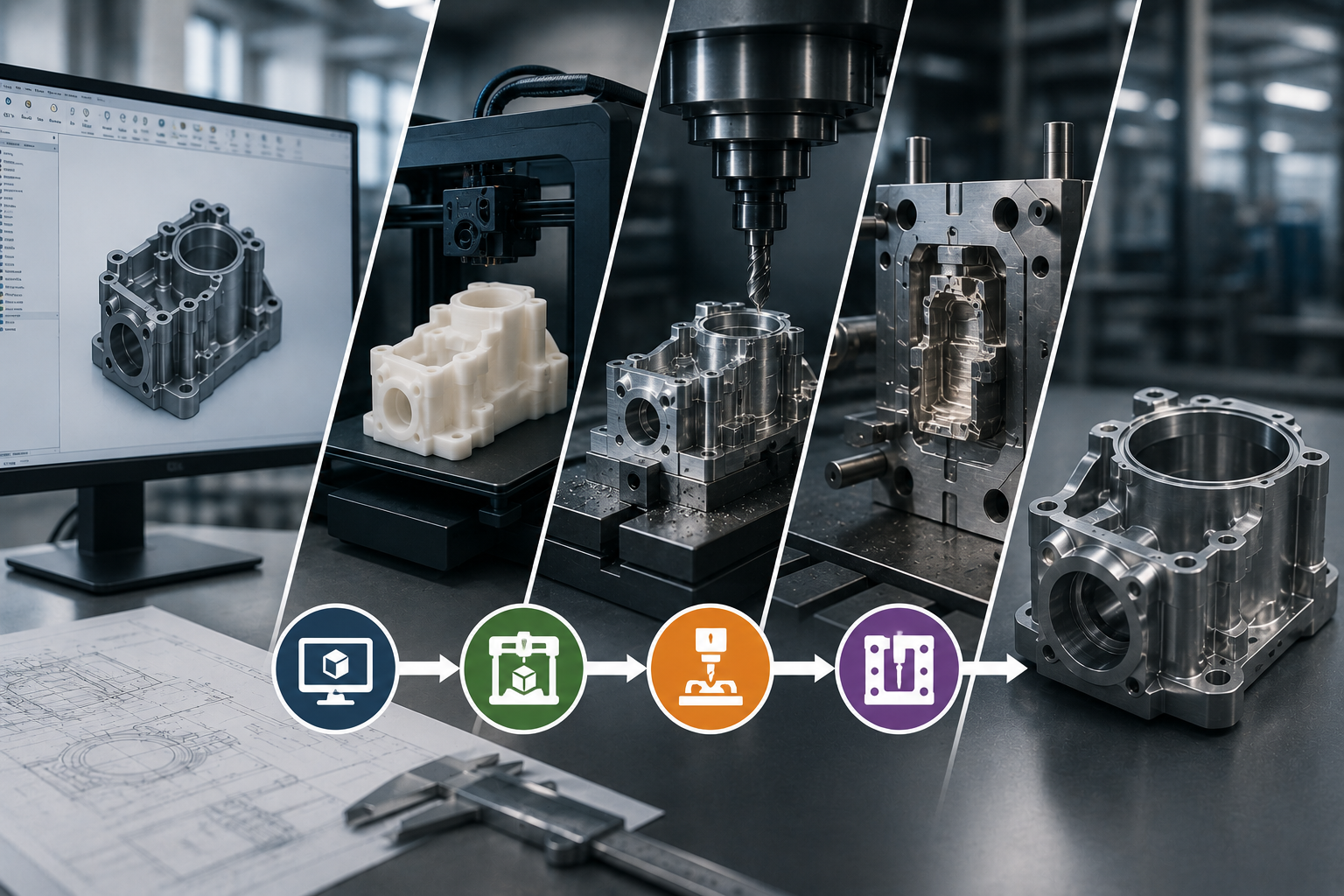
Concept → 3D Printed Prototype → CNC Functional Prototype → Testing → Design Optimization → Prototype Tooling → Production
However, not every product requires every stage.
Therefore, selecting only the processes that provide useful validation can save both time and money.
10. Use Design for Manufacturability Before Prototyping
Design for Manufacturability (DFM) evaluates whether a component can be produced efficiently using the selected manufacturing process.
For CNC components, DFM may review:
- Internal corner radii
- Deep cavities
- Thin walls
- Tool accessibility
- Hole dimensions
- Thread depth
- Tolerances
- Material selection
For injection-molded components, DFM may consider:
- Draft angles
- Wall thickness
- Undercuts
- Rib design
- Gate locations
- Parting lines
- Ejection
Therefore, conducting DFM before manufacturing can identify potential problems before they become expensive.
Which Prototype Manufacturing Process Should You Choose?
A simple decision framework can make the selection easier.
Choose CNC Machining When:
✔ You need functional prototypes
✔ Tight tolerances are important
✔ Production-grade material is required
✔ You need metal prototypes
✔ Surface quality matters
✔ You plan low-volume production
Choose 3D Printing When:
✔ You need rapid concept models
✔ Geometry is highly complex
✔ You expect frequent design changes
✔ Internal structures are required
✔ Early-stage visual validation is the priority
Choose Prototype Injection Molding When:
✔ You need production-like plastic parts
✔ You require multiple identical prototypes
✔ Plastic material behaviour must be validated
✔ Your project is approaching mass production
As a result, selecting the right process becomes easier once you clearly define your prototype’s purpose.
Why CNC Machining Is Important for Functional Prototyping
Although every manufacturing process has advantages, CNC machining plays an especially important role during engineering validation.
A CNC-machined prototype can closely represent the final component in terms of:
- Material
- Dimensions
- Mechanical strength
- Surface quality
- Assembly performance
Therefore, manufacturers can conduct more meaningful testing before committing to larger production quantities.
Moreover, the same CNC manufacturing approach can often continue into low-volume production after the design has been validated.
Industries That Use Prototype Manufacturing
Prototype manufacturing supports product development across many sectors.
Automotive
Custom mechanical parts, brackets, housings, fixtures, and vehicle components.
Aerospace
Lightweight precision components and complex engineering prototypes.
Industrial Equipment
Machine components, automation systems, fixtures, and replacement parts.
Robotics
Robot components, mounts, housings, grippers, and mechanical interfaces.
Electronics
Enclosures, heat sinks, housings, and precision assemblies.
Mold and Tooling
Mold inserts, core components, fixtures, tooling, and production aids.
Consequently, the correct prototyping strategy can improve product development across a wide range of manufacturing industries.
Prototype Manufacturing Services at Polymach365
At Polymach365, we support manufacturers through different stages of product development.
Our capabilities include:
✔ Prototype Manufacturing Services
✔ Rapid Prototyping
✔ CNC Milling
✔ CNC Turning
✔ 5-Axis CNC Machining
✔ Precision CNC Machining
✔ Custom CNC Machining
✔ Low-Volume Production
✔ Injection Mold Design
✔ Custom Mold Components
✔ DFM and Engineering Support
✔ Quality Inspection
Therefore, customers can move from an early design toward functional prototypes and production with coordinated manufacturing support.
Our Prototype Manufacturing Process
Step 1: Submit Your Design
Provide your 3D CAD model, technical drawings, material, quantity, and project requirements.
Step 2: Engineering Review
We evaluate manufacturability and identify potential design improvements.
Step 3: Select the Manufacturing Process
The appropriate process is chosen based on geometry, material, quantity, tolerances, and intended testing.
Step 4: Prototype Manufacturing
The component is manufactured using the selected process.
Step 5: Quality Inspection
Critical dimensions and project requirements are verified.
Step 6: Testing and Design Improvement
Customers can test the prototype and update the design where necessary.
Step 7: Move Toward Production
Once the design is validated, the project can transition to low-volume or larger-scale manufacturing.
As a result, the development process remains structured from initial prototype through production.
Why Choose Polymach365 for Prototype Manufacturing in Canada?
Choosing a manufacturing partner is just as important as selecting the manufacturing process.
At Polymach365, we focus on helping customers find an efficient route from CAD design to physical components.
Our approach combines engineering support, precision CNC machining, rapid prototyping, low-volume production, mold solutions, and quality-focused manufacturing.
Furthermore, our experience with multiple manufacturing methods allows us to evaluate projects based on actual engineering requirements rather than forcing every component into the same production process.
Therefore, businesses can select solutions that balance performance, cost, lead time, and scalability.
Final Thoughts
Choosing the right prototype manufacturing process starts with understanding what your prototype needs to accomplish.
If you need fast concept validation and complex geometries, 3D printing may be appropriate. However, if you require functional prototypes, production-grade materials, tight tolerances, and excellent surface quality, CNC machining can provide significant advantages.
Meanwhile, prototype injection molding becomes valuable when a plastic product is approaching production and requires production-like components.
Ultimately, the best approach depends on design complexity, material, quantity, accuracy, budget, timeline, and future production requirements.
At Polymach365, we help businesses across Canada move from initial concepts to functional prototypes and production-ready components through flexible manufacturing solutions.
Start Your Prototype Manufacturing Project
Have a new product or component ready for prototyping?
Send your CAD files and project requirements to Polymach365 for an engineering review. Our team can help evaluate your design and determine a suitable prototype manufacturing process based on your performance, quantity, material, and production requirements.