How Rapid Prototyping Helps Manufacturers Reduce Risk, Improve Designs, and Accelerate Time-to-Market
Bringing a new product to market requires speed, accuracy, testing, and reliable manufacturing. However, traditional manufacturing processes can slow development when they require expensive tooling or lengthy setup. CNC machining provides manufacturers with a faster and more flexible way to turn digital designs into functional components.
At Polymach365, we provide CNC machining and prototype manufacturing solutions in Canada for businesses developing custom components and new products. CNC milling, CNC turning, and 5-axis machining can help shorten development cycles, simplify design changes, and support the transition from prototype to production.
Therefore, CNC machining can play an important role in helping Canadian manufacturers improve product development efficiency while maintaining precision and quality.
What Is Rapid Prototyping?
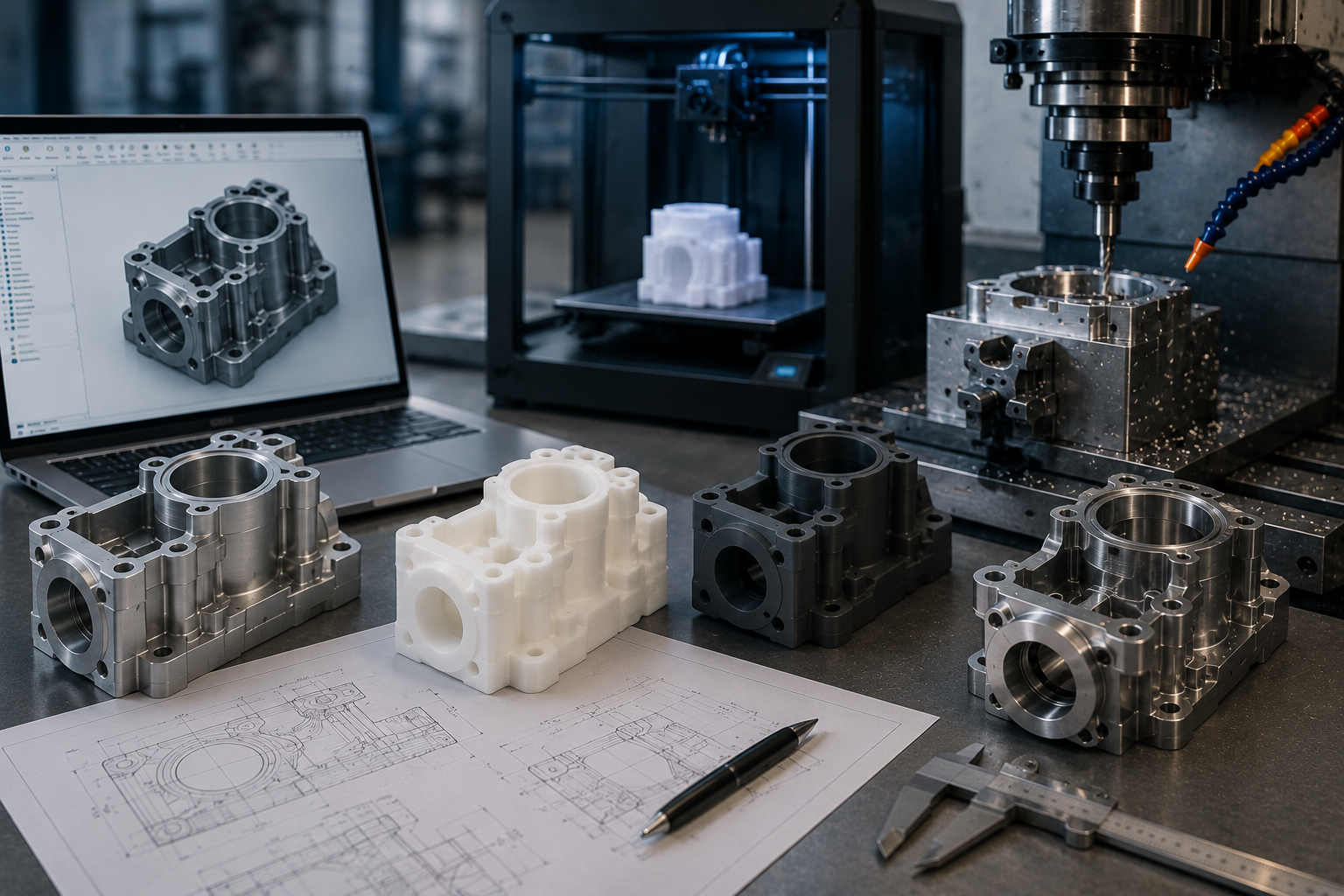
Rapid prototyping is the process of quickly manufacturing a physical model or functional component directly from a digital design.
Depending on the product and testing requirements, manufacturers may use processes such as:
- CNC machining
- 3D printing
- CNC milling
- CNC turning
- 5-axis machining
- Prototype injection molding
- Low-volume manufacturing
The objective is not simply to create a sample. Instead, rapid prototyping helps engineers understand how a product will look, fit, function, assemble, and perform before larger manufacturing investments begin.
As a result, prototypes become an important bridge between product design and production
Why Rapid Prototyping Matters in Modern Product Development
Traditional product development often involved long gaps between design, tooling, testing, and manufacturing. Consequently, discovering a problem late in the process could lead to costly modifications.
Rapid prototyping creates a faster feedback cycle:
Design → Prototype → Test → Improve → Validate → Produce
Because teams can evaluate physical parts earlier, they can make better engineering decisions before committing to final tooling or production.
Furthermore, this iterative approach helps manufacturers improve product performance while shortening development cycles.
1. Rapid Prototyping Speeds Up Product Development
Speed is one of the biggest advantages of rapid prototyping.
Instead of waiting for complete production tooling, engineers can manufacture prototypes directly from CAD data using suitable rapid manufacturing processes.
Therefore, teams can quickly evaluate their designs and move to the next development stage.
For competitive industries, shorter development cycles can help businesses:
- Respond to market opportunities
- Complete engineering validation sooner
- Introduce new products faster
- Improve existing products efficiently
- Reduce delays between design iterations
Consequently, rapid prototyping can significantly improve overall product development efficiency.
2. Identify Design Problems Before Production
A CAD model may appear perfect on a computer screen. However, physical testing can reveal issues that are difficult to identify digitally.
For example, a prototype may reveal:
✔ Poor component fit
✔ Assembly interference
✔ Incorrect dimensions
✔ Weak structural areas
✔ Difficult access points
✔ Unnecessary material
✔ Ergonomic problems
✔ Manufacturing challenges
Finding these issues during prototyping is considerably better than discovering them after production has begun.
Therefore, rapid prototyping helps reduce the financial risk associated with design errors.
3. Improve Product Quality Through Testing
A successful product must perform reliably in its intended application.
Rapid prototypes allow engineering teams to perform physical tests before final manufacturing.
Depending on the application, engineers may evaluate:
- Mechanical strength
- Component fit
- Assembly performance
- Dimensional accuracy
- Movement
- Material behaviour
- Thermal performance
- Functional performance
After testing, the design can be modified and another prototype produced.
As a result, each development cycle can improve the final product.
4. Reduce Product Development Costs
Rapid prototyping requires an upfront investment. However, it can prevent much larger expenses later.
Changing a CAD model and producing another prototype is often significantly less expensive than modifying production tooling or correcting thousands of finished components.
For example, early prototype testing can help prevent:
- Tooling modifications
- Production scrap
- Assembly failures
- Product redesigns
- Manufacturing delays
- Unnecessary material use
Therefore, rapid prototyping should be viewed as a risk-reduction strategy, not simply an additional manufacturing expense.
5. Test Multiple Design Versions
Product development often involves several possible design solutions.
Rapid prototyping allows engineers to manufacture and compare multiple versions before selecting the final design.
For example, teams may compare:
Prototype A: Lightweight design
Prototype B: Higher-strength design
Prototype C: Lower-cost manufacturing design
Engineers can then evaluate which version performs best.
Consequently, design decisions can be based on physical testing rather than assumptions alone.
6. Validate Fit and Assembly
Components rarely operate independently.
Most products contain multiple parts that must fit together accurately. Even small dimensional errors can create assembly problems.
Rapid prototyping allows manufacturers to verify:
- Hole alignment
- Fastener locations
- Mating surfaces
- Component clearances
- Assembly interfaces
- Mechanical movement
Therefore, engineers can correct fitment issues before final production begins.
This benefit is particularly valuable for machinery, automation systems, automotive components, electronics, and multi-part assemblies.
7. Evaluate Materials Before Final Production
Material selection has a major impact on product performance.
Depending on the manufacturing process, prototypes can be produced using engineering-grade materials similar to those planned for the final product.
Common Metals
- Aluminum
- Stainless steel
- Carbon steel
- Brass
- Copper
- Titanium
- Tool steel
Engineering Plastics
- ABS
- Nylon
- Delrin/Acetal
- Polycarbonate
- PEEK
- PTFE
Therefore, engineers can evaluate strength, weight, durability, machinability, and other characteristics before finalizing material selection.
8. CNC Machining for Functional Rapid Prototypes
While several processes can support rapid prototyping, CNC machining is particularly valuable for functional engineering prototypes.
CNC machining removes material from solid stock using computer-controlled cutting tools.
Key Advantages Include:
✔ High dimensional accuracy
✔ Production-grade materials
✔ Excellent mechanical properties
✔ High-quality surface finishes
✔ Tight-tolerance capability
✔ Suitable for functional testing
Furthermore, CNC-machined prototypes can closely represent future production components.
Therefore, engineers can perform realistic mechanical and assembly testing before scaling manufacturing.
9. 5-Axis CNC Machining for Complex Prototypes
Some prototype components contain complex curves, angled surfaces, or features that are difficult to manufacture using conventional machining.
In these situations, 5-axis CNC machining can provide significant advantages.
Because the cutting tool can access the component from multiple directions, complex features can often be machined with fewer setups.
This can provide:
- Better access to difficult geometries
- Fewer workpiece repositioning operations
- Improved dimensional consistency
- Efficient complex-part machining
- High-quality surface finishes
Consequently, 5-axis machining can support sophisticated prototypes for demanding engineering applications.
10. Rapid Prototyping Supports Design for Manufacturability
A product should not only function correctly; it should also be practical to manufacture.
Design for Manufacturability (DFM) helps engineers identify features that may unnecessarily increase production complexity or cost.
For CNC components, DFM may evaluate:
- Deep pockets
- Internal corner radii
- Thin walls
- Tool accessibility
- Hole depth
- Threads
- Tolerances
- Surface finish requirements
For molded components, engineers may consider draft angles, wall thickness, undercuts, ribs, gates, and ejection requirements.
Therefore, combining rapid prototyping with DFM can create designs that are both functional and manufacturing-friendly.
11. Bridge the Gap Between Prototype and Production
Rapid prototyping is not only useful for creating the first sample.
It also supports the transition toward production.
A typical development process may look like:
CAD Design → Prototype → Functional Testing → Design Revision → Final Prototype → Low-Volume Production → Full Production
For example, a company may first manufacture one prototype. After successful testing, it may order 20 or 50 components for field evaluation.
Later, production can increase as market demand grows.
Consequently, manufacturers can scale more gradually while reducing inventory and financial risk.
12. Improve Communication Between Teams
Physical prototypes can improve communication between designers, engineers, production teams, investors, and customers.
A CAD model may be difficult for non-technical stakeholders to fully understand. However, a physical prototype provides a clear representation of the proposed product.
Teams can examine:
- Size
- Shape
- Appearance
- Assembly
- Movement
- User interaction
- Functional features
Therefore, prototypes can help stakeholders provide more useful feedback before final production.
Rapid Prototyping vs Traditional Product Development
| Factor | Rapid Prototyping | Traditional Approach |
|---|---|---|
| Design Validation | Early | Often later |
| Design Changes | Easier | Can become costly |
| Functional Testing | Early in development | May occur later |
| Iterations | Faster | Generally slower |
| Development Risk | Reduced through testing | Potentially higher |
| Tooling Commitment | Can be delayed | May happen earlier |
| Time-to-Market | Potentially shorter | Often longer |
Therefore, rapid prototyping creates a more flexible and iterative development environment.
Which Rapid Prototyping Process Should You Choose?
The right process depends on what your prototype needs to accomplish.
Choose CNC Machining When:
✔ Functional performance matters
✔ Metal components are required
✔ Tight tolerances are important
✔ Production-grade materials are needed
✔ Surface quality matters
Choose 3D Printing When:
✔ Fast concept validation is required
✔ Geometry is highly complex
✔ You expect frequent design changes
✔ Internal structures are required
✔ Visual evaluation is the priority
Choose Prototype Injection Molding When:
✔ Production-like plastic parts are required
✔ Multiple identical prototypes are needed
✔ Plastic material behaviour must be tested
✔ The project is approaching volume production
Therefore, defining the prototype’s purpose before manufacturing is essential.
Industries That Benefit from Rapid Prototyping
Rapid prototyping supports innovation across many manufacturing sectors.
Automotive
Prototype brackets, housings, fixtures, structural parts, and mechanical components.
Aerospace
Complex lightweight components and precision engineering prototypes.
Industrial Equipment
Custom machine components, fixtures, replacement parts, and automation equipment.
Robotics and Automation
Grippers, mounts, housings, brackets, shafts, and custom interfaces.
Electronics
Enclosures, heat sinks, mounting components, and precision housings.
Mold and Tool Manufacturing
Core pins, cavity inserts, mold components, fixtures, and tooling prototypes.
As a result, rapid prototyping provides value across both product-focused and industrial manufacturing applications.
Rapid Prototyping Services in Canada with Polymach365
At Polymach365, we support manufacturers through different stages of product development.
Our capabilities include:
✔ Rapid Prototyping Services
✔ Prototype Manufacturing Services
✔ Precision CNC Machining
✔ CNC Milling Services
✔ CNC Turning Services
✔ 5-Axis CNC Machining
✔ Custom CNC Machining Solutions
✔ Low-Volume Production
✔ Injection Mold Design
✔ Custom Mold Components
✔ Engineering and DFM Support
✔ Quality Inspection
Therefore, customers can move from an early CAD model toward a functional prototype and production-ready component through a coordinated manufacturing workflow.
Why Choose Polymach365 for Rapid Prototyping?
Successful prototyping requires more than simply producing a physical part.
The manufacturing partner must understand the purpose of the prototype, critical dimensions, materials, testing requirements, and future production goals.
At Polymach365, our approach focuses on helping customers evaluate these requirements before manufacturing begins.
Moreover, our CNC machining and manufacturing capabilities can support both initial prototypes and subsequent low-volume production.
As a result, customers can maintain greater continuity as projects move from prototype to production.
Our Rapid Prototyping Process
Step 1: Submit Your CAD Design
Provide your 3D CAD file, drawings, material requirements, quantity, and project specifications.
Step 2: Engineering Review
The design is reviewed for manufacturability and critical requirements.
Step 3: Select the Manufacturing Process
A suitable process is determined based on material, geometry, tolerance, quantity, and testing goals.
Step 4: Prototype Manufacturing
The component is manufactured using the selected process.
Step 5: Quality Inspection
Critical dimensions and project requirements are verified.
Step 6: Testing and Design Revision
The prototype can then be evaluated and revised where necessary.
Step 7: Move Toward Production
After successful validation, the design can progress to low-volume or larger-scale manufacturing.
This structured approach helps reduce unnecessary development delays.
Final Thoughts
Rapid prototyping has become an essential part of modern product development because it enables manufacturers to test earlier, identify problems faster, improve designs, and reduce production risk.
Furthermore, technologies such as CNC machining, 5-axis machining, 3D printing, and prototype injection molding give engineers several options for transforming CAD designs into physical parts.
The key is choosing a prototyping method that matches your design, material, accuracy, testing, budget, and future production requirements.
At Polymach365, we support Canadian manufacturers with rapid prototyping, precision CNC machining, prototype manufacturing, and scalable production solutions designed to help move products efficiently from concept to production.
Start Your Rapid Prototyping Project
Have a new component or product ready for testing?
Send your CAD files and technical requirements to Polymach365 for an engineering review. Our team can help evaluate your design and determine an appropriate prototyping and manufacturing approach for your project.