Precision Components for Better Accuracy, Faster Cycles and Longer Mold Life
Injection molding depends on much more than the injection machine and plastic material. In fact, the performance of an injection mold depends heavily on the accuracy, durability, and reliability of its individual components.
Therefore, precision mold components play a critical role in achieving consistent part quality, reliable mold operation, efficient production cycles, and longer tooling life.
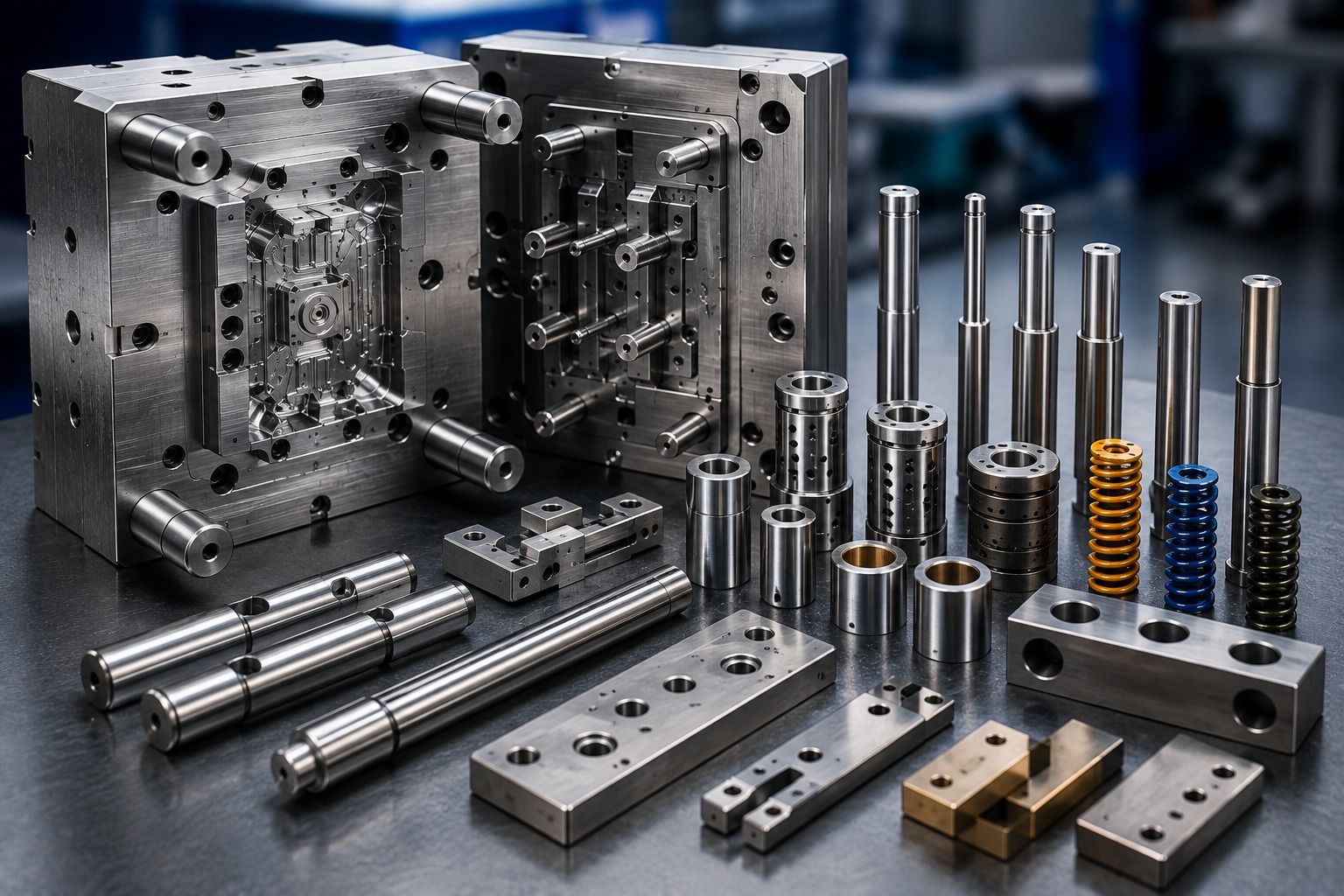
At Polymach365, we manufacture precision mold components including core pins, cavity inserts, ejector pins, ejector sleeves, guide pins, bushings, wear plates, and custom tooling components. Our manufacturing capabilities combine CNC machining, EDM, precision grinding, and dimensional inspection to produce components according to specific engineering requirements.
Whether you are building a new injection mold, repairing existing tooling, replacing worn components, or improving production performance, choosing the right precision mold components can make a significant difference.
What Are Precision Mold Components?
Precision mold components are the individual parts that work together inside an injection mold to form, align, cool, and eject molded products.
These components include:
- Core pins
- Core inserts
- Cavity inserts
- Ejector pins
- Ejector sleeves
- Guide pins
- Guide bushings
- Wear plates
- Mold inserts
- Support components
- Custom tooling parts
Each component has a specific function. Therefore, even a relatively small dimensional error can affect the operation of the complete mold.
For example, inaccurate guide components can affect mold alignment, while worn ejector pins can cause inconsistent part release.
Consequently, precision manufacturing is essential for maintaining reliable injection molding performance. Polymach365’s existing mold-component content similarly identifies alignment, ejection, part accuracy, cycle time, and tooling life as areas directly influenced by component quality.
Why Precision Matters in Injection Molding
Injection molds repeatedly operate under pressure, heat, friction, and mechanical movement.
Therefore, mold components must maintain their dimensions and functional surfaces throughout repeated production cycles.
High-quality precision components can help manufacturers achieve:
- Better dimensional accuracy
- Consistent molded parts
- Reliable mold alignment
- Smooth ejection
- Reduced component wear
- Faster maintenance
- Longer tooling life
- Lower production downtime
As a result, precision mold components can improve both product quality and overall manufacturing efficiency.
1. Precision Components Improve Mold Alignment
Accurate mold alignment is fundamental to consistent injection molding.
Guide pins and guide bushings help maintain the correct relationship between the mold halves during opening and closing.
Therefore, properly manufactured guide components can help prevent:
- Misalignment
- Uneven component wear
- Parting-line problems
- Mold damage
- Inconsistent part dimensions
Moreover, accurate alignment helps protect other mold components from unnecessary stress.
As a result, precision guide pins and bushings contribute to smoother mold operation and longer tooling life. Polymach365 specifically manufactures guide pins and bushings designed for accurate alignment, reduced wear, and consistent molding performance.
2. Precision Core Pins Improve Part Accuracy
Core pins create holes, channels, and other internal features within molded components.
Therefore, their diameter, length, surface finish, straightness, and dimensional accuracy directly influence the finished plastic part.
For example, if a core pin does not maintain the required dimensions, the resulting hole or internal feature may fall outside the required specification.
Precision core pins can help provide:
- Accurate internal features
- Consistent hole dimensions
- Better repeatability
- Reduced secondary machining
- Improved mold performance
Consequently, manufacturers should select core pins according to the actual application rather than treating them as standard interchangeable parts.
3. Precision Cavity Inserts Improve Mold Flexibility
Cavity inserts create the external geometry and surface details of molded components.
Because manufacturers can replace individual inserts, they can often repair or modify specific areas without rebuilding the complete mold.
Therefore, precision cavity inserts can provide several advantages:
- Better dimensional accuracy
- Easier mold maintenance
- Faster repairs
- Flexible tooling modifications
- Reduced replacement costs
- Improved part consistency
Furthermore, interchangeable cavity inserts can make it easier to support product variations.
As a result, precision inserts can improve both tooling flexibility and long-term production efficiency. Polymach365 manufactures cavity inserts specifically for part accuracy, tooling flexibility, and maintenance efficiency.
4. Precision Ejector Pins Reduce Part Release Problems
After plastic cools inside the mold, the finished component must be removed.
Ejector pins push the molded part away from the cavity.
Therefore, accurate ejector pins are essential for reliable and repeatable part ejection.
Poorly manufactured or worn ejector components can contribute to:
- Uneven ejection
- Part deformation
- Surface marks
- Component sticking
- Increased downtime
- Premature mold wear
In contrast, properly manufactured ejector pins and sleeves can support smooth and repeatable ejection.
Consequently, precision ejection components help maintain production efficiency while reducing unnecessary maintenance.
5. Wear Plates Extend Mold Component Life
Molds experience repeated movement and friction during production.
Therefore, certain contact surfaces require protection against continuous wear.
Wear plates provide replaceable surfaces that can protect critical tooling areas.
They are particularly useful for:
- Sliding mold components
- Moving assemblies
- High-cycle tooling
- Wear-prone contact surfaces
As a result, precision wear plates can reduce damage to more expensive mold components.
Moreover, replacing a worn wear plate can be considerably more practical than repairing or replacing a larger tooling assembly.
6. Precision Components Help Maintain Consistent Cycle Performance
Every injection molding cycle requires the mold to open, close, fill, cool, and eject the finished component.
Therefore, each mechanical component must operate consistently.
For example:
Accurate Guide Components → Reliable Alignment
Accurate Ejection Components → Consistent Part Release
Precision Inserts → Consistent Part Geometry
Effective Cooling Components → Stable Mold Temperature
Consequently, precision components contribute to a more predictable molding cycle.
Polymach365’s mold-component information identifies cooling and venting components as important elements for cycle efficiency and molding quality as well.
7. Precision Components Reduce Mold Maintenance
Mold maintenance becomes increasingly important as production volumes increase.
Repeated cycles expose tooling to mechanical movement, heat, pressure, friction, and material-related wear.
Therefore, high-quality components can reduce the frequency of premature repairs.
Precision manufacturing helps maintain:
- Accurate dimensions
- Proper component fit
- Smooth movement
- Reliable alignment
- Consistent surface conditions
As a result, manufacturers can spend less time dealing with avoidable component failures.
Furthermore, custom replacement components can help restore existing tooling without requiring a complete mold replacement.
8. Precision Mold Components Can Reduce Production Downtime
Unexpected mold problems can interrupt production schedules.
For example, a damaged ejector pin or worn guide component can stop a production run while technicians diagnose and repair the problem.
Therefore, reliable components can help reduce unplanned downtime.
When replacement components are manufactured according to the original engineering specifications, manufacturers can restore tooling performance more efficiently.
Polymach365 provides custom mold components for new tooling, replacement requirements, mold repair, and engineering modifications.
Consequently, precision component manufacturing can become an important part of an effective mold-maintenance strategy.
9. Precision Manufacturing Improves Repeatability
Repeatability is critical when manufacturers produce thousands or millions of identical plastic components.
Every production cycle should reproduce the same essential geometry.
Therefore, mold components must maintain consistent dimensions and positioning throughout production.
Precision machining can help manufacturers achieve:
- Consistent component dimensions
- Repeatable mold alignment
- Stable part geometry
- Reliable ejection
- Consistent tooling performance
As a result, manufacturers can maintain product quality across longer production runs.
10. Precision Mold Components Support Longer Tool Life
A complete injection mold represents a significant investment.
Therefore, manufacturers want tooling to remain productive for as long as possible.
High-quality components can help reduce unnecessary wear on critical tooling surfaces.
For example, accurate guide systems can reduce misalignment, while properly manufactured wear plates can protect contact surfaces.
Similarly, durable core pins and cavity inserts can withstand repeated molding cycles.
Consequently, precision components can contribute to longer and more reliable mold service life.
Precision Mold Components vs Standard Components
Manufacturers can generally choose between standard and custom mold components.
Standard Mold Components
Standard components are manufactured according to common dimensions and specifications.
They can be useful when:
- The mold uses conventional dimensions
- Replacement components are readily available
- Cost efficiency is the priority
- The required geometry matches standard specifications
Custom Mold Components
Custom components are manufactured according to project-specific requirements.
They are particularly useful when you need:
- Unique dimensions
- Special geometries
- Tight tolerances
- Replacement components for existing tooling
- Engineering modifications
- Specialized mold designs
- Prototype tooling
Therefore, the best option depends on the mold design and application.
Polymach365 provides both standard and fully customized mold-component solutions according to specific tooling requirements.
Materials Used for Precision Mold Components
Material selection plays an important role in component performance.
Depending on the application, mold components may use:
- Tool Steel
- Hardened Steel
- Stainless Steel
- H13 Steel
- S7 Steel
- Carbide
- Beryllium Copper
Each material provides different characteristics related to hardness, wear resistance, toughness, thermal performance, and machinability.
Therefore, material selection should consider:
Production Volume: High-volume molds may require greater wear resistance.
Operating Temperature: Thermal conditions can affect material performance.
Wear: Sliding and moving components require suitable wear resistance.
Part Requirements: Critical features may require high dimensional stability.
Maintenance: Material choice can influence service life and replacement frequency.
Consequently, manufacturers should select materials based on the actual tooling application rather than using the same material for every component.
Advanced Manufacturing Technologies for Precision Mold Components
Producing precision mold components requires appropriate manufacturing processes.
At Polymach365, the manufacturing workflow combines several technologies.
CNC Precision Machining
CNC machining produces accurate profiles, pockets, holes, surfaces, and complex component geometries.
Therefore, CNC machining provides flexibility for custom mold-component manufacturing.
EDM Machining
Electrical Discharge Machining can produce intricate features and geometries that may be difficult to manufacture using conventional cutting tools.
Consequently, EDM expands the range of mold-component geometries that can be produced.
Precision Grinding
Grinding can achieve accurate dimensions and high-quality surfaces on appropriate components.
Therefore, precision grinding is particularly useful when tight dimensional control and surface quality are important.
Dimensional Inspection
Critical components require dimensional verification.
Therefore, inspection helps confirm that manufactured parts meet the approved drawings and specifications.
As a result, combining machining and inspection helps improve consistency from one component to another.
Precision Mold Components for Injection Mold Repair
Precision components are not only used when manufacturers build new molds.
Existing molds eventually require maintenance and replacement components.
For example:
Worn Core Pin → Precision Replacement Core Pin
Damaged Cavity Insert → Custom Replacement Insert
Worn Guide Pin → New Precision Guide Pin
Damaged Ejector → Replacement Ejector Component
Worn Sliding Surface → Precision Wear Plate
Therefore, manufacturers can often restore tooling performance by replacing individual components instead of rebuilding the entire mold.
This approach can reduce downtime and extend the useful life of existing tooling.
The relationship between tooling accuracy and molded-part quality is direct.
For example, accurate cavity inserts help maintain external dimensions. Similarly, precision core pins maintain internal features.
Guide systems maintain mold alignment, while reliable ejector components help remove parts without unnecessary deformation.
Therefore:
Precision Mold Components → Better Tooling Performance → More Consistent Molding → Better Part Quality
Consequently, manufacturers should consider mold-component quality as an important part of their overall quality-control strategy.
Precision mold components support a wide range of industries.
Automotive Manufacturing
Automotive manufacturers use precision molds for components such as housings, brackets, clips, connectors, and interior parts.
Medical Devices
Medical products often require tight dimensional control and repeatable tooling performance.
Electronics
Precision mold components support enclosures, connectors, housings, and other technical plastic products.
Packaging
High-volume packaging production requires durable tooling capable of repeated cycles.
Consumer Products
Household and consumer products rely on consistent plastic molding for repeat production.
Therefore, precision mold components remain essential across many modern manufacturing sectors. Polymach365 currently highlights automotive, medical, packaging, electronics, and consumer products among industries supported by its mold-component solutions.
Polymach365 combines CNC machining, EDM technology, precision grinding, engineering support, and quality inspection to manufacture precision mold components.
Our capabilities include:
- Custom Core Pins
- Core Inserts
- Cavity Inserts
- Ejector Pins
- Ejector Sleeves
- Guide Pins
- Guide Bushings
- Wear Plates
- Custom Mold Components
- Injection Mold Design Support
- CNC Machining
- EDM Machining
- Precision Grinding
- Quality Inspection
Moreover, Polymach365’s broader manufacturing platform supports CNC machining, injection mold manufacturing, injection mold design, molding, 3D printing, prototyping, and full production.
Precision mold components may be small compared with an entire injection mold, but their impact on production performance is significant.
From core pins and cavity inserts to ejector systems, guide components, and wear plates, each component contributes to mold accuracy, reliability, efficiency, and service life.
Therefore, investing in precision mold components can help manufacturers improve part quality, reduce downtime, control maintenance costs, improve repeatability, and extend tooling life.
At Polymach365, we manufacture custom and precision mold components according to customer CAD files, drawings, material requirements, tolerances, and application specifications.
Request Precision Mold Components
Need custom core pins, cavity inserts, ejector pins, guide components, wear plates, or other precision mold components?
Submit your CAD files, technical drawings, material requirements, tolerances, and quantities to Polymach365 for manufacturing review.