A Practical Guide to Selecting the Right Mold Components for Injection Tooling
Injection molds rely on accurately manufactured components to maintain alignment, part quality, repeatability, and reliable production. Therefore, selecting between custom mold components and standard mold components is an important decision for mold manufacturers, injection molders, OEMs, and tooling engineers.
Standard components can provide a cost-effective solution for common tooling requirements. However, custom mold components offer greater flexibility when a mold requires unique dimensions, complex geometries, tight tolerances, or replacement parts that are no longer available.
At Polymach365, we manufacture precision mold components for injection molds, tooling systems, mold repair, prototype tooling, and specialized manufacturing applications. Our capabilities include CNC machining, EDM machining, precision grinding, and dimensional inspection, allowing us to manufacture components according to CAD files, engineering drawings, material specifications, and tolerance requirements.
Therefore, the right choice depends on your mold design, production volume, component requirements, budget, and expected tooling life.
What Are Standard Mold Components?
Standard mold components are manufactured according to commonly used dimensions and specifications.
These components are widely used in conventional injection mold designs and are available in standardized sizes.
Common examples include:
- Standard guide pins
- Guide bushings
- Ejector pins
- Ejector sleeves
- Standard core pins
- Standard screws
- Locating components
- Standard mold plates
- Standard wear components
Because manufacturers produce these components in commonly used sizes, they can often be sourced faster than fully custom parts.
Consequently, standard components are particularly useful when your mold design matches established industry dimensions.
What Are Custom Mold Components?
Custom mold components are manufactured specifically for an individual tooling application.
Instead of adapting the mold to an existing component size, engineers can manufacture the component according to the actual mold design.
Custom components can include:
- Custom core pins
- Custom core inserts
- Cavity inserts
- Special ejector pins
- Custom ejector sleeves
- Guide components
- Wear plates
- Precision spacers
- Mold inserts
- Specialty tooling components
- Replacement mold components
Therefore, custom manufacturing provides greater control over dimensions, geometry, materials, tolerances, and surface requirements.
Polymach365 provides custom mold-component manufacturing based on customer CAD files and engineering specifications.
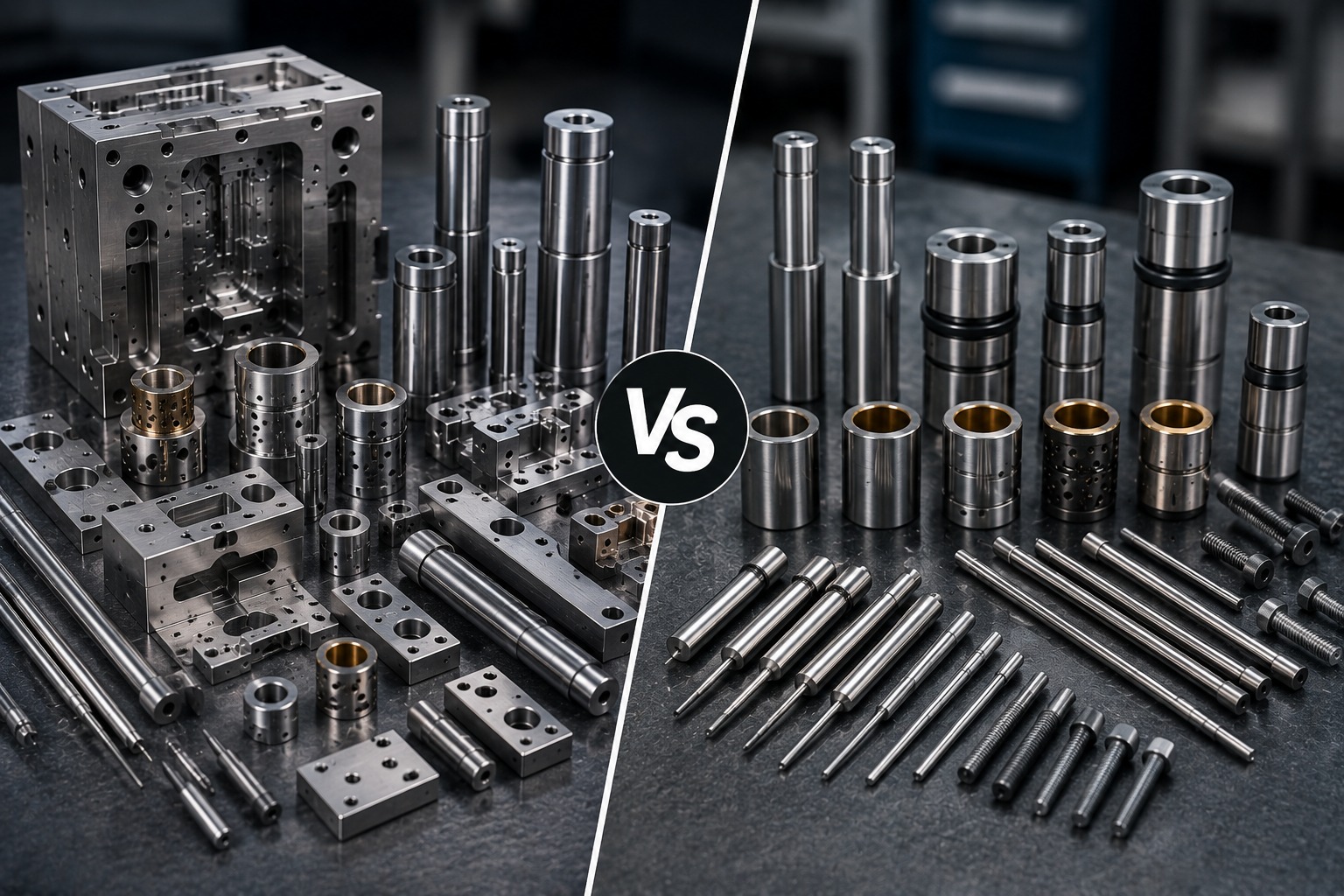
Custom Mold Components vs Standard Mold Components
The main difference is flexibility.
| Standard Mold Components | Custom Mold Components |
|---|---|
| Predefined dimensions | Project-specific dimensions |
| Faster sourcing | Manufactured to requirement |
| Suitable for common designs | Suitable for unique designs |
| Generally lower initial cost | Cost depends on complexity |
| Limited geometry options | High geometry flexibility |
| Easy replacement when available | Ideal for specialized replacements |
| Best for conventional tooling | Best for complex or customized tooling |
Therefore, neither option is automatically better. Instead, the correct choice depends on the specific requirements of your mold.
When Should You Choose Standard Mold Components?
Standard components are often the better option when your tooling requirements are conventional.
1. Your Mold Uses Common Dimensions
If your mold design already accommodates standard component dimensions, there may be little reason to manufacture a custom alternative.
For example, a conventional ejector pin may be available in the required diameter and length.
Therefore, a standard component can provide a practical and economical solution.
2. You Need Components Quickly
Standard components are typically easier to source because they are manufactured according to established specifications.
Consequently, they can be useful when a production mold requires a common replacement part quickly.
3. The Geometry Is Simple
Standard components work well when the tooling does not require unusual profiles, special holes, unique lengths, or application-specific features.
As a result, manufacturers can avoid unnecessary custom manufacturing costs.
4. Cost Is a Major Consideration
Standard components can reduce manufacturing requirements because the component does not need to be developed from scratch.
Therefore, they can be an attractive option for straightforward tooling applications.
When Should You Choose Custom Mold Components?
Custom components become more valuable when standard options cannot satisfy your engineering requirements.
1. Your Mold Requires Unique Dimensions
Every injection mold has different geometry.
Therefore, a standard component may not always provide the required length, diameter, profile, or mounting configuration.
Custom manufacturing allows the component to match the actual mold design.
2. You Need Tight Tolerances
Some tooling applications require highly controlled dimensions.
Therefore, custom precision manufacturing can be used when standard components do not provide the required tolerance.
This is particularly important for:
- Critical mating surfaces
- Precision inserts
- Core pins
- Cavity components
- Alignment components
- Specialized tooling
Consequently, custom components can help maintain accurate mold assembly and performance.
Core pins create internal holes and features within molded parts.
Standard core pins are suitable when the required dimensions match commonly available sizes.
However, custom core pins become useful when the mold requires:
- Special diameters
- Non-standard lengths
- Stepped profiles
- Special tip geometries
- Unique surface finishes
- Application-specific dimensions
Therefore, custom core pins provide greater flexibility for specialized mold designs.
Polymach365 manufactures precision core pins and core inserts for custom tooling and replacement applications.
Cavity inserts form important external features of injection-molded components.
Standard inserts may work well for conventional tooling designs. However, custom cavity inserts provide more flexibility when the mold contains unique geometry or requires specific engineering modifications.
Custom cavity inserts can help manufacturers:
- Modify individual mold areas
- Replace damaged sections
- Support product variations
- Simplify mold maintenance
- Improve tooling flexibility
- Reduce the need to rebuild complete molds
As a result, custom inserts can be particularly valuable for complex and repair-oriented tooling applications.
Ejection systems remove finished parts from the mold after cooling.
Standard ejector pins and sleeves can satisfy many conventional applications.
However, custom ejector components may be necessary when the mold contains:
- Special ejection geometry
- Unusual dimensions
- Restricted installation areas
- Complex part features
- Specialized ejection requirements
Therefore, selecting the correct ejector component helps support smooth and repeatable part removal.
Custom Guide Pins and Bushings
Guide pins and bushings maintain alignment between mold sections.
Standard guide components can provide an economical solution when the mold uses conventional dimensions.
However, custom guide components may be necessary when the tooling requires special dimensions, lengths, mounting arrangements, or operating conditions.
Consequently, custom manufacturing allows alignment components to match the actual tooling requirements.
Wear plates protect tooling surfaces exposed to repeated movement and friction.
Standard wear plates may work when the required dimensions are readily available.
However, custom wear plates can provide advantages when the tooling contains unique sliding surfaces or specialized contact areas.
Custom components can include:
- Wear plates
- Support blocks
- Retainers
- Precision spacers
- Sliding components
- Tooling plates
- Specialty inserts
Therefore, manufacturers can replace specific worn areas without redesigning the complete mold.
Advantages of Standard Mold Components
Standard mold components offer several practical benefits.
Faster Availability
Common components can often be sourced without waiting for custom manufacturing.
Lower Manufacturing Complexity
Standard dimensions reduce the need for specialized machining.
Cost Efficiency
Common components can provide economical solutions for conventional tooling.
Easy Replacement
When the exact standard component remains available, replacement can be straightforward.
Proven Designs
Standard components have established dimensions and applications.
Therefore, standard components remain a valuable choice for many conventional injection molds.
Advantages of Custom Mold Components
Custom components provide a different set of benefits.
Greater Design Flexibility
Manufacturers can specify the exact geometry required for the application.
Better Compatibility
Components can be manufactured to fit existing molds precisely.
Specialized Geometries
Custom manufacturing can produce complex or unusual profiles.
Replacement for Legacy Tooling
Older molds may use components that are no longer commercially available.
Engineering Modifications
Custom components can support tooling changes without replacing the complete mold.
Precision Control
Manufacturers can specify critical dimensions and tolerances according to the application.
Consequently, custom mold components can provide significant value for specialized tooling projects.
Custom Mold Components for Mold Repair
One of the strongest applications for custom manufacturing is injection mold repair.
Over time, production molds can experience:
- Core pin wear
- Cavity damage
- Ejector pin wear
- Guide component wear
- Sliding surface damage
- Corrosion
- Engineering modifications
Instead of replacing an entire mold, manufacturers can sometimes replace the affected component.
For example:
Worn Core Pin → Custom Replacement Core Pin
Damaged Cavity Insert → Precision Replacement Insert
Worn Guide Component → Custom Guide Pin or Bushing
Damaged Wear Plate → Precision Replacement Wear Plate
Therefore, custom components can help extend the useful life of existing tooling.
How to Choose Between Custom and Standard Components
Before selecting a component, evaluate the following factors.
Mold Design
Does the mold accommodate a standard component?
If yes, a standard option may be appropriate.
If not, consider a custom component.
Tolerance Requirements
Does the application require dimensions outside standard specifications?
If so, custom manufacturing may provide better control.
Production Volume
High-volume molds often justify investing in durable, precision-engineered components.
Therefore, production volume should influence both material and component selection.
Availability
If a standard component is readily available, it may provide the fastest solution.
However, discontinued or unavailable components may require custom manufacturing.
Tooling Life
Consider how long the mold needs to operate and how much wear the component will experience.
Consequently, material and component design should match expected service conditions.
Budget
Standard components may provide lower initial costs for straightforward applications.
However, custom components can offer better long-term value when they solve a specific tooling problem.
Precision Manufacturing Technologies at Polymach365
Custom mold components require accurate manufacturing processes.
At Polymach365, manufacturing can combine multiple technologies depending on the component requirements.
CNC Machining
CNC machining produces accurate profiles, pockets, holes, surfaces, and complex geometries.
Therefore, CNC machining provides flexibility for custom mold components.
EDM Machining
Electrical Discharge Machining can produce intricate features and difficult geometries in suitable conductive materials.
Consequently, EDM expands the range of components that can be manufactured.
Precision Grinding
Grinding helps achieve accurate dimensions and high-quality surfaces.
Therefore, it can complement CNC and EDM processes for critical mold components.
Quality Inspection
Critical dimensions require verification before delivery.
As a result, dimensional inspection helps ensure the finished component matches the approved engineering requirements.
Materials for Custom Mold Components
Material selection should match the application’s operating conditions.
Common choices can include:
- Tool steel
- Hardened steel
- Stainless steel
- H13 steel
- S7 steel
- Carbide
- Other engineering materials
When selecting a material, consider:
- Wear resistance
- Hardness
- Toughness
- Corrosion resistance
- Thermal conditions
- Production volume
- Machinability
- Expected service life
Therefore, material selection should never be based only on initial cost.
Why Choose Polymach365 for Custom Mold Components?
Polymach365 provides precision mold-component manufacturing for injection molds, tooling, mold repair, and specialized manufacturing requirements.
Our capabilities include:
- Custom Core Pins
- Core Inserts
- Cavity Inserts
- Ejector Pins
- Ejector Sleeves
- Guide Pins
- Guide Bushings
- Wear Plates
- Custom Mold Inserts
- Specialty Tooling Components
- CNC Machining
- EDM Machining
- Precision Grinding
- Quality Inspection
Moreover, Polymach365 combines mold-component manufacturing with CNC machining, injection mold design, injection mold manufacturing, prototyping, and custom manufacturing.
Final Thoughts
The choice between custom mold components and standard mold components depends on your tooling requirements.
Standard components are often the right choice when dimensions are conventional, availability is important, and the mold does not require specialized geometry.
On the other hand, custom components provide greater flexibility when you need unique dimensions, tight tolerances, complex geometries, replacement parts, engineering modifications, or specialized tooling solutions.
Therefore, manufacturers should evaluate component requirements before deciding which option provides the best combination of performance, cost, availability, durability, and tooling compatibility.
At Polymach365, we manufacture precision and custom mold components according to your CAD files, engineering drawings, materials, tolerances, quantities, and application requirements.
Have a standard component that does not fit your mold—or need a replacement component for existing tooling?
Send your CAD files, 2D drawings, material requirements, tolerances, quantities, and surface-finish specifications to Polymach365 for project review.