How High-Quality Mold Components Improve Accuracy, Productivity and Tool Life
High-volume injection molding demands consistency. When a mold produces thousands or millions of plastic parts, even a small component problem can gradually affect part quality, production speed, maintenance requirements, and tooling life.
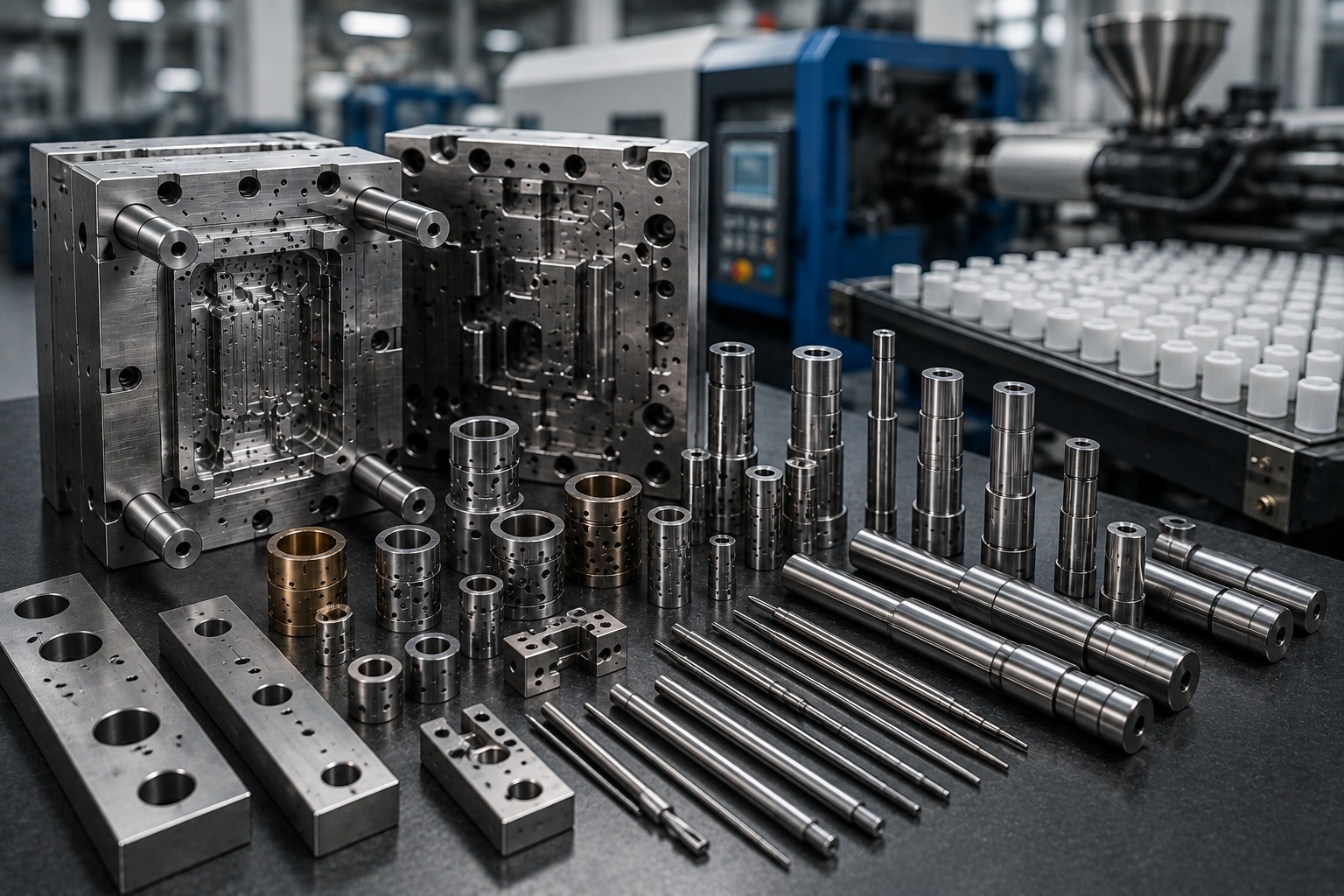
Therefore, precision mold components play a critical role in high-volume injection molding. Components such as core pins, cavity inserts, ejector pins, guide pins, bushings, wear plates, and custom mold inserts must maintain accurate dimensions and reliable performance throughout repeated production cycles.
At Polymach365, we manufacture precision and custom mold components for injection molding, tooling, mold repair, replacement applications, and specialized manufacturing requirements. Our capabilities include CNC machining, EDM machining, precision grinding, and dimensional inspection, allowing components to be manufactured according to CAD files, engineering drawings, tolerances, materials, and application requirements.
As a result, manufacturers can improve mold reliability while reducing unnecessary downtime and maintenance.
What Are Precision Mold Components?
Precision mold components are the individual parts that work together to form, align, operate, and release plastic parts during injection molding.
Common components include:
- Core Pins
- Core Inserts
- Cavity Inserts
- Ejector Pins
- Ejector Sleeves
- Guide Pins
- Guide Bushings
- Wear Plates
- Mold Inserts
- Support Components
- Precision Spacers
- Custom Tooling Components
Although these components may be smaller than the complete mold, they have a major effect on tooling performance.
For example, an inaccurate guide pin can affect mold alignment, while a worn ejector pin can create ejection problems. Similarly, a damaged cavity insert can directly affect the dimensions and appearance of the finished part.
Therefore, precision should remain a priority when selecting components for high-volume tooling.
Why Precision Matters in High-Volume Injection Molding
High-volume molds operate continuously for extended periods.
Consequently, mold components experience repeated:
- Mechanical movement
- Friction
- Heat cycles
- Injection pressure
- Ejection cycles
- Mold opening and closing
- Material exposure
Over time, small imperfections or poor component fits can become larger production problems.
Precision mold components help manufacturers maintain:
- Consistent part dimensions
- Reliable mold alignment
- Repeatable ejection
- Stable production cycles
- Better surface quality
- Reduced component wear
- Lower maintenance requirements
- Longer tooling life
Therefore, precision components are not simply replacement parts. Instead, they form an important part of a high-volume manufacturing strategy.
1. Precision Components Improve Part Consistency
High-volume production requires every molded part to meet the same specifications.
Therefore, the mold must reproduce the same geometry during every production cycle.
Precision cavity inserts and core components help maintain accurate part features throughout production.
For example, a precision core pin can consistently create the required hole diameter, while a precision cavity insert maintains the external geometry of the component.
As a result, manufacturers can achieve greater dimensional repeatability across large production runs.
2. Precision Core Pins Protect Critical Part Features
Core pins create holes, channels, openings, and other internal features in molded parts.
During high-volume production, these components repeatedly experience heat, pressure, and mechanical stress.
Therefore, core pins must maintain their dimensions and surface condition throughout their service life.
Precision core pins can provide:
- Accurate diameters
- Consistent lengths
- Better surface finishes
- Improved wear resistance
- Repeatable internal features
- Application-specific geometries
Consequently, properly manufactured core pins help maintain part accuracy during extended production runs.
3. Precision Cavity Inserts Improve Product Quality
Cavity inserts form important external surfaces and features of molded components.
Therefore, their accuracy directly affects the final product.
Precision cavity inserts can help manufacturers maintain:
- Accurate part dimensions
- Consistent surface details
- Repeatable product geometry
- Better cosmetic quality
- Easier mold maintenance
Furthermore, interchangeable inserts can allow manufacturers to replace or modify individual tooling areas instead of rebuilding an entire mold.
As a result, cavity inserts can provide both production accuracy and maintenance flexibility.
4. Precision Ejector Pins Improve Production Reliability
Every molding cycle requires the finished part to leave the cavity.
Therefore, ejector pins and sleeves must operate smoothly and consistently.
Worn or poorly manufactured ejector components can contribute to:
- Part sticking
- Uneven ejection
- Ejector marks
- Part deformation
- Increased downtime
- Premature tooling wear
In contrast, precision ejector components provide controlled and repeatable part removal.
Consequently, manufacturers can maintain smoother production cycles while reducing unnecessary interruptions.
5. Precision Guide Pins Maintain Mold Alignment
Guide pins and guide bushings help maintain alignment between the mold halves.
This alignment becomes especially important during high-volume production because the mold opens and closes repeatedly.
Therefore, accurate guide components can help reduce:
- Misalignment
- Uneven wear
- Friction
- Mold damage
- Parting-line problems
- Component stress
Moreover, properly aligned mold sections help protect other precision components.
As a result, guide pins and bushings contribute to overall tooling reliability.
6. Precision Components Reduce Production Downtime
High-volume manufacturing depends on continuous production.
Therefore, unexpected mold failures can become extremely expensive.
A damaged ejector pin, worn guide bushing, or failed cavity insert can interrupt an entire production run.
Precision components can reduce the risk of premature component failure when manufacturers combine them with appropriate maintenance and inspection.
Furthermore, custom replacement components allow manufacturers to restore worn tooling without necessarily replacing the complete mold.
Consequently, precision mold components can support greater production uptime.
7. Precision Mold Components Extend Tooling Life
Injection molds represent a significant investment.
Therefore, manufacturers want their tooling to remain productive for as long as possible.
Precision components can help reduce unnecessary stress and wear throughout the mold.
For example:
Accurate Guide Components → Better Alignment
Precision Ejectors → Smoother Ejection
Durable Core Pins → Longer Feature Accuracy
Precision Cavity Inserts → Consistent Part Geometry
Wear Plates → Protection for Critical Surfaces
As a result, properly selected and manufactured components can contribute to longer mold service life.
8. Wear Plates Protect High-Contact Areas
High-volume molds experience repeated movement between tooling surfaces.
Therefore, wear-prone areas require appropriate protection.
Wear plates provide replaceable surfaces that can absorb repeated contact and movement.
They can be used in:
- Sliding mold assemblies
- Moving components
- High-cycle tooling
- Contact surfaces
- Specialized mechanisms
Consequently, replacing a worn wear plate can help protect larger and more expensive mold structures.
9. Precision Components Improve Maintenance Efficiency
Maintenance becomes increasingly important as production volumes increase.
Instead of waiting for components to fail, manufacturers can monitor wear and replace components before they affect production.
For example:
Worn Core Pin → Planned Replacement
Worn Ejector Pin → Scheduled Replacement
Damaged Cavity Insert → Precision Insert Replacement
Worn Guide Bushing → New Guide Bushing
Therefore, manufacturers can move from reactive maintenance toward planned tooling maintenance.
As a result, production teams can better control downtime and maintenance costs.
10. Precision Manufacturing Supports Tight Tolerances
Some injection-molded components require highly controlled dimensions.
Therefore, mold components must be manufactured according to appropriate tolerances.
Precision machining processes can help control:
- Diameter
- Length
- Flatness
- Parallelism
- Perpendicularity
- Hole location
- Surface finish
- Mating dimensions
Consequently, accurate components help maintain the dimensional relationships required within the mold.
Materials for High-Volume Mold Components
Material selection becomes particularly important for high-volume applications.
Because components experience repeated cycles, manufacturers must consider wear resistance, hardness, toughness, thermal stability, and operating conditions.
Common materials can include:
- Tool Steel
- Hardened Steel
- Stainless Steel
- H13 Steel
- S7 Steel
- Carbide
- Other Engineering Materials
Therefore, material selection should reflect the component’s specific function.
For example, a component exposed to continuous sliding may require different material properties than a stationary support component.
As a result, choosing the correct material can help improve component durability and tooling performance.
Precision Mold Components for High-Cycle Applications
High-cycle injection molds require components that can maintain their performance over extended production periods.
Therefore, manufacturers should consider component quality during the initial mold design stage.
High-cycle applications commonly require:
- Durable core pins
- Wear-resistant inserts
- Precision ejector systems
- Accurate guide components
- Reliable wear plates
- High-quality mold materials
- Consistent dimensional inspection
Furthermore, component selection should consider the expected production volume from the beginning.
Consequently, manufacturers can build a tooling strategy that supports long-term production rather than focusing only on initial tooling cost.
Custom Mold Components for High-Volume Production
Standard components can satisfy many conventional tooling requirements.
However, high-volume molds sometimes require specialized dimensions or geometries.
Custom mold components are particularly useful when you need:
- Non-standard dimensions
- Tight tolerances
- Special profiles
- Complex geometries
- Replacement components
- Engineering modifications
- Legacy mold components
- Specialized tooling solutions
Therefore, custom manufacturing allows the component to match the actual mold instead of forcing the mold design to accommodate a standard component.
Advanced Manufacturing Technologies
Precision mold components require appropriate manufacturing technologies.
At Polymach365, different processes can be selected according to the component design and requirements.
CNC Precision Machining
CNC machining produces accurate holes, profiles, pockets, surfaces, and complex geometries.
Therefore, CNC machining provides flexibility for custom mold-component manufacturing.
EDM Machining
Electrical Discharge Machining can produce intricate features that may be difficult to manufacture through conventional cutting.
Consequently, EDM expands the range of precision mold geometries that can be produced.
Precision Grinding
Grinding can achieve accurate dimensions and high-quality surfaces on suitable components.
Therefore, precision grinding complements CNC and EDM machining for critical tooling parts.
Dimensional Inspection
Critical components require dimensional verification.
As a result, inspection helps confirm that the finished component meets the approved engineering specifications.
Precision Mold Components for Mold Repair
High-volume production molds eventually require maintenance.
Components may wear because of repeated cycles, friction, heat, or mechanical movement.
Therefore, manufacturers may need replacement components such as:
- Core Pins
- Cavity Inserts
- Ejector Pins
- Ejector Sleeves
- Guide Pins
- Guide Bushings
- Wear Plates
- Custom Mold Inserts
Instead of replacing an entire mold, manufacturers can often address specific wear areas with precision replacement components.
Consequently, custom mold-component manufacturing can help extend the useful life of existing tooling.
Precision mold components are important across many industries.
Automotive Manufacturing
Automotive manufacturers use high-volume injection molding for numerous interior, exterior, electrical, and functional plastic components.
Medical Manufacturing
Medical products often require highly consistent dimensions and reliable tooling performance.
Consumer Products
High-volume consumer products depend on repeatable molds to maintain consistent product quality.
Packaging
Packaging applications frequently require molds that operate continuously at high production rates.
Electronics
Electronic housings, connectors, covers, and other components require accurate tooling and repeatable molding.
Industrial Manufacturing
Industrial plastic components often require durable molds capable of supporting extended production runs.
Therefore, precision mold components support a broad range of high-volume manufacturing applications.
Polymach365 provides precision and custom mold-component manufacturing for injection molding and tooling applications.
Our capabilities include:
- Custom Core Pins
- Core Inserts
- Cavity Inserts
- Ejector Pins
- Ejector Sleeves
- Guide Pins
- Guide Bushings
- Wear Plates
- Custom Mold Inserts
- Precision Tooling Components
- CNC Machining
- EDM Machining
- Precision Grinding
- Dimensional Inspection
Moreover, Polymach365 supports a broader manufacturing workflow that includes CNC machining, injection mold design, injection mold manufacturing, rapid prototyping, and custom manufacturing.
Therefore, manufacturers can access multiple manufacturing capabilities through one supplier.
Precision components perform best when manufacturers combine quality manufacturing with proper maintenance.
Follow these practices:
- Inspect critical components regularly.
- Keep mold surfaces clean.
- Use suitable lubrication.
- Monitor guide pins and bushings.
- Check ejector systems for wear.
- Maintain cooling channels.
- Inspect cavity and core components.
- Replace worn components before failure.
- Maintain accurate production records.
- Use precision replacement components.
Consequently, proactive maintenance can help manufacturers achieve greater tooling reliability.
Precision mold components are critical for high-volume injection molding because every production cycle places mechanical and thermal demands on the tooling.
Core pins, cavity inserts, ejector components, guide systems, wear plates, and custom inserts all contribute to mold accuracy, reliability, productivity, and service life.
Therefore, manufacturers should not evaluate mold components based solely on their initial purchase price. Instead, consider precision, material quality, durability, compatibility, maintenance requirements, production volume, and expected tool life.
At Polymach365, we manufacture precision mold components according to CAD files, engineering drawings, materials, tolerances, quantities, and application requirements.
Whether you need components for a new high-volume injection mold or replacement parts for existing tooling, Polymach365 can support your precision manufacturing requirements.
Send your CAD files, technical drawings, material requirements, tolerances, quantities, and surface-finish specifications to Polymach365 for project review.