Understanding the Role of Precision Core Pins and Cavity Inserts in Injection Molding
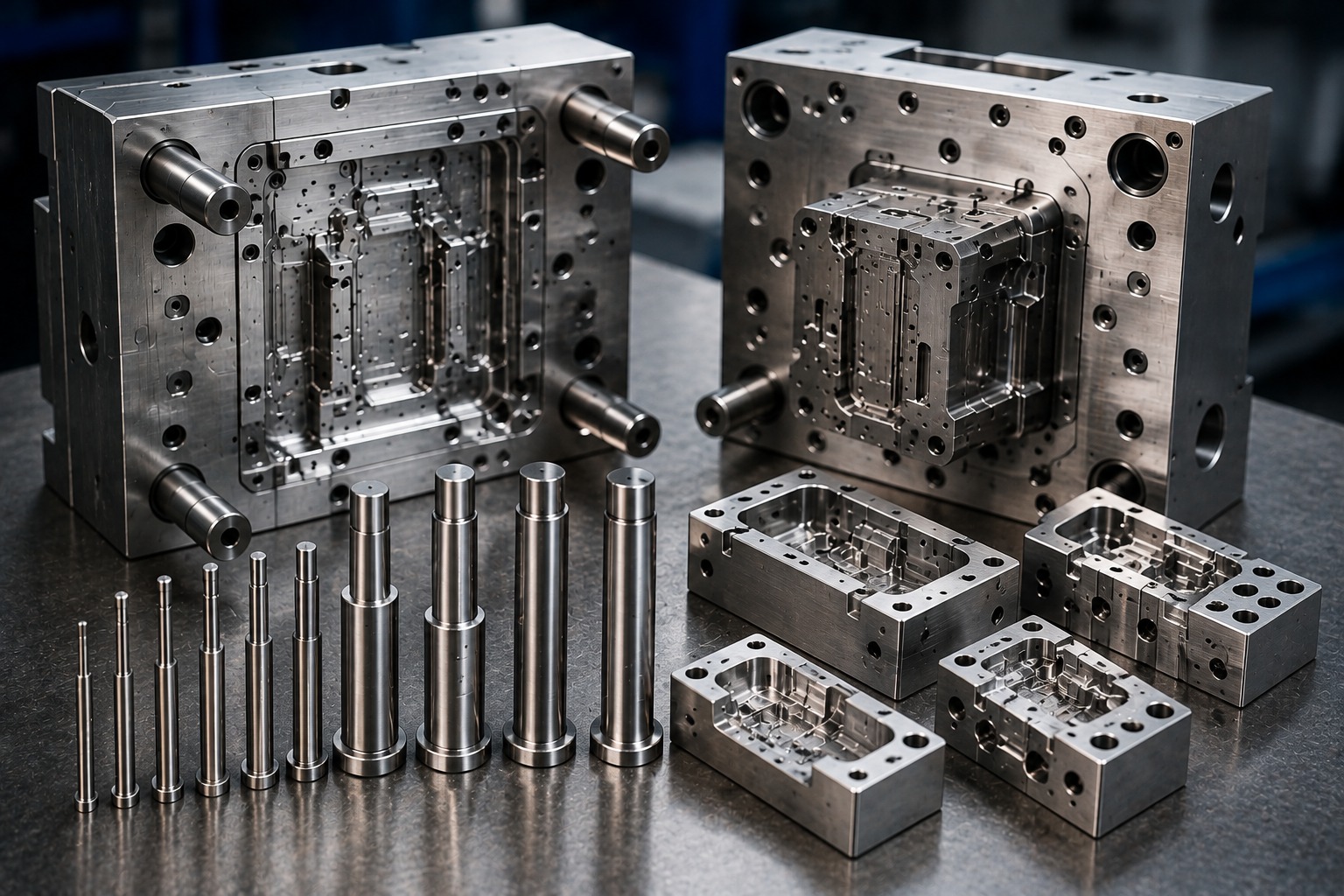
Injection mold performance depends on the accuracy, durability, and condition of its individual components. Among these components, core pins and cavity inserts play a particularly important role because they directly influence the geometry, dimensions, surface quality, and repeatability of molded parts.
A core pin forms internal features such as holes, openings, and channels, while a cavity insert forms important external surfaces and details of the molded component. Therefore, even small dimensional errors, surface damage, or excessive wear can affect the final product.
At Polymach365, we manufacture precision core pins, core inserts, cavity inserts, and custom mold components for injection molding and tooling applications. Our manufacturing capabilities include CNC machining, EDM machining, precision grinding, and dimensional inspection. Consequently, manufacturers can obtain components designed around their specific tooling requirements.
Whether you are developing a new injection mold, maintaining production tooling, or replacing worn components, understanding how core pins and cavity inserts affect mold performance can help you make better tooling decisions.
What Are Core Pins?
Core pins are precision components used inside injection molds to create internal features in molded parts.
Depending on the mold design, core pins can create:
- Holes
- Internal channels
- Openings
- Recesses
- Cylindrical features
- Internal profiles
- Specialized geometries
Therefore, the dimensional accuracy of a core pin directly affects the corresponding feature in the finished plastic part.
For example, if a core pin requires a specific diameter, even a small dimensional variation can affect the final hole size.
As a result, precision core pins are essential for applications that require consistent internal features.
What Are Cavity Inserts?
Cavity inserts are removable tooling components that create external surfaces and features of molded parts.
Instead of manufacturing the entire cavity as one piece, manufacturers can use inserts for specific areas of the mold.
Cavity inserts can provide:
- Complex part geometry
- Replaceable tooling sections
- Easier mold maintenance
- Faster repairs
- Product variations
- Specialized surface details
Therefore, cavity inserts provide both precision and flexibility within injection mold designs.
When a specific cavity area becomes damaged or requires modification, manufacturers can often replace or modify the insert instead of rebuilding the complete mold.
Core Pins vs Cavity Inserts
Although both components are important, they perform different functions.
| Core Pins | Cavity Inserts |
|---|---|
| Create internal features | Create external features |
| Form holes and openings | Form surfaces and profiles |
| Commonly cylindrical or specialized | Often shaped to match part geometry |
| Directly influence internal dimensions | Directly influence external dimensions |
| Require high dimensional accuracy | Require accurate geometry and surface finish |
| Can be replaced when worn | Can be replaced or modified for tooling changes |
Therefore, manufacturers should consider both components when evaluating injection mold performance.
How Core Pins Affect Mold Performance
1. Core Pins Influence Internal Part Accuracy
Core pins directly determine the size and geometry of internal features.
Therefore, manufacturers need to control critical dimensions such as:
- Diameter
- Length
- Straightness
- Concentricity
- Surface finish
- Tip geometry
A properly manufactured core pin helps produce repeatable internal features throughout the molding process.
Consequently, precision core pins can contribute to better dimensional consistency.
2. Core Pin Wear Can Affect Part Quality
Core pins experience repeated exposure to heat, pressure, plastic flow, and ejection forces.
Over time, these conditions can cause wear.
As a result, worn core pins may affect:
- Hole dimensions
- Internal geometry
- Surface finish
- Part consistency
- Mold performance
Therefore, manufacturers should inspect core pins regularly, especially when molds operate at high production volumes.
If wear exceeds acceptable limits, replacing the core pin can help restore the required tooling performance.
3. Core Pin Surface Finish Matters
The surface condition of a core pin can influence the surface of the molded feature.
Therefore, manufacturers should select an appropriate surface finish according to the application.
A suitable surface can help support:
- Easier part release
- Consistent internal surfaces
- Reduced friction
- Better tooling performance
Consequently, precision grinding and finishing can be important steps when manufacturing critical core pins.
4. Core Pin Material Influences Service Life
Core pins repeatedly experience mechanical and thermal stress.
Therefore, material selection should match the application.
Depending on the tooling requirements, manufacturers may consider materials based on:
- Hardness
- Wear resistance
- Toughness
- Thermal stability
- Corrosion resistance
- Machinability
As a result, choosing an appropriate material can help improve core-pin durability and reduce premature replacement.
How Cavity Inserts Affect Mold Performance
5. Cavity Inserts Determine External Part Geometry
Cavity inserts create important external surfaces and features.
Therefore, their dimensional accuracy directly affects the finished molded component.
A precision cavity insert can help maintain:
- Part dimensions
- Surface details
- Profiles
- Cosmetic features
- Repeatability
Consequently, cavity insert quality plays an important role in final product quality.
6. Cavity Inserts Improve Mold Maintenance
One major advantage of cavity inserts is replaceability.
Instead of manufacturing the entire mold cavity as a single structure, manufacturers can isolate critical or wear-prone areas.
Therefore, when an insert becomes damaged, engineers may replace only the affected component.
This can provide:
- Faster repairs
- Reduced maintenance complexity
- Lower replacement requirements
- Easier tooling modifications
- Improved mold flexibility
As a result, cavity inserts can make long-term tooling maintenance more manageable.
7. Cavity Inserts Support Product Modifications
Product designs sometimes change after tooling development.
For example, manufacturers may need to modify:
- Logos
- Ribs
- Bosses
- Surface features
- Dimensions
- Functional details
If the affected area uses a replaceable cavity insert, engineers may be able to modify the insert rather than rebuilding the entire mold.
Therefore, cavity inserts can provide valuable flexibility during product development and production
8. Cavity Insert Wear Can Affect Surface Quality
Cavity surfaces directly contact the molten plastic.
Therefore, surface damage or excessive wear can influence the appearance and dimensions of molded parts.
Potential issues can include:
- Scratches
- Surface marks
- Dimensional variation
- Cosmetic defects
- Flash around damaged areas
Consequently, regular inspection of cavity inserts becomes especially important for high-volume production.
Core Pins and Cavity Inserts Work Together
Core pins and cavity inserts do not operate independently.
Instead, they work together to create the complete geometry of the molded component.
For example:
Cavity Insert → Forms External Geometry
Core Pin → Forms Internal Geometry
Injection Process → Fills the Mold
Cooling → Solidifies the Plastic
Ejection System → Removes the Finished Part
Therefore, both components must maintain the correct relationship throughout the molding cycle.
If either component becomes damaged or misaligned, the final part can be affected.
How Precision Improves Mold Performance
Precision manufacturing helps ensure that core pins and cavity inserts fit correctly within the mold.
Therefore, accurate components can support:
- Better mold assembly
- Consistent part geometry
- Reliable alignment
- Repeatable molding cycles
- Reduced component wear
- Easier maintenance
- Longer tooling life
Moreover, precision becomes increasingly important when molds operate at high production volumes.
As a result, manufacturers should consider component accuracy during both new mold development and replacement-component manufacturing.
Importance of Tolerances
Tolerance requirements vary according to the part design and application.
Therefore, manufacturers should define critical dimensions before manufacturing begins.
Important considerations may include:
- Diameter tolerance
- Length tolerance
- Flatness
- Parallelism
- Concentricity
- Position
- Surface finish
- Mating dimensions
Consequently, clear engineering drawings and CAD models help manufacturers understand the required specifications.
At Polymach365, customers can provide CAD files and technical drawings to support custom mold-component manufacturing.
CNC Machining for Core Pins and Cavity Inserts
CNC machining is widely used to manufacture precision mold components.
It can produce:
- Profiles
- Holes
- Pockets
- Slots
- Complex surfaces
- Precision features
Therefore, CNC machining provides flexibility for producing custom core pins and cavity inserts.
For complex components, multi-axis machining can also reduce the number of setups required.
As a result, manufacturers can achieve greater manufacturing efficiency while maintaining dimensional consistency.
EDM Machining for Complex Mold Features
Some mold features are difficult to manufacture using conventional cutting tools.
Therefore, Electrical Discharge Machining (EDM) can be used for suitable conductive materials and intricate tooling geometries.
EDM can support the production of:
- Fine details
- Narrow features
- Deep cavities
- Sharp internal geometries
- Complex profiles
Consequently, combining CNC machining and EDM can expand the manufacturing possibilities for precision mold components.
Precision Grinding for Critical Components
Grinding can provide accurate dimensions and controlled surface finishes for suitable mold components.
Therefore, precision grinding may be used for critical areas of:
- Core pins
- Inserts
- Ejector components
- Guide components
- Precision tooling parts
As a result, grinding can complement CNC and EDM operations where tighter dimensional control is required.
How Core Pins and Cavity Inserts Affect Production Efficiency
High-volume injection molding requires reliable tooling.
Therefore, component performance can directly influence production efficiency.
Well-maintained core pins and cavity inserts can help manufacturers achieve:
- Consistent production cycles
- Fewer tooling interruptions
- Reduced maintenance
- Stable part quality
- Better repeatability
Furthermore, replaceable inserts can simplify repairs when specific tooling areas experience wear.
Consequently, precision components can support a more predictable manufacturing process.
Core Pins and Cavity Inserts for Mold Repair
Core pins and cavity inserts are frequently replaced during mold maintenance.
For example:
Worn Core Pin → Precision Replacement Core Pin
Damaged Cavity Insert → Custom Replacement Insert
Modified Product Feature → Redesigned Cavity Insert
Worn Internal Feature → New Core Component
Therefore, manufacturers do not always need to replace an entire mold when an individual component reaches the end of its useful life.
Custom manufacturing can provide a practical solution for older or specialized tooling.
Custom vs Standard Core Pins and Inserts
Standard components can work well when your tooling matches common dimensions.
However, custom components are useful when the mold requires unique specifications.
Standard Components
Suitable when:
- Dimensions are conventional
- Availability is important
- Geometry is straightforward
- Replacement parts are readily available
Custom Components
Suitable when:
- Dimensions are non-standard
- Tight tolerances are required
- Geometry is specialized
- Existing components are discontinued
- Tooling requires modifications
- Replacement components must match an existing mold
Therefore, manufacturers should select the component type based on actual tooling requirements.
Industries That Use Precision Core Pins and Cavity Inserts
Precision mold components support many manufacturing industries.
Automotive
Used for housings, brackets, clips, connectors, interior components, and other molded parts.
Medical
Precision tooling supports products that require consistent dimensions and repeatable production.
Electronics
Cavity inserts and core pins help manufacture housings, connectors, enclosures, and technical plastic components.
Consumer Products
High-volume consumer products depend on repeatable mold performance.
Packaging
Precision components support molds used for containers, closures, caps, and packaging products.
Industrial Manufacturing
Specialized tooling components support industrial plastic parts and technical products.
Therefore, core pins and cavity inserts remain important across a wide range of manufacturing applications.
Why Choose Polymach365 for Core Pins and Cavity Inserts?
Polymach365 provides precision and custom mold-component manufacturing for injection molding and tooling applications.
Our capabilities include:
- Custom Core Pins
- Core Inserts
- Cavity Inserts
- Ejector Pins
- Ejector Sleeves
- Guide Pins
- Guide Bushings
- Wear Plates
- Custom Mold Components
- CNC Machining
- EDM Machining
- Precision Grinding
- Dimensional Inspection
Moreover, Polymach365 supports broader manufacturing requirements, including CNC machining, injection mold design, injection mold manufacturing, rapid prototyping, and custom manufacturing.
Therefore, customers can work with one manufacturing partner for multiple tooling and production requirements.
How to Maintain Core Pins and Cavity Inserts
Proper maintenance can help extend component life.
Follow these practices:
- Inspect components regularly.
- Keep surfaces clean.
- Monitor wear and dimensional changes.
- Use suitable lubrication where required.
- Check alignment during scheduled maintenance.
- Inspect cavity surfaces for damage.
- Replace worn components before failure.
- Record maintenance and replacement history.
- Monitor production quality for early warning signs.
- Use precision replacement components.
Consequently, proactive maintenance can reduce unexpected tooling problems.
Final Thoughts
Core pins and cavity inserts are essential components of injection molds. Core pins create internal features, while cavity inserts form external geometry and important surface details.
Therefore, their accuracy, material, surface finish, durability, and condition directly influence mold performance.
When manufacturers use precision-engineered components and maintain them properly, they can support better part consistency, reliable mold operation, easier maintenance, reduced downtime, and longer tooling life.
At Polymach365, we manufacture custom and precision core pins, cavity inserts, and other mold components according to CAD files, technical drawings, material requirements, tolerances, quantities, and application specifications.
Request Custom Core Pins & Cavity Inserts
Need a replacement core pin, custom cavity insert, or precision mold component?
Send your CAD files, 2D drawings, material specifications, tolerances, quantities, and surface-finish requirements to Polymach365 for project review.