A Practical Guide for Injection Molding Manufacturers
Choosing the right mold components supplier in Canada can directly affect mold accuracy, production efficiency, maintenance costs, and tooling life. Therefore, manufacturers should look beyond price when evaluating a supplier.
A reliable supplier should provide the right combination of precision manufacturing, material knowledge, quality inspection, customization, engineering support, lead time, and dependable communication.
At Polymach365, we manufacture precision and custom mold components for injection molding, compression molding, die-casting tooling, mold repair, prototype tooling, and production applications. Our capabilities include CNC machining, EDM machining, precision grinding, and dimensional inspection.
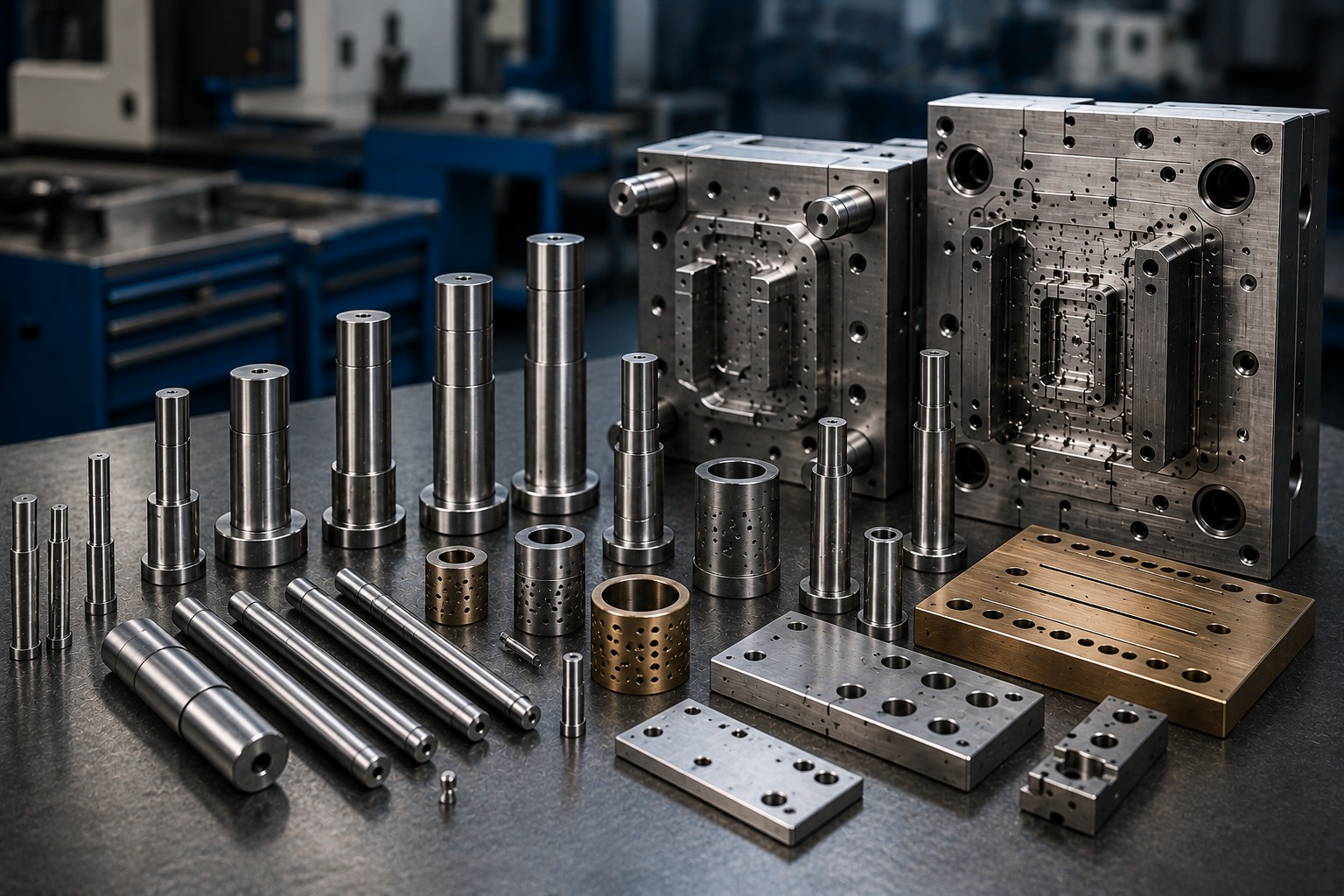
Whether you need core pins, cavity inserts, ejector pins, ejector sleeves, guide pins, bushings, wear plates, or custom mold components, selecting the right manufacturing partner can help you achieve consistent tooling performance.
Why Choosing the Right Mold Components Supplier Matters
Injection molds operate under repeated pressure, heat, friction, and mechanical movement. Consequently, even a small problem with a critical component can affect the entire production process.
Poor-quality or incorrectly manufactured components can contribute to:
- Mold misalignment
- Ejection problems
- Premature wear
- Part dimensional variation
- Surface defects
- Increased maintenance
- Production downtime
- Shorter mold life
On the other hand, precision-manufactured components can support accurate mold assembly, reliable operation, and repeatable production.
Therefore, supplier selection should be treated as an important part of your overall tooling strategy.
1. Check the Supplier's Mold Component Experience
First, determine whether the supplier actually specializes in mold components.
A supplier with experience in precision tooling should understand how individual components interact within an injection mold.
Look for experience with:
- Core pins
- Core inserts
- Cavity inserts
- Ejector pins
- Ejector sleeves
- Guide pins
- Guide bushings
- Wear plates
- Mold inserts
- Custom tooling components
For example, Polymach365’s current mold-component offering includes these types of components and supports injection molds, compression molds, die-casting tools, and custom tooling applications.
Therefore, choose a supplier whose manufacturing capabilities match your actual tooling requirements.
2. Evaluate Precision and Tolerance Capabilities
Precision is one of the most important factors when choosing a mold components supplier.
Mold components must fit correctly within the tooling system. Therefore, the supplier should have appropriate machining and inspection capabilities for your required tolerances.
Ask the supplier:
- What machining processes do you use?
- How do you control dimensional accuracy?
- How are critical dimensions inspected?
- Can you manufacture according to customer drawings?
- Can you provide inspection documentation when required?
Polymach365 uses CNC machining, EDM machining, precision grinding, and dimensional inspection as part of its mold-component manufacturing process.
Consequently, manufacturers should evaluate both the machining process and the supplier’s inspection procedure.
3. Make Sure They Manufacture Custom Components
Standard components can work well for conventional tooling. However, many molds require components with unique dimensions or geometries.
Therefore, your supplier should have the ability to manufacture custom parts according to your requirements.
Custom manufacturing can support:
- Non-standard core pins
- Custom cavity inserts
- Special ejector components
- Custom wear plates
- Replacement mold components
- Engineering modifications
- Legacy tooling
- Prototype tooling
Polymach365 manufactures custom components based on CAD models, technical drawings, tolerances, material requirements, surface specifications, and production quantities.
As a result, you can develop components around your mold instead of changing your tooling to fit a standard part.
4. Review the Available Manufacturing Technologies
A good mold components supplier should have suitable manufacturing technology for both simple and complex components.
CNC Machining
CNC machining can produce accurate profiles, holes, pockets, surfaces, and complex geometries.
Therefore, CNC machining provides flexibility for many mold-component applications.
EDM Machining
Electrical Discharge Machining can produce intricate features and geometries that may be difficult to create using conventional cutting tools.
Consequently, EDM can expand the range of components a supplier can manufacture.
Precision Grinding
Grinding can help achieve accurate dimensions and high-quality surface finishes.
Therefore, precision grinding is particularly useful for components where dimensional and surface requirements are critical.
Dimensional Inspection
Inspection verifies whether the finished component matches the approved engineering specifications.
As a result, suppliers with appropriate metrology capabilities can provide greater confidence in component consistency.
Polymach365 currently highlights CNC machining, EDM, precision grinding, and dimensional inspection among its manufacturing capabilities.
5. Ask About Material Selection
The right mold component material depends on the application.
For example, production volume, wear, temperature, corrosion, and mechanical loading can all influence material selection.
Common mold-component materials may include:
- P20-type mold steel
- H13
- Stainless mold steel
- S7
- D2
- Aluminum
- Other engineering steels and alloys
Therefore, your supplier should understand why a particular material is suitable rather than simply offering the cheapest option.
Ask about:
- Material grade
- Hardness
- Heat treatment
- Wear resistance
- Corrosion resistance
- Thermal requirements
- Material certification
As a result, you can select materials according to the actual operating conditions of your mold.
6. Check Quality Control Procedures
Quality control should begin before machining and continue through final inspection.
A reliable supplier should have a structured process for checking critical components.
Look for:
Design Review → Material Verification → Machining → In-Process Inspection → Finishing → Final Inspection → Delivery
Polymach365 describes a similar manufacturing workflow that includes engineering review, material selection, precision manufacturing, quality inspection, and delivery.
Therefore, ask potential suppliers how they identify and control dimensional problems before components reach the customer.
7. Consider Lead Times and Delivery Reliability
A low component price does not help if a delayed component stops production.
Therefore, evaluate the supplier’s ability to meet your required delivery schedule.
Ask about:
- Standard lead times
- Custom-component lead times
- Rush manufacturing options
- Shipping arrangements
- Production capacity
- Communication during manufacturing
Canadian suppliers already compete on delivery and responsiveness. For example, Mold Parts in Ontario highlights in-house manufacturing and short lead times, while the Canadian Association of Mold Makers lists multiple Canadian mold-component suppliers.
Consequently, delivery reliability should be part of your supplier evaluation—not an afterthought.
8. Look for Engineering Support
A strong mold component supplier should do more than manufacture a drawing.
Engineering support can help identify:
- Manufacturability concerns
- Material considerations
- Tolerance requirements
- Surface-finish requirements
- Component modifications
- Potential machining challenges
Therefore, look for a supplier that reviews your requirements before production.
Polymach365 states that its process begins with design review and engineering analysis before manufacturing.
As a result, potential manufacturing problems can be identified earlier.
9. Check Whether They Support Replacement Components
You may need mold components for an existing production mold rather than a new project.
In that situation, finding an exact replacement can sometimes be difficult, particularly when the original component is discontinued or no longer available.
A capable supplier should be able to manufacture replacement components from:
- Existing CAD files
- Engineering drawings
- Samples
- Measurements
- Reverse-engineering information, where appropriate
Therefore, replacement capability can provide significant value for long-running production molds.
10. Evaluate the Supplier's Component Range
A supplier with a broader component range can simplify sourcing.
Instead of contacting multiple companies for different tooling parts, you may be able to source several components from one manufacturing partner.
For example, Polymach365 offers manufacturing capabilities covering core pins, cavity inserts, ejector systems, guide components, wear plates, and custom mold components.
Consequently, one supplier can potentially support more of your tooling requirements.
11. Consider Standard and Custom Components
Not every mold requires a custom component.
Standard components can provide a practical solution when your tooling uses conventional dimensions.
However, custom components become valuable when you need:
- Special dimensions
- Unique profiles
- Tight tolerances
- Replacement parts
- Engineering modifications
- Specialized tooling
Therefore, the best supplier should ideally support both standard and custom requirements.
Polymach365 positions its offering around both standard and fully customized mold components.
12. Compare More Than the Initial Price
Price matters, but it should not be the only deciding factor.
A cheaper component can become expensive if it causes:
- Premature failure
- Production downtime
- Frequent replacement
- Mold damage
- Part-quality problems
- Additional maintenance
Instead, compare the total cost of ownership.
Consider:
Component Price + Shipping + Lead Time + Maintenance + Expected Service Life + Downtime Risk
Therefore, a slightly higher-quality component can sometimes provide better long-term value.
13. Check Canadian Manufacturing Support
If your production is based in Canada, working with a supplier that understands the Canadian manufacturing market can simplify communication and logistics.
The Canadian Association of Mold Makers maintains a directory of mold-component suppliers and other companies serving Canada’s mold-making and plastics industry.
Moreover, Canadian suppliers can provide advantages related to communication, shipping, time zones, and local project coordination.
Therefore, consider location alongside technical capability.
14. Review the Supplier's Industries and Applications
Different industries can have very different tooling requirements.
Ask whether the supplier has experience supporting applications such as:
Automotive
High-volume tooling and durable components.
Medical
Precision-focused tooling and repeatable manufacturing.
Packaging
High-cycle molds requiring reliable component performance.
Consumer Products
Repeatable tooling for large production quantities.
Electronics
Precision tooling for housings, connectors, and technical components.
Industrial Manufacturing
Specialized tooling for demanding production environments.
Polymach365 currently lists automotive, medical, packaging, consumer products, industrial manufacturing, and electronics among the industries supported by its custom mold components.
Good communication can prevent expensive manufacturing mistakes.
Before placing an order, provide:
- 3D CAD files
- 2D drawings
- Material requirements
- Tolerances
- Surface-finish requirements
- Quantity
- Heat-treatment requirements
- Delivery requirements
Then, ask the supplier to confirm that the information is understood.
Consequently, both sides have a clear understanding of the manufacturing requirements before production begins.
Polymach365 provides precision and custom mold-component manufacturing for manufacturers across Canada and North America.
Our capabilities include:
- Core Pins & Core Inserts
- Cavity Inserts
- Ejector Pins & Sleeves
- Guide Pins & Bushings
- Wear Plates
- Custom Mold Components
- CNC Precision Machining
- EDM Machining
- Precision Grinding
- Dimensional Inspection
Moreover, Polymach365’s broader manufacturing capabilities include CNC milling, CNC lathe machining, injection mold design, injection mold manufacturing, injection molding, compression molding, die casting, and 3D printing.
Therefore, manufacturers can work with a supplier that understands both individual mold components and the wider tooling process.
Before selecting your supplier, check the following:
☑ Mold-component manufacturing experience
☑ CNC machining capability
☑ EDM capability
☑ Precision grinding
☑ Dimensional inspection
☑ Custom manufacturing
☑ Standard component capability
☑ Material expertise
☑ Engineering support
☑ Replacement-component manufacturing
☑ Reliable lead times
☑ Clear communication
☑ Competitive total cost
☑ Experience with your application
If a supplier meets these requirements, you have a much stronger basis for evaluating the partnership.
Choosing the right mold components supplier in Canada requires more than comparing prices.
The right supplier should combine precision, material knowledge, manufacturing technology, quality control, customization, engineering support, reliable delivery, and clear communication.
Therefore, start by defining your component requirements. Then, evaluate each supplier based on their actual manufacturing capabilities and quality processes.
For injection mold makers, OEMs, and manufacturers, Polymach365 provides precision and custom mold components manufactured according to CAD files, technical drawings, tolerances, material specifications, and application requirements.
Whether you need a custom core pin, cavity insert, ejector pin, guide component, wear plate, or replacement mold component, selecting a capable manufacturing partner can help improve tooling reliability, reduce downtime, and support consistent production.
Request a Mold Component Quote
Have a mold component ready for manufacturing?
Send your CAD files, 2D drawings, material requirements, tolerances, quantities, and surface-finish specifications to Polymach365 for project review.