
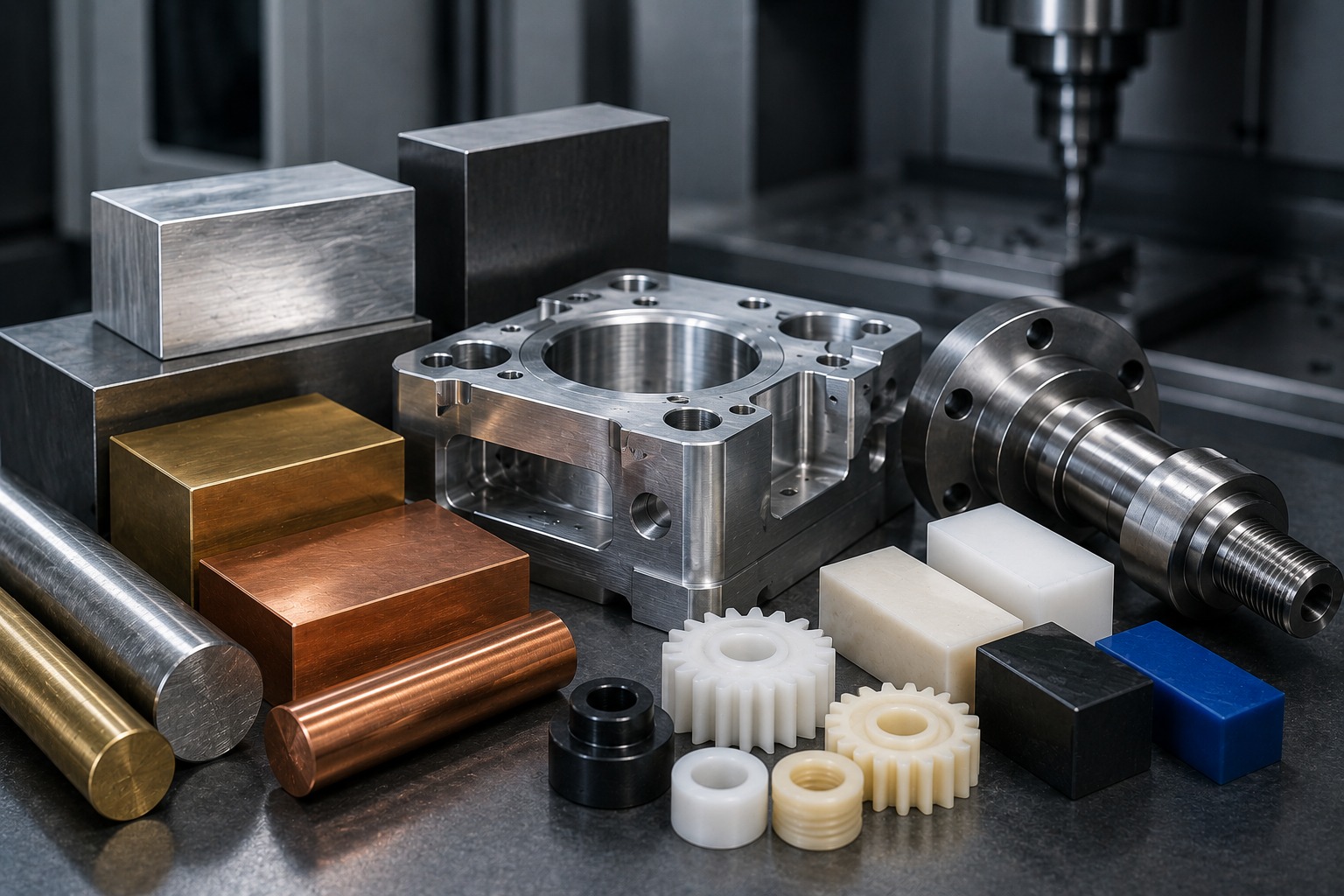
A Complete Guide to Choosing Materials for CNC Machined Components
Choosing the right material is one of the most important decisions when designing a CNC machined part. Material selection affects strength, weight, durability, corrosion resistance, machinability, surface finish, cost, and overall product performance.
Therefore, engineers should select a material based on the actual application rather than choosing a material simply because it is easy to machine or inexpensive.
At Polymach365, we support CNC milling, CNC turning, 3-axis, 4-axis and 5-axis machining, prototype manufacturing, low-volume production, custom CNC parts, and precision machined components. Understanding the characteristics of different CNC machining materials can help you make better manufacturing decisions.
Why Material Selection Matters in CNC Machining
Every CNC machined component operates under different conditions.
For example, an automotive component may require strength and wear resistance, while an electronic housing may prioritize lightweight construction and electrical insulation.
Therefore, material selection should consider:
- Mechanical strength
- Hardness
- Weight
- Corrosion resistance
- Temperature resistance
- Wear resistance
- Chemical resistance
- Machinability
- Surface finish
- Material availability
- Manufacturing cost
As a result, selecting the correct material can improve both part performance and manufacturing efficiency.
Common CNC Machining Materials
CNC machines can manufacture components from a wide range of metals and engineering plastics.
Common CNC machining materials include:
Metals
- Aluminum
- Stainless Steel
- Carbon Steel
- Alloy Steel
- Tool Steel
- Brass
- Copper
- Titanium
Engineering Plastics
- ABS
- Nylon
- Delrin
- Polycarbonate
- PEEK
- PTFE
Each material has different properties. Therefore, engineers should evaluate the material according to the requirements of the finished component.
1. Aluminum CNC Machining
Aluminum is one of the most widely used materials for CNC machining.
It offers a useful combination of low weight, good machinability, strength, and corrosion resistance.
Advantages of Aluminum
- Lightweight
- Good machinability
- Good strength-to-weight ratio
- Corrosion resistance
- Suitable for complex machining
- Good surface finishing options
Therefore, aluminum is commonly selected for:
- Automotive components
- Aerospace components
- Electronic housings
- Brackets
- Enclosures
- Fixtures
- Machine components
- Prototypes
Moreover, aluminum can be an excellent choice when reducing component weight is important.
2. Stainless Steel CNC Machining
Stainless steel provides strength, durability, and corrosion resistance.
Therefore, it is suitable for components that operate in demanding environments.
Common Applications
- Industrial equipment
- Medical components
- Food-processing equipment
- Automotive parts
- Machinery components
- Chemical-processing equipment
- Precision tooling
However, stainless steel can require more cutting force than aluminum.
Consequently, manufacturers need appropriate cutting tools and machining parameters to achieve efficient production and good surface quality.
3. Carbon Steel CNC Machining
Carbon steel provides a combination of strength, durability, and cost efficiency.
It can be used for:
- Machine components
- Shafts
- Brackets
- Fixtures
- Industrial equipment
- Structural components
Therefore, carbon steel can be a practical choice when strength is important and the application does not require the corrosion resistance of stainless steel.
4. Tool Steel CNC Machining
Tool steel is designed for applications requiring high hardness, strength, and wear resistance.
It is commonly used for:
- Dies
- Tooling
- Mold components
- Cutting tools
- Fixtures
- Precision manufacturing components
However, harder materials can increase machining difficulty.
Therefore, manufacturers should select appropriate tooling and machining strategies when working with tool steels.
5. Brass CNC Machining
Brass is known for its good machinability, corrosion resistance, and attractive appearance.
Therefore, CNC-machined brass components are often used for:
- Fittings
- Bushings
- Connectors
- Valves
- Electrical components
- Decorative components
- Precision mechanical parts
Moreover, brass can provide a good combination of machinability and functional performance.
6. Copper CNC Machining
Copper provides excellent electrical and thermal conductivity.
Therefore, it is commonly selected for components where heat or electrical conductivity is important.
Applications include:
- Electrical components
- Heat-transfer components
- Connectors
- Busbars
- Specialized industrial components
However, copper can present machining challenges because of its material characteristics.
Consequently, tool selection and cutting parameters should be optimized for reliable results.
7. Titanium CNC Machining
Titanium provides a high strength-to-weight ratio and excellent corrosion resistance.
Therefore, it is commonly used in demanding applications such as:
- Aerospace
- Medical equipment
- High-performance engineering
- Chemical processing
- Specialized industrial components
However, titanium can be more difficult to machine than many conventional materials.
It can generate heat during cutting and place higher demands on cutting tools.
As a result, titanium machining requires appropriate tooling, speeds, feeds, and cooling strategies.
8. ABS CNC Machining
ABS is an engineering thermoplastic that combines relatively low weight with good impact resistance and machinability.
Therefore, it can be useful for:
- Prototype housings
- Enclosures
- Consumer products
- Fixtures
- Product-development components
Moreover, CNC machining ABS can provide functional prototypes without requiring injection molding tooling.
9. Nylon CNC Machining
Nylon is a lightweight engineering plastic with good wear resistance and low friction characteristics.
Therefore, it can be useful for:
- Bushings
- Rollers
- Gears
- Guides
- Spacers
- Mechanical components
However, plastics can respond differently to heat and machining forces than metals.
Consequently, manufacturers should consider thermal effects and workholding when machining nylon.
10. Delrin CNC Machining
Delrin, also known as acetal, is widely used for precision plastic components.
It provides:
- Good dimensional stability
- Low friction
- Good machinability
- Wear resistance
- Low moisture absorption compared with many other plastics
Therefore, Delrin is suitable for:
- Bushings
- Gears
- Rollers
- Fixtures
- Mechanical components
- Precision plastic parts
11. PEEK CNC Machining
PEEK is a high-performance engineering plastic used when components require demanding mechanical and thermal performance.
Therefore, PEEK may be selected for specialized applications involving:
- High temperatures
- Chemical exposure
- Wear
- Mechanical loading
- Electrical insulation
However, PEEK can be significantly more expensive than common engineering plastics.
Consequently, it should generally be selected when its performance characteristics justify the additional material cost.
Metal vs Plastic for CNC Machining
One of the first decisions engineers often make is whether to manufacture a component from metal or plastic.
Choose Metal When You Need:
- Higher mechanical strength
- Greater rigidity
- Higher temperature capability
- Improved wear resistance
- Long-term structural performance
Choose Engineering Plastic When You Need:
- Lower weight
- Electrical insulation
- Reduced friction
- Corrosion resistance
- Lower component weight
- Specialized chemical resistance
Therefore, the correct choice depends on the operating conditions of the component.
How Machinability Affects Material Selection
Machinability describes how easily a material can be cut and processed.
Materials with good machinability can often provide:
- Faster machining
- Longer tool life
- Better surface finish
- Lower cutting forces
- Improved production efficiency
However, a highly machinable material is not automatically the best material for every application.
For example, titanium may be more difficult to machine than aluminum, but its strength-to-weight ratio can make it the better choice for certain demanding applications.
Therefore, performance should come first, while machinability should be considered alongside it.
How Strength Affects Material Selection
Strength is important when a component must withstand mechanical loads.
Before choosing a material, consider whether the part will experience:
- Tensile loads
- Compression
- Bending
- Impact
- Vibration
- Repeated loading
For example, a heavily loaded machine component may require steel, while a lightweight enclosure may work better with aluminum or engineering plastic.
As a result, understanding the component’s loading conditions can help prevent premature failure.
How Temperature Affects Material Selection
Operating temperature can significantly influence material performance.
Some plastics may soften or lose mechanical properties at elevated temperatures, while certain metals can maintain their performance under more demanding conditions.
Therefore, engineers should consider:
- Continuous operating temperature
- Peak temperature
- Thermal expansion
- Heat transfer requirements
- Exposure to thermal cycling
Consequently, the material should be selected according to the actual temperature environment.
How Corrosion Resistance Affects Material Selection
Components exposed to moisture, chemicals, salt, or other corrosive environments may require corrosion-resistant materials.
For example:
- Stainless steel can provide strong corrosion resistance.
- Aluminum naturally forms a protective oxide layer.
- Engineering plastics can resist many forms of corrosion.
Therefore, environmental exposure should always be considered before finalizing the material.
Material cost is only one part of the total manufacturing cost.
The material can also influence:
- Machining time
- Tool wear
- Cutting speed
- Coolant requirements
- Finishing requirements
- Inspection
- Scrap risk
For example, a material that costs more per kilogram may still reduce overall production costs if it machines efficiently or provides better component performance.
Therefore, manufacturers should consider total manufacturing cost, not simply raw material price.
Prototype materials should represent the intended application as closely as practical.
If a prototype only needs to demonstrate shape and fit, a machinable material may be sufficient.
However, if engineers need to test:
- Strength
- Temperature resistance
- Wear
- Assembly
- Mechanical performance
then the prototype should use a material with properties closer to the final production component.
Consequently, selecting the right prototype material can provide more meaningful test results.
Material Selection for Production Parts
Production components require consistent material properties throughout the manufacturing process.
Therefore, manufacturers should consider:
- Material availability
- Material certification
- Batch consistency
- Machinability
- Production quantity
- Dimensional stability
- Cost
- Supply reliability
Moreover, selecting an easily available material can help reduce production delays.
Before selecting a material, ask the following questions:
1. What Will the Part Do?
Understand the component’s primary function.
2. What Loads Will It Experience?
Consider mechanical, thermal, and environmental loads.
3. What Environment Will It Operate In?
Evaluate moisture, chemicals, temperature, wear, and corrosion.
4. How Important Is Weight?
If weight matters, aluminum or engineering plastics may be appropriate.
5. What Tolerances Are Required?
Some materials may require additional machining considerations when tight tolerances are necessary.
6. What Quantity Will You Manufacture?
Prototype, low-volume, and high-volume projects may have different material considerations.
7. What Is the Target Budget?
Balance material cost with machining and finishing costs.
Therefore, answering these questions before production can help you select a more suitable CNC machining material.
At Polymach365, we provide CNC machining solutions for prototypes, custom parts, mold components, and production manufacturing.
Our machining capabilities include:
- CNC Milling
- CNC Turning
- 3-Axis CNC Machining
- 4-Axis CNC Machining
- 5-Axis CNC Machining
- Prototype Manufacturing
- Low-Volume Production
- Custom CNC Machining
- Precision Machined Components
- Mold Components
We support a broad selection of metals and engineering plastics for different manufacturing requirements.
Therefore, when submitting your CAD design, providing the material, quantity, tolerances, surface finish, and application requirements can help establish the appropriate manufacturing approach.
Digital Manufacturing Workflow
CAD File → Material Selection → Manufacturing Review → CNC Machining → Quality Inspection → Finished Part
As a result, you can move from your digital design toward a production-ready component through a streamlined CNC manufacturing process.
Selecting the right CNC machining material requires more than comparing material prices.
Engineers should evaluate strength, weight, machinability, corrosion resistance, temperature, wear, dimensional stability, availability, and total manufacturing cost before making a decision.
Aluminum can be an excellent option for lightweight components, while stainless steel may suit demanding environments. Similarly, titanium can provide high strength-to-weight performance, while engineering plastics can offer low weight, corrosion resistance, and specialized properties.
Therefore, the best material is the one that meets the component’s functional requirements while remaining practical to manufacture.
Whether you need a CNC prototype, custom machined part, mold component, low-volume production run, or production component, Polymach365 can support your manufacturing requirements with CNC milling, CNC turning, multi-axis machining, and digital manufacturing solutions.
Have a CAD design ready?
Upload your CAD file and provide your material, quantity, tolerance, and finishing requirements to start your CNC machining project with Polymach365.