Choosing the Right Material for Precision, Durability, and Long Tool Life
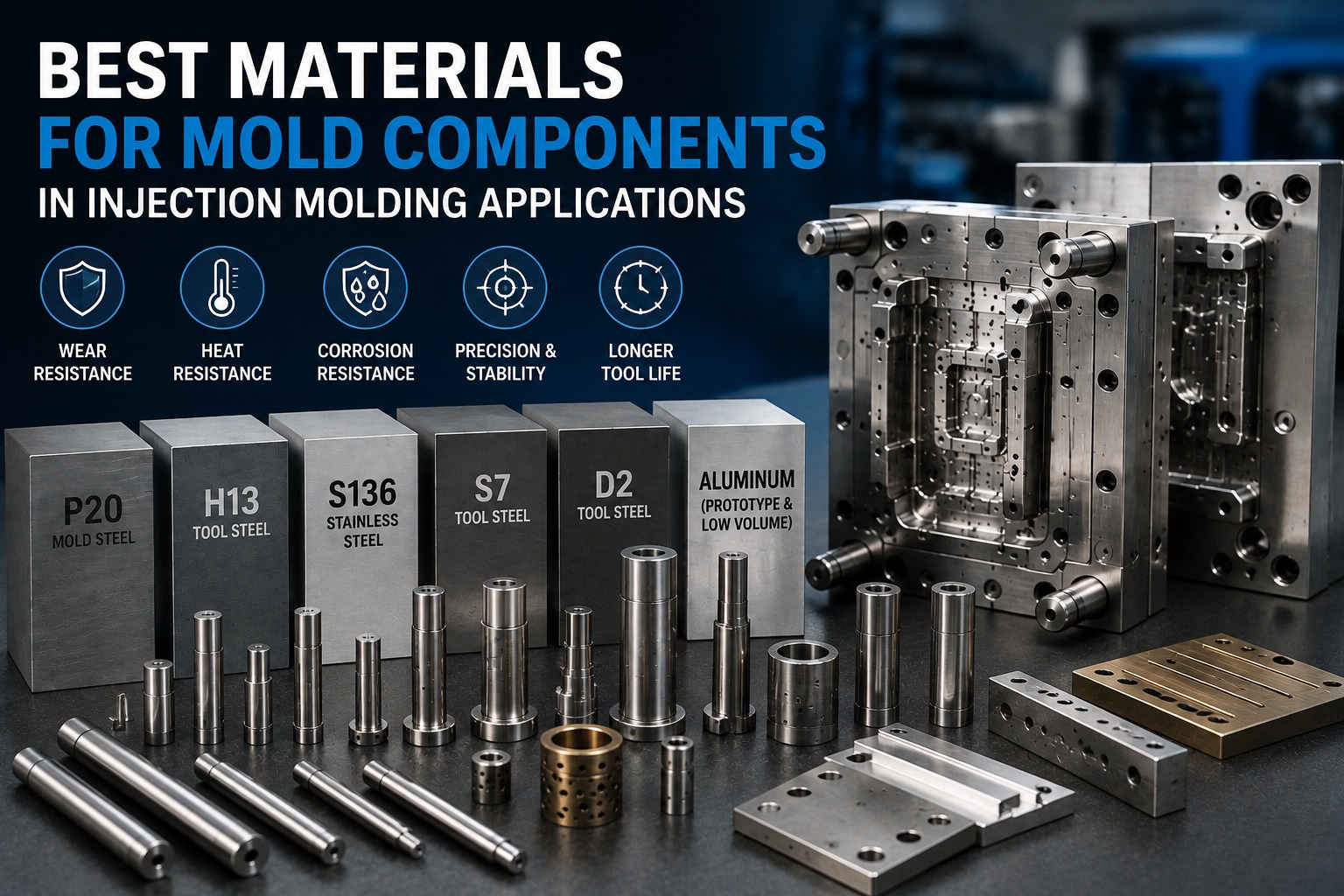
The performance of an injection mold depends on more than its design and machining accuracy. Material selection for mold components also plays a major role in tooling life, dimensional stability, wear resistance, surface finish, maintenance, and production consistency.
Therefore, manufacturers should select mold-component materials according to the component’s function, plastic material, production volume, operating temperature, wear conditions, and required surface finish.
For example, a mold designed for moderate production may use a pre-hardened P20-type mold steel, while high-volume or demanding applications may require harder or more wear- and corrosion-resistant materials. H13 is commonly used where repeated thermal cycling and heat resistance matter, while stainless mold steels are valuable where corrosion resistance and polishability are important.
At Polymach365, we manufacture precision and custom mold components according to CAD files, engineering drawings, material specifications, tolerances, and application requirements. Our capabilities include CNC machining, EDM machining, precision grinding, and dimensional inspection.
Injection molds repeatedly experience mechanical movement, pressure, friction, heat, cooling, and ejection forces.
Consequently, the wrong material can lead to premature wear, dimensional changes, corrosion, surface damage, or frequent maintenance.
The right material can help improve:
- Mold component durability
- Wear resistance
- Dimensional stability
- Surface finish
- Corrosion resistance
- Heat resistance
- Production consistency
- Mold service life
- Maintenance efficiency
Moreover, different components experience different operating conditions. Therefore, manufacturers should not automatically use the same material for every mold component.
Before choosing a material, evaluate several important factors.
1. Production Volume
Production volume strongly influences material selection.
For lower-volume tooling, manufacturers may prioritize machinability and tooling cost. However, high-volume production requires components that can withstand repeated cycles and wear.
Steel tooling is generally preferred for very high production requirements, while aluminum tooling can be attractive for lower-volume applications because it is easier and faster to machine.
Therefore, expected production volume should be considered before selecting the mold-component material.
2. Wear Resistance
Some mold components move continuously or experience repeated contact.
For example:
- Guide pins
- Guide bushings
- Ejector components
- Slides
- Wear plates
- Core pins
These components may require good wear resistance.
Consequently, selecting a suitable tool steel or hardened material can help reduce premature component replacement.
3. Corrosion Resistance
Certain plastics, additives, moisture, and production environments can increase corrosion risks.
Therefore, corrosion-resistant stainless mold steels can be valuable for applications where surface condition and long-term tooling performance are important.
Uddeholm identifies stainless mold steels such as Stavax ESR / Mirrax ESR as corrosion- and wear-resistant grades with excellent polishability for plastic molding applications.
4. Heat Resistance
Injection molding involves repeated heating and cooling.
Therefore, components exposed to significant thermal cycling require suitable thermal stability.
H13-type hot-work tool steel is commonly associated with injection molding and die-casting applications because it maintains useful strength during repeated heating and cooling.
As a result, H13 can be an excellent choice for demanding tooling applications where heat resistance is a priority.
There is no single material that is best for every mold component.
Instead, the most appropriate choice depends on the component and application.
The following materials are commonly considered for injection mold tooling and components.
1. P20 Mold Steel
P20 is one of the most widely recognized pre-hardened mold-steel grades for plastic injection molding.
It provides a useful combination of:
- Machinability
- Toughness
- Strength
- Polishability
- Moderate wear resistance
- Cost efficiency
Therefore, P20-type steels are often suitable for mold bases, mold plates, cavities, cores, and other tooling applications where moderate production requirements apply.
Uddeholm’s Impax Supreme is a modified P20-type pre-hardened mold steel designed for injection molds, blow molds, and plastic extrusion dies. It is supplied in a pre-hardened condition and offers good machinability and polishing properties.
Best suited for:
- General injection molds
- Mold bases
- Cavity blocks
- Core blocks
- Moderate production
- General-purpose tooling
Main advantage:
Good balance between machinability, toughness, performance, and cost.
H13 is a hot-work tool steel frequently used for demanding tooling applications.
It offers good resistance to thermal fatigue and maintains strength during repeated heating and cooling.
Therefore, H13 can be suitable for:
- High-cycle tooling
- Hot runner components
- High-temperature applications
- Core components
- Cavity components
- Die-casting tooling
- High-wear tooling
Protolabs identifies H13 as a hot-work steel suitable for injection molds and high-volume applications, while Uddeholm describes its Orvar Supreme, an improved H13-type grade, as a versatile mold and die steel with good wear resistance and polishability.
Main advantage:
Excellent thermal performance and good durability for demanding tooling.
3. S136 / 420-Type Stainless Mold Steel
Stainless mold steels are particularly valuable when corrosion resistance and surface finish are important.
Therefore, stainless grades can be considered for:
- Medical molds
- Optical components
- Cosmetic tooling
- Corrosive plastics
- High-polish applications
- Components exposed to moisture
Uddeholm lists Stavax ESR and Mirrax ESR, both modified 420-type stainless mold steels, as corrosion- and wear-resistant materials with excellent polishability.
Main advantage:
Excellent corrosion resistance and polishability.
4. S7 Tool Steel
S7 is a shock-resistant tool steel.
Therefore, it can be considered for mold components that experience impact or mechanical shock.
Potential applications include:
- Slides
- Inserts
- Wear components
- Heavy-duty tooling components
- Components exposed to impact
Protolabs describes S7 as a shock-resistant steel designed to withstand repeated shock loads.
Main advantage:
High toughness for components exposed to impact or shock.
5. D2 Tool Steel
D2 is a high-chromium tool steel known for strong wear resistance.
Therefore, it can be useful where abrasion is a significant concern.
Potential applications include:
- Wear components
- High-wear inserts
- Cutting/forming tooling
- Specialized mold components
However, material selection should consider the complete tooling application rather than choosing D2 solely because of its high wear resistance.
Main advantage:
Strong wear resistance for demanding applications.
6. Aluminum for Prototype and Low-Volume Tooling
Aluminum is not a direct replacement for hardened mold steel in every application. However, it can be an excellent tooling material for prototypes, development molds, and lower-volume production.
Aluminum provides:
- Excellent machinability
- Faster machining
- Lower tooling weight
- Faster tooling development
- Lower initial tooling cost
Protolabs notes that aluminum tooling is well suited to lower production quantities and can support 10,000 or more cycles depending on the material and geometry.
Therefore, aluminum can be a practical option when manufacturers need to validate a product before investing in long-life steel tooling.
Material Comparison for Mold Components
| Material | Main Strength | Typical Consideration |
|---|---|---|
| P20 | Machinability and balanced performance | General injection molds |
| H13 | Heat and thermal-fatigue resistance | High-cycle and demanding tooling |
| S136 / 420-type stainless | Corrosion resistance and polishability | Medical, cosmetic and high-polish molds |
| S7 | Shock resistance | Impact-prone components |
| D2 | Wear resistance | High-wear applications |
| Aluminum | Fast machining and lower tooling cost | Prototype and low-volume tooling |
The actual performance of any grade depends on its specific composition, heat treatment, hardness, processing, and application. Therefore, this table should be treated as a starting point rather than a universal material-selection rule.
Best Materials for Core Pins
Core pins create internal holes and features in molded parts.
Therefore, they require good dimensional stability, surface quality, and resistance to repeated wear.
Depending on the application, manufacturers may consider:
- Hardened tool steels
- H13-type steels
- Stainless mold steels
- Wear-resistant specialty steels
For high-volume applications, a harder and more wear-resistant material may provide better long-term performance.
Consequently, core-pin material should be selected according to production volume, plastic resin, geometry, tolerance, and expected tool life.
Best Materials for Cavity Inserts
Cavity inserts create external surfaces and details of molded components.
Therefore, their material must support the required:
- Surface finish
- Dimensional stability
- Wear resistance
- Corrosion resistance
- Production life
For general applications, P20-type steel can provide a practical balance.
For demanding applications, manufacturers may consider H13 or stainless mold steels depending on the specific requirements.
As a result, cavity-insert material should be selected based on both the molded plastic and the required production performance.
Best Materials for Ejector Pins and Sleeves
Ejector components operate during every molding cycle.
Therefore, they require suitable hardness, wear resistance, dimensional stability, and surface finish.
The correct material helps maintain smooth movement and reliable part ejection.
This is particularly important because ejector pins must repeatedly extend into the mold cavity and retract before the mold closes for the next cycle.
Consequently, manufacturers should pay close attention to ejector-component material selection and maintenance.
Best Materials for Guide Pins and Bushings
Guide pins and bushings maintain alignment between mold sections.
Therefore, these components require:
- Dimensional accuracy
- Hardness
- Wear resistance
- Smooth surface finish
- Proper fit
A suitable material combination can reduce friction and maintain reliable alignment over repeated cycles.
As a result, high-quality guide components can contribute to longer mold life and more consistent production.
Material Selection for High-Volume Production
High-volume production places greater demands on mold components.
A mold may open and close thousands or millions of times. Therefore, component wear becomes an important consideration.
For high-volume applications, manufacturers should evaluate:
- Hardness
- Wear resistance
- Thermal stability
- Corrosion resistance
- Fatigue resistance
- Surface treatment
- Expected tool life
Consequently, investing in appropriate tooling materials can reduce long-term maintenance and replacement costs.
Material Selection for Corrosive Plastics
Some plastics and additives can create more demanding conditions for mold surfaces.
Therefore, corrosion resistance may become a major material-selection factor.
Stainless mold steels can be particularly useful when manufacturers require improved corrosion resistance and polished surfaces. Uddeholm specifically positions stainless mold-steel grades for applications where corrosion resistance, wear resistance, and polishability are important.
As a result, material selection should account for the actual resin and additives being processed.
Heat Treatment and Surface Treatment Matter Too
Choosing the right base material is only part of the process.
Heat treatment can change hardness and mechanical properties, while surface treatments and coatings can improve wear, friction, and corrosion performance.
For example, Protolabs notes that tool steels can be enhanced through treatments such as nitriding and PVD coatings to increase hardness, reduce friction, and improve corrosion protection.
Therefore, manufacturers should consider:
Base Material → Heat Treatment → Surface Treatment → Machining → Inspection
This complete approach can provide better tooling performance than material selection alone.
How Polymach365 Supports Precision Mold Components
At Polymach365, we manufacture precision and custom mold components according to specific tooling requirements.
Our capabilities include:
- Core Pins
- Core Inserts
- Cavity Inserts
- Ejector Pins
- Ejector Sleeves
- Guide Pins
- Guide Bushings
- Wear Plates
- Custom Mold Inserts
- Precision Tooling Components
- CNC Machining
- EDM Machining
- Precision Grinding
- Dimensional Inspection
Moreover, we can manufacture components based on 3D CAD models, 2D engineering drawings, material specifications, tolerances, quantities, and surface-finish requirements.
Therefore, customers can select the material and manufacturing approach according to the actual application rather than relying on a one-size-fits-all solution.
Before placing a manufacturing order, ask these questions:
What is the expected production volume?
Higher production generally increases the importance of wear resistance and tool life.
What plastic material will the mold process?
The resin, additives, fillers, and processing conditions can influence material requirements.
Is corrosion resistance important?
If moisture, corrosive materials, or demanding resins are involved, stainless mold steel may be worth considering.
Does the component experience repeated movement?
If yes, prioritize suitable hardness, wear resistance, surface finish, and lubrication.
Does the component experience high temperatures?
If yes, evaluate thermal stability and hot-work tool steels such as H13-type grades.
Is the tooling for prototyping?
If yes, aluminum or other easily machined tooling materials may offer advantages for lower-volume applications.
Is a high-polish finish required?
If yes, choose a material with suitable polishability and consider the complete finishing process.
Therefore, material selection should always begin with the actual application.
The best material for mold components in injection molding applications depends on the component’s function, production volume, plastic resin, temperature, wear conditions, corrosion requirements, tolerances, and expected tool life.
P20 offers a practical balance for many general-purpose mold applications. H13 is a strong choice for demanding thermal and high-cycle environments. Stainless mold steels such as 420-type grades can provide valuable corrosion resistance and polishability. S7 is useful where shock resistance matters, while D2 can be considered for high-wear applications. Finally, aluminum can be an attractive option for prototypes and lower-volume tooling.
However, the material alone does not determine mold performance. Design, heat treatment, machining accuracy, surface finish, maintenance, and inspection all contribute to the final result.
At Polymach365, we manufacture precision mold components designed around your specific tooling requirements.
Have a core pin, cavity insert, ejector component, guide component, wear plate, or other precision mold component that needs manufacturing?
Submit your CAD files or technical drawings to Polymach365 for a manufacturing review.