Precision CNC Manufacturing for Complex Components
Manufacturing complex parts requires more than simply removing material from a workpiece. Components with deep cavities, tight tolerances, angled surfaces, intricate contours, and features across multiple faces can create significant machining challenges.
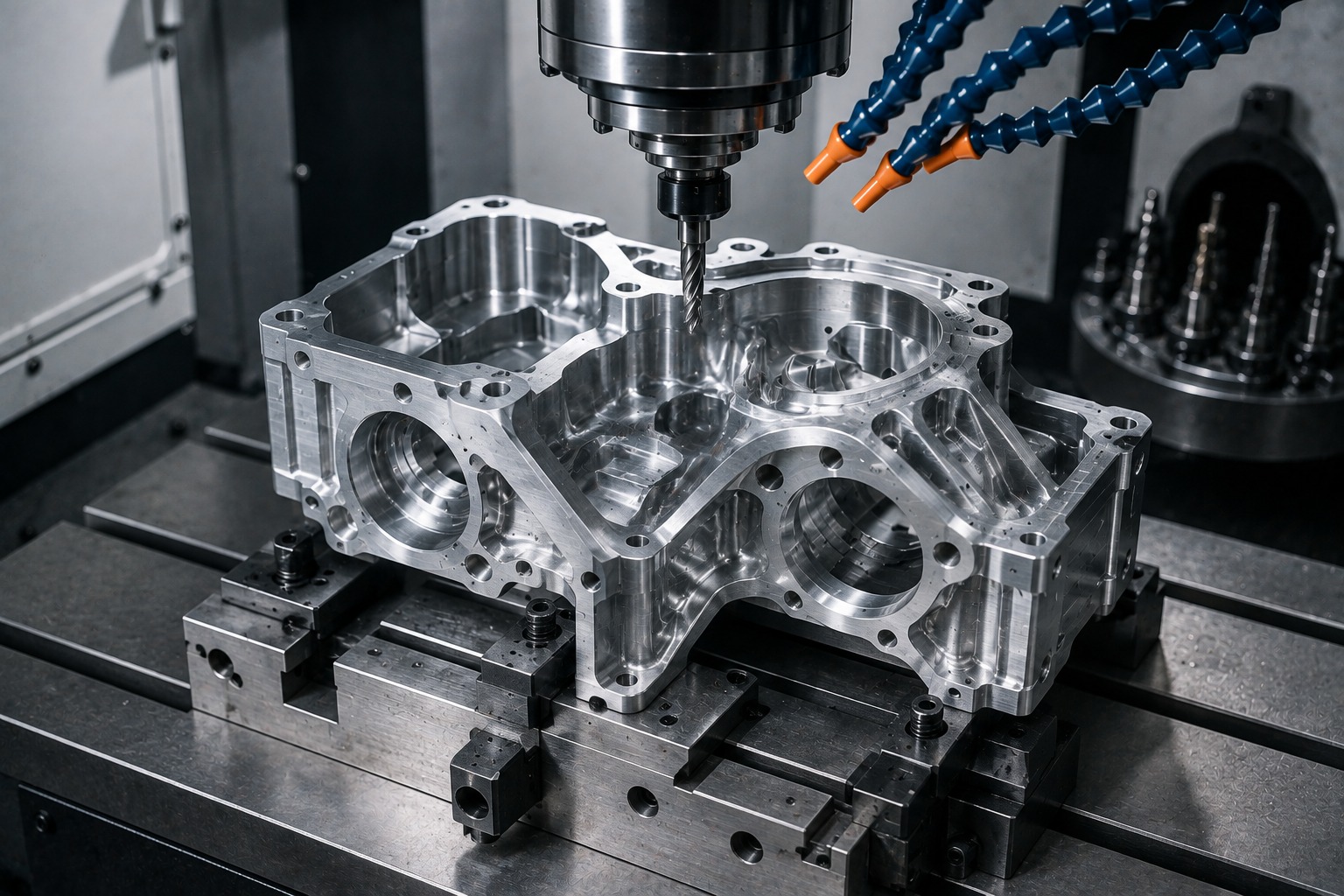
CNC machining for complex parts provides manufacturers with a flexible solution for producing these components accurately and consistently. By combining advanced CNC equipment, appropriate tooling, CAM programming, workholding, and careful inspection, manufacturers can produce complex components for demanding applications.
At Polymach365 , we provide CNC milling, CNC turning, 3-axis, 4-axis, and 5-axis machining, prototype manufacturing, low-volume production, custom CNC machining, and precision machined components. Therefore, choosing the right machining strategy from the beginning can help improve part quality while controlling production time and costs.
What Are Complex CNC Machined Parts?
Complex CNC machined parts contain geometries or manufacturing requirements that are more difficult to produce than conventional components.
These parts may include:
- Deep cavities
- Angled surfaces
- Complex contours
- Thin walls
- Small holes
- Tight tolerances
- Multiple machining faces
- Internal features
- Curved surfaces
- Difficult-to-reach areas
- Complex 3D profiles
For example, an aerospace component may contain several angled surfaces and curved profiles, while a mold component may require precise cavities, inserts, and fine details.
Therefore, complex machining requires careful coordination between part design, CNC programming, tooling, workholding, machining parameters, and inspection .
Why Is Complex CNC Machining Challenging?
Several factors can make complex components difficult to manufacture.
1. Multiple Machining Setups
A complex component may require access to several surfaces.
With a conventional setup, the operator may need to reposition the workpiece multiple times.
Every additional setup can introduce:
- Alignment errors
- Additional setup time
- Positioning variation
- Increased labor
- Longer production times
Therefore, reducing unnecessary setups can improve both efficiency and consistency.
Manufacturing Solution
Multi-axis CNC machining can provide access to multiple surfaces without requiring as many repositioning operations.
As a result, suitable 4-axis and 5-axis machining strategies can simplify the production of certain complex components.
2. Difficult-to-Reach Features
Deep cavities, internal pockets, and angled surfaces can make tool access difficult.
A conventional cutting tool may not reach the required feature effectively.
Using an excessively long tool can also increase:
- Tool deflection
- Vibration
- Chatter
- Dimensional variation
- Tool wear
Therefore, tool selection should be considered during the design and programming stages.
Manufacturing Solution
Manufacturers can select appropriate tool lengths, diameters, holders, and machining orientations.
Furthermore, 5-axis machining can position the cutting tool at suitable angles for certain difficult-to-reach features.
3. Tight Machining Tolerances
Some complex parts require very precise dimensions.
However, maintaining tight tolerances across multiple features can become challenging because machining accuracy can be affected by:
- Machine condition
- Tool wear
- Material movement
- Temperature
- Workholding
- Tool deflection
- Machining parameters
Therefore, manufacturers should identify critical tolerances before production begins.
Manufacturing Solution
A suitable process may include:
CAD Review → DFM Analysis → CNC Programming → Controlled Machining → Inspection
Consequently, manufacturers can focus quality-control efforts on the features that directly affect component performance.
4. Tool Deflection
Tool deflection occurs when cutting forces cause the cutting tool to bend slightly during machining.
This problem can become more noticeable when machining:
- Deep pockets
- Thin walls
- Hard materials
- Narrow features
- Long-reach geometries
As a result, the finished feature may not match the intended CAD geometry precisely.
Manufacturing Solution
Manufacturers can reduce the risk of deflection by using:
- Appropriate tool diameters
- Shorter tools where possible
- Suitable cutting parameters
- Multiple machining passes
- Appropriate toolpaths
Therefore, a well-planned machining strategy can improve dimensional consistency.
5. Thin Walls and Delicate Features
Thin walls can deform under machining forces.
Similarly, small ribs and delicate features can become damaged during aggressive material removal.
Therefore, complex designs should consider the relationship between wall thickness and machining forces.
Manufacturing Solution
A manufacturer can use multiple lighter passes rather than removing large amounts of material in a single operation.
Furthermore, suitable workloads can provide additional stability.
As a result, the manufacturer can reduce deformation while maintaining the required geometry.
6. Complex Internal Cavities
Internal cavities can be difficult because cutting tools may have limited access.
Deep cavities can also create problems with:
- Chip evacuation
- Coolant access
- Tool deflection
- Heat generation
- Visibility
Therefore, internal geometry should be designed with manufacturing ability in mind.
Manufacturing Solution
Appropriate tool selection, machining orientation, chip evacuation, and staged roughing and finishing operations can improve cavity machining.
Consequently, manufacturers can produce deeper and more detailed features more efficiently.
7. Surface Finish Requirements
Complex parts may contain surfaces that require specific finishes.
However, difficult tool access can make consistent finishing challenging.
Surface quality can be influenced by:
- Tool condition
- Feed rate
- Spindle speed
- Toolpath
- Material
- Machine rigidity
- Tool geometry
Therefore, finishing operations should be planned separately from aggressive roughing operations.
Manufacturing Solution
A typical approach is:
Roughing → Semi-Finishing → Finishing → Inspection
This strategy allows manufacturers to remove material efficiently first and then focus on achieving the required surface condition.
8. Material Selection
The material can significantly affect machining difficulty.
For example, aluminum is generally easier to machine than many harder alloys, while titanium and some hardened steels may require more specialized machining strategies.
Common materials for complex CNC components include:
- Aluminum
- Stainless steel
- Carbon steel
- Tool steel
- Brass
- Copper
- Titanium
- Engineering plastics
Therefore, material selection should consider both the component’s performance requirements and its machinability.
9. Complex CAD Geometry
A highly detailed CAD model does not automatically mean that the component can be manufactured efficiently.
Designs may contain features that are:
- Too deep
- Too narrow
- Too small
- Difficult to access
- Expensive to machine
Therefore, engineers should review manufacturing ability before releasing the design for production.
Manufacturing Solution
Design for Manufacture (DFM) can identify potential machining problems before production.
A DFM review may evaluate:
- Tool accessibility
- Internal radii
- Wall thickness
- Hole sizes
- Tolerances
- Setup requirements
- Material
- Machining orientation
Consequently, early design improvements can reduce manufacturing difficulties later.
10. 5-Axis CNC Machining for Complex Parts
5-axis machining is particularly useful when a component contains multiple surfaces, angled features, and complex contours.
Unlike conventional 3-axis machining, 5-axis equipment can provide additional movement between the cutting tool and workpiece.
This can be useful for:
- Complex aerospace components
- Mold components
- Turbine-related geometries
- Medical components
- Robotics components
- Specialized industrial parts
- Complex tooling
Therefore, 5-axis machining can reduce the number of setups required for suitable components.
However, not every complex component requires 5-axis machining. The appropriate process depends on the actual geometry, tolerances, production quantity, and manufacturing requirements.
CNC Milling for Complex Components
CNC milling remains one of the most widely used processes for complex components.
It can produce:
- Pockets
- Slots
- Holes
- Contours
- Mounting features
- Curved surfaces
- Complex profiles
Furthermore, 3-axis, 4-axis, and 5-axis milling can be selected according to the component’s geometry.
Therefore, the machining strategy should match the complexity of the part rather than automatically choosing the most advanced machine.
CNC Turning for Complex Rotational Parts
Complex rotational components can often be manufactured using CNC turning.
Examples include:
- Shafts
- Bushings
- Sleeves
- Pins
- Rollers
- Couplings
- Threaded components
For components that combine rotational and milled features, manufacturers may use suitable mill-turn or combined machining approaches.
Consequently, combining machining processes can reduce unnecessary handling for certain component designs.
How CAM Programming Supports Complex Machining
CAM software plays an important role in complex CNC machining.
It helps generate toolpaths based on the CAD model and selected machining strategy.
CAM programming can control:
- Tool movement
- Cutting direction
- Machining sequence
- Feed rates
- Spindle speeds
- Tool changes
- Multi-axis movements
Before machining begins, toolpaths can also be evaluated to identify potential collisions or other programming problems.
Therefore, effective CAM programming can improve machining efficiency and reduce manufacturing risks.
Quality Control for Complex CNC Parts
Complex components require appropriate inspection because many features may interact with each other.
Inspection may include:
- Dimensional measurement
- Hole location checks
- Surface inspection
- Geometric measurement
- Tolerance verification
- Surface roughness measurement
For highly complex components, advanced inspection equipment such as a Coordinate Measuring Machine (CMM) may be appropriate.
Therefore, inspection should be planned alongside machining rather than treated as an afterthought.
CNC Machining Complex Parts for Prototypes
Complex CNC machining is particularly useful during product development.
A functional prototype allows engineers to test:
- Fit
- Assembly
- Geometry
- Performance
- Strength
- Clearances
- Surface finish
A typical development workflow is:
CAD Design → DFM Review → Prototype Machining → Testing → Design Improvement → Production
As a result, manufacturers can identify potential design issues before committing to larger production quantities.
Applications of Complex CNC Machining
Complex CNC machining supports many industries.
Aerospace
Aerospace components may require lightweight materials, complex profiles, and controlled tolerances.
Automotive
CNC machining can produce custom components, tooling, fixtures, and prototype parts.
Medical
Precision components may require complex geometries and carefully controlled manufacturing processes.
Robotics and Automation
Robotic systems often require custom brackets, mounts, shafts, and specialized components.
Industrial Machinery
Complex machine components can be manufactured according to specific equipment requirements.
Mold and Tooling
Mold components often contain cavities, inserts, angled surfaces, and precision features that require carefully planned machining.
Consequently, complex CNC machining can support a broad range of advanced manufacturing applications.
How to Improve Complex CNC Machining Results
Manufacturers can improve results by following several practices.
Start With Manufactured Design
Review the CAD model before production.
Use Appropriate Tolerances
Specify tight tolerances only where function requires them.
Choose the Right Machine
Match the machining technology to the component’s geometry.
Select Suitable Tooling
Choose tools based on material, depth, feature size, and required finish.
Minimize Setups
Reduces unnecessary repositioning when practical.
Monitor Tool Wear
Replace tools before excessive wear affects part quality.
Plan Inspection
Identify critical features and appropriate measurement methods before machining.
Therefore, a complete manufacturing strategy can improve both quality and production efficiency.
Why Choose Polymach365 for Complex CNC Machining?
At Polymach365 , we provide digital manufacturing solutions for complex components, prototypes, custom parts, mold components, and production requirements.
Our CNC capabilities include:
- CNC Milling
- CNC Turning
- 3-Axis CNC Machining
- 4-Axis CNC Machining
- 5-Axis CNC Machining
- Prototype Manufacturing
- Low-Volume Production
- Custom CNC Machining
- Precision Machined Components
- Mold Components
Digital Manufacturing Workflow
Upload CAD File → Manufacturing Review → Quote → CNC Machining → Quality Inspection → Delivery
Therefore, customers can provide their CAD model together with the required material, quantity, tolerances, surface finish, and other specifications .
This information helps determine the most appropriate manufacturing approach
Final Thoughts
CNC machining for complex parts requires careful planning fromDeep
However, manufacturers can address these challenges through DFM analysis, appropriate tooling, multi-axis machining, effective CAM programming, controlled machining parameters, suitable workholding, and thorough.
Most importantly, the best machining solution depends on the specific component. A 5-axis machine may be ideal for one geometry, while a carefully planned 3-axis or 4-axis process may be more efficient for another.
Whether you need a co, Polymach365 provides CNC milling, CNC turning, multi-axis machining, and digital manufacturing solutions.
Start Your Complex CNC Machining Project
Have a complex component ready for manufacturing?
Upload your CAD file and provide your material, quantity, tolerance