Reliable Custom Manufacturing for Replacement Components
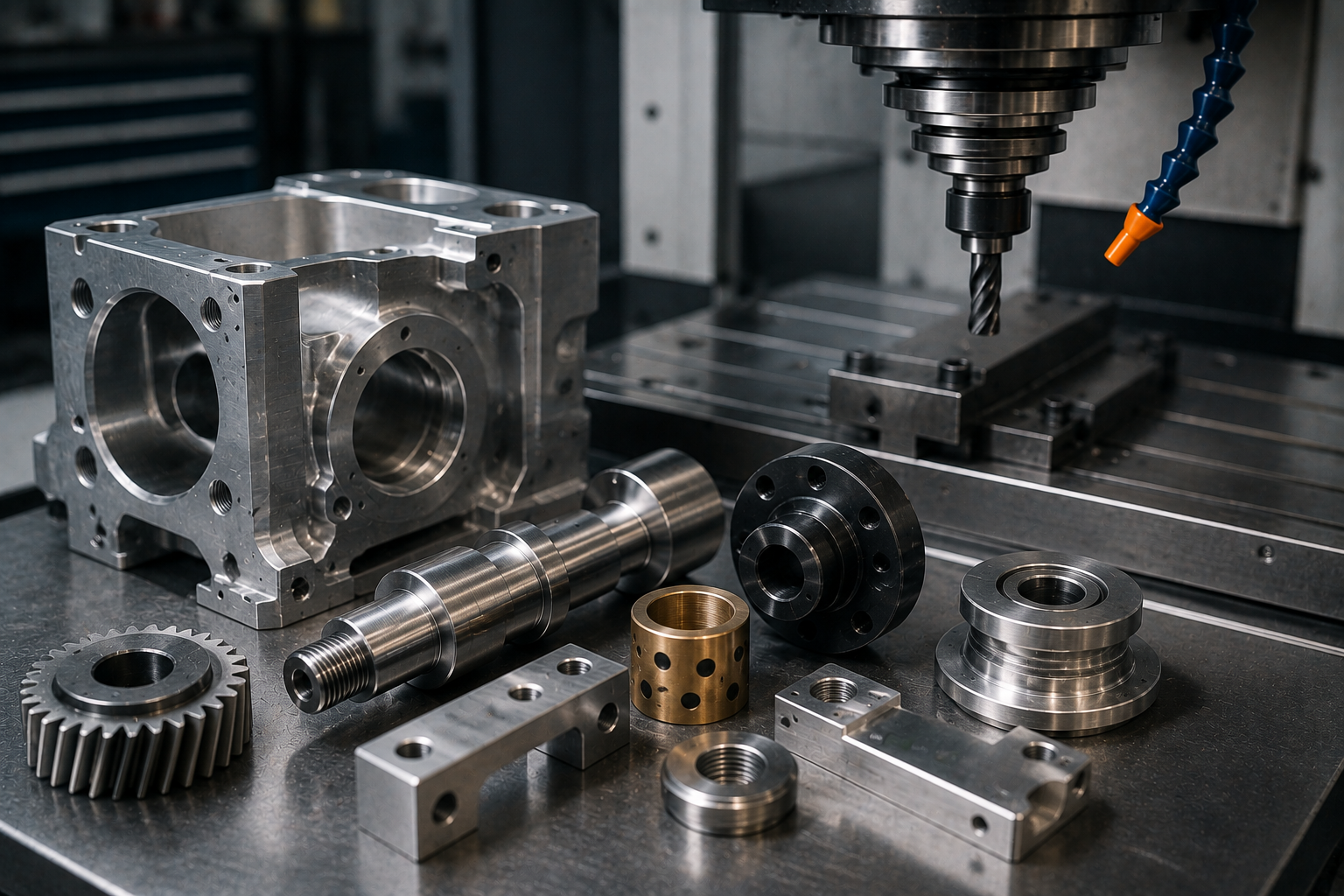
When an essential machine component fails, finding the correct replacement part quickly can be challenging. Original components may be discontinued, unavailable, difficult to source, or subject to long lead times. CNC machining for replacement parts provides manufacturers and maintenance teams with a flexible way to produce custom components according to specific dimensions and application requirements.
Instead of waiting for a standard replacement to become available, businesses can manufacture a component from a CAD model, engineering drawing, existing sample, or measured specifications, depending on the project requirements.
At Polymach365, we provide CNC milling, CNC turning, 3-axis, 4-axis, and 5-axis machining, prototype manufacturing, low-volume production, custom CNC parts, and precision machining solutions. These capabilities can support replacement-part requirements across industrial machinery, automation, automotive, tooling, and other applications.
What Are CNC Replacement Parts?
CNC replacement parts are custom-machined components manufactured to replace an original or damaged component.
These parts may be required when the original component is:
- Worn out
- Damaged
- Discontinued
- Difficult to source
- No longer supported
- Available only with long lead times
- No longer manufactured
Therefore, CNC machining can provide an alternative manufacturing route for components that are not readily available through conventional suppliers.
Common CNC replacement parts include:
- Shafts
- Bushings
- Pins
- Brackets
- Housings
- Couplings
- Spacers
- Mounting plates
- Rollers
- Fixtures
- Machine components
- Custom tooling
Why Use CNC Machining for Replacement Parts?
CNC machining provides several advantages when a replacement component needs to match an existing part.
1. Manufacture Parts to Specific Dimensions
Replacement components often need to fit directly into an existing assembly.
Therefore, dimensional accuracy is particularly important.
CNC machining can manufacture features such as:
- Precise holes
- Shafts
- Threads
- Slots
- Pockets
- Mounting surfaces
- Cylindrical features
As a result, manufacturers can produce replacement components according to defined engineering specifications.
2. Reduce Equipment Downtime
Unexpected component failure can interrupt production.
When a critical part is unavailable, equipment may remain inactive until a replacement arrives.
CNC machining can provide a manufacturing option for certain custom replacement components, helping businesses address urgent requirements more efficiently.
However, actual production and delivery times depend on factors such as:
- Part complexity
- Material availability
- Quantity
- Tolerances
- Finishing requirements
- Machine availability
Therefore, providing complete technical information early can help streamline the manufacturing process.
3. Manufacture Discontinued Components
Older machinery may use components that are no longer produced by the original manufacturer.
Replacing the entire machine simply because one component is unavailable may not be practical.
Instead, a replacement component can potentially be manufactured based on available technical information.
This may include:
- Original CAD files
- Engineering drawings
- Technical specifications
- Existing samples
- Measured dimensions
Consequently, CNC machining can help extend the useful life of older equipment when suitable replacement manufacturing is technically feasible.
4. Support One-Off and Low-Volume Requirements
Replacement parts are often needed in very small quantities.
For example, a business may require only:
- One shaft
- Two bushings
- A replacement bracket
- A small batch of machine components
CNC machining can support one-off and low-volume manufacturing without requiring large production quantities.
Therefore, it can be particularly useful for specialized or infrequently replaced components.
5. Manufacture Custom Components
Not every replacement component has a standard equivalent.
Some machines use custom-designed parts that cannot be purchased from regular component suppliers.
CNC machining allows manufacturers to reproduce components according to specific requirements.
Therefore, custom machining can support replacement parts with:
- Unique dimensions
- Custom mounting patterns
- Special holes
- Complex profiles
- Specific materials
- Tight tolerances
CNC Milling for Replacement Parts
CNC milling is suitable for replacement components with flat surfaces, pockets, holes, slots, and complex profiles.
Common replacement milled parts include:
- Brackets
- Mounting plates
- Machine housings
- Fixtures
- Covers
- Tooling components
- Custom mechanical parts
Furthermore, 4-axis and 5-axis machining can provide access to multiple surfaces when a replacement component has more complex geometry.
CNC Turning for Replacement Parts
CNC turning is particularly suitable for rotational replacement components.
Typical examples include:
- Shafts
- Bushings
- Pins
- Rollers
- Sleeves
- Spacers
- Couplings
- Threaded components
Because the workpiece rotates during machining, CNC turning can produce consistent cylindrical features and diameters.
Consequently, it can be an effective manufacturing method for many mechanical replacement components.
5-Axis CNC Machining for Complex Replacement Components
Some replacement parts have features across multiple surfaces or contain difficult-to-access geometry.
In suitable applications, 5-axis CNC machining can provide greater flexibility for these components.
It can be useful for:
- Complex contours
- Angled surfaces
- Deep cavities
- Multi-sided components
- Specialized tooling
- Complex machine components
Therefore, selecting the appropriate machining process is important when reproducing complex replacement parts.
Materials for CNC Replacement Parts
The replacement material should be selected according to the original component’s function and operating environment.
Common CNC machining materials include:
Aluminum
Aluminum provides low weight and good machinability. Therefore, it can be suitable for lightweight brackets, housings, fixtures, and machine components.
Stainless Steel
Stainless steel offers strength and corrosion resistance. Consequently, it can be useful for components operating in demanding environments.
Carbon Steel
Carbon steel provides strength and durability for many industrial applications.
Brass
Brass offers good machinability and corrosion resistance, making it suitable for fittings, bushings, connectors, and other components.
Copper
Copper is useful when electrical or thermal conductivity is important.
Titanium
Titanium provides a high strength-to-weight ratio and corrosion resistance, although it requires appropriate machining strategies.
Engineering Plastics
Materials such as ABS, Nylon, Delrin, Polycarbonate, PEEK, and PTFE can be considered when low weight, electrical insulation, chemical resistance, or low friction is required.
Therefore, material selection should always consider the component’s original function and operating conditions.
How to Manufacture a CNC Replacement Part
A typical replacement-part workflow can include several stages.
Step 1: Identify the Failed Component
Determine the component’s function and how it interacts with the surrounding assembly.
Step 2: Collect Technical Information
Provide an available:
- CAD file
- Engineering drawing
- Dimensions
- Material specification
- Existing component
- Photographs
- Technical requirements
The more complete the information, the easier it is to establish the manufacturing requirements.
Step 3: Review the Design
The component can be evaluated for:
- Manufacturability
- Tolerances
- Material
- Tool access
- Workholding
- Machining process
Step 4: Select the CNC Process
Depending on the geometry, manufacturers may use CNC milling, CNC turning, or multi-axis machining.
Step 5: Machine the Component
The selected material is machined according to the approved design and manufacturing requirements.
Step 6: Inspect the Finished Part
Critical dimensions and features can be checked against the applicable specifications.
Therefore, a structured workflow helps ensure that the replacement component is manufactured according to the required specifications.
Benefits of CNC Machined Replacement Parts
CNC machining can provide several benefits for replacement-component manufacturing.
Faster Response to Custom Requirements
Manufacturers can work from digital designs and technical specifications rather than depending exclusively on standard catalog components.
Design Flexibility
Replacement components can be manufactured according to specific dimensions.
Low-Volume Capability
CNC machining can support small quantities and one-off components.
Material Flexibility
Different metals and engineering plastics can be selected according to the application.
Complex Geometry
Multi-axis CNC machining can support complex replacement components.
Repeatability
Once the manufacturing process is established, additional replacement parts can be produced using the same digital design.
Equipment Life Extension
Manufacturing replacement components can help maintain older equipment when suitable parts are no longer readily available.
Consequently, CNC machining can provide a flexible approach to replacement-part manufacturing.
CNC Replacement Parts for Industrial Machinery
Industrial machinery frequently relies on components that experience wear over time.
Examples include:
- Shafts
- Bushings
- Rollers
- Couplings
- Brackets
- Mounting components
- Machine housings
- Fixtures
When these components fail, replacement availability can directly affect equipment operation.
Therefore, CNC machining can be considered when a custom replacement component needs to be manufactured according to engineering requirements.
CNC Replacement Parts for Automation Equipment
Automation systems often contain custom brackets, mounts, shafts, fixtures, and mechanical components.
If one component fails, replacing the entire system may not be necessary.
Instead, a suitable replacement component can potentially be manufactured according to the original design.
As a result, CNC machining can support maintenance and repair requirements for automation equipment.
CNC Replacement Parts for Automotive Applications
Automotive equipment and manufacturing systems can require specialized replacement components.
These may include:
- Brackets
- Shafts
- Bushings
- Fixtures
- Mounting components
- Custom tooling
Therefore, CNC machining can provide flexibility when a specific replacement component is unavailable or requires customization.
CNC Replacement Parts for Tooling and Molds
Tooling and molding equipment often contains precision components that experience repeated mechanical and thermal loads.
Replacement requirements may include:
- Mold inserts
- Plates
- Pins
- Bushings
- Fixtures
- Custom tooling components
Consequently, CNC machining can support maintenance and replacement requirements for tooling and mold-related applications.
How to Reduce Replacement-Part Manufacturing Costs
Several design and planning decisions can help control CNC replacement-part costs.
Provide Accurate Technical Information
Complete drawings or CAD files can reduce unnecessary design clarification.
Use Practical Tolerances
Apply tight tolerances only to features where they are functionally necessary.
Select Appropriate Materials
Choose a material that meets the application’s requirements without unnecessary specification.
Avoid Unnecessary Complexity
Simpler geometries can reduce machining time and tooling requirements.
Combine Replacement Quantities
If multiple identical parts are likely to be required, producing them together may improve manufacturing efficiency.
Therefore, planning ahead can be useful for frequently replaced components.
At Polymach365, we provide CNC manufacturing solutions for custom components, prototypes, replacement parts, tooling, and production requirements.
Our capabilities include:
- CNC Milling
- CNC Turning
- 3-Axis CNC Machining
- 4-Axis CNC Machining
- 5-Axis CNC Machining
- Prototype Manufacturing
- Low-Volume Production
- Custom CNC Machining
- Precision Machined Components
- Mold Components
CAD File / Technical Information → Manufacturing Review → Quote → CNC Machining → Quality Inspection → Finished Replacement Part
Therefore, you can provide your existing design information and manufacturing requirements to begin the replacement-part process.
Final Thoughts
CNC machining for replacement parts provides manufacturers with a flexible way to reproduce custom components when original parts are damaged, discontinued, unavailable, or difficult to source.
From simple bushings and shafts to complex multi-axis components, CNC machining can support a wide range of replacement requirements.
The right combination of CAD data, material selection, machining process, tolerances, inspection, and manufacturing planning can help produce replacement components that meet the required specifications.
Whether you need one replacement component, a small batch, a custom machine part, or recurring replacement components, Polymach365 provides CNC milling, CNC turning, multi-axis machining, prototype manufacturing, and custom machining solutions.
Have an existing component or CAD design that needs to be reproduced?
Upload your CAD file or provide the available technical information, along with your material, quantity, tolerance, and finishing requirements, to start your replacement-part manufacturing project with Polymach365.