
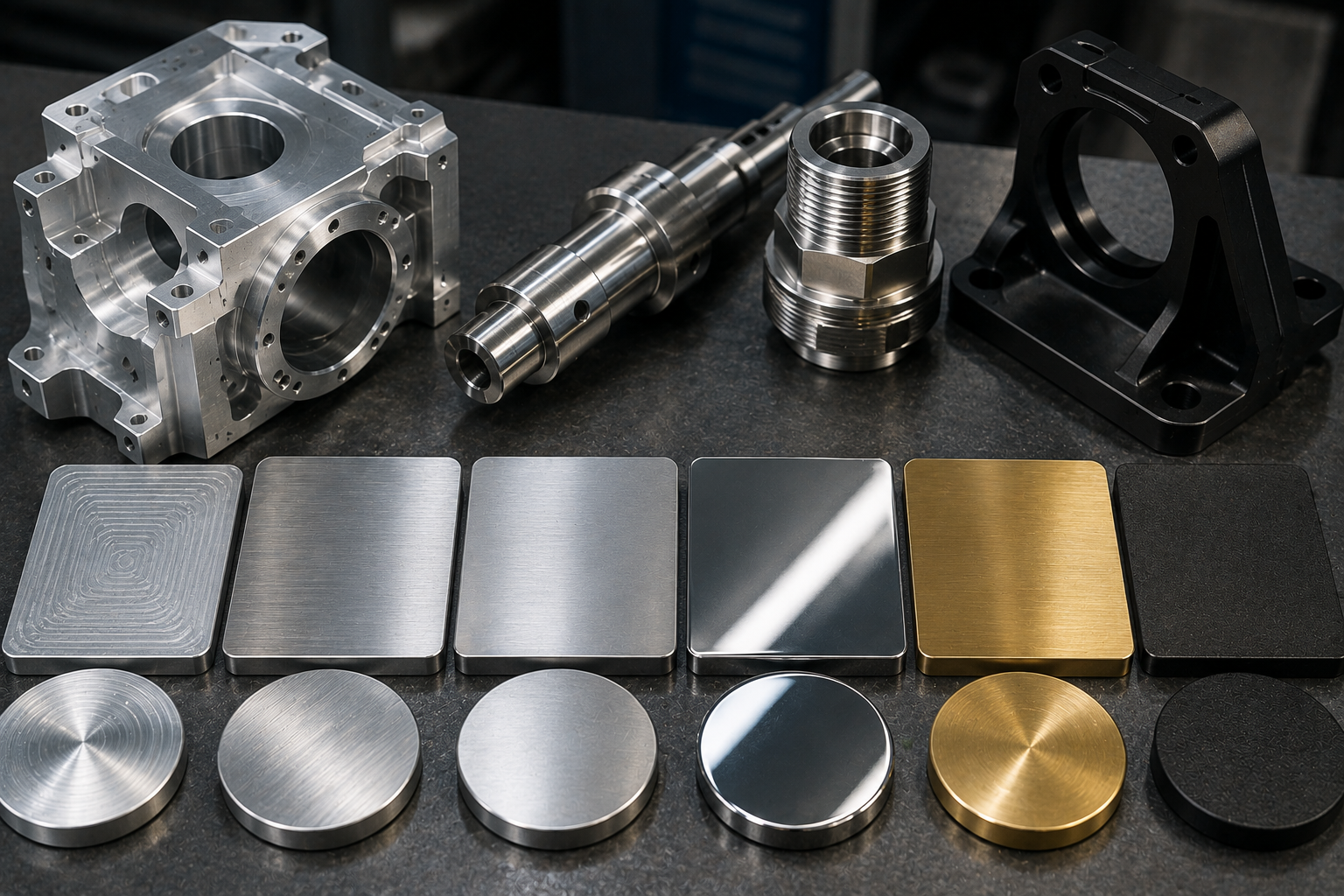
A Complete Guide to Choosing the Right Surface Finish for CNC Machined Parts
Surface finish is an important part of CNC machining because it affects the appearance, functionality, durability, friction, corrosion resistance, and overall performance of a machined component. A part may have accurate dimensions, but the wrong surface finish can still affect how it performs in an assembly or operating environment.
Therefore, choosing the right CNC machining surface finish should be considered during the design and manufacturing stages.
At Polymach365, we provide CNC milling, CNC turning, 3-axis, 4-axis, and 5-axis machining, prototype manufacturing, low-volume production, custom CNC machining, and precision machined components. Understanding different surface finish options can help engineers select the most suitable solution for their parts.
What Is CNC Machining Surface Finish?
CNC machining surface finish refers to the texture and condition of a component’s surface after machining and any additional finishing processes.
The final surface can be influenced by:
- Cutting tool condition
- Feed rate
- Spindle speed
- Material
- Toolpath
- Depth of cut
- Machining process
- Tool geometry
- Finishing operations
Surface finish is commonly described using surface roughness, often represented by parameters such as Ra (average surface roughness).
However, surface roughness is only one aspect of surface quality. Depending on the application, manufacturers may also consider appearance, coating, hardness, corrosion resistance, and wear resistance.
Why Does Surface Finish Matter in CNC Machining?
The required finish depends on how the component will be used.
A surface finish can influence:
Appearance
Visible components may require a smoother and more uniform appearance.
Friction
Moving components may require a suitable surface texture to control friction and wear.
Corrosion Resistance
Some finishing processes can provide additional protection against environmental exposure.
Wear Resistance
Components exposed to repeated movement or contact may benefit from appropriate finishing treatments.
Assembly
Mating surfaces may require controlled surface characteristics for proper fitting and operation.
Sealing
Certain sealing surfaces require appropriate roughness to support reliable contact.
Therefore, surface finish should be selected according to the function of the component rather than simply choosing the smoothest possible option.
CNC Machining Surface Finish Options
There are several ways to achieve the desired surface condition.
1. As-Machined Finish
An as-machined finish is the surface produced directly by the CNC machining process without an additional cosmetic finishing operation.
The final appearance depends on:
- Cutting tool
- Feed rate
- Material
- Machining strategy
- Toolpath
- Machine condition
Therefore, as-machined finishing can be a practical choice when appearance is not the primary concern.
Common Applications
- Internal machine components
- Fixtures
- Structural parts
- Functional prototypes
- Hidden components
Moreover, avoiding unnecessary finishing can help control manufacturing costs.
2. Smooth CNC Machined Finish
A finishing pass can improve the surface quality of a CNC machined component.
Manufacturers may adjust:
- Feed rate
- Cutting depth
- Toolpath
- Tool geometry
- Cutting speed
A suitable finishing operation can reduce visible tool marks and improve surface consistency.
Therefore, a smoother machined finish may be appropriate for components where surface quality is important but additional coating is unnecessary.
3. Polishing
Polishing removes or reduces surface imperfections to create a smoother and more refined appearance.
It can be used when the component requires:
- Smooth surfaces
- Improved appearance
- Reduced surface roughness
- Decorative finishing
Polishing can be applied to suitable metals and other materials depending on their properties.
Consequently, polished CNC components are often selected for visible or presentation-focused applications.
4. Brushing
Brushing creates a consistent directional texture across the surface.
It is commonly used when manufacturers want a uniform appearance without creating a highly reflective polished surface.
Brushed finishes can be useful for:
- Enclosures
- Consumer products
- Panels
- Visible machine components
Therefore, brushing can combine functional surface treatment with an attractive appearance.
5. Anodizing
Anodizing is commonly used for aluminum components.
It can improve:
- Surface durability
- Corrosion resistance
- Appearance
- Surface hardness
Anodized aluminum is widely used in applications where both appearance and surface protection are important.
Common applications include:
- Electronic housings
- Automotive components
- Aerospace parts
- Consumer products
- Machine components
Therefore, anodizing can be a useful finishing option for CNC-machined aluminum parts.
6. Powder Coating
Powder coating applies a protective coating to the component’s surface.
It can provide:
- Corrosion protection
- Surface durability
- Color options
- Improved appearance
Therefore, powder coating can be useful for components that require a durable external coating.
However, designers should consider coating thickness when specifying critical dimensions or mating surfaces.
7. Plating
Plating deposits a layer of another material onto the surface of a component.
Depending on the application, plating can improve:
- Corrosion resistance
- Wear resistance
- Electrical properties
- Surface appearance
Therefore, plating can be considered when the component requires properties beyond those provided by the base material.
8. Heat Treatment
Heat treatment changes the properties of suitable metal components through controlled heating and cooling.
Depending on the material and process, heat treatment can improve:
- Hardness
- Strength
- Wear resistance
- Dimensional stability
Therefore, heat treatment may be appropriate for CNC components exposed to demanding mechanical conditions.
CNC Surface Finish for Different Materials
Different materials respond differently to machining and finishing processes.
Aluminum
Aluminum is highly machinable and supports several finishing options, including:
- As-machined
- Anodizing
- Polishing
- Brushing
- Powder coating
Therefore, aluminum provides considerable flexibility when appearance and corrosion resistance are important.
Stainless Steel
Stainless steel can be machined and subsequently finished using processes such as:
- Polishing
- Brushing
- Passivation
- Other application-specific treatments
Therefore, stainless steel can provide both functional performance and a wide range of appearance options.
Brass
Brass can provide an attractive natural appearance and can also be polished or otherwise finished depending on the application.
It is commonly considered for:
- Fittings
- Decorative components
- Connectors
- Precision mechanical parts
Titanium
Titanium may require specialized finishing depending on the intended application.
Because titanium is often selected for demanding environments, the finishing process should be compatible with the component’s mechanical and environmental requirements.
Surface Finish in CNC Milling
CNC milling can produce different surface characteristics depending on the machining strategy.
Surface quality can be affected by:
- Cutter selection
- Tool diameter
- Toolpath direction
- Stepover
- Feed rate
- Spindle speed
- Finishing passes
For example, a roughing operation prioritizes material removal, while a finishing operation focuses more heavily on dimensional accuracy and surface quality.
Therefore, complex components may require separate roughing and finishing strategies.
Surface Finish in CNC Turning
CNC turning is commonly used for cylindrical components such as:
- Shafts
- Pins
- Bushings
- Sleeves
- Spacers
- Rollers
Surface finish in turning can depend on:
- Feed rate
- Cutting speed
- Tool geometry
- Tool condition
- Workpiece material
- Machine rigidity
Consequently, controlling these factors can help achieve consistent cylindrical surface quality.
Factors That Affect CNC Machining Surface Finish
1. Cutting Tool Condition
A worn tool can produce poor surface quality and visible machining marks.
Therefore, tools should be monitored and replaced when necessary.
2. Feed Rate
Excessive feed rates can increase visible tool marks and surface roughness.
Consequently, the feed rate should be selected according to the material, tool, and required finish.
3. Spindle Speed
Spindle speed influences cutting conditions, heat generation, and surface quality.
Therefore, it should be balanced with feed rate and tooling.
4. Tool Geometry
The cutting edge, tool diameter, and tool type can affect the resulting surface.
5. Machine Rigidity
Vibration and machine movement can create unwanted patterns and roughness.
Therefore, stable workholding and machine conditions are important.
6. Material Properties
Hardness, toughness, thermal behavior, and machinability can influence the final surface.
7. Coolant and Lubrication
Appropriate coolant or lubrication can help manage heat and cutting conditions where required.
As a result, surface finish should be treated as a combination of machining parameters rather than a single machine setting.
How to Choose the Right CNC Surface Finish
Before specifying a surface finish, consider the function of the component.
Ask These Questions:
Does the part need a specific appearance?
If yes, consider polishing, brushing, anodizing, or another suitable finishing process.
Will the part experience friction or wear?
If yes, consider the surface requirements of the mating components and operating conditions.
Will the component be exposed to moisture or chemicals?
If yes, corrosion or chemical resistance may become important.
Does the component contain mating or sealing surfaces?
If yes, specify appropriate surface requirements for those critical areas.
Are tight dimensional tolerances required?
If yes, consider how additional coatings or finishing processes could affect dimensions.
Therefore, specifying the finish based on the component’s function can prevent unnecessary manufacturing costs.
Surface Finish and CNC Machining Cost
A smoother or specialized surface finish can increase manufacturing cost.
Additional finishing may require:
- Extra machining operations
- Longer production time
- Additional equipment
- Additional inspection
- Coating or treatment
- Secondary processing
Therefore, specifying an unnecessarily smooth finish across the entire component can increase costs without providing functional benefits.
A better approach is to specify tighter surface requirements only where they are actually needed.
For example, a sealing surface may require a different finish from a non-functional external surface.
Consequently, selective finishing can provide a balance between performance and manufacturing cost.
Surface Finish for CNC Prototypes
Prototype components do not always require the same finishing process as production parts.
However, if the prototype is being tested for:
- Assembly
- Friction
- Sealing
- Wear
- Appearance
- Functional performance
then the surface finish should represent the intended production condition as closely as practical.
Therefore, engineers should determine whether the prototype needs functional or cosmetic finishing before manufacturing.
Surface Finish for Production Components
Production parts require consistent surface quality from batch to batch.
Therefore, manufacturers should establish clear specifications for:
- Surface roughness
- Finishing method
- Critical surfaces
- Coating requirements
- Inspection requirements
Clear specifications can reduce misunderstandings between design and manufacturing teams.
As a result, consistent surface-finish requirements can improve production repeatability.
Common CNC Surface Finish Problems
Manufacturers may encounter issues such as:
- Visible tool marks
- Chatter
- Scratches
- Uneven finishing
- Burrs
- Excessive roughness
- Coating inconsistencies
These problems can result from:
- Tool wear
- Incorrect cutting parameters
- Poor workholding
- Machine vibration
- Incorrect finishing methods
- Material characteristics
Therefore, identifying the root cause is important before changing the finishing process.
How Polymach365 Supports CNC Surface Finishing
At Polymach365, we provide CNC manufacturing solutions for prototypes, custom components, mold components, and production parts.
Our capabilities include:
- CNC Milling
- CNC Turning
- 3-Axis CNC Machining
- 4-Axis CNC Machining
- 5-Axis CNC Machining
- Prototype Manufacturing
- Low-Volume Production
- Custom CNC Machining
- Precision Machined Components
- Mold Components
Manufacturing Workflow
CAD File → Manufacturing Review → CNC Machining → Surface Finishing → Quality Inspection → Delivery
Therefore, customers can provide their CAD files along with the required material, quantity, tolerances, surface finish, and finishing specifications.
This information helps establish the appropriate machining and finishing approach for the component.
Final Thoughts
CNC machining surface finishes play an important role in the performance, appearance, durability, and cost of machined components.
The right finish depends on the component’s function, material, operating environment, dimensional requirements, and appearance expectations.
Common options include as-machined finishes, polished finishes, brushed finishes, anodizing, powder coating, plating, and heat treatment. However, not every component requires a specialized finish.
Therefore, engineers should specify the surface finish according to actual functional requirements and avoid unnecessarily strict specifications.
Whether you need a CNC prototype, custom metal component, precision machined part, mold component, or low-volume production run, Polymach365 can support your project with CNC milling, CNC turning, multi-axis machining, and digital manufacturing solutions.
Start Your CNC Machining Project
Have a CAD design ready?
Upload your CAD file and provide your material, quantity, tolerances, surface finish, and finishing requirements to start your CNC machining project with Polymach365.