
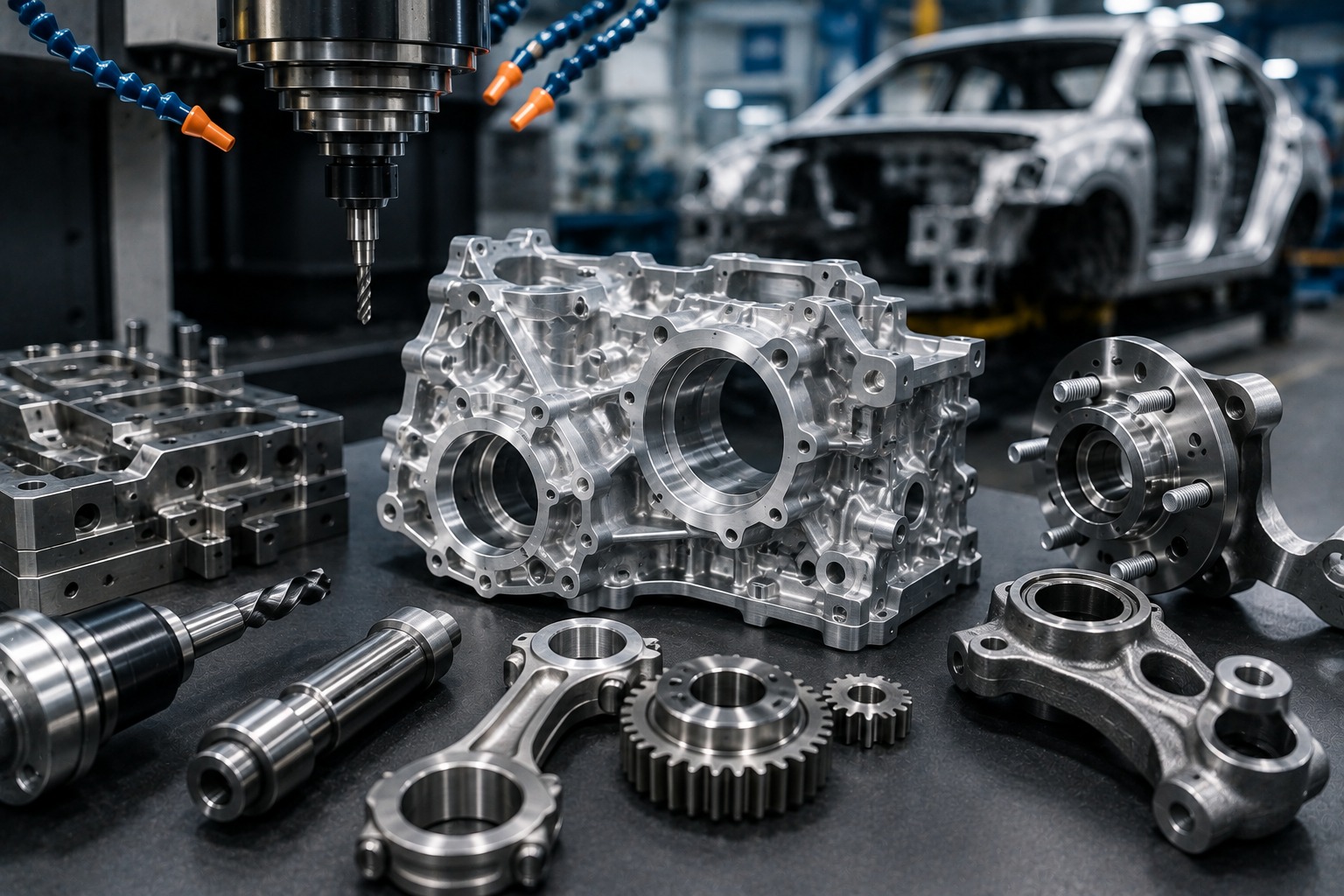
Precision CNC Manufacturing for Automotive Parts and Components
The automotive industry requires components that meet demanding requirements for accuracy, repeatability, durability, and consistent production quality . From engine and transmission components to brackets, shafts, fixtures, prototypes, and custom tooling, manufacturers need reliable processes that can produce parts according to precise engineering specifications.
CNC machining supports automotive component manufacturing by converting digital CAD designs into accurate physical parts using computer-controlled machining equipment. Depending on the component, manufacturers can use CNC milling, CNC turning, 3-axis, 4-axis, or 5-axis machining to produce complex geometries and precision features.
At Polymach365 , we provide CNC milling, CNC turning, multi-axis machining, prototype manufacturing, low-volume production, custom CNC machining, and precision machined components. Therefore, CNC machining can support automotive projects from initial prototypes through production requirements.
What Is CNC Machining in Automotive Manufacturing?
CNC machining uses computer-controlled equipment to remove material from a workpiece according to programmed toolpaths.
The process begins with a digital CAD model or engineering drawing. CAM software then converts the design into machining instructions that control the CNC machine.
A typical workflow is:
CAD Design → DFM Review → CAM Programming → CNC Machining → Inspection → Finishing → Finished Component
As a result, manufacturers can produce automotive components with repeatable dimensions and controlled machining processes.
Why Is CNC Machining Important for Automotive Parts?
Automotive components often contain features that require precise manufacturing.
These may include:
- Precision holes
- Shafts
- Threads
- Mounting surfaces
- Pockets
- Slots
- Curved profiles
- Complex contours
- Mating surfaces
Therefore, CNC machining can provide the flexibility required for manufacturing both simple and complex automotive components.
1.Supports Automotive Prototyping
Before a new automotive component enters production, engineers often need prototypes for testing and validation.
CNC machining can manufacture functional prototypes directly from CAD designs.
These prototypes can be used to evaluate:
- Fit
- Assembly
- Dimensions
- Clearances
- Strength
- Function
- Surface finish
Therefore, CNC machining can help engineers identify design problems before committing to larger production quantities.
A typical development process is:
CAD Design → CNC Prototype → Testing → Design Modification → Production
Consequently, manufacturers can improve designs before scaling production.
2. Produces Custom Automotive Components
Not every automotive component is a standard catalog item.
Manufacturers may require custom parts for:
- Vehicle development
- Motorsport
- Specialty vehicles
- Testing equipment
- Manufacturing machinery
- Restoration projects
- Automotive tooling
CNC machining allows components to be produced according to specific CAD models, drawings, dimensions, and material requirements.
As a result, manufacturers can produce parts that match the requirements of a particular vehicle or application.
3. CNC Milling for Automotive Components
CNC milling is suitable for many automotive components that require pockets, holes, slots, flat surfaces, and complex profiles.
Applications may include:
- Braces
- Mounting plates
- Housings
- Fixtures
- Engine-related components
- Tooling components
- Custom automotive parts
Furthermore, multi-axis milling can provide access to multiple surfaces when a component contains complex geometry.
Therefore, CNC milling provides considerable flexibility for automotive manufacturing.
4. CNC Turning for Automotive Parts
CNC turning is particularly useful for cylindrical automotive components.
Common examples include:
- Shafts
- Pins
- Bushings
- Spacers
- Sleeves
- Rollers
- Couplings
- Threaded components
During CNC turning, the workpiece rotates while the cutting tool removes material.
Consequently, turning can produce consistent cylindrical features and diameters for automotive applications.
5. 5-Axis CNC Machining for Complex Automotive Parts
Some automotive components contain complex surfaces and features across multiple sides.
5-axis machining can provide additional flexibility when manufacturing these geometries.
It can be useful for parts containing:
- Angled surfaces
- Complex contours
- Deep cavities
- Multi-sided features
- Difficult-to-access areas
Therefore, 5-axis machining can reduce the need for multiple setups for suitable component designs.
However, not every automotive part requires 5-axis machining. The appropriate process depends on the component’s geometry, tolerances, material, quantity, and production requirements.
6.Supports Low-Volume Automotive Production
Automotive manufacturing does not always involve large production quantities.
Engineers and specialty manufacturers may require small quantities for:
- Testing
- Validation
- Pilot production
- Replacement parts
- Engineering changes
- Specialty vehicles
CNC machining can support one-off components and small production batches.
Therefore, it can provide flexibility when high-volume manufacturing is unnecessary.
7.CNC Machining for Automotive Replacement Parts
Automotive machinery and production equipment require regular maintenance.
When a custom component becomes damaged or unavailable, manufacturers may need a replacement part.
CNC machining can produce suitable replacement components using available:
- CAD files
- Engineering drawings
- Measurements
- Existing part specifications
Common replacement components include:
- Shafts
- Bushings
- Braces
- Mounting components
- Fixtures
- Spacers
- Custom machine parts
As a result, CNC machining can provide a flexible manufacturing option for specialized replacement components.
8. Automotive Tooling and Fixtures
Automotive production depends heavily on tooling and fixtures.
These components help position, hold, inspect, and manufacture production parts.
CNC machining can produce:
- Assembly fixtures
- Inspection fixtures
- Drilling fixtures
- Jigs
- Mounting fixtures
- Custom tooling
- Production aids
Therefore, CNC machining can support not only automotive components but also the equipment used to manufacture them.
9. Material Options for Automotive CNC Parts
Material selection is an important consideration in automotive manufacturing.
Depending on the application, CNC-machined components may be manufactured from materials such as:
- Aluminum
- Stainless steel
- Carbon steel
- Tool steel
- Brass
- Copper
- Titanium
- Engineering plastics
Aluminum
Aluminum offers low weight and good machinability, making it suitable for many automotive components and prototypes.
Stainless Steel
Stainless steel provides strength and corrosion resistance for demanding applications.
Carbon Steel
Carbon steel can provide strength and durability for various mechanical components.
Engineering Plastics
Materials such as Nylon, Delrin, PEEK, ABS, and Polycarbonate can be considered for applications where reduced weight or specific material properties are required.
Therefore, the material should be selected according to the component’s mechanical, thermal, environmental, and functional requirements.
Quality Control During Prototype Production
Prototype components may require different inspection priorities compared with large production batches.
For prototypes, manufacturers may focus heavily on:
- Design verification
- Critical dimensions
- Assembly fit
- Functional features
- Material
- Surface finish
Therefore, prototype inspection can help engineers identify design or manufacturing issues before production quantities increase.
10. CNC Machining and Automotive Quality Control
Automotive components often require consistent dimensions and reliable assembly.
Therefore, quality control is an important part of CNC manufacturing.
Inspection may include:
- Dimensional measurements
- Hole diameter checks
- Hole position
- Thickness
- Flatness
- Surface finish
- Geometric features
- Critical tolerances
Depending on the component, manufacturers may use calipers, micrometers, gauges, or advanced inspection equipment.
Consequently, appropriate inspection helps verify that manufactured components meet their specified requirements.
11. Supports Design Changes
Automotive product development often involves multiple design revisions.
A component may be modified after prototype testing to improve:
- Fit
- Strength
- Weight
- Performance
- Assembly
- Manufacturability
Because CNC machining relies on digital manufacturing data, updated designs can be incorporated into subsequent production runs.
Therefore, CNC machining can support an iterative automotive product-development process.
12. Helps Manufacture Complex Automotive Components
Modern automotive designs can include complex geometries that require carefully planned machining.
Challenges may include:
- Deep pockets
- Thin walls
- Tight tolerances
- Complex contours
- Difficult tool access
- Multiple machining surfaces
A suitable combination of DFMcan address these challenges.
As a result, manufacturers can produce
CNC
CNC machining can support various automotive-related applications
Automotive Prototyping
Manufacturing function
Custom
Producing components according to sp
Automotive Tooli
Manufacturing jigs, fixtures, and production tooling.
Replacement Components
Producing specialized p
Low
Small manufacturing
Production Support
Producing components and tooling used within auto
Final Thoughts
CNC Machining for Automotive Component Manufacturing
From prototypes and custom components to tooling, replace
The right combination of CAD design, DFM analysis, material selection, CNC milling, CNC turning, mcan help manufacturers achieve reliable results.
Whether you need a custom automotive component, functional prototype, replacement part, production fixture, or low-volume batch , Polymach365 provides CNC machining solution.
Start Your Automotive CNC Machining Project
Have an automotive component ready for manufacturing?
Upload your CAD file and provide your material, quantity, tolerance