Practical Maintenance Strategies for Longer-Lasting Mold Performance
Injection molds operate under repeated pressure, heat, friction, and mechanical movement. Therefore, even high-quality mold components can eventually experience wear if manufacturers do not maintain them properly.
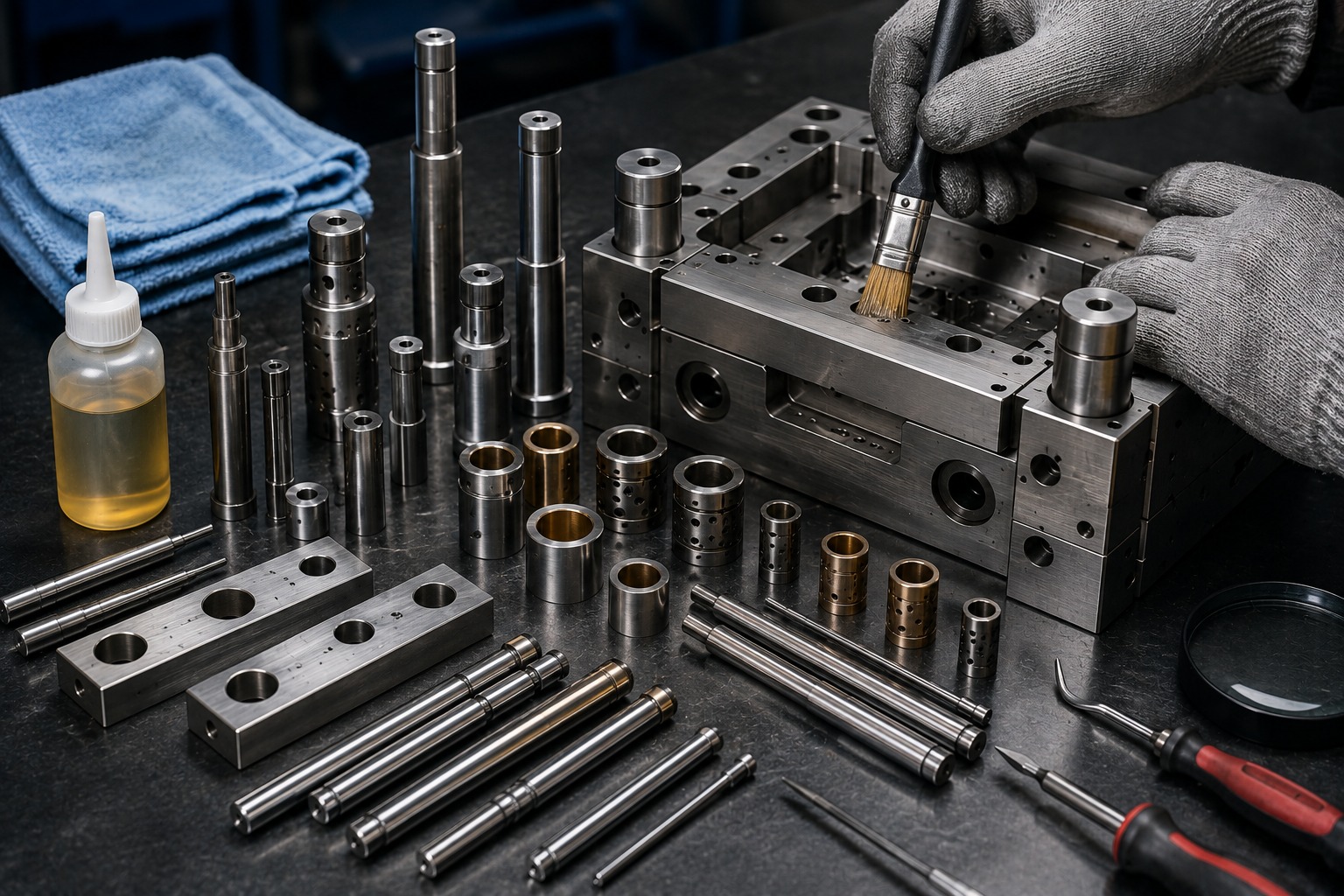
Core pins, cavity inserts, ejector pins, guide pins, bushings, wear plates, and other precision mold components all contribute to mold performance. Polymach365 manufactures these components using CNC machining, EDM, precision grinding, and inspection processes for demanding tooling applications.
However, manufacturing precision components is only one part of extending mold life. Proper maintenance, lubrication, cleaning, inspection, cooling, and timely replacement are equally important.
In this guide, we explain how to extend the life of injection mold components, reduce unexpected downtime, maintain part quality, and get more value from your tooling investment.
Why Injection Mold Component Life Matters
An injection mold contains many moving and precision-fitted components. During production, these components repeatedly operate under demanding conditions.
Over time, poor maintenance can lead to:
- Component wear
- Mold misalignment
- Ejection problems
- Surface damage
- Dimensional variation
- Flash
- Part defects
- Increased downtime
- Higher repair costs
Therefore, maintaining mold components should be part of your regular production strategy.
High-quality mold components can improve dimensional accuracy, reduce maintenance requirements, and support longer tooling life.
As a result, proactive maintenance can often cost significantly less than emergency mold repairs or unexpected production interruptions.
1. Perform Regular Mold Inspections
Regular inspection is one of the simplest ways to extend the life of injection mold components.
Instead of waiting until a component fails, inspect critical areas according to your production schedule.
During inspection, check:
- Core pins
- Cavity inserts
- Ejector pins
- Ejector sleeves
- Guide pins
- Guide bushings
- Wear plates
- Slides
- Lifters
- Mold surfaces
- Cooling channels
- Venting areas
Look for signs such as scratches, scoring, corrosion, deformation, unusual wear, or changes in component movement.
Therefore, early inspection allows manufacturers to identify problems before they affect production.
2. Keep Mold Components Clean
Contamination can accelerate wear and affect mold performance.
For example, plastic residue, dust, moisture, oil buildup, and corrosion can interfere with moving components.
Therefore, clean mold components according to the appropriate maintenance procedure after production runs or during scheduled maintenance.
Pay particular attention to:
- Parting surfaces
- Ejector systems
- Guide components
- Slides
- Inserts
- Vents
- Cooling areas
Consequently, regular cleaning helps maintain smooth movement and reduces the risk of contamination-related problems.
3. Use the Correct Lubrication
Proper lubrication reduces friction between moving components.
Guide pins, bushings, slides, ejector systems, and other moving components may require suitable lubrication depending on the mold design and operating conditions.
However, more lubricant does not always mean better performance.
Excessive lubrication can attract dust and contaminants, while insufficient lubrication can increase friction and wear.
Therefore, use the correct lubricant and follow the tooling manufacturer’s recommended maintenance procedure.
As a result, components can move more smoothly while minimizing unnecessary wear.
4. Monitor Guide Pins and Bushings
Guide pins and bushings maintain alignment between the mold halves.
Therefore, their condition directly affects mold accuracy and component life.
Check for:
- Scoring
- Uneven wear
- Excessive clearance
- Lubrication problems
- Misalignment
- Surface damage
If guide components become excessively worn, continuing production can place additional stress on other mold components.
Polymach365 identifies accurate guide pins and bushings as important for mold alignment, reduced component wear, and extended tooling life.
Consequently, replacing worn guide components at the appropriate time can help protect the rest of the mold.
5. Maintain Ejector Pins and Sleeves
Ejector components operate repeatedly during every molding cycle.
Therefore, ejector pins and sleeves can experience significant mechanical wear over long production runs.
Inspect them for:
- Bending
- Scoring
- Wear
- Galling
- Poor movement
- Excessive clearance
- Damage to ejector holes
Moreover, inspect the ejector system whenever you notice incomplete ejection, sticking parts, unusual marks, or changes in cycle performance.
As a result, manufacturers can prevent small ejector problems from developing into larger tooling issues.
Polymach365 manufactures standard and custom ejector pins, sleeves, stripper components, and specialty ejection systems for precision tooling applications.
6. Protect Core Pins and Cavity Inserts
Core pins and cavity inserts directly create important features of molded parts.
Therefore, damage or wear on these components can quickly affect product quality.
Inspect core pins and inserts for:
- Scratches
- Chipping
- Corrosion
- Dimensional wear
- Surface damage
- Cracks
- Unusual marks
Furthermore, clean these components carefully and avoid using inappropriate tools that could damage precision surfaces.
If a component becomes worn beyond acceptable limits, replace or refurbish it according to the tooling requirements.
Consequently, maintaining these components helps preserve part accuracy and surface quality.
7. Use Wear Plates to Protect Critical Surfaces
Wear plates provide replaceable surfaces in areas exposed to repeated movement and friction.
Therefore, they can protect more expensive mold structures from unnecessary wear.
Wear plates are particularly useful for:
- Sliding assemblies
- Moving mold sections
- High-cycle tooling
- Contact surfaces
- Specialized tooling mechanisms
Instead of allowing a critical mold surface to wear continuously, a properly designed wear plate can provide a controlled and replaceable wear surface.
As a result, manufacturers can simplify maintenance and potentially extend the useful life of larger tooling components.
8. Maintain Proper Cooling Systems
Cooling has a major influence on injection molding cycle performance and part consistency.
Therefore, manufacturers should regularly monitor mold cooling systems.
Check for:
- Blocked cooling channels
- Restricted water flow
- Scale buildup
- Leaks
- Corrosion
- Uneven cooling
Poor cooling can increase cycle times and create dimensional or warpage problems.
Polymach365’s mold-component information highlights cooling channels, baffles, bubblers, and thermal pins as components that help regulate mold temperature and improve cycle efficiency.
Consequently, maintaining the cooling system can support both component longevity and production efficiency.
9. Keep Mold Vents Clear
Proper venting allows trapped air and gases to escape during injection.
Therefore, blocked or damaged vents can contribute to molding problems such as burn marks, short shots, voids, and incomplete filling.
Regularly inspect venting areas and clean them according to your tooling maintenance procedure.
As a result, proper vent maintenance can help maintain consistent filling and reduce unnecessary stress on the molding process.
10. Control Mold Operating Conditions
Mold components operate within specific mechanical and thermal conditions.
Therefore, excessive pressure, temperature, speed, or mechanical force can accelerate wear.
Monitor important production parameters such as:
- Injection pressure
- Mold temperature
- Cooling temperature
- Ejection speed
- Clamping force
- Cycle time
- Material type
If production parameters change significantly, evaluate their potential effect on mold components.
Consequently, maintaining stable operating conditions can reduce unnecessary mechanical and thermal stress.
Material selection directly affects component durability.
For example, components exposed to repeated friction may require greater wear resistance, while other applications may prioritize toughness, corrosion resistance, or dimensional stability.
Common mold-component materials include:
- Tool Steel
- Hardened Steel
- Stainless Steel
- Specialty Tool Steels
Therefore, material selection should consider:
Wear Resistance: Important for components exposed to repeated movement.
Hardness: Helps resist surface deformation.
Toughness: Helps components withstand mechanical loading.
Corrosion Resistance: Important for demanding environments.
Dimensional Stability: Critical for precision tooling.
As a result, choosing an appropriate material can significantly influence component service life.
12. Use Precision-Machined Replacement Components
When a mold component becomes worn, replacement quality matters.
Installing a poorly manufactured replacement component can create alignment, fit, or performance problems.
Therefore, replacement components should match the original engineering requirements.
Provide the manufacturer with:
- CAD files
- 2D drawings
- Material specifications
- Dimensions
- Tolerances
- Surface-finish requirements
- Quantity requirements
Polymach365 manufactures custom mold components according to customer drawings, CAD models, material requirements, tolerances, and application specifications.
Consequently, manufacturers can obtain replacement components designed specifically for their existing tooling.
One of the biggest mistakes manufacturers make is waiting until a component completely fails.
For example:
Worn Guide Pin → Mold Alignment Problem
Worn Ejector Pin → Ejection Problem
Damaged Cavity Insert → Part Quality Problem
Worn Wear Plate → Structural Wear
Therefore, replacing components based on inspection findings can prevent unexpected failures.
A planned replacement is generally easier to manage than an emergency production shutdown.
14. Maintain a Mold Maintenance Schedule
A documented maintenance schedule helps manufacturers maintain consistency.
Depending on the mold and production environment, the schedule may include:
Daily Checks
- Clean visible surfaces
- Check for leaks
- Observe unusual movement
- Check production quality
Scheduled Checks
- Inspect guide components
- Inspect ejector systems
- Check lubrication
- Examine inserts
- Inspect wear areas
Periodic Maintenance
- Inspect cooling channels
- Inspect vents
- Measure critical components
- Replace worn components
- Check alignment
Therefore, a structured maintenance program can help manufacturers identify problems earlier.
Maintenance records provide valuable information about mold performance.
Record:
- Component replacement dates
- Production cycles
- Repair history
- Component failures
- Maintenance activities
- Dimensional measurements
- Lubrication schedules
For example, if the same ejector pin repeatedly fails after a specific number of cycles, the maintenance team can investigate the underlying cause.
Consequently, maintenance records can help manufacturers move from reactive repairs toward predictive maintenance.
Precision Mold Components from Polymach365
When replacement or custom components are required, Polymach365 provides precision manufacturing solutions for injection molds and tooling.
Our capabilities include:
- Core Pins & Core Inserts
- Cavity Inserts
- Ejector Pins & Sleeves
- Guide Pins & Bushings
- Wear Plates
- Custom Mold Components
- CNC Precision Machining
- EDM Machining
- Precision Grinding
- Dimensional Inspection
Polymach365 states that its manufacturing process combines CNC machining, EDM, precision grinding, and quality inspection to produce components for demanding tooling applications.
Furthermore, the company supports injection mold design and manufacturing in addition to mold components, CNC machining, molding, and prototyping.
Therefore, manufacturers can source individual replacement components or work with one supplier for broader tooling requirements.
Benefits of Extending Injection Mold Component Life
A proactive maintenance strategy can provide several benefits:
- Longer tooling life
- Fewer unexpected breakdowns
- Reduced maintenance costs
- Lower production downtime
- More consistent part quality
- Better mold alignment
- Reliable ejection
- Reduced component wear
- Improved production efficiency
- Better return on tooling investment
As a result, proper component maintenance becomes an important part of overall manufacturing efficiency.
When Should You Replace Injection Mold Components?
There is no single replacement interval that applies to every mold.
Instead, replacement should depend on the component’s condition, production cycles, material, operating conditions, tolerances, and performance.
Consider replacement when you notice:
- Visible wear
- Dimensional changes
- Excessive clearance
- Scratching or scoring
- Component deformation
- Ejection problems
- Alignment problems
- Increasing part defects
- Repeated maintenance issues
Therefore, manufacturers should use inspection data and actual tooling performance to determine replacement requirements.
Extending the life of injection mold components requires more than simply purchasing durable tooling.
Manufacturers should combine regular inspection, proper cleaning, suitable lubrication, cooling-system maintenance, controlled operating conditions, timely replacement, and precision-engineered components.
Most importantly, do not wait for a critical component to fail before taking action.
At Polymach365, we manufacture precision mold components designed for demanding injection molding applications, including core pins, cavity inserts, ejector components, guide pins, bushings, wear plates, and custom tooling parts.
Therefore, whether you need a replacement component for an existing mold or custom components for new tooling, Polymach365 can support your manufacturing requirements.
Send your CAD files, technical drawings, material requirements, tolerances, quantities, and surface-finish specifications to Polymach365 for project review.