A Complete Guide for Manufacturers
When developing a plastic product, many manufacturers use the terms injection mold design and injection mold manufacturing interchangeably. However, they are two different stages of the tooling process. Understanding the difference can help you plan your project, control tooling costs, reduce production risks, and achieve better molded-part quality.
At Polymach365, we provide both Injection Mold Design and Injection Mold Manufacturing solutions. Our engineering process combines Design for Manufacturability (DFM), mold-flow analysis, detailed CAD design, precision CNC machining, EDM, assembly, and inspection. Therefore, customers can move from a product concept to production-ready tooling through a coordinated manufacturing workflow.
Whether you are developing a prototype, launching a new plastic product, or preparing for high-volume production, understanding how mold design differs from mold manufacturing is essential.
What Is Injection Mold Design?
Injection mold design is the engineering stage where manufacturers determine how the mold will produce the final plastic component.
Instead of immediately machining steel or aluminum, engineers first create a detailed digital representation of the complete tooling system.
Therefore, mold design determines important elements such as:
- Core and cavity geometry
- Parting line
- Gate location
- Runner system
- Cooling channels
- Ejection system
- Mold venting
- Slides and lifters
- Mold base
- Inserts
- Mold materials
- Cavity configuration
At Polymach365, the design process begins with your CAD files and technical requirements. Our engineers use DFM principles to optimize the part and tooling before manufacturing begins.
Consequently, good mold design can prevent expensive tooling modifications later.
What Is Injection Mold Manufacturing?
Injection mold manufacturing is the physical production of the mold based on the approved engineering design.
Once the mold design receives approval, manufacturers begin producing the actual tooling components.
This stage can involve:
- CNC machining
- EDM machining
- Wire EDM
- Precision grinding
- Heat treatment
- Component assembly
- Hand fitting
- Mold testing
- Dimensional inspection
Polymach365’s published manufacturing workflow includes project kickoff and DFM analysis, CAD tool design, mold-flow simulation, precision machining, assembly and hand fitting, and first article inspection.
Injection Mold Design vs Mold Manufacturing
The easiest way to understand the difference is to compare their primary purposes.
| Injection Mold Design | Injection Mold Manufacturing |
|---|---|
| Creates the tooling concept | Builds the physical mold |
| Uses CAD and engineering software | Uses CNC, EDM and grinding equipment |
| Focuses on geometry and functionality | Focuses on precision production |
| Determines gates and runners | Machines the designed features |
| Designs cooling channels | Produces the cooling system |
| Designs ejection mechanisms | Manufactures and assembles ejection components |
| Includes DFM analysis | Includes machining and fitting |
| Uses simulation for validation | Uses inspection and testing |
| Produces mold design files | Produces the finished mold |
Therefore, both stages are equally important. A well-designed mold still requires accurate manufacturing, while precise manufacturing cannot compensate for a fundamentally poor mold design.
Why Injection Mold Design Matters
A mold represents a significant investment, especially for medium- and high-volume production.
Therefore, manufacturers should solve potential problems during the design stage rather than after the tool has been manufactured.
Part Geometry Optimization
The product design directly affects mold performance.
Polymach365’s mold-design process considers important factors such as wall thickness, draft angles, ribs, bosses, gate placement, and part geometry.
Uniform Wall Thickness
Consistent wall thickness promotes more predictable cooling.
As a result, manufacturers can reduce the risk of defects such as warpage, sink marks, and internal stresses.
Draft Angles
Draft angles allow the molded component to separate from the cavity more easily.
Consequently, proper draft design can reduce ejection problems and protect mold surfaces.
Ribs and Bosses
Ribs can strengthen a plastic component, while bosses can provide mounting or fastening features.
However, poorly designed ribs and bosses can contribute to sink marks or other molding issues.
Therefore, engineers should optimize their dimensions and placement during mold design.
Gate and Runner System Design
Plastic must flow through the mold before it fills the cavity.
Therefore, gate location and runner design play an important role in filling performance.
A suitable gating strategy can help improve:
- Material flow
- Filling balance
- Part appearance
- Cycle performance
- Material usage
- Production consistency
Polymach365’s mold-design services include engineering of gating and runner systems, including consideration of hot-runner and cold-runner configurations.
Consequently, selecting the correct system depends on the product design, material, production volume, and tooling requirements.
Cooling System Design
Cooling directly affects injection molding cycle time and dimensional stability.
Therefore, engineers need to design cooling channels according to the component’s geometry and thermal requirements.
An effective cooling strategy can help:
- Reduce cycle time
- Improve dimensional consistency
- Reduce warpage
- Improve production efficiency
- Maintain more consistent mold temperatures
Polymach365 specifically identifies cooling-system engineering as an important part of its injection mold design process.
Ejection System Design
After the plastic component cools, the mold must release it efficiently.
Therefore, engineers design suitable ejection systems based on the part’s geometry.
Common ejection solutions include:
- Ejector pins
- Ejector sleeves
- Stripper systems
- Lifters
- Specialized ejection mechanisms
As a result, proper ejection design helps prevent part damage and supports repeatable molding cycles.
Mold Flow Analysis and Simulation
Modern mold design can use simulation before manufacturing begins.
Polymach365 uses mold-flow analysis to evaluate how molten plastic moves through the cavity and to identify potential issues such as knit lines, pressure drops, flow imbalance, and cooling inconsistencies.
Therefore, simulation allows engineers to identify potential problems before they become expensive tooling problems.
Consequently, manufacturers can make design improvements earlier in the development process.
What Happens During Mold Manufacturing?
After the design is approved, the manufacturing stage begins.
Step 1: Material Preparation
The appropriate mold material is selected according to production volume, wear requirements, plastic material, and expected tool life.
For example, Polymach365 manufactures tooling using materials such as aluminum and hardened steel for different production requirements.
Step 2: CNC Machining
CNC machining produces the mold structure, cavities, pockets, holes, and other required features.
Therefore, machining accuracy directly influences the final mold’s performance.
Step 3: EDM Machining
Some intricate features are difficult to manufacture using conventional cutting tools.
Therefore, EDM can be used for suitable conductive materials and complex mold geometries.
Step 4: Precision Grinding
Grinding helps achieve accurate dimensions and surface finishes on appropriate mold components.
Consequently, grinding complements CNC and EDM operations.
Step 5: Heat Treatment
Depending on the selected mold material and application, heat treatment can improve hardness, wear resistance, and tool life.
Step 6: Assembly and Hand Fitting
After machining, individual mold components are assembled.
Polymach365’s manufacturing process includes assembly and hand fitting to fine-tune tooling components before validation.
Step 7: Inspection and Validation
Finally, critical dimensions and tooling performance are checked before production approval.
Therefore, inspection confirms that the manufactured mold matches the approved engineering requirements.
Mold design always comes before full mold manufacturing.
The design establishes the specifications that manufacturing must follow.
Therefore, the typical workflow looks like this:
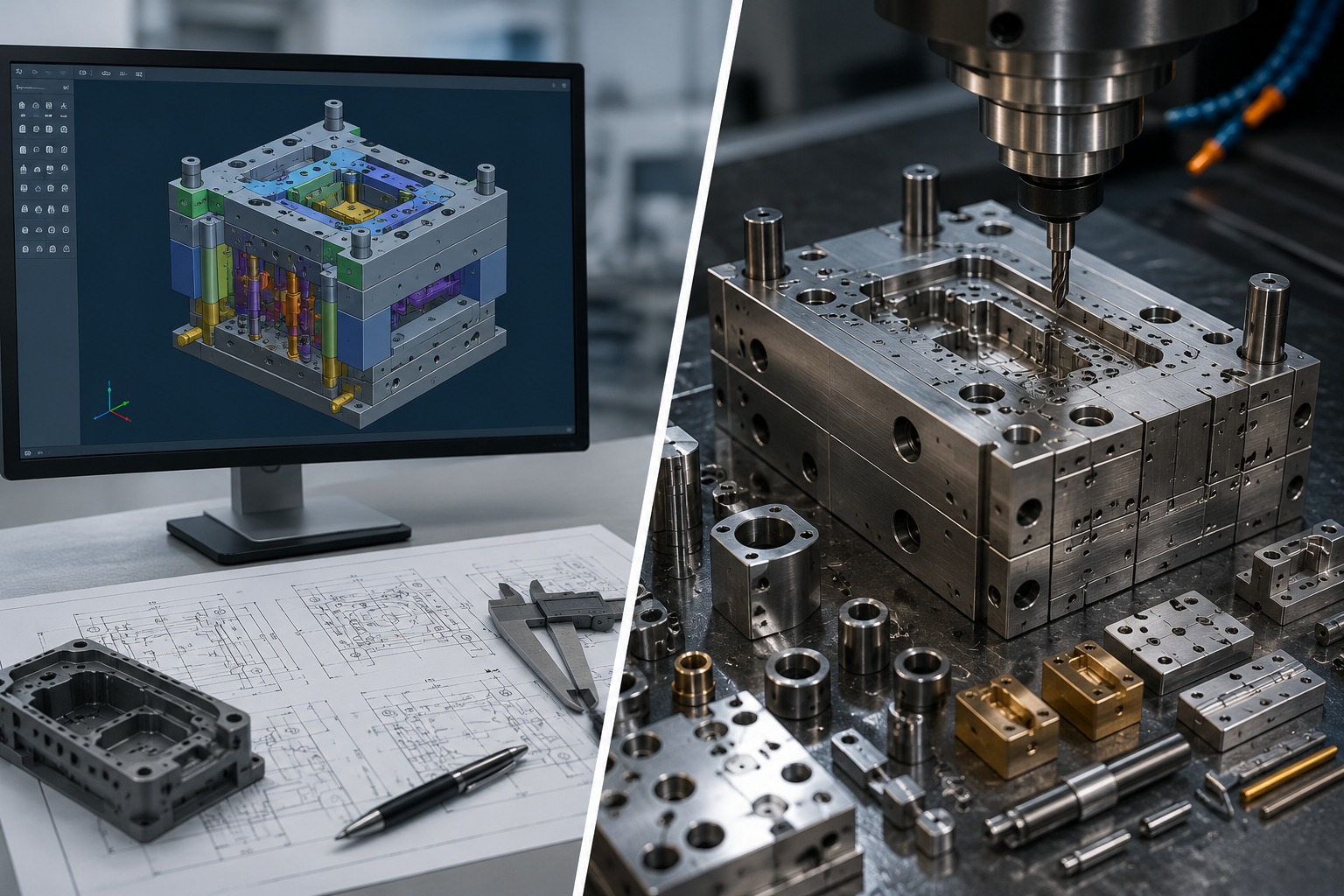
Product CAD → DFM Analysis → Mold Design → Simulation → Design Approval → Mold Manufacturing → Assembly → Inspection → Mold Trial → Production
This structured approach helps manufacturers identify design problems before committing to expensive tooling operations.
Although design and manufacturing are different stages, they work best when engineers and toolmakers collaborate closely.
For example, a theoretically ideal mold design may contain a feature that is difficult or expensive to machine.
Therefore, manufacturing feedback can improve the design before production begins.
Likewise, the design team may identify a tooling requirement that affects machining, material selection, or inspection.
Consequently, integrating engineering and manufacturing knowledge can improve the final tooling solution.
The manufacturing strategy also depends on your expected production volume.
Prototype Tooling
Prototype molds are generally designed for faster development and design validation.
Polymach365 describes aluminum prototype molds as suitable for approximately 500 to 10,000 shots, depending on the project.
Therefore, prototype tooling can be useful when the product design still requires validation.
Production Tooling
Production molds are designed for substantially higher production requirements.
Polymach365’s published tooling information describes hardened-steel production molds capable of 100,000+ production cycles, depending on the tooling design and application.
Consequently, production tooling typically requires greater consideration of durability, cooling, ejection, maintenance, and cycle efficiency.
When Do You Need Custom Injection Mold Design?
Custom mold design becomes particularly important when your product contains:
- Complex geometry
- Undercuts
- Threads
- Side holes
- Snap-fit features
- Thin walls
- Multiple cavities
- Cosmetic surfaces
- Tight tolerances
- Specialized ejection requirements
Therefore, a customized tooling strategy can provide better control over production performance.
Polymach365 also designs complex mold features using slides, lifters, collapsible cores, and other mechanisms when the product geometry requires them.
Custom injection molds support many manufacturing industries.
Automotive
Injection molds produce housings, clips, brackets, interior components, connectors, and other plastic parts.
Medical Devices
Precision molds support medical equipment, laboratory components, housings, and other engineered plastic products.
Consumer Electronics
Manufacturers use custom molds for enclosures, connectors, switches, and precision plastic components.
Industrial Equipment
Custom tooling produces machine housings, components, covers, and specialized industrial parts.
Packaging
Molds support containers, caps, closures, and other packaging products.
Polymach365 identifies automotive, medical devices, consumer electronics, industrial equipment, packaging, and aerospace among the industries supported by its mold-design services.
Benefits of Professional Mold Design and Manufacturing
When both stages are handled correctly, manufacturers can achieve:
- Better part consistency
- Improved dimensional accuracy
- Reduced molding defects
- Faster production cycles
- Longer mold life
- Lower maintenance requirements
- Improved material flow
- Better cooling performance
- Reliable ejection
- Lower long-term production costs
Therefore, professional mold engineering provides value beyond simply producing a physical tool.
How Polymach365 Handles Mold Design and Manufacturing
Polymach365 provides an integrated tooling workflow that combines injection mold design, DFM analysis, simulation, precision machining, mold manufacturing, mold components, and production support.
Our process includes:
1. CAD File Review
We review your product geometry and manufacturing requirements.
2. DFM Analysis
We identify potential molding and tooling issues.
3. Mold Design
We develop the core, cavity, cooling, gating, runner, venting, and ejection systems.
4. Simulation & Validation
We evaluate filling, cooling, and critical tolerances.
5. Precision Manufacturing
We manufacture mold components using CNC machining, EDM, grinding, and related processes.
6. Assembly & Fitting
We assemble and fine-tune the tooling.
7. Inspection
We verify critical dimensions and tooling requirements.
8. Production Support
The completed mold moves toward production and ongoing manufacturing requirements.
Consequently, customers can move from digital product design toward production-ready tooling through a structured process.
Injection Mold Design vs Mold Manufacturing: Which One Do You Need?
The answer depends on where you are in your product-development process.
Choose Injection Mold Design When:
- Your product CAD is ready
- You need DFM analysis
- You want to validate the tooling concept
- You need mold-flow simulation
- You need a complete mold design
- You want to estimate tooling requirements
Choose Mold Manufacturing When:
- Your mold design is already approved
- You need physical tooling
- You need CNC-machined mold components
- You require EDM or precision grinding
- You need mold assembly and fitting
- You are ready for tooling validation
Need Both?
If you are starting a new plastic product, combining both services is usually the most efficient approach.
Therefore, Polymach365 can support the project from CAD review and DFM through mold design, manufacturing, inspection, and production support.
Final Thoughts
Injection mold design and mold manufacturing are different, but equally important stages of the tooling process.
Mold design determines how the tooling should work, while mold manufacturing turns that engineering design into a precise physical tool.
Therefore, manufacturers should treat both stages as connected parts of one manufacturing strategy.
At Polymach365, we combine engineering, DFM, simulation, precision machining, mold manufacturing, and quality inspection to help manufacturers develop reliable injection molding solutions.
Whether you need custom injection mold design, production tooling, prototype molds, mold components, or complete mold manufacturing, our team can help move your product from concept to production.
Request an Injection Mold Design or Manufacturing Quote
Send your 3D CAD files, 2D drawings, material requirements, production volume, tolerances, and project specifications to Polymach365 for engineering review.