How Digital CNC Manufacturing Is Making Custom Part Production Faster, Smarter, and More Flexible
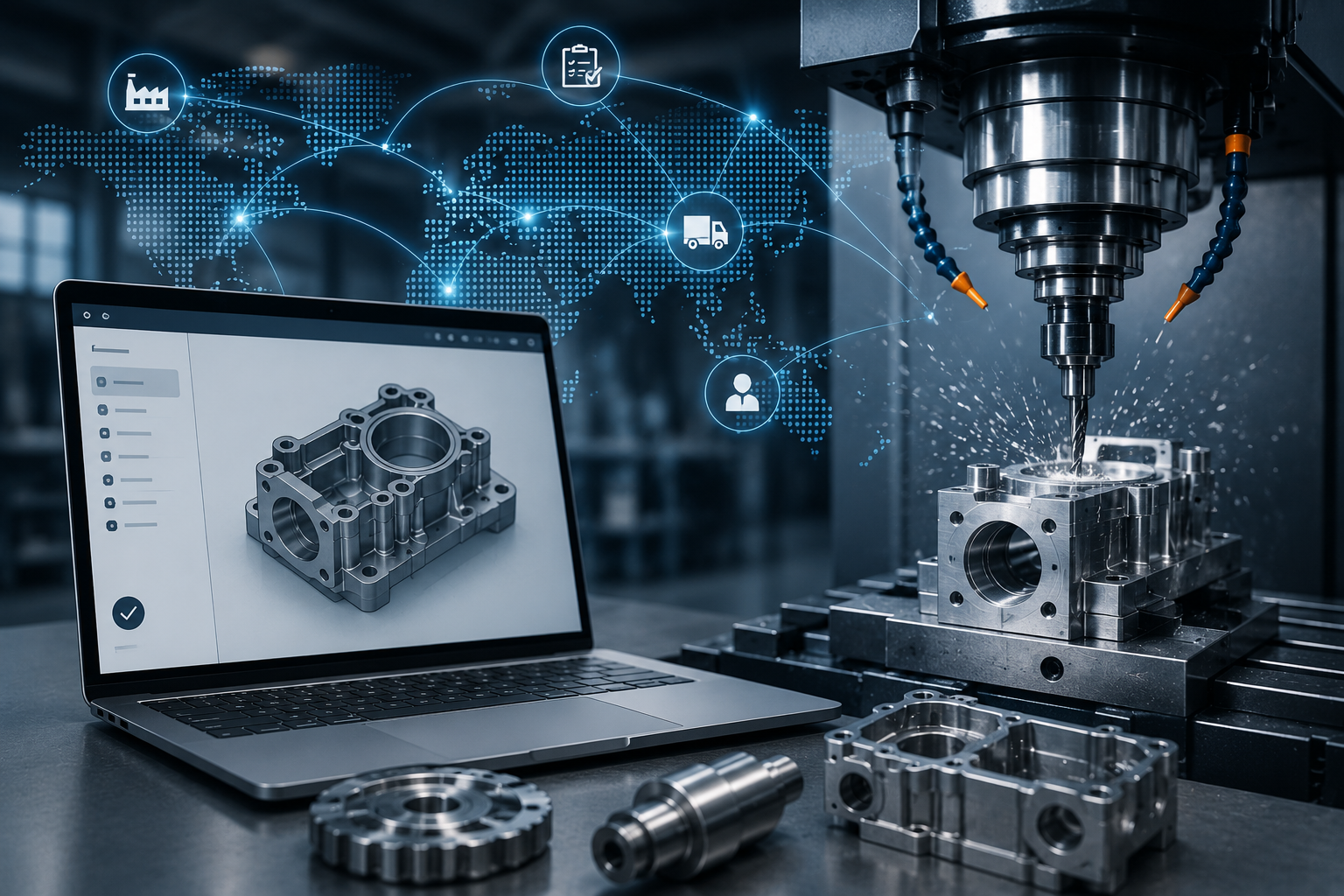
Manufacturing is becoming increasingly digital. Today, engineers and product developers expect faster quotations, easier communication, flexible production volumes, and efficient ways to move from CAD design to finished components. Therefore, online CNC machining services are changing how businesses source custom-manufactured parts.
Instead of relying entirely on lengthy traditional procurement processes, manufacturers can use digital workflows to submit CAD files, define project requirements, receive manufacturing feedback, and move projects toward production more efficiently.
At Polymach365, we support businesses with online CNC machining services in Canada, including CNC milling, CNC turning, 5-axis machining, rapid prototyping, precision machining, and low-volume production. As a result, customers can simplify sourcing while maintaining a strong focus on part quality and manufacturability.
In this guide, we explain why online CNC machining is transforming modern manufacturing and how businesses can benefit from a more connected manufacturing process.
What Are Online CNC Machining Services?
Online CNC machining combines precision manufacturing with a digital project workflow.
Traditionally, sourcing custom-machined components could involve multiple emails, drawings, supplier discussions, and manual quotation processes. However, an online manufacturing approach simplifies many of these steps.
A typical process may include:
CAD File Submission → Engineering Review → DFM Feedback → Quotation → CNC Machining → Quality Inspection → Delivery
Therefore, engineers can move from a digital design toward physical components through a more streamlined process.
Online CNC machining can support both simple and complex projects, including prototypes, custom components, replacement parts, tooling, and production batches.
Why Is Online CNC Machining Growing?
Manufacturers increasingly need shorter development cycles and more flexible supply chains. At the same time, engineering teams often work across different cities, provinces, and countries.
Consequently, digital manufacturing platforms can make supplier communication and project coordination easier.
Online CNC machining can help businesses:
- Reduce quotation delays
- Simplify CAD file submission
- Access engineering feedback
- Compare manufacturing requirements
- Accelerate prototyping
- Manage custom production
- Scale quantities as demand changes
- Reduce unnecessary administrative work
As a result, engineering teams can spend more time developing products and less time managing repetitive procurement activities.
1. Faster CNC Machining Quotations
Traditional CNC quotation processes can require several rounds of communication before manufacturing begins.
However, online CNC machining services simplify the initial information exchange. Customers can provide CAD files, material requirements, tolerances, quantities, and finishing specifications together.
Therefore, manufacturers can evaluate the project more efficiently.
A complete request typically includes:
✔ 3D CAD Model
✔ 2D Technical Drawing
✔ Material
✔ Quantity
✔ Critical Tolerances
✔ Surface Finish
✔ Required Delivery Schedule
Providing complete information from the beginning can significantly reduce unnecessary quotation delays.
2. Easier CAD-to-Part Manufacturing
One of the greatest advantages of digital manufacturing is the connection between CAD design and CNC production.
Engineers already create components using digital CAD software. Therefore, an online CNC workflow naturally extends that process into manufacturing.
Common file formats may include:
- STEP
- STP
- IGES
- IGS
- DXF
- DWG
After reviewing the design, manufacturing engineers can determine suitable machining operations, tooling requirements, material selection, and production methods.
Consequently, the transition from design to manufacturing becomes more efficient.
3. Design for Manufacturability Feedback
A part can look correct in CAD while still being difficult or expensive to machine.
For example, a design may contain extremely deep pockets, sharp internal corners, inaccessible features, thin walls, or unnecessarily tight tolerances.
Therefore, Design for Manufacturability (DFM) plays an important role in online CNC machining.
DFM analysis can help identify opportunities to:
✔ Simplify part geometry
✔ Improve tool accessibility
✔ Reduce machining time
✔ Select practical tolerances
✔ Minimize unnecessary setups
✔ Reduce material waste
✔ Lower manufacturing costs
As a result, manufacturers can optimize components before production rather than correcting expensive problems afterward.
4. Faster Rapid Prototyping
Speed is critical during product development.
Engineers often need physical prototypes to evaluate fit, functionality, assembly, strength, and dimensional accuracy. However, waiting too long for prototypes can delay the entire development cycle.
Online CNC machining can simplify the process of submitting prototype designs and communicating manufacturing requirements.
Moreover, CNC machining allows engineers to create functional prototypes from engineering materials such as aluminum, stainless steel, brass, and engineering plastics.
Therefore, companies can test realistic components before moving toward production.
5. Flexible Low-Volume Production
Not every manufacturer needs thousands of components.
Startups, equipment manufacturers, automation companies, and product developers may require only:
- 5 parts
- 20 parts
- 50 parts
- 100 parts
- Several hundred components
Online CNC machining is well suited to this type of low-volume production because manufacturers can produce components without investing in dedicated molds for many applications.
Consequently, businesses can manufacture according to actual demand while reducing unnecessary inventory.
6. Access to Advanced CNC Machining Capabilities
A single project may require several manufacturing processes.
For example, one component may require milling, while another requires turning. Meanwhile, a complex part may benefit from multi-axis machining.
Online CNC manufacturing can provide access to capabilities such as:
CNC Milling
CNC milling uses rotating cutting tools to create pockets, holes, surfaces, slots, and complex geometries.
CNC Turning
CNC turning is ideal for cylindrical components such as shafts, bushings, sleeves, pins, and threaded parts.
5-Axis CNC Machining
5-axis machining allows cutting tools to approach a component from multiple directions. Therefore, manufacturers can produce complex geometries while reducing the number of setups required.
As a result, customers can source different precision components through a coordinated manufacturing workflow.
7. Greater Material Flexibility
Modern product development requires materials suited to specific mechanical and environmental requirements.
Online CNC machining can support a broad selection of metals and engineering plastics.
Common CNC Metals
- Aluminum
- Stainless Steel
- Carbon Steel
- Tool Steel
- Brass
- Copper
- Titanium
Engineering Plastics
- ABS
- Nylon
- Delrin/Acetal
- Polycarbonate
- PEEK
- PTFE
Therefore, engineers can select materials according to strength, weight, machinability, temperature resistance, chemical resistance, and application requirements.
8. Improved Cost Control
Online CNC machining can also make manufacturing costs easier to evaluate.
Several factors influence the cost of CNC parts, including:
- Raw material
- Component dimensions
- Geometry
- Machining time
- Number of setups
- Tolerances
- Quantity
- Inspection requirements
- Surface finishing
By combining CAD review with DFM analysis, manufacturers can identify features that unnecessarily increase production costs.
For example, simplifying a deep cavity or relaxing a non-critical tolerance may reduce machining time.
Therefore, good engineering decisions can lower costs without sacrificing functional performance.
9. Easier Scaling from Prototype to Production
Product demand can change quickly.
Initially, a business may need only a few prototypes. After validation, it may require 50 components for testing. Later, demand may increase to hundreds or thousands of parts.
CNC machining provides flexibility during these stages.
A typical development path could be:
Prototype → Engineering Validation → Low-Volume Production → Production Manufacturing
Because CNC machining does not require dedicated production tooling for every project, businesses can often scale quantities gradually.
As a result, manufacturers can respond more effectively to changing market demand.
10. Digital Manufacturing Improves Supply Chain Flexibility
Recent supply chain challenges have encouraged businesses to reconsider how they source manufactured components.
Depending heavily on a single production route can increase risk. Therefore, companies increasingly value flexible manufacturing networks and responsive suppliers.
Online manufacturing simplifies communication between engineers, purchasing teams, and manufacturing partners.
Consequently, businesses can develop more adaptable sourcing strategies while maintaining control over technical requirements.
Online CNC Machining vs Traditional Machine Shops
Both traditional machine shops and online CNC manufacturing have important roles. However, digital workflows can provide additional convenience for many projects.
| Factor | Online CNC Machining | Traditional Process |
|---|---|---|
| CAD Submission | Digital | Often manual/digital mix |
| Quotation Workflow | Streamlined | May require more communication |
| DFM Review | Integrated into workflow | Depends on supplier |
| Prototype Ordering | Convenient | Supplier-dependent |
| Remote Project Management | Easy | Varies |
| Production Scaling | Flexible | Capacity-dependent |
| Project Communication | Digitally organized | Often email/phone based |
Ultimately, manufacturing capability and quality matter more than whether a supplier operates online or offline. However, combining strong machining expertise with an efficient digital workflow can provide the advantages of both approaches.
Industries Using Online CNC Machining
Online CNC machining supports many industries across Canada.
Automotive Manufacturing
Custom brackets, housings, tooling, prototypes, and precision mechanical components.
Aerospace
Complex components that require controlled dimensions and high-quality machining.
Industrial Equipment
Replacement components, machine parts, fixtures, tooling, and automation equipment.
Robotics and Automation
Precision brackets, shafts, housings, mounts, and custom assemblies.
Electronics
Enclosures, heat-management components, mounting parts, and precision housings.
Mold and Tool Manufacturing
Core pins, cavity inserts, mold components, fixtures, and custom tooling.
Therefore, online CNC manufacturing can support both established manufacturers and growing product companies.
How the Polymach365 Online CNC Machining Process Works
Polymach365 focuses on making custom manufacturing straightforward.
Step 1: Submit Your CAD Files
Send your CAD model, technical drawings, quantity, material, and project specifications.
Step 2: Engineering Review
Our team reviews the component and evaluates manufacturability.
Step 3: Receive Your Quote
We prepare pricing based on material, geometry, machining requirements, quantity, and finishing.
Step 4: CNC Manufacturing
Once approved, your components move into CNC milling, turning, or multi-axis machining as required.
Step 5: Quality Inspection
Finished parts undergo dimensional and visual inspection based on project requirements.
Step 6: Delivery
After final inspection, components are prepared for delivery.
Therefore, customers can manage the manufacturing journey through a clear and efficient process.
Why Choose Polymach365 for Online CNC Machining Services in Canada?
At Polymach365, our goal is to combine digital convenience with precision manufacturing expertise.
Our manufacturing capabilities include:
✔ Online CNC Machining Services
✔ CNC Milling Services
✔ CNC Turning Services
✔ 5-Axis CNC Machining
✔ Precision CNC Machining
✔ Custom CNC Machining Solutions
✔ Rapid Prototyping
✔ Prototype Manufacturing
✔ Low-Volume Production
✔ Mold Components Manufacturing
✔ Injection Mold Design
✔ Engineering and DFM Support
Furthermore, our broad manufacturing capabilities allow customers to move from early product development to more advanced production requirements with a single manufacturing partner.
The Future of Online CNC Manufacturing in Canada
Digital manufacturing will continue to influence how companies develop and source custom components.
Automation, CAD integration, advanced CNC equipment, digital quality systems, and smarter production planning are making manufacturing workflows increasingly connected.
However, technology alone does not guarantee successful manufacturing. Engineering knowledge, machining capability, material expertise, quality control, and clear communication remain essential.
Therefore, the strongest online CNC machining solutions combine digital efficiency with real manufacturing expertise.
For Canadian manufacturers, this combination can help shorten product development cycles, improve sourcing flexibility, and create more efficient production strategies.
Final Thoughts
Online CNC machining services are transforming manufacturing by connecting digital engineering directly with precision production.
Manufacturers can submit CAD files more efficiently, receive engineering feedback, create functional prototypes, manufacture custom components, and scale production according to demand.
Moreover, CNC milling, turning, and 5-axis machining provide the precision and material flexibility required for demanding industrial applications.
At Polymach365, we support Canadian manufacturers with online CNC machining solutions designed for prototypes, custom components, mold parts, and production requirements.
Start Your Online CNC Machining Project
Have a CAD model ready?
Send your drawings and manufacturing requirements to Polymach365. Our team can review your project, evaluate manufacturability, and help you determine an efficient CNC machining solution.