A Complete Guide for Manufacturers in Canada
When developing a new product, one of the first decisions manufacturers face is choosing the right prototyping method. Two of the most popular options are 3D Printing and CNC Machining. While both technologies help transform digital designs into physical parts, they offer different advantages depending on your project requirements.
At Polymach365, we provide both Rapid Prototyping Services and Precision CNC Machining Services to help businesses across Canada accelerate product development and reduce manufacturing risks. Therefore, understanding the strengths and limitations of each process is essential before selecting the best solution for your prototype.
In this guide, we’ll compare 3D printing and CNC machining based on accuracy, materials, cost, speed, surface finish, and production readiness so you can make the right decision for your project.
What Is 3D Printing?
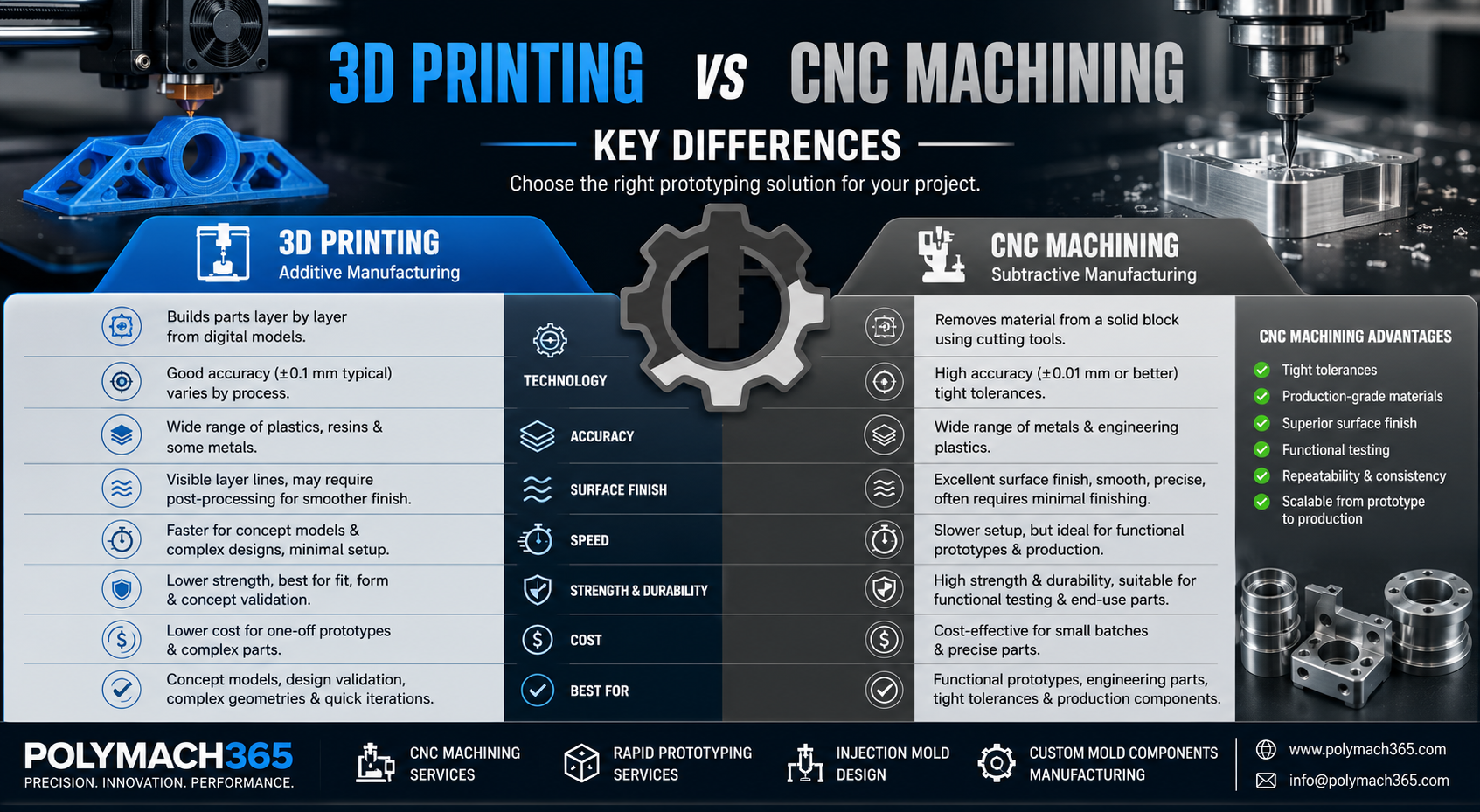
3D printing, also known as additive manufacturing, creates parts layer by layer from a digital CAD model. Unlike traditional manufacturing methods, 3D printing adds material only where needed. Therefore, it allows engineers to create highly complex geometries and internal structures that would be difficult or impossible to machine.
Common 3D Printing Technologies
✔ FDM (Fused Deposition Modeling)
✔ SLA (Stereolithography)
✔ SLS (Selective Laser Sintering)
✔ MJF (Multi Jet Fusion)
✔ Metal 3D Printing
As a result, 3D printing has become a popular solution for concept models, design validation, and early-stage product development.
What Is CNC Machining?
CNC machining is a subtractive manufacturing process that removes material from a solid block using computer-controlled cutting tools. Consequently, CNC machining produces highly accurate parts with excellent mechanical properties and superior surface finishes.
Common CNC Processes
✔ CNC Milling
✔ CNC Turning
✔ 5-Axis Machining
✔ Precision Drilling
✔ Multi-Axis Machining
Therefore, CNC machining is widely used for functional prototypes, engineering validation, and production-ready components.
3D Printing vs CNC Machining: Key Differences
Accuracy and Tolerances
One of the biggest differences between the two technologies is dimensional accuracy.
CNC Machining
CNC machining delivers extremely tight tolerances and repeatable precision. Therefore, it is ideal for parts that require exact dimensions and assembly compatibility. Typical CNC tolerances can be significantly tighter than those achieved with most 3D printing technologies.
3D Printing
While modern 3D printers offer good accuracy, layer-based manufacturing can introduce slight variations depending on the process and material used. As a result, 3D printed parts may require additional finishing for high-precision applications.
Winner: CNC Machining
For precision engineering and tight tolerances, CNC machining is the preferred choice.
Material Selection
Material performance plays a major role in prototype success.
CNC Machining Materials
- Aluminum
- Stainless Steel
- Brass
- Copper
- Titanium
- ABS
- Delrin
- Nylon
- PEEK
Because CNC machining uses production-grade materials, prototypes accurately represent final product performance.
3D Printing Materials
- PLA
- ABS
- PETG
- Nylon
- Resin Materials
- Metal Powders
Although material options continue to expand, some 3D printed materials may not fully replicate the strength and durability of production-grade materials.
Winner: CNC Machining
For functional testing and real-world performance validation, CNC machining offers superior material options.
Design Complexity
This is where 3D printing often excels.
3D Printing Advantages
Because parts are built layer by layer, engineers can create:
✔ Internal channels
✔ Lattice structures
✔ Organic geometries
✔ Lightweight designs
✔ Complex assemblies
Therefore, 3D printing provides greater design freedom.
CNC Machining Limitations
CNC machining is restricted by cutting tool access and machining constraints. Consequently, some highly complex geometries may be difficult or expensive to manufacture.
Winner: 3D Printing
For highly complex shapes and intricate designs, 3D printing offers greater flexibility.
Surface Finish Quality
Surface quality is critical for many prototypes.
CNC Machining
CNC-machined parts generally have smoother surfaces and superior finishes directly from the machine. Therefore, they often require minimal post-processing.
3D Printing
Layer lines are often visible on printed parts. As a result, sanding, polishing, or additional finishing may be required for aesthetic applications.
Winner: CNC Machining
For professional appearance and production-quality finishes, CNC machining delivers better results.
Speed of Prototyping
Speed is often a deciding factor during product development.
3D Printing
Because there is minimal setup required, 3D printing can produce prototypes quickly, especially for one-off parts and design iterations. Therefore, it is excellent for rapid concept validation.
CNC Machining
CNC machining requires programming, tooling setup, and machine preparation. Consequently, lead times may be slightly longer for single prototypes.
Winner: 3D Printing
For fast design iterations and early-stage development, 3D printing is often the quickest solution.
Cost Comparison
Cost depends on part complexity, quantity, and material selection.
3D Printing
For one-off prototypes and highly complex parts, 3D printing is often more cost-effective because there is little setup cost.
CNC Machining
While setup costs may be higher initially, CNC machining becomes more economical for small production runs and repeat manufacturing.
Winner
✔ Single Prototype → 3D Printing
✔ Functional Prototype → CNC Machining
✔ Small Production Runs → CNC Machining
Production Readiness
Many manufacturers use prototypes to prepare for production.
CNC Machining
Because CNC machining uses production-grade materials and manufacturing processes, prototypes closely match final production parts. Therefore, engineering validation becomes more accurate.
3D Printing
While excellent for concept development, some printed materials may not replicate final production performance. Consequently, additional validation may be required before manufacturing begins.
Winner: CNC Machining
For production-ready prototypes and engineering validation, CNC machining is the better choice.
When Should You Choose 3D Printing?
Choose 3D printing when you need:
✔ Rapid concept models
✔ Design validation
✔ Complex geometries
✔ Internal structures
✔ Fast design iterations
✔ Low-cost early-stage prototypes
Therefore, 3D printing is ideal during the initial stages of product development.
When Should You Choose CNC Machining?
Choose CNC machining when you need:
✔ Tight tolerances
✔ Production-grade materials
✔ Functional testing
✔ Superior surface finishes
✔ Production-ready prototypes
✔ Small-batch manufacturing
Consequently, CNC machining is often the preferred solution for engineering prototypes and market-ready products.
Why Polymach365 Is Your Prototyping Partner
At Polymach365, we help manufacturers select the most effective prototyping solution based on project goals, timelines, and budgets.
Our Services Include:
✔ Rapid Prototyping Services
✔ CNC Milling Services
✔ CNC Turning Services
✔ 5-Axis CNC Machining
✔ Prototype Manufacturing
✔ Low-Volume Production
✔ Injection Mold Design Services
✔ Custom Mold Components Manufacturing
✔ Engineering & DFM Support
✔ Quality Inspection & Testing
Moreover, our experienced engineering team works closely with customers to optimize designs for manufacturability and cost efficiency.
Final Thoughts
There is no single answer to whether 3D printing or CNC machining is better for prototyping. The best choice depends on your design complexity, material requirements, budget, and production goals.
If you need fast concept models and design flexibility, 3D printing is an excellent option. However, if you require precision, durability, production-grade materials, and functional testing, CNC machining remains the superior choice.
Many successful product development projects use both technologies strategically. Therefore, combining rapid 3D printing with precision CNC machining often delivers the fastest and most cost-effective path to production.
Get Started with Polymach365 Today
Upload your CAD files and discover how our rapid prototyping and CNC machining services can help accelerate product development, reduce costs, and bring your ideas to market faster.