A Complete Manufacturing Guide for Canadian Businesses
Selecting the right manufacturing process is one of the most important decisions when developing a new product. Two of the most widely used manufacturing methods are CNC Machining and Injection Molding. While both processes produce high-quality components, they serve different purposes depending on production volume, material requirements, complexity, and budget.
At Polymach365, we provide both Precision CNC Machining Services and Injection Mold Design & Manufacturing Services across Canada. Therefore, we help manufacturers choose the most cost-effective production method for every stage of product development—from rapid prototyping to high-volume production.
This guide compares CNC machining and injection molding to help you determine which process best fits your project.
What Is CNC Machining?
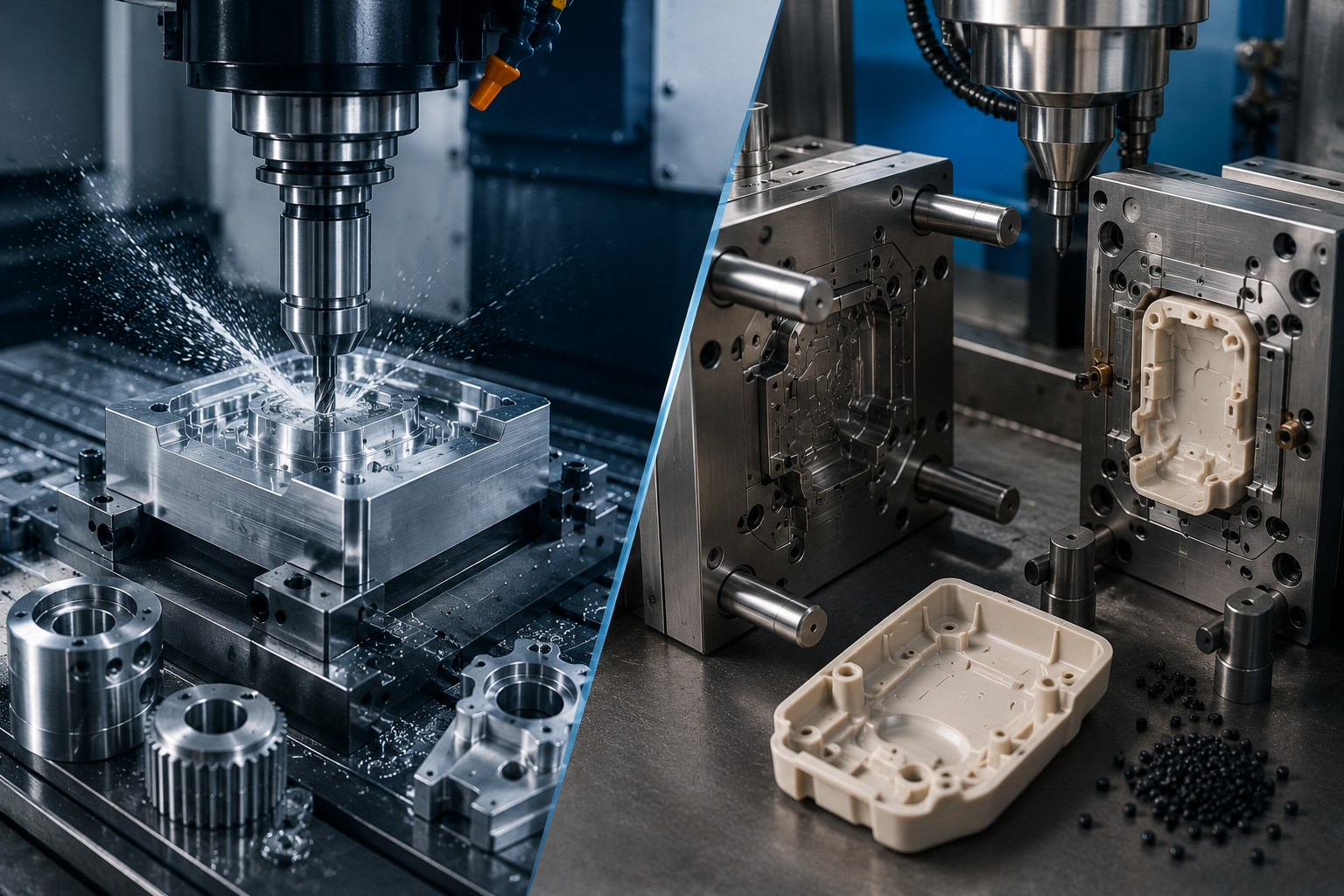
CNC (Computer Numerical Control) machining is a subtractive manufacturing process that removes material from a solid block using computer-controlled cutting tools.
Therefore, CNC machining is ideal for manufacturing high-precision metal and plastic components with excellent dimensional accuracy.
Common CNC Machining Processes
✔ CNC Milling
✔ CNC Turning
✔ 5-Axis CNC Machining
✔ Precision Drilling
✔ Multi-Axis Machining
As a result, CNC machining is widely used for prototypes, custom parts, and low-volume production.
What Is Injection Molding?
Injection molding is a manufacturing process that injects molten plastic into a precision-engineered mold cavity. After cooling, the finished part is ejected and the cycle repeats.
Because the same mold is used repeatedly, injection molding is ideal for producing thousands or even millions of identical plastic components.
Common Applications
✔ Automotive Parts
✔ Medical Devices
✔ Consumer Products
✔ Electronic Housings
✔ Packaging Products
✔ Industrial Components
Consequently, injection molding becomes highly economical for large production volumes.
CNC Machining vs Injection Molding: Key Differences
| Feature | CNC Machining | Injection Molding |
|---|---|---|
| Manufacturing Method | Material Removal | Plastic Injection |
| Best For | Prototypes & Low Volume | High-Volume Production |
| Initial Investment | Low | High (Mold Cost) |
| Production Speed | Moderate | Very Fast |
| Design Changes | Easy | Expensive |
| Material Options | Metals & Plastics | Primarily Plastics |
| Dimensional Accuracy | Excellent | Excellent |
| Surface Finish | Superior | Very Good |
| Production Quantity | 1–10,000 Parts | 10,000+ Parts |
Therefore, the right process depends on your project goals, budget, and production requirements.
When Should You Choose CNC Machining?
CNC machining is the preferred choice when flexibility, accuracy, and speed are essential.
Ideal for Rapid Prototyping
Because CNC machining requires no expensive tooling, prototypes can be manufactured quickly.
As a result, engineers can validate designs before investing in production tooling.
Excellent for Low-Volume Production
If you only require a few parts or small production batches, CNC machining is significantly more cost-effective.
Typical production quantities include:
- One-off Components
- Engineering Samples
- Pilot Production
- Low-Volume Manufacturing
Therefore, CNC machining minimizes upfront investment.
Superior Material Options
CNC machining supports both engineering plastics and metals.
Common Materials
- Aluminum
- Stainless Steel
- Titanium
- Brass
- Copper
- Carbon Steel
- ABS
- Nylon
- Delrin
- PEEK
Consequently, manufacturers can select materials based on strength, durability, and application requirements.
Outstanding Precision
Modern CNC machines produce components with extremely tight tolerances.
Therefore, industries such as aerospace, medical, robotics, and automotive rely heavily on CNC machining.
When Should You Choose Injection Molding?
Injection molding becomes the best option when producing large quantities of plastic components.
High-Volume Manufacturing
Although mold manufacturing requires a higher initial investment, production costs decrease dramatically as volumes increase.
Consequently, injection molding delivers the lowest cost per part for mass production.
Consistent Quality
Every molded component is produced using the same precision mold.
As a result, product consistency remains exceptionally high throughout long production runs.
Faster Production Cycles
Once the mold is completed, each molding cycle typically takes only a few seconds to a few minutes.
Therefore, manufacturers can produce thousands of components every day.
Lower Unit Costs
While tooling costs are higher initially, the cost per component becomes extremely low during mass production.
Consequently, injection molding is the preferred manufacturing method for consumer products and plastic assemblies.
Cost Comparison
Cost is one of the biggest factors when selecting a manufacturing process.
CNC Machining
- Low startup cost
- No mold investment
- Higher cost per part
- Ideal for prototypes and low-volume production
Injection Molding
- Higher tooling investment
- Lower cost per part
- Best for large production quantities
- Excellent long-term manufacturing value
Therefore, CNC machining is more affordable for small projects, while injection molding becomes more economical for large production runs.
Speed Comparison
Production speed depends on project requirements.
CNC Machining
Prototype lead time:
3–7 Business Days
Low-volume production:
1–3 Weeks
Injection Molding
Mold Manufacturing:
4–12 Weeks
Production after mold completion:
Thousands of parts per day
Consequently, CNC machining is faster for prototypes, whereas injection molding is significantly faster for mass production.
Design Flexibility
CNC Machining
Design changes are simple because only the CAD file needs updating.
Therefore, engineers can modify designs without major additional costs.
Injection Molding
Once the mold has been manufactured, design changes often require expensive mold modifications.
Consequently, product design should be finalized before mold production begins.
Surface Finish and Accuracy
Both manufacturing methods produce high-quality components.
CNC Machining
✔ Superior surface finish
✔ Tight tolerances
✔ Production-grade accuracy
Injection Molding
✔ Smooth cosmetic finish
✔ Excellent repeatability
✔ Consistent dimensions
Therefore, both processes deliver excellent quality, depending on the application.
Which Industries Use CNC Machining?
Polymach365 supports manufacturers across numerous industries.
Automotive Manufacturing
Engine components, brackets, fixtures, and performance parts.
Aerospace
Precision lightweight components.
Medical Devices
Surgical instruments and precision assemblies.
Industrial Equipment
Custom machinery components.
Robotics
Precision automation parts.
Which Industries Use Injection Molding?
njection molding is commonly used for:
Consumer Products
Plastic housings and household products.
Medical Equipment
Disposable medical devices.
Electronics
Plastic enclosures and connectors.
Packaging
Caps, containers, and closures.
Automotive
Interior and exterior plastic components.
CNC Machining vs Injection Molding: Which Should You Choose?
Choose CNC Machining if you need:
✔ Rapid prototypes
✔ Low-volume production
✔ Metal components
✔ Tight tolerances
✔ Fast design modifications
✔ High precision
Choose Injection Molding if you need:
✔ High-volume production
✔ Plastic components
✔ Low unit cost
✔ Consistent product quality
✔ Long-term manufacturing efficiency
✔ Mass production
Therefore, your production quantity, budget, and material requirements should determine the most suitable manufacturing method.
Why Choose Polymach365?
At Polymach365, we provide complete manufacturing solutions from concept to production.
Our Services
✔ Precision CNC Machining
✔ CNC Milling
✔ CNC Turning
✔ 5-Axis CNC Machining
✔ Rapid Prototyping
✔ Prototype Manufacturing
✔ Injection Mold Design
✔ Custom Injection Mold Manufacturing
✔ Mold Components Manufacturing
✔ Low-Volume Production
✔ High-Volume Manufacturing
✔ Engineering & DFM Support
✔ Quality Inspection
✔ Fast Delivery Across Canada
Moreover, our experienced engineering team helps you choose the right manufacturing process based on your project requirements.
Final Thoughts
Both CNC machining and injection molding play vital roles in modern manufacturing. While CNC machining offers exceptional flexibility, precision, and rapid turnaround for prototypes and low-volume production, injection molding provides unmatched efficiency and cost savings for large-scale plastic manufacturing.
At Polymach365, we help businesses across Canada select the most effective manufacturing solution to reduce costs, improve product quality, and accelerate time-to-market.
Whether you’re developing a prototype or planning full-scale production, our team is ready to support your project with industry-leading manufacturing expertise.
Get Your Free Manufacturing Quote Today
Upload your CAD files today and receive a fast, transparent quote with expert Design for Manufacturability (DFM) feedback. Let Polymach365 help you choose the right process for your next project.