
Introduction
Core and cavity components are two of the most important elements in injection mold manufacturing. They work together to create the required shape, dimensions, and surface finish of plastic products. Their design, material selection, and machining accuracy directly influence the quality and consistency of molded components.
Manufacturers must understand how core and cavity components function to develop reliable molds and reduce production defects. In addition, proper CNC machining, surface finishing, and alignment help improve mold performance and service life.
In this guide, we explain the differences between injection mold cores and cavities, their functions, manufacturing requirements, and important design considerations.
What Are Core and Cavity Components in Injection Molds?
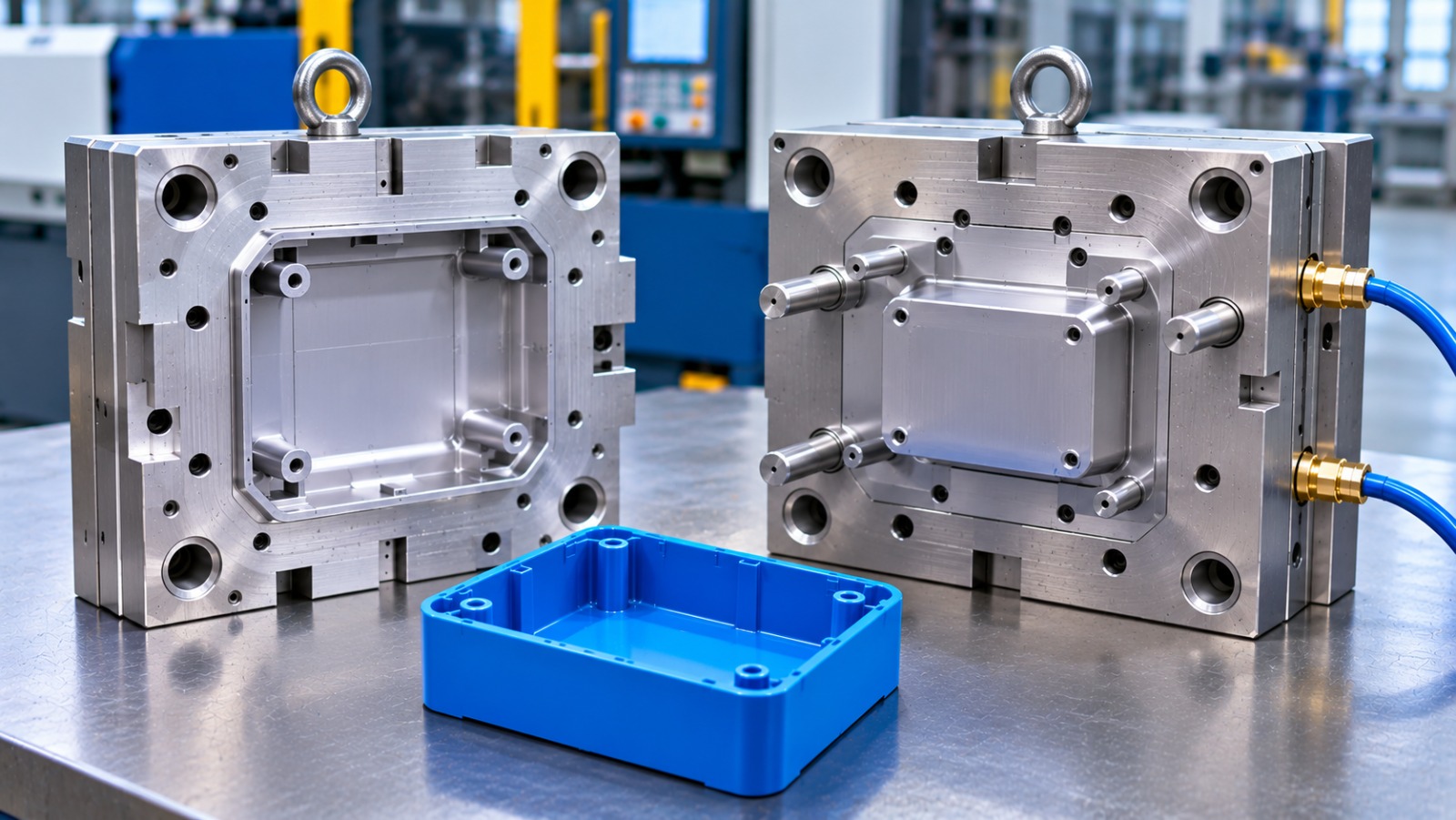
Core and cavity components are precision-machined sections of an injection mold that form the geometry of a plastic product.
Mold cavity: Generally forms the external shape and surface of the plastic component.
Mold core: Generally forms the internal shape, including holes, recesses, and hollow sections.
When the mold closes, the core and cavity create the required space fo
1. Understanding Injection Mold Cavity Components
The mold cavity is the section that creates the external geometry of a plastic product. It determines important features such as the outer dimensions, shape, and surface appearance.
For example, when manufacturing a plastic container, the cavity forms its outer walls and external contours.
Main functions of a mold cavity:
Creates the external shape of the product.
Determines outer dimensions and surface details.
Influences the final product’s appearance.
Helps maintain dimensional consistency.
Supports accurate plastic material formation.
Important Cavity Design Considerations
Manufacturers should consider several factors when designing a mold cavity:
Dimensional accuracy: Cavity dimensions must match the product specifications.
Surface finish: The cavity surface influences the appearance of the molded component.
Draft angles: Suitable draft angles help release the product from the mold.
Wall thickness: Proper geometry supports consistent material distribution.
Cooling arrangement: Effective cooling helps control shrinkage and warpage.
Accurate cavity design helps manufacturers produce plastic parts with consistent dimensions and surface quality.
2. Understanding Injection Mold Core Components
The mold core forms the internal geometry of a plastic component. It works with the cavity to create the complete product shape.
For example, in a plastic electrical enclosure, the core creates the internal space, mounting sections, and other internal features.
Main functions of a mold core:
Forms internal product geometry.
Creates holes, recesses, and internal sections.
Supports accurate wall thickness.
Helps define product dimensions.
Contributes to proper component formation.
Important Core Design Considerations
Core design requires careful planning to achieve accurate product dimensions and reliable mold operation.
Core strength: The material must withstand injection pressure and repeated production cycles.
Core alignment: Correct positioning helps maintain uniform wall thickness.
Draft angles: Suitable angles support smooth part ejection.
Cooling channels: Proper cooling helps maintain dimensional stability.
Machining accuracy: Precision machining supports correct product geometry.
3. Difference Between Mold Core and Cavity
Although core and cavity components work together, they perform different functions during injection molding.
Comparison | Mold Core | Mold Cavity |
|---|---|---|
Main function | Forms internal features | Forms external features |
Product geometry | Internal shape | External shape |
Typical features | Holes, recesses, internal walls | Outer walls, contours, surface details |
Design focus | Core strength and ejection | External dimensions and surface finish |
Manufacturing | CNC machining, EDM, grinding | CNC machining, EDM, grinding |
Quality influence | Internal dimensions and geometry | External dimensions and appearance |
Both components must fit accurately to produce the required plastic product.
4. Materials Used for Core and Cavity Manufacturing
Material selection plays an important role in injection mold manufacturing. Core and cavity materials should withstand repeated heating, cooling, pressure, and mechanical wear.
Commonly used materials include:
Material | Common Application |
|---|---|
P20 Tool Steel | General-purpose injection molds |
H13 Tool Steel | Applications requiring high-temperature resistance |
S136 Stainless Steel | Corrosion-resistant mold applications |
420 Stainless Steel | Selected applications requiring corrosion resistance and polishing |
Aluminium | Prototype and lower-volume tooling |
The appropriate material depends on production volume, plastic material, required surface finish, operating conditions, and expected mold life.
5. CNC Machining Processes for Core and Cavity Components
CNC machining is essential for manufacturing accurate core and cavity components. These parts often contain complex shapes, pockets, curves, and precision features that require controlled machining operations.
Common manufacturing processes include:
CNC Milling
CNC milling produces cavities, pockets, slots, contours, and complex surfaces. It is widely used for machining core and cavity inserts.
CNC Turning
CNC turning manufactures cylindrical mold components and inserts that require accurate diameters and concentric features.
EDM Machining
Electrical Discharge Machining (EDM) creates detailed shapes, narrow slots, and complex features that may be difficult to produce using conventional cutting tools.
Surface Grinding
Surface grinding produces flat and accurate mating surfaces. It also helps achieve the required dimensions and surface finish.
Drilling
Drilling creates holes for cooling channels, mounting points, and other functional features.
Selecting suitable machining operations helps manufacturers achieve the required geometry and surface quality.
6. Importance of Core and Cavity Alignment
Core and cavity alignment is essential for producing dimensionally accurate plastic components. Incorrect alignment can create uneven wall thickness, flash, dimensional variations, and other molding defects.
Manufacturers can improve alignment by:
Using accurate guide pins and guide bushings.
Maintaining precise mold base dimensions.
Inspecting core and cavity mating surfaces.
Checking alignment during mold assembly.
Performing trial molding and dimensional inspection.
Proper alignment supports reliable mold operation and consistent product quality.
7. Surface Finish Requirements for Core and Cavity
Surface finish affects the appearance, functionality, and release characteristics of molded plastic components.
Different products require different surface finishes depending on their applications.
Common finishing methods include:
CNC finishing operations.
Surface grinding.
Polishing.
Texturing.
EDM surface finishing.
For example, transparent plastic products may require highly polished mold surfaces, while certain consumer products may need textured finishes.
The required finish should be defined during the mold design stage.
8. Common Problems in Core and Cavity Manufacturing
Manufacturing defects can affect mold performance and increase production costs.
Common Problem | Possible Cause | Recommended Approach |
|---|---|---|
Dimensional inaccuracy | Incorrect machining | Use dimensional inspection |
Flash formation | Poor mold fit or excessive injection pressure | Check parting surfaces and molding conditions |
Uneven wall thickness | Core and cavity misalignment | Verify alignment and geometry |
Surface defects | Improper finishing | Apply suitable polishing or finishing |
Part sticking | Insufficient draft or unsuitable surface condition | Review draft angles and ejection design |
Warpage | Uneven cooling or material shrinkage | Improve cooling and review part design |
Identifying potential problems during design and machining can reduce rework and improve mold reliability.
9. Quality Inspection of Core and Cavity Components
Quality inspection ensures that manufactured mold components meet the required specifications before assembly.
Important inspection activities include:
Dimensional measurement.
Surface finish inspection.
Flatness and parallelism checks.
Core and cavity alignment verification.
Material and hardness verification, where specified.
Cooling channel inspection.
Final mold trial evaluation.
Suitable inspection methods depend on the component geometry and required tolerances.
10. How Core and Cavity Design Affects Plastic Part Quality
Core and cavity design directly influences the final appearance, dimensions, and functionality of molded products.
A properly designed mold helps achieve:
Consistent product dimensions.
Uniform wall thickness.
Better surface appearance.
Reliable part ejection.
Reduced molding defects.
Improved production consistency.
Therefore, manufacturers should consider product geometry, material properties, cooling requirements, and machining limitations before finalizing mold designs.
Why Precision Manufacturing Matters for Core and Cavity Components
Core and cavity components require accurate machining because even small dimensional variations can affect the final molded product.
Combining CNC milling, turning, EDM, grinding, and suitable finishing processes helps manufacturers produce complex mold geometries with controlled dimensions.
Proper machining and inspection also support accurate mold assembly, consistent production, and reduced correction work.
Conclusion
Core and cavity components are essential parts of every conventional injection mold. The cavity forms the external product geometry, while the core creates the internal features. Both components must be designed, machined, and aligned accurately to achieve the required product quality.
By selecting suitable materials, applying precision CNC machining, optimizing surface finishes, and performing proper quality inspections, manufacturers can improve mold performance and produce consistent plastic components.
Understanding these essential components helps manufacturers make informed decisions throughout the injection mold manufacturing process.
Frequently Asked Questions (FAQs)
1. What is the difference between an injection mold core and cavity?
The mold cavity generally forms the external shape of a plastic product, while the mold core forms its internal geometry. Both work together to create the finished component.
2. Which materials are used for injection mold cores and cavities?
Common materials include P20 tool steel, H13 tool steel, S136 stainless steel, 420 stainless steel, and aluminium. Selection depends on production requirements and application.
3. How are core and cavity components manufactured?
They are commonly manufactured using CNC milling, CNC turning, EDM, drilling, surface grinding, and polishing.
4. Why is core and cavity alignment important?
Correct alignment helps maintain uniform wall thickness, accurate dimensions, and proper mold closure. Poor alignment can lead to flash and other molding defects.
5. What causes surface defects in injection mold components?
Surface defects may result from machining errors, unsuitable finishing, tool marks, polishing problems, or incorrect mold design.
6. How does CNC machining improve core and cavity manufacturing?
CNC machining helps produce complex geometries, accurate dimensions, and repeatable features through controlled milling and turning operations.
7. Can core and cavity components be replaced separately?
In many mold designs, cores and cavities are manufactured as replaceable inserts. This allows damaged or worn components to be serviced without replacing the complete mold, provided the tooling design supports it.