Introduction
Injection molding is a widely used manufacturing process for producing plastic components with consistent dimensions, complex shapes, and smooth finishes. The quality and performance of the final product depend heavily on the design and construction of the injection mold.
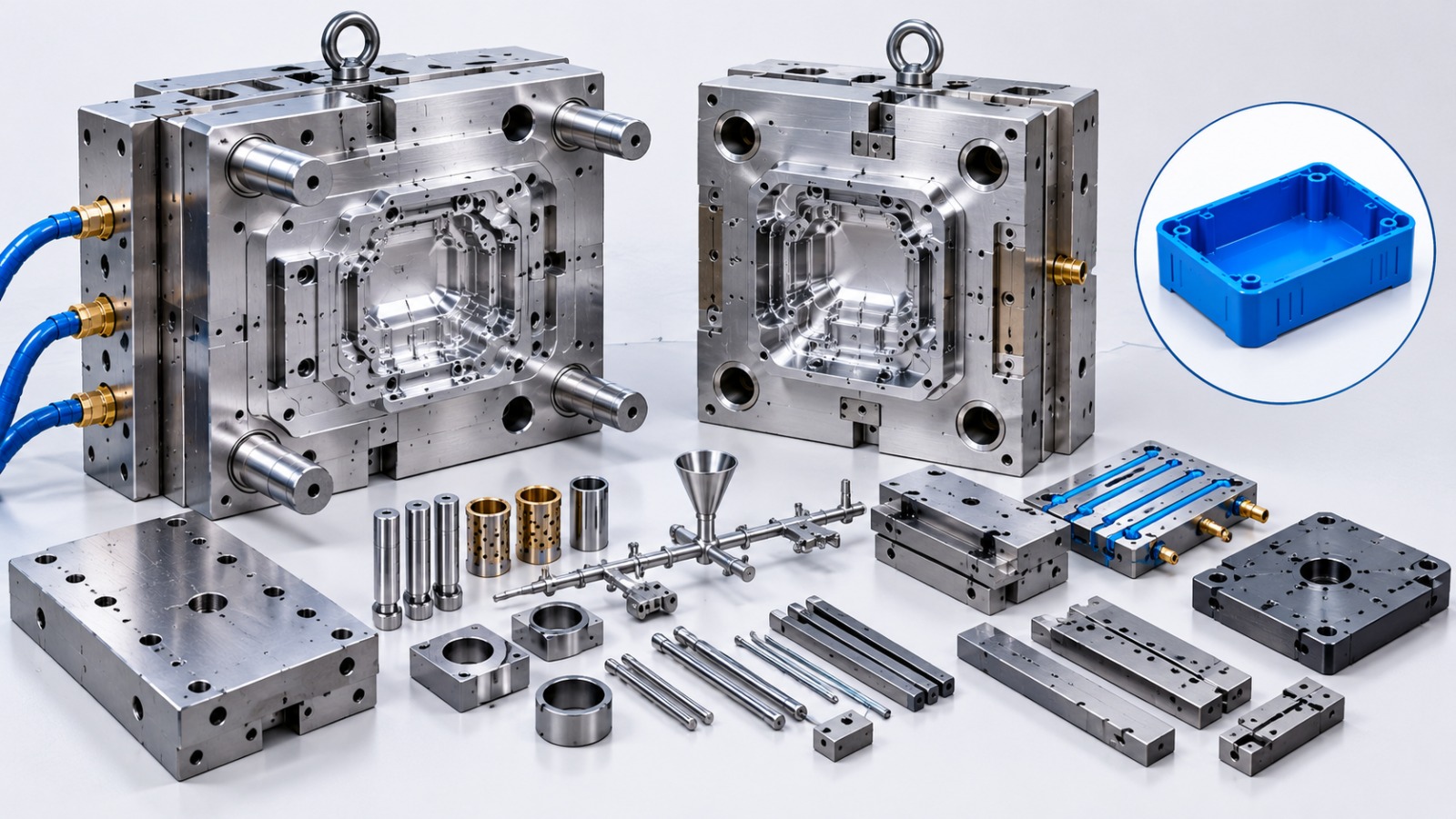
An injection mold consists of several essential components that work together to shape, cool, and eject plastic parts. Each component performs a specific function during the molding cycle. Understanding these parts helps manufacturers improve mold performance, reduce production defects, and maintain consistent product quality.
In this guide, we explain the essential components of an injection mold and their functions.
What Are the Main Components of an Injection Mold?
1. Mold Base
An injection mold contains several mechanical and functional components. The main parts include the mold base, cavity, core, sprue, runner, gate, cooling channels, ejector system, guide pins, and support plates.
Each component contributes to the overall molding process, from receiving molten plastic to releasing the finished part.
The mold base is the main supporting structure of an injection mold. It holds and aligns different mold components during operation.
It generally consists of several steel plates and mounting sections that provide stability and support.
Functions of a mold base:
Supports the cavity and core.
Holds mold components in their correct positions.
Provides mounting points for the injection molding machine.
Maintains structural stability during operation.
Supports the cooling and ejection systems.
A properly designed mold base helps maintain alignment and reliable mold operation.
2. Mold Cavity
The mold cavity is the section that forms the external shape of the plastic component. Molten plastic enters the cavity and takes its shape as it cools and solidifies.
The cavity design directly affects the appearance, dimensions, and surface finish of the final product.
Key functions:
Forms the external geometry of the component.
Determines important product dimensions.
Influences surface finish.
Helps maintain consistency between molded parts.
Accurate cavity machining is essential for producing plastic components that meet design specifications.
3. Mold Core
The mold core forms the internal features of a plastic component. It works together with the cavity to create the required product geometry.
For example, when manufacturing a plastic enclosure, the core helps form its internal space, walls, and other internal details.
Key functions:
Forms internal product features.
Helps create holes, recesses, and internal shapes.
Supports accurate component dimensions.
Works with the cavity to define the final part.
The core and cavity must align correctly to prevent dimensional problems and uneven wall thickness.
4. Sprue
The sprue is the main passage through which molten plastic enters the mold from the injection molding machine nozzle.
It directs the material toward the runner system, which distributes the plastic to the mold cavity or cavities.
Key functions:
Receives molten plastic from the machine nozzle.
Directs plastic into the runner system.
Provides a controlled material entry path.
Supports consistent material flow into the mold.
The sprue design should support smooth material flow and reduce unnecessary pressure loss.
5. Runner System
The runner system consists of channels that carry molten plastic from the sprue to the gate. In multi-cavity molds, runners distribute material to multiple cavities.
Proper runner design helps maintain balanced filling and consistent product quality.
Key functions:
Transfers molten plastic toward the cavities.
Distributes material in multi-cavity molds.
Supports balanced cavity filling.
Helps control material flow and pressure.
Runner dimensions and layout depend on the plastic material, part design, and number of cavities.
6. Gate
The gate is the small opening through which molten plastic enters the mold cavity from the runner system.
Gate position, size, and type influence filling behaviour, weld lines, surface appearance, and the ease of separating the molded part from the runner.
Key functions:
Controls plastic entry into the cavity.
Influences filling speed and flow patterns.
Helps control the location of weld lines.
Supports separation of the molded component from the runner.
Common gate types include edge gates, pin gates, fan gates, and submarine gates.
7. Cooling Channels
Cooling channels are passages inside the mold that circulate water or another suitable cooling medium. They help remove heat from the molten plastic after it enters the cavity.
Cooling is an important part of the injection molding cycle because it affects production time, shrinkage, and dimensional stability.
Key functions:
Removes heat from the mold.
Helps solidify molten plastic.
Reduces cooling time.
Supports consistent part dimensions.
Helps prevent uneven shrinkage and warpage.
An effective cooling layout distributes temperature more evenly throughout the mold.
8. Ejector System
The ejector system removes the solidified plastic component from the mold after cooling. It typically includes ejector pins, ejector plates, and related mechanical components.
When the mold opens, the ejector mechanism pushes the molded part away from the core.
Key functions:
Releases the molded component.
Reduces the risk of parts sticking inside the mold.
Supports repeatable part removal.
Helps maintain production cycle efficiency.
Ejector pin locations should be carefully planned to prevent marks, deformation, or damage to the finished component.
9. Guide Pins and Guide Bushings
Guide pins and guide bushings help align the two halves of an injection mold during opening and closing.
They maintain proper positioning between the core and cavity, which is essential for accurate molding.
Key functions:
Maintain mold alignment.
Support smooth opening and closing.
Reduce misalignment between mold halves.
Help protect cavity and core surfaces.
Accurate guide systems contribute to reliable mold operation and consistent part production.
10. Support Plates
Support plates provide additional structural strength to the mold assembly. They help distribute the forces generated during injection and clamping.
Key functions:
Support the mold structure.
Reduce excessive plate deflection.
Distribute operating loads.
Improve overall mold stability.
Proper plate thickness and support positioning help maintain mold performance under operating pressure.
11. Locating Ring
The locating ring positions the mold correctly against the injection molding machine. It helps align the sprue bushing with the machine nozzle.
Key functions:
Positions the mold on the machine.
Helps align the nozzle and sprue.
Supports accurate mold installation.
Reduces the risk of incorrect positioning.
12. Venting System
The venting system allows trapped air and gases to escape from the mold cavity as molten plastic enters.
Without proper venting, trapped air can contribute to burn marks, incomplete filling, and other molding defects.
Key functions:
Releases trapped air.
Helps prevent air-related defects.
Supports complete cavity filling.
Improves molded part quality.
Vent locations and dimensions must be designed according to the material and mold geometry.
Injection Mold Components and Their Functions
Component | Main Function |
|---|---|
Mold Base | Supports the mold assembly |
Mold Cavity | Forms the external shape |
Mold Core | Forms internal features |
Sprue | Transfers molten plastic from the machine nozzle |
Runner System | Distributes plastic to the gate |
Gate | Controls plastic entry into the cavity |
Cooling Channels | Remove heat from the mold |
Ejector System | Releases the molded part |
Guide Pins and Bushings | Maintain mold alignment |
Support Plates | Provide structural support |
Locating Ring | Positions the mold on the machine |
Venting System | Releases trapped air and gases |
How CNC Machining Supports Injection Mold Component Manufacturing
CNC machining plays an important role in producing accurate injection mold components. Mold cores, cavities, inserts, plates, and other precision parts require controlled dimensions and suitable surface finishes.
Manufacturers use different machining methods depending on the component geometry and material requirements.
CNC Milling: Produces mold cavities, pockets, slots, and complex surfaces.
CNC Turning: Manufactures cylindrical components such as pins and bushings.
EDM Machining: Creates detailed features and geometries that are difficult to machine using conventional cutting tools.
Surface Grinding: Achieves accurate dimensions and smooth mating surfaces.
Combining suitable machining processes with proper inspection helps ensure that mold components fit and function correctly.
Why Is Proper Injection Mold Component Design Important?
Every injection mold component contributes to the performance of the complete tooling system. Poor design or inaccurate machining can affect production efficiency and final part quality.
Proper component design helps manufacturers achieve:
Accurate plastic part dimensions.
Consistent surface finishes.
Balanced material flow.
Effective cooling performance.
Reliable part ejection.
Reduced maintenance requirements.
More consistent production cycles.
Therefore, manufacturers should consider component selection, material properties, machining accuracy, and mold assembly requirements during the design stage.
Conclusion
Injection molds contain several essential components that work together to produce accurate plastic parts. The mold base provides structural support, while the core and cavity create the product geometry. The sprue, runner, and gate control material flow, and the cooling and ejector systems support solidification and part removal.
Understanding these components helps manufacturers make better tooling decisions and improve production performance. In addition, precision CNC machining and proper mold design are important for achieving reliable injection mold components.
Frequently Asked Questions (FAQs)
1. What are the main components of an injection mold?
The main components include the mold base, core, cavity, sprue, runner, gate, cooling channels, ejector system, guide pins, support plates, locating ring, and venting system.
2. What is the difference between a mold core and cavity?
The cavity generally forms the external shape of the plastic part, while the core forms its internal features. Both work together to create the final component geometry.
3. What is the function of the ejector system?
The ejector system pushes the cooled and solidified plastic component out of the mold after the mold opens.
4. Why are cooling channels important in injection molds?
Cooling channels remove heat from the mold, help solidify the plastic, and influence cycle time, shrinkage, and dimensional consistency.
5. What is the purpose of a sprue and runner?
The sprue receives molten plastic from the machine nozzle. The runner system then carries and distributes the material toward the mold gate or gates.
6. How are injection mold components manufactured?
Injection mold components are commonly produced using CNC milling, CNC turning, EDM, drilling, and surface grinding, depending on their design and material.
7. Which components affect injection molding cycle time?
Cooling channels and the ejector system directly influence important stages of the molding cycle. Material flow and mold design also affect overall cycle performance.