
Introduction
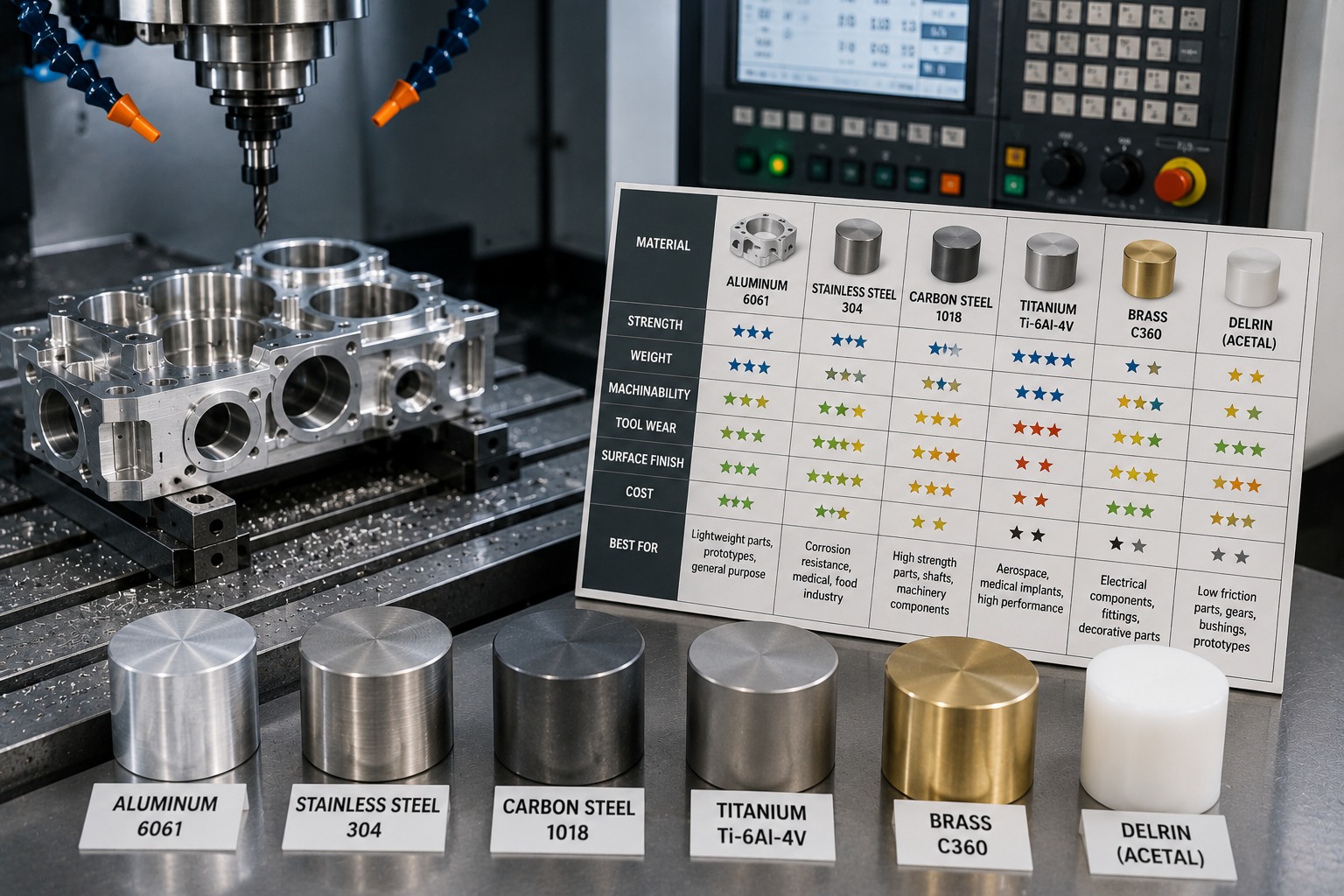
Material selection is one of the most important decisions when designing a CNC machined part. The material affects not only the strength, weight, durability, and performance of the finished component but also the machining time, tooling requirements, surface finish, and overall production cost .
Therefore, choosing a material simply because it meets the basic strength requirement may not always be the best approach. Engineers and manufacturers should also consider machinability, operating conditions, dimensional requirements, finishing needs, and production volume.
At Polymach365 , CNC machining supports a wide range of applications, including prototypes, custom components, low-volume production, and production parts. Selecting a suitable material at the beginning can help create a more efficient path from CAD design to finished component.
Why Material Selection Matters in CNC Machining
Every CNC material behaves differently during machining.
For example, aluminum is generally lightweight and relatively easy to machine, while titanium offers excellent strength-to-weight performance but can require more demanding machining conditions.
Similarly, engineering plastics can provide low weight and chemical resistance, but their thermal and mechanical properties differ significantly from metals.
Therefore, material selection influences several aspects of manufacturing:
- Machining speed
- Cutting tool life
- Cycle time
- Surface finish
- Dimensional stability
- Part weight
- Strength
- Wear resistance
- Corrosion resistance
- Production cost
As a result, selecting the right material requires balancing performance and manufacturing ability .
How Material Affects CNC Machining Cost
Material cost is only one part of the total machining cost.
A material that costs less per kilogram may still produce a more expensive component if it requires slower machining, specialized tooling, or additional finishing.
The overall cost can be influenced by:
- Raw material price
- Material availability
- Machining time
- Tool wear
- Cutting parameters
- Coolant requirements
- Setup requirements
- Surface finishing
- Inspection requirements
- Scrap and material waste
Therefore, material selection should be evaluated as part of the complete manufacturing process.
1. Material Price Influences Production Cost
The most obvious factor is the price of the raw material.
Common CNC materials include:
- Aluminum
- Stainless steel
- Carbon steel
- Tool steel
- Brass
- Copper
- Titanium
- Alloy steel
- ABS
- Nylon
- Delrin
- Polycarbonate
- PEEK
- PTFE
However, material price alone should not determine the final choice.
For example, selecting a cheaper material may reduce raw material expenses but increase machining time or finishing costs.
Consequently, the best material is usually the one that provides the required performance at an acceptable total manufacturing cost.
2. Machinability Affects CNC Cycle Time
Machinability describes how easily a material can be cut and shaped.
Materials with good machinability can often be processed efficiently with appropriate tooling and cutting parameters.
Poorly machinable materials may require:
- Lower cutting speeds
- Reduced feed rates
- Specialized tooling
- Additional passes
- More frequent tool replacement
Therefore, machinability can have a significant effect on CNC machining cycle time.
3. Material Hardness Affects Tool Wear
Harder materials can place greater demands on cutting tools.
For example, hardened steels may require suitable carbide tooling and carefully controlled cutting parameters.
As tool wear increases, manufacturers may experience:
- Reduced dimensional consistency
- Poorer surface finish
- Increased tool replacement
- Longer production times
Therefore, material hardness should be considered alongside tool selection and machining strategy.
4. Aluminum for Lightweight CNC Components
Aluminum is widely used for CNC machined components because it offers a useful combination of low weight, strength, corrosion resistance, and machinability .
It is commonly selected for:
- Housings
- Braces
- Fixtures
- Machine components
- Automotive components
- Prototypes
- Aerospace components
Furthermore, aluminum can often be machined efficiently with suitable cutting tools and parameters.
Therefore, it is a popular option when weight reduction and efficient machining are important.
5.Stainless Steel for Strength and Corrosion Resistance
Stainless steel is frequently selected when components require strength and resistance to corrosion.
Typical applications include:
- Industrial equipment
- Medical components
- Food-processing equipment
- Mechanical components
- Automotive parts
- Custom machinery
However, some stainless-steel grades can be more demanding to machine than aluminum.
Therefore, manufacturers may need to use appropriate tooling, cutting parameters, and coolant strategies.
As a result, stainless steel can provide excellent performance while requiring more machining consideration.
6. Carbon Steel for Mechanical Applications
Carbon steel can provide a useful combination of strength, durability, and cost.
It is commonly considered for:
- Machinery components
- Shafts
- Braces
- Fixtures
- Structural components
- Custom mechanical parts
However, the appropriate grade should be selected according to the component’s required mechanical and environmental properties.
Therefore, material grade is just as important as the general material category.
7. Titanium for High-Performance Components
Titanium provides an excellent strength-to-weight ratio and can perform well in demanding environments.
It is often associated with applications where weight reduction and high mechanical performance are important.
However, titanium can be more difficult and expensive to machine than many commonly used metals.
Therefore, machining titanium may require:
- Appropriate cutting tools
- Controlled cutting parameters
- Effective chip management
- Proper coolant application
- Careful tool-life monitoring
Consequently, titanium should be selected when its performance advantages justify the additional manufacturing requirements.
8. Brass and Copper for Specialized Components
Brass offers good machinability and is commonly used for components such as:
- Bushings
- Fittings
- Connectors
- Valves
- Precision mechanical parts
Copper, meanwhile, provides excellent electrical and thermal conductivity.
Therefore, copper can be useful for:
- Electrical components
- Heat-transfer components
- Conductive parts
- Specialized industrial applications
However, copper’s machining behavior differs from brass and aluminum, so tooling and cutting conditions should be selected accordingly.
9. Engineering Plastics for Lightweight Parts
CNC machining is not limited to metals.
Engineering plastics can be suitable for components that require:
- Low weight
- Electrical insulation
- Chemical resistance
- Low friction
- Dimensional stability
Common options include:
ABS
Useful for lightweight prototypes and general-purpose components.
Nylon
Often selected for wear-resistant and lightweight applications.
Delrin
Known for good machinability, low friction, and dimensional stability.
Polycarbonate
Provides impact resistance and transparency in suitable applications.
PEEK
Used in demanding environments where high temperature and chemical resistance are important.
PTFE
Known for low friction and chemical resistance.
Therefore, engineering plastics can provide useful alternatives to metals when the application allows.
How Material Affects Surface Finish
Material properties can influence the surface finish achievable through CNC machining.
A material’s hardness, toughness, thermal behavior, and cutting characteristics can affect how it responds to the cutting tool.
Therefore, the same machining strategy may not produce identical results across different materials.
Surface finish requirements may also influence the final manufacturing process.
For example, a component requiring a highly controlled surface may need:
- Specific tooling
- Optimized cutting parameters
- Additional finishing
- Careful inspection
Consequently, surface finish should be considered during material and process selection.
How Material Affects Dimensional Accuracy
Material behavior can also influence dimensional stability.
Some materials may respond differently to:
- Cutting heat
- Machining forces
- Tool pressure
- Temperature changes
- Workholding forces
Therefore, manufacturers need to consider these factors when machining precision components.
This becomes particularly important for parts with:
- Tight tolerances
- Thin walls
- Deep cavities
- Large dimensions
- Critical mating features
As a result, material selection and machining strategy should work together to achieve the required accuracy.
Material Selection and Tool Life
Different materials can produce different levels of cutting-tool wear.
A suitable material-tool combination can help improve:
- Tool life
- Machining consistency
- Surface quality
- Production efficiency
However, tool life also depends on cutting speed, feed rate, depth of cut, coolant, tool geometry, and machining strategy.
Therefore, material selection should never be considered separately from the tooling process.
Material Selection for CNC Milling
CNC milling is commonly used for components containing:
- Pockets
- Slots
- Holes
- Contours
- Mounting features
- Complex surfaces
Material selection affects how these features can be machined.
For example, a complex aluminum component may allow efficient material removal, while a similar geometry in a harder material may require different tooling and machining parameters.
Therefore, engineers should evaluate the material before finalizing the machining approach.
Material Selection for CNC Turning
CNC turning is ideal for cylindrical components such as:
- Shafts
- Pins
- Bushings
- Sleeves
- Spacers
- Rollers
- Threaded components
Material characteristics can affect turning speed, tool wear, chip formation, surface finish, and dimensional consistency.
Consequently, selecting an appropriate material can help improve both productivity and component performance.
Material Selection for Prototypes
Prototype requirements can differ from production requirements.
During early development, engineers may prioritize:
- Fast manufacturing
- Easy design changes
- Representative performance
- Reasonable cost
Therefore, the prototype material should be selected according to the purpose of testing.
If the prototype needs to replicate the mechanical behavior of the final component, using a production-equivalent material may be beneficial.
As a result, material selection can influence how accurately prototype testing represents the eventual product.
Material Selection for Low-Volume Production
Low-volume manufacturing often requires a balance between performance and cost.
For small production runs, manufacturers may prefer materials that are:
- Readily available
- Economical
- Easy to machine
- Suitable for the application
Therefore, choosing a material with good machinability can be particularly valuable when production quantities are limited.
Material Selection for Production Manufacturing
For larger production volumes, small differences in machining efficiency can become significant.
Suppose one material requires substantially more machining time per component. Across hundreds or thousands of parts, that difference can increase total manufacturing costs considerably.
Therefore, production material selection should consider:
- Raw material cost
- Cycle time
- Tool life
- Scrap rate
- Finishing
- Quality requirements
- Long-term component performance
Consequently, the cheapest raw material is not necessarily the cheapest manufacturing solution.
How to Choose the Right CNC Machining Material
A practical material-selection process can follow these steps:
1. Define the Application
Understand how the component will be used.
2. Identify Performance Requirements
Consider:
- Strength
- Weight
- Temperature
- Corrosion
- Wear
- Chemical exposure
- Electrical requirements
3. Consider Machinability
Determine how easily the material can be CNC machined.
4. Evaluate Material Availability
Check whether the required grade and size are readily available.
5. Compare Total Manufacturing Cost
Consider material, machining, tooling, finishing, and inspection.
6. Consider Production Quantity
A suitable material for a prototype may not always be the best choice for high-volume production.
7. Confirm Finishing Requirements
Make sure the selected material can achieve the required surface treatment and finish.
Therefore, this approach helps balance technical performance with manufacturing practicality.
Material Selection Mistakes to Avoid
Choosing Only Based on Price
A low-cost material may increase machining or finishing expenses.
Ignoring Machinability
A difficult-to-machine material can increase cycle time and tool wear.
Selecting the Wrong Grade
Different grades within the same material family can have very different properties.
Over-Specifying Material Performance
Choosing a premium material when a more economical option meets the application requirements can unnecessarily increase cost.
Ignoring Finishing Requirements
Some applications require coatings, anodizing, polishing, heat treatment, or other processes.
Therefore, material selection should consider the complete lifecycle of the component.
Material Selection and DFM
Material selection is also an important part of Design for Manufacture (DFM) .
A DFM review can evaluate whether the chosen material works effectively with the component’s:
- Geometry
- Tolerances
- Wall thickness
- Feature sizes
- Surface finish
- Machining process
As a result, engineers can identify potential manufacturing challenges before production begins.
How Polymach365 Supports Material-Based CNC Manufacturing
At Polymach365 , we provide digital manufacturing solutions for custom components, prototypes, low-volume production, and production parts.
Our CNC capabilities include:
- CNC Milling
- CNC Turning
- 3-Axis CNC Machining
- 4-Axis CNC Machining
- 5-Axis CNC Machining
- Prototype Manufacturing
- Low-Volume Production
- Custom CNC Machining
- Precision Machined Components
- Mold Components
Our workflow connects your CAD design with manufacturing:
Upload CAD File → Manufacturing Review → Quote → CNC Machining → Quality Inspection → Delivery
You can provide your required:
- Material
- Quantity
- Dimensions
- Tolerances
- Surface finish
- Finishing requirements
Therefore, your project can be evaluated according to both its technical and manufacturing requirements.
Final Thoughts
Material selection has a direct impact on CNC machining cost and component performance.
The right material should provide the required strength, durability, weight, corrosion resistance, temperature performance, and other application-specific properties. At the same time, it should be practical to machine within your required budget and production volume.
Therefore, engineers should evaluate material price, machinability, tool life, cycle time, tolerances, surface finish, finishing requirements, and application performance before making a final decision.
Whether you are manufacturing a prototype, custom component, low-volume batch, or production part, choosing the right material can help create a better balance between quality, performance, and manufacturing cost .
Start Your CNC Machining Project
Do you have a CAD design ready?
Submit your CAD file along with the material, quantity, tolerances, surface finish, and other requirements to start your CNC machining project with Polymach365.