Introduction
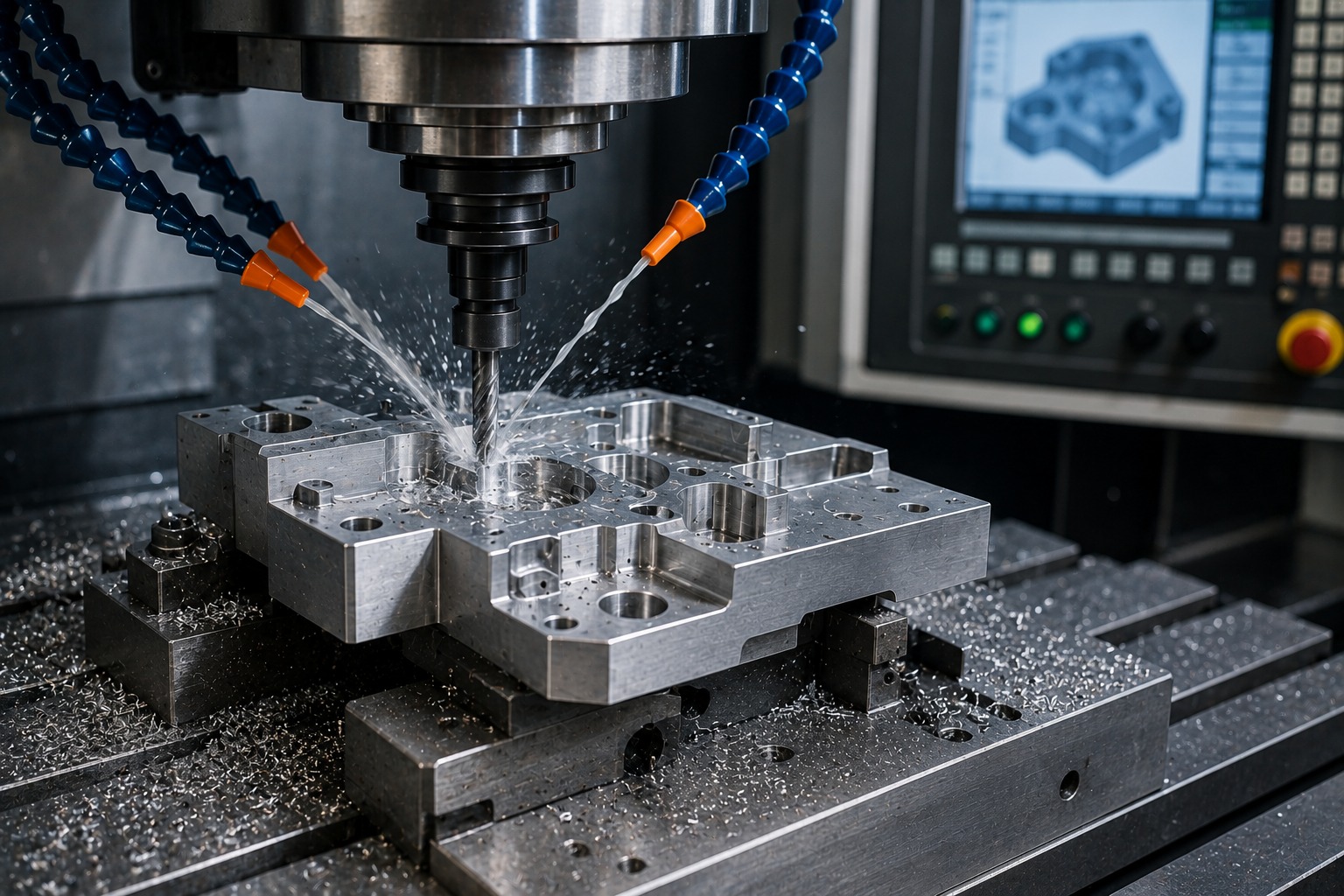
CNC milling is one of the most widely used manufacturing processes for producing custom metal parts, plastic components, prototypes, tooling, and precision machine components. It uses computer-controlled cutting tools to remove material from a workpiece and create a finished component based on a digital CAD design.
Unlike manual machining, CNC milling provides automated and repeatable tool movement. Therefore, manufacturers can produce complex geometries, accurate holes, pockets, slots, contours, and other features with consistent results.
For manufacturers, engineers, and product developers, understanding how CNC milling works, which machines are available, what materials can be machined, and when to use CNC milling can help make better manufacturing decisions.
At Polymach365, CNC manufacturing solutions support custom components, prototypes, low-volume production, and production requirements using modern CNC machining processes.
What Is CNC Milling?
CNC milling is a subtractive manufacturing process that uses computer-controlled cutting tools to remove material from a solid workpiece.
The term CNC means Computer Numerical Control. A CNC milling machine follows programmed instructions to control the movement of the cutting tool and, depending on the machine configuration, the workpiece.
The process can create a wide range of features, including:
- Holes
- Slots
- Pockets
- Threads
- Contours
- Flat surfaces
- Angled surfaces
- Complex 3D profiles
Therefore, CNC milling is suitable for both relatively simple components and highly complex parts.
How Does CNC Milling Work?
The CNC milling process starts with a digital design and ends with an inspected machined component.
A typical workflow is:
CAD Design → DFM Review → CAM Programming → Material Preparation → CNC Milling → Inspection → Finishing → Finished Part
1. Create the CAD Model
The engineer creates a 2D drawing or 3D CAD model of the required component.
The design defines the part’s geometry, dimensions, holes, pockets, contours, and other features.
2. Review the Design
Before machining, the design can be reviewed for manufacturability.
This step helps identify issues such as:
- Difficult tool access
- Extremely thin walls
- Deep pockets
- Small internal radii
- Unnecessary tight tolerances
As a result, manufacturers can address potential production problems before machining begins.
3. Prepare the CAM Program
CAM software converts the CAD geometry into machining toolpaths.
The program determines how the cutting tool should move, including:
- Tool selection
- Cutting paths
- Cutting depth
- Feed rate
- Spindle speed
- Machining sequence
4. Set Up the CNC Machine
The workpiece is secured using suitable workholding.
The cutting tools are installed, and the machine is prepared according to the programmed operation.
5. Machine the Component
The CNC machine follows the programmed toolpaths to remove material.
Depending on the design, several tools may be used to perform roughing, drilling, contouring, pocketing, and finishing operations.
6. Inspect the Finished Part
After machining, the component can be inspected to verify dimensions and other project requirements.
Therefore, inspection helps confirm that the finished part matches the approved design.
What Can a CNC Milling Machine Produce?
CNC milling can produce many different component geometries.
Common examples include:
Mechanical Components
- Brackets
- Mounting plates
- Housings
- Frames
- Fixtures
- Spacers
Precision Components
- Machine components
- Custom tooling
- Functional prototypes
- Assembly components
- Precision inserts
Complex Components
- Mold components
- Complex housings
- Multi-sided parts
- Components with angled surfaces
- 3D contoured parts
Therefore, CNC milling can support a wide range of manufacturing applications.
Types of CNC Milling Machines
Different CNC milling configurations are available depending on the component requirements.
3-Axis CNC Milling
A 3-axis machine typically moves the cutting tool along three primary axes.
It is suitable for many standard components containing:
- Pockets
- Holes
- Slots
- Flat surfaces
- Basic contours
Therefore, 3-axis milling is a practical option for many general-purpose CNC components.
4-Axis CNC Milling
A 4-axis machine adds rotational movement to the standard linear axes.
This can allow manufacturers to access additional surfaces without completely repositioning the component.
As a result, 4-axis machining can be useful for parts requiring features around multiple sides.
5-Axis CNC Milling
5-axis CNC machining provides additional movement and tool orientation capabilities.
It is particularly useful for complex components containing:
- Angled surfaces
- Deep cavities
- Complex contours
- Multi-sided features
- Difficult-to-access geometries
Therefore, 5-axis milling can reduce the need for multiple setups in suitable applications.
CNC Milling vs CNC Turning
CNC milling and CNC turning are both subtractive manufacturing processes, but they work differently.
CNC milling generally uses rotating cutting tools to remove material from a workpiece.
CNC turning rotates the workpiece while a cutting tool removes material.
Therefore:
- Milling is often suitable for prismatic and complex multi-feature parts.
- Turning is generally suited to cylindrical and rotational components.
Some components may require both processes.
For example, a part could be turned to create its primary cylindrical geometry and then milled to add slots, holes, or flat surfaces.
Materials Used for CNC Milling
CNC milling can be used with a broad range of materials.
Aluminum
Aluminum is widely used because it combines:
- Low weight
- Good machinability
- Useful strength
- Corrosion resistance
It is commonly used for prototypes, housings, brackets, machine components, and other custom parts.
Stainless Steel
Stainless steel is often selected when strength and corrosion resistance are important.
It can be used for industrial components, mechanical parts, and equipment applications.
Carbon Steel
Carbon steel can provide strength and durability for various mechanical components.
Brass
Brass offers good machinability and is frequently used for fittings, bushings, connectors, and other components.
Copper
Copper is useful where electrical or thermal conductivity is important.
Titanium
Titanium provides high strength relative to its weight and can be useful for demanding applications. However, it generally requires more careful machining conditions.
Engineering Plastics
CNC milling can also machine materials such as:
- ABS
- Nylon
- Delrin
- Polycarbonate
- PEEK
- PTFE
Therefore, material selection should depend on the component’s performance requirements as well as machining considerations.
What Are the Advantages of CNC Milling?
High Repeatability
Once the machining process has been programmed correctly, CNC equipment can repeat the same operations consistently.
Therefore, CNC milling is suitable for producing multiple components with consistent geometry.
Complex Geometries
Modern CNC milling machines can produce intricate shapes that may be difficult to manufacture using conventional machining methods.
Design Flexibility
Because CNC machining works from digital designs, engineers can modify the CAD model and produce revised components.
As a result, CNC milling works well during product development.
Suitable for Prototypes
CNC milling can produce functional prototypes from production-grade materials.
Therefore, engineers can evaluate fit, assembly, strength, and functionality before committing to larger production quantities.
Suitable for Production
CNC milling can also support repeated manufacturing of custom components.
Consequently, it can be used across different stages of the product lifecycle.
CNC Milling for Prototype Manufacturing
CNC milling is particularly useful when a prototype needs to represent the final component closely.
A typical development cycle is:
CAD Design → CNC Prototype → Testing → Design Improvements → Revised Prototype → Production
Because the machining process can use metals and engineering plastics, prototypes can provide useful information about real-world component performance.
Therefore, CNC milling can help engineers identify design problems before production scaling.
CNC Milling for Low-Volume Production
Not every project requires thousands of components.
Businesses may need small quantities for:
- Product testing
- Engineering validation
- Replacement components
- Specialized equipment
- Pilot production
- Small product runs
CNC milling can be a practical solution because it does not require dedicated injection-molding tooling for each component.
As a result, manufacturers can produce smaller quantities while maintaining control over component geometry.
CNC Milling for Custom Parts
Custom manufacturing often requires components that are not available as standard products.
CNC milling allows manufacturers to produce parts directly from CAD designs.
Typical custom components include:
- Machine brackets
- Mounting plates
- Custom housings
- Fixtures
- Tooling
- Mold components
- Mechanical components
Therefore, CNC milling is well suited to applications where standard off-the-shelf parts cannot meet the design requirements.
How to Design Parts for CNC Milling
Good design can make CNC milling more efficient.
Keep Tool Access in Mind
Cutting tools need sufficient access to the required features.
Use Practical Internal Radii
Internal corners naturally require cutting tools with a radius.
Therefore, extremely sharp internal corners may require specialized approaches.
Avoid Unnecessarily Deep Pockets
Deep narrow pockets can increase machining difficulty and tool deflection.
Use Appropriate Wall Thickness
Very thin walls can be more difficult to machine reliably.
Specify Functional Tolerances
Do not apply extremely tight tolerances to every feature unless they are necessary.
As a result, design-for-manufacturing considerations can improve production efficiency and help control costs.
What Affects CNC Milling Cost?
Several factors influence the cost of a milled component.
Material
Different materials have different raw material prices and machining characteristics.
Part Complexity
Complex geometry can require additional machining operations.
Machining Time
Longer cycle times generally increase manufacturing costs.
Number of Setups
Multiple setups may be necessary for multi-sided components.
Tolerances
Tighter tolerances may require additional process control and inspection.
Surface Finish
Additional finishing requirements can increase the overall cost.
Quantity
Larger production quantities can change the economics of machining.
Therefore, providing complete CAD and manufacturing requirements helps manufacturers evaluate the project more accurately.
CNC Milling Quality Control
Quality control is an important part of CNC manufacturing.
Depending on project requirements, manufacturers may inspect:
- Overall dimensions
- Hole diameters
- Feature locations
- Thickness
- Flatness
- Surface finish
- Critical tolerances
Inspection can take place during different stages of production.
Therefore, quality control helps identify dimensional problems before components move further through the manufacturing process.
CNC Milling Applications
CNC milling is used across many industries.
Automotive
Manufacturers use CNC milling for custom brackets, fixtures, housings, tooling, and mechanical components.
Aerospace
Precision-machined components can require complex geometries and controlled dimensions.
Robotics
Robotic systems often require custom mechanical components, mounting plates, brackets, and structural parts.
Industrial Machinery
CNC milling can produce replacement parts, machine components, fixtures, and tooling.
Product Development
Engineers can use CNC milling to create prototypes for functional testing.
Therefore, CNC milling has applications across both development and production environments.
Why Choose Polymach365 for CNC Milling?
At Polymach365, we provide digital manufacturing solutions for customers who need custom CNC components, prototypes, low-volume production, and production parts.
Our manufacturing capabilities include:
- CNC Milling
- CNC Turning
- 3-Axis Machining
- 4-Axis Machining
- 5-Axis Machining
- Prototype Manufacturing
- Low-Volume Production
- Custom CNC Parts
- Precision Machined Components
- Mold Components
Our digital workflow can connect your design with manufacturing:
Upload CAD File → Manufacturing Review → Quote → CNC Milling → Quality Inspection → Delivery
Therefore, you can move from a digital design toward a finished component through a streamlined manufacturing process.
Frequently Asked Questions About CNC Milling
Is CNC milling suitable for prototypes?
Yes. CNC milling can produce functional prototypes from metals and engineering plastics, making it useful for testing fit, function, and assembly.
What materials can be CNC milled?
Common options include aluminum, stainless steel, carbon steel, brass, copper, titanium, ABS, nylon, Delrin, polycarbonate, PEEK, and PTFE.
What is the difference between 3-axis and 5-axis CNC milling?
3-axis machining primarily moves along three linear axes, while 5-axis machining provides additional movement and tool-orientation capabilities for more complex geometries.
Is CNC milling suitable for low-volume production?
Yes. CNC milling can be suitable for one-off parts, prototypes, small batches, and low-volume production.
How do I get started with CNC milling?
Prepare your CAD model and provide the required material, quantity, tolerances, surface finish, and other specifications. These details help determine the appropriate manufacturing process.
CNC milling is a flexible and highly useful manufacturing process for producing custom components, prototypes, tooling, and production parts.
From simple brackets and mounting plates to complex multi-sided components, CNC milling can accommodate a wide range of geometries and materials.
Moreover, modern 3-axis, 4-axis, and 5-axis machining capabilities allow manufacturers to select a process according to the complexity of the component.
The best results come from combining an accurate CAD design with practical DFM principles, appropriate material selection, suitable tooling, controlled machining parameters, and effective quality inspection.
Whether you need a single prototype, small batch, custom component, or production part, CNC milling can provide a flexible route from digital design to finished component.
Have a CAD file ready?
Submit your design to Polymach365 with your material, quantity, tolerances, surface finish, and other requirements to begin your CNC milling project.