
Introduction
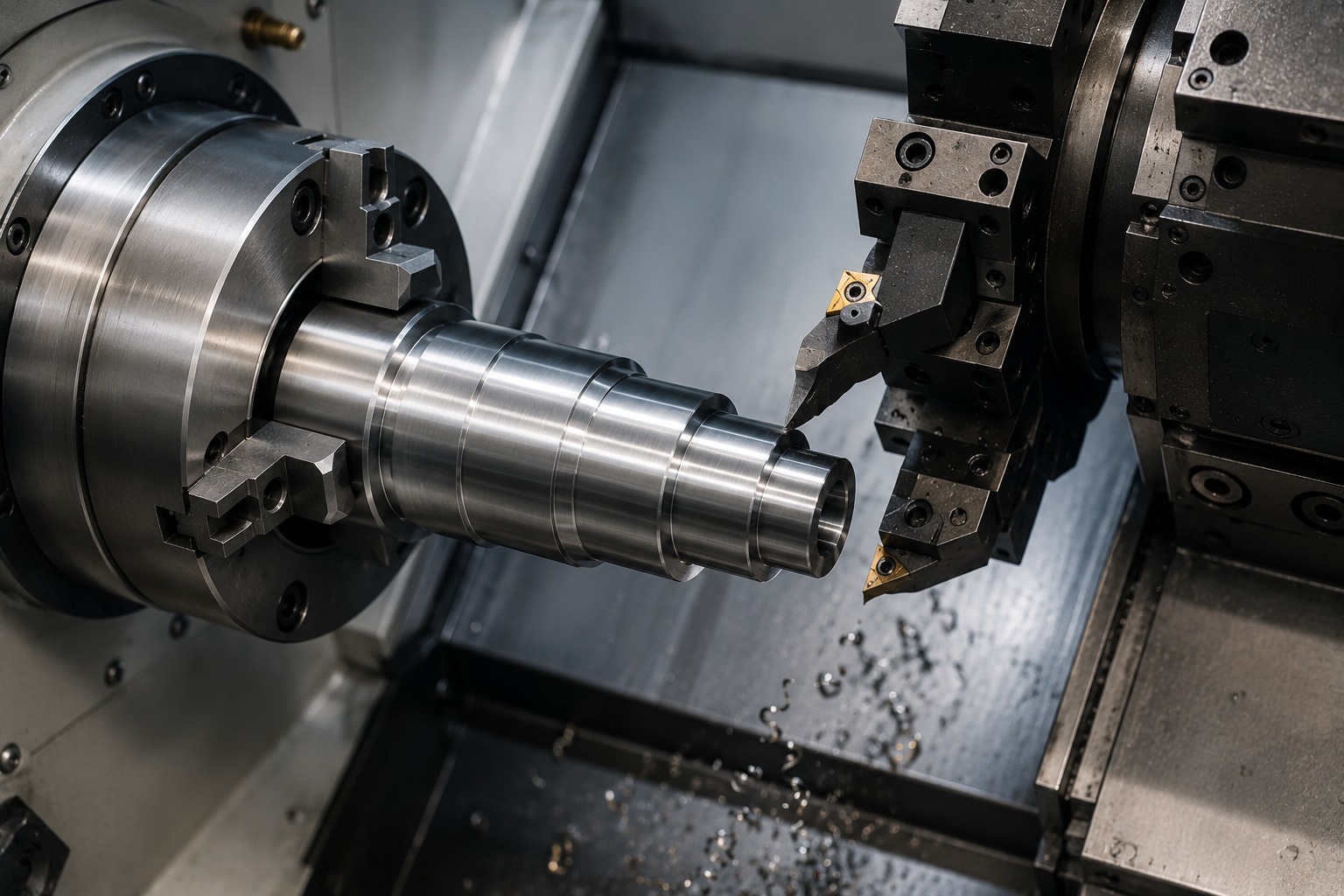
CNC turning is a widely used manufacturing process for producing cylindrical and rotational components with consistent dimensions and repeatable quality. It uses computer-controlled equipment to rotate a workpiece while cutting tools remove material according to programmed instructions.
From shafts and pins to bushings, sleeves, rollers, and threaded components, CNC turning can manufacture a wide range of custom parts. Therefore, it is an important process for industries that require accurate and repeatable rotational components.
At Polymach365, CNC manufacturing solutions support custom components, prototypes, low-volume production, and production parts using digital manufacturing workflows.
What Is CNC Turning?
CNC turning is a subtractive manufacturing process in which a workpiece rotates while a cutting tool removes material to create the required shape.
CNC stands for Computer Numerical Control. Instead of manually controlling the cutting operation, the machine follows programmed instructions generated from the component’s digital design.
CNC turning is particularly suitable for components with rotational geometry, including:
- Shafts
- Pins
- Bushings
- Sleeves
- Rollers
- Spacers
- Couplings
- Threaded components
- Cylindrical housings
As a result, CNC turning can produce both simple and complex rotational parts with repeatable dimensions.
How Does CNC Turning Work?
The CNC turning process typically follows these steps:
CAD Design → CAM Programming → Material Preparation → Machine Setup → CNC Turning → Inspection → Finishing → Delivery
1. CAD Design
The process begins with a digital CAD model or engineering drawing.
The design defines the required dimensions, diameters, lengths, threads, grooves, holes, and other features.
2. CAM Programming
CAM software converts the design into machine-readable toolpaths.
The program determines:
- Tool movements
- Cutting speeds
- Feed rates
- Cutting depths
- Machining sequence
3. Workpiece Setup
The raw material is secured in the machine using a chuck or another suitable workholding method.
The correct cutting tools are then installed.
4. Material Removal
The workpiece rotates while the cutting tool moves against it.
Material is gradually removed until the required geometry is achieved.
Different tools can be used for operations such as roughing, finishing, threading, grooving, and drilling.
5. Inspection
The finished component is inspected to verify dimensions and other specified requirements.
Therefore, inspection helps ensure the component matches the approved design.
What Parts Can Be Made Using CNC Turning?
CNC turning is ideal for components with rotational or cylindrical features.
Common CNC turned parts include:
Shafts
Used in machinery, motors, automation equipment, and mechanical assemblies.
Pins
Used for alignment, fastening, and mechanical connections.
Bushings
Used to reduce friction and support moving components.
Spacers
Used to maintain specific distances between components.
Sleeves
Used in mechanical and industrial assemblies.
Rollers
Used in machinery, material-handling systems, and automation.
Threaded Components
CNC turning can produce external and internal threaded features when appropriate tooling and processes are used.
Therefore, CNC turning can support many mechanical and industrial applications.
CNC Turning Process Operations
Different operations can be performed on a CNC turning machine depending on the part design.
Facing
Facing creates a flat surface on the end of the workpiece.
Turning
Turning reduces the diameter of the workpiece to the required dimension.
Boring
Boring enlarges or finishes an existing internal hole.
Drilling
Drilling creates holes in the workpiece.
Threading
Threading produces internal or external threads.
Grooving
Grooving creates narrow recesses or channels.
Parting
Parting separates the finished component from the remaining material.
Therefore, multiple turning operations can be combined to manufacture a complete component.
CNC Turning Machine Types
Different CNC turning machines are available for different manufacturing requirements.
CNC Lathe
A CNC lathe rotates the workpiece while cutting tools perform the required machining operations.
It is suitable for many standard cylindrical components.
CNC Turning Center
A turning center can combine turning with additional operations such as drilling and other machining processes.
As a result, it can reduce the need for transferring components between different machines.
Multi-Axis Turning
More advanced CNC turning equipment can provide additional machine movement and tooling capabilities for more complex components.
Therefore, the appropriate machine configuration depends on the geometry, quantity, and manufacturing requirements of the part.
Materials Used for CNC Turning
CNC turning can be performed on many metals and engineering plastics.
Common materials include:
- Aluminum
- Stainless steel
- Carbon steel
- Alloy steel
- Tool steel
- Brass
- Copper
- Titanium
- Nylon
- Delrin
- PEEK
- Other engineering plastics
Aluminum
Aluminum is widely used because it is lightweight and generally easy to machine.
Stainless Steel
Stainless steel is suitable when strength and corrosion resistance are important.
Brass
Brass offers good machinability and can be used for fittings, bushings, connectors, and other components.
Titanium
Titanium offers a high strength-to-weight ratio but requires careful machining conditions.
Therefore, material selection should consider both the required part performance and manufacturing requirements.
Benefits of CNC Turning
High Repeatability
Computer-controlled machining allows the same programmed operations to be repeated across multiple components.
Therefore, CNC turning is suitable for batch and production manufacturing.
Consistent Dimensions
Controlled machining parameters can help maintain consistent diameters, lengths, and other critical features.
Complex Rotational Components
CNC turning can produce components containing multiple diameters, grooves, threads, tapers, and other features.
Reduced Manual Intervention
Once the machine is properly programmed and set up, many machining operations can be performed automatically.
Suitable for Prototypes
CNC turning can produce functional prototypes directly from digital designs.
Suitable for Production
The process can also support repeated manufacturing of custom components.
As a result, CNC turning can be used throughout different stages of product development.
CNC Turning for Prototype Manufacturing
Product development often requires functional prototypes before production begins.
CNC turning allows engineers to create prototypes that closely represent the intended production component.
A typical workflow is:
CAD Design → Prototype Machining → Testing → Design Improvements → Production
This allows teams to evaluate:
- Fit
- Dimensions
- Assembly
- Function
- Mechanical performance
Therefore, CNC turning can help identify design issues before production quantities increase.
CNC Turning for Low-Volume Production
Many businesses require smaller quantities rather than thousands of components.
CNC turning can be suitable for:
- One-off parts
- Small batches
- Low-volume production
- Replacement components
- Engineering validation
- Specialized components
Because CNC turning does not require dedicated injection-molding tooling for each design, it can provide flexibility when component quantities are limited.
CNC Turning for Production Parts
Once a component design has been validated, CNC turning can support ongoing production.
Production turning focuses on:
- Repeatability
- Dimensional consistency
- Process control
- Tool management
- Quality inspection
- Production efficiency
Therefore, selecting a capable CNC manufacturing partner can help maintain consistency as production quantities increase.
CNC Turning vs CNC Milling
CNC turning and CNC milling use different machining approaches.
| CNC Turning | CNC Milling |
|---|---|
| Workpiece generally rotates | Cutting tool generally rotates |
| Best suited to rotational parts | Suitable for prismatic and complex parts |
| Common for shafts and bushings | Common for brackets and housings |
| Produces cylindrical features efficiently | Produces pockets, slots, contours, and flat surfaces |
| Ideal for many round components | Suitable for multi-feature components |
Some components require both processes.
For example, a shaft may first be turned to create its primary cylindrical geometry and then milled to add flats, slots, or other features.
What Affects CNC Turning Cost?
Several factors influence the cost of CNC turned components.
Material
Raw material cost and machinability affect manufacturing expenses.
Part Complexity
Additional features and operations can increase machining time.
Tolerances
Very tight tolerances may require additional process control and inspection.
Quantity
Production quantity affects setup and machining economics.
Tooling
Specialized tooling may be required for certain materials or features
Surface Finish
Additional finishing requirements can increase the total cost.
Therefore, providing a complete CAD model and clear specifications can help manufacturers determine the appropriate machining process.
How to Design Parts for CNC Turning
Good design practices can make CNC turning more efficient.
Use Practical Diameters
Select dimensions that can be efficiently machined using standard tooling where possible.
Consider Tool Access
Ensure the cutting tool can reach the required features.
Avoid Unnecessarily Deep Features
Deep holes and narrow grooves can increase machining difficulty.
Specify Necessary Tolerances
Only apply tight tolerances where they are functionally required.
Consider Threads Carefully
Thread specifications should clearly define the required size, pitch, and type.
As a result, designing with manufacturing considerations in mind can help reduce unnecessary machining complexity.
Quality Control in CNC Turning
Quality inspection is important for precision turned components.
Depending on the project requirements, manufacturers may inspect:
- Overall length
- Outside diameters
- Inside diameters
- Hole dimensions
- Thread dimensions
- Grooves
- Concentricity
- Surface finish
- Critical tolerances
Therefore, inspection helps verify that finished components meet the specified requirements.
Applications of CNC Turning
CNC turning is used across many industries.
Automotive
Used for shafts, bushings, pins, fittings, and other mechanical components.
Aerospace
Used for precision rotational components where dimensional consistency is important.
Robotics and Automation
Used for shafts, pins, spacers, couplings, and other robotic components.
Industrial Machinery
Used for machine components, replacement parts, rollers, and custom mechanical components.
Tooling and Manufacturing
Used for fixtures, tooling components, inserts, and other custom parts.
Therefore, CNC turning is an important manufacturing process for many industrial applications.
Why Choose Polymach365 for CNC Turning?
At Polymach365, we provide digital manufacturing solutions for custom CNC components, prototypes, low-volume production, and production manufacturing.
Our capabilities include:
- CNC Turning
- CNC Milling
- 3-Axis Machining
- 4-Axis Machining
- 5-Axis Machining
- Prototype Manufacturing
- Low-Volume Production
- Custom CNC Parts
- Precision Machined Components
- Mold Components
Our digital manufacturing workflow connects your CAD design with production:
Upload CAD File → Manufacturing Review → Quote → CNC Turning → Quality Inspection → Delivery
You can provide your required material, quantity, tolerances, surface finish, and other specifications so the appropriate manufacturing process can be determined.
Frequently Asked Questions
What is CNC turning used for?
CNC turning is primarily used to manufacture cylindrical and rotational components such as shafts, pins, bushings, sleeves, rollers, spacers, and threaded parts.
What materials can be CNC turned?
Common materials include aluminum, stainless steel, carbon steel, brass, copper, titanium, and various engineering plastics.
Is CNC turning suitable for prototypes?
Yes. CNC turning can produce functional prototypes directly from CAD designs and production-grade materials.
Can CNC turning be used for low-volume production?
Yes. It can be suitable for one-off components, small batches, replacement parts, and low-volume production.
What is the difference between CNC turning and CNC milling?
CNC turning generally rotates the workpiece while the cutting tool removes material, whereas CNC milling generally uses a rotating cutting tool to machine a stationary workpiece.
CNC turning is an efficient and versatile manufacturing process for producing accurate cylindrical and rotational components.
From prototypes and replacement parts to low-volume batches and production components, CNC turning can support a wide range of manufacturing requirements.
The right combination of CAD design, material selection, tooling, machining parameters, tolerances, and quality inspection helps achieve consistent results.
Whether you need a simple shaft or a complex turned component, CNC turning provides a practical route from digital design to a finished part.
Have a CAD design ready?
Submit your CAD file to Polymach365 with your material, quantity, tolerances, surface finish, and other requirements to begin your CNC turning project.