Introduction
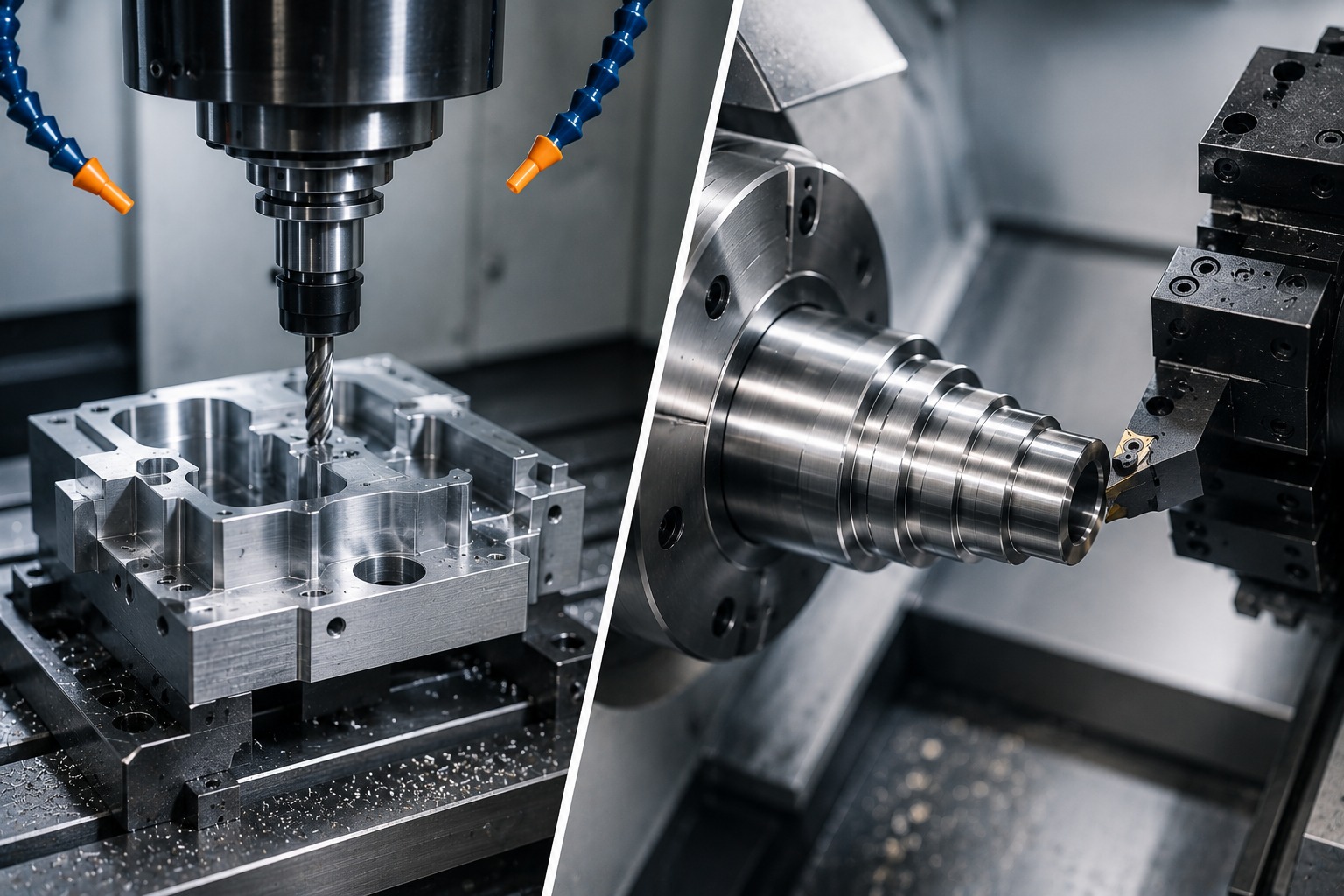
Choosing between CNC milling and CNC lathe machining is an important decision when manufacturing custom components. Although both are computer-controlled machining processes, they use different cutting methods and are designed for different types of part geometries.
CNC milling is generally suited to parts with flat surfaces, pockets, slots, holes, contours, and complex features, while CNC lathe machining is primarily used for round and rotational components such as shafts, pins, bushings, sleeves, and rollers.
Understanding the difference between CNC milling and CNC turning can help engineers and manufacturers select the right process based on the part design, material, tolerances, quantity, and production requirements.
At Polymach365, digital manufacturing solutions support CNC milling, CNC turning, multi-axis machining, prototypes, custom components, and production requirements.
What Is CNC Milling?
CNC milling is a subtractive manufacturing process that uses rotating cutting tools to remove material from a workpiece.
The cutting tool moves along programmed axes to create the required geometry. Depending on the machine configuration, CNC milling can produce features on multiple sides of a component.
Common CNC milling features include:
- Pockets
- Slots
- Holes
- Flat surfaces
- Contours
- Threads
- Angled surfaces
- Complex 3D profiles
Therefore, CNC milling is particularly useful for components with non-rotational or complex geometries.
What Is CNC Lathe Machining?
CNC lathe machining, commonly called CNC turning, rotates the workpiece while a cutting tool removes material.
The rotating workpiece allows the cutting tool to create cylindrical and rotational features.
Typical CNC lathe components include:
- Shafts
- Pins
- Bushings
- Sleeves
- Rollers
- Spacers
- Couplings
- Cylindrical housings
- Threaded components
As a result, CNC lathe machining is often the preferred process for round or rotational parts.
CNC Milling vs CNC Lathe: Key Difference
The main difference is how the workpiece and cutting tool move.
CNC Milling
The cutting tool rotates and moves around a generally stationary workpiece.
CNC Lathe
The workpiece rotates while the cutting tool moves against it.
This fundamental difference determines the types of geometries each machine can efficiently manufacture.
CNC Milling vs CNC Lathe Comparison
| Feature | CNC Milling | CNC Lathe |
|---|---|---|
| Primary movement | Rotating cutting tool | Rotating workpiece |
| Best for | Complex and prismatic parts | Cylindrical and rotational parts |
| Common features | Pockets, slots, holes, contours | Diameters, threads, grooves, tapers |
| Typical parts | Brackets, housings, plates | Shafts, pins, bushings |
| Multi-sided machining | Highly suitable | More limited depending on machine |
| Complex 3D geometry | Excellent with multi-axis machines | Better suited to rotational geometry |
| Common operations | Milling, drilling, pocketing | Turning, facing, boring, threading |
| Typical workpiece shape | Blocks, plates, irregular forms | Round bars and cylindrical stock |
When Should You Choose CNC Milling?
CNC milling is generally the better choice when your part contains multiple non-cylindrical features.
It can be particularly suitable for:
Complex Shapes
Components with irregular profiles and 3D contours can often be efficiently produced using CNC milling.
Pockets and Slots
If the design contains multiple pockets, slots, or recessed features, milling is typically appropriate.
Flat Surfaces
Mounting plates, brackets, housings, and similar components often require several machined flat surfaces.
Multiple Holes
CNC milling can efficiently create holes at different positions and orientations.
Multi-Sided Parts
4-axis and 5-axis machining can provide access to multiple surfaces without requiring as many separate setups.
Therefore, CNC milling is a versatile choice for many custom components.
When Should You Choose CNC Lathe Machining?
CNC lathe machining is generally preferred when the primary geometry is rotational.
It is commonly used for:
Shafts
Long cylindrical components used in machinery, motors, automation, and mechanical assemblies.
Bushings
Components designed to support movement and reduce friction.
Pins
Used for alignment, fastening, and mechanical connections.
Rollers
Used in machinery, automation, and material-handling equipment.
Sleeves and Spacers
Cylindrical components used in mechanical assemblies.
Threaded Components
CNC turning can produce external and internal threads using appropriate tooling and machining processes.
Therefore, if the majority of your component’s geometry revolves around a central axis, CNC lathe machining may be the more efficient option.
CNC Milling Operations
CNC milling machines can perform several different operations depending on the part design.
Face Milling
Creates flat surfaces on the workpiece.
Pocket Milling
Removes material from enclosed areas to create pockets.
Slot Milling
Creates channels and slots.
Drilling
Produces holes in specified locations.
Contour Milling
Machines external profiles and complex boundaries.
Thread Milling
Creates threaded features using specialized cutting tools.
As a result, multiple operations can often be combined within a single CNC milling setup.
CNC Lathe Operations
CNC lathes can also perform several operations.
Facing
Creates a flat end surface.
Turning
Reduces the diameter of the workpiece.
Boring
Machines or enlarges internal holes.
Drilling
Creates axial holes.
Threading
Produces internal or external threads.
Grooving
Creates narrow channels or recesses.
Parting
Separates the finished component from the remaining stock.
Therefore, CNC turning can manufacture a complete rotational component through a sequence of machining operations.
What About Complex Parts?
Some components cannot be classified as purely milling or turning parts.
For example, a component may have:
- A cylindrical body
- Multiple holes
- Flat surfaces
- Slots
- Threads
- Complex side features
In such cases, a combination of CNC turning and CNC milling may be appropriate.
The primary cylindrical geometry can be produced through turning, followed by milling operations for additional features.
Therefore, selecting a machining process should be based on the complete part geometry rather than just one feature.
3-Axis, 4-Axis, and 5-Axis CNC Milling
CNC milling capabilities vary depending on machine configuration.
3-Axis CNC Milling
Suitable for many standard components containing holes, pockets, slots, and flat surfaces.
4-Axis CNC Milling
Adds rotational movement, allowing additional surfaces to be machined without completely repositioning the workpiece.
5-Axis CNC Milling
Provides greater flexibility for complex geometries, angled surfaces, deep cavities, and multi-sided features.
Therefore, more advanced machining capabilities can be useful when a component has difficult-to-access features.
CNC Milling vs CNC Lathe for Prototypes
Both processes can be useful for prototype manufacturing.
Choose CNC Milling When:
- The prototype has complex geometry.
- The design contains multiple pockets or slots.
- Several flat surfaces are required.
- The part has multiple non-cylindrical features.
Choose CNC Lathe When:
- The prototype is primarily cylindrical.
- The component contains multiple diameters.
- Threads or grooves are important.
- The part rotates around a central axis.
Therefore, the prototype’s geometry should determine the appropriate machining process.
CNC Milling vs CNC Lathe for Production
Production requirements can also influence the choice.
CNC milling can efficiently manufacture repeated batches of complex custom components.
CNC turning can be highly efficient for repeated production of rotational components.
When the design is optimized for the appropriate process, manufacturers can potentially reduce:
- Machining time
- Tool changes
- Setup requirements
- Material waste
- Production costs
As a result, choosing the right machine at the beginning can improve overall manufacturing efficiency.
Material Considerations
Both CNC milling and CNC turning can work with a wide range of materials.
Common options include:
- Aluminum
- Stainless steel
- Carbon steel
- Alloy steel
- Brass
- Copper
- Titanium
- ABS
- Nylon
- Delrin
- Polycarbonate
- PEEK
- PTFE
However, different materials behave differently during machining.
Material hardness, machinability, thermal properties, and required surface finish can influence tooling and machining parameters.
Therefore, material selection should be considered alongside the machining process.
How Part Design Influences Machine Selection
The geometry of your part is one of the most important factors.
Before selecting CNC milling or CNC turning, consider:
Part Shape
Is the component primarily cylindrical or prismatic?
Feature Locations
Are features located on multiple sides?
Hole Orientation
Are the holes axial, radial, angled, or positioned on multiple surfaces?
Internal Features
Does the component require pockets, cavities, or internal bores?
Tolerances
Are certain dimensions critical to assembly or performance?
Production Quantity
Is the project a prototype, small batch, or production order?
Therefore, evaluating the complete design helps determine the most appropriate manufacturing approach.
Can One Part Require Both CNC Milling and CNC Turning?
Yes.
Some complex components benefit from both processes.
For example:
Raw Round Stock → CNC Turning → CNC Milling → Drilling → Inspection → Finishing
Turning can create the primary cylindrical geometry, while milling can produce flats, slots, pockets, and other features.
This approach can be particularly useful for components that combine rotational and prismatic features.
How to Choose the Right CNC Machining Process
A simple decision process can help:
Choose CNC Milling If:
- The part is mainly block-shaped or irregular.
- It requires pockets and slots.
- It has multiple flat surfaces.
- It contains complex contours.
- Features are required on multiple sides.
Choose CNC Lathe If:
- The part is mainly cylindrical.
- Multiple diameters are required.
- The component contains grooves or threads.
- The geometry is symmetrical around a central axis.
Consider Both If:
- The component combines cylindrical and non-cylindrical features.
- Turning can create the main body efficiently.
- Milling is required for secondary features.
Cost Factors to Consider
The cost of CNC milling or CNC lathe machining depends on several factors.
Material Cost
Different materials have different prices and machining characteristics.
Part Complexity
More complex components may require additional operations and setups.
Machining Time
Longer machining cycles generally increase manufacturing costs.
Tooling
Specialized tools may be required for certain materials and features.
Tolerances
Tight tolerances can require additional process control and inspection.
Quantity
Production quantity affects setup and manufacturing economics.
Therefore, the cheapest machine is not always the best option. The right process is the one that can manufacture the required geometry efficiently while meeting quality requirements.
Why Choose Polymach365?
At Polymach365, we support different CNC manufacturing requirements through digital manufacturing solutions.
Our capabilities include:
- CNC Milling
- CNC Turning
- 3-Axis Machining
- 4-Axis Machining
- 5-Axis Machining
- Prototype Manufacturing
- Low-Volume Production
- Custom CNC Parts
- Precision Machined Components
- Mold Components
Our digital workflow allows customers to move from design toward manufacturing:
Upload CAD File → Manufacturing Review → Quote → CNC Machining → Quality Inspection → Delivery
By reviewing the CAD design and manufacturing requirements, the appropriate CNC process can be selected for the component.
Frequently Asked Questions
Is CNC milling better than CNC lathe machining?
Neither process is universally better. CNC milling is generally better for complex and prismatic components, while CNC lathe machining is typically better for cylindrical and rotational parts.
Can a CNC lathe make square parts?
A standard CNC lathe is primarily designed for rotational machining. Additional milling capabilities or secondary operations may be required for substantial non-cylindrical features.
Can CNC milling make cylindrical parts?
Yes. CNC milling can create cylindrical features, but CNC turning is often more efficient when the component is primarily rotational.
Which is better for shafts: CNC milling or CNC turning?
CNC turning is generally the more suitable process for shafts because shafts are primarily cylindrical and rotational.
Which process is better for brackets?
CNC milling is generally more suitable for brackets because they commonly contain flat surfaces, holes, slots, and other non-rotational features.
Can one component use both processes?
Yes. Complex components can be turned first and then milled to create additional features.
CNC milling and CNC lathe machining are both valuable manufacturing processes, but each is designed for different types of component geometry.
CNC milling is generally the better choice for brackets, housings, plates, fixtures, pockets, slots, and complex multi-sided components. CNC lathe machining is typically better suited to shafts, pins, bushings, sleeves, rollers, spacers, and other rotational parts.
For components that combine both types of geometry, using CNC turning and CNC milling together can provide an efficient manufacturing solution.
The right choice ultimately depends on your part geometry, material, tolerances, surface requirements, quantity, and production goals.
Have a CAD design ready?
Submit your CAD file to Polymach365 with your material, quantity, tolerances, surface finish, and other requirements to determine the right CNC machining process for your part.