Improving Part Consistency, Accuracy, and Production Efficiency with CNC Manufacturing
Manufacturers often need to produce the same custom component multiple times while maintaining consistent dimensions, fit, and performance. This can be challenging when parts require complex geometries, tight tolerances, or multiple machining operations.
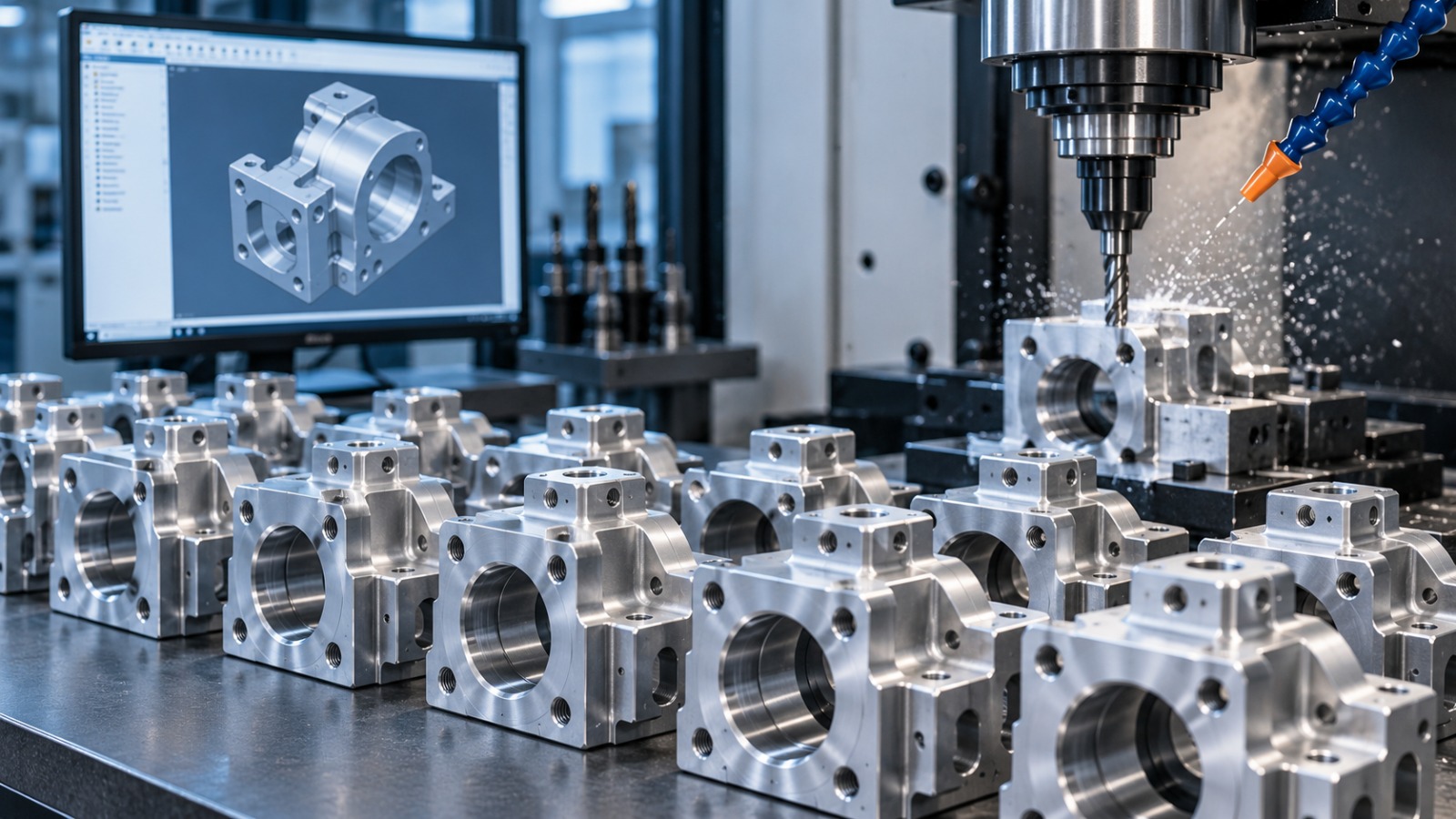
CNC machining helps manufacturers create repeatable custom parts by using programmed machining instructions, controlled cutting parameters, standardized setups, and quality inspection. Once a machining process has been properly developed and validated, the same digital instructions can be used to reproduce the component with consistent results.
For this reason, CNC machining is widely used for custom components, prototypes, replacement parts, low-volume batches, and production manufacturing.
What Does Repeatability Mean in CNC Machining?
Repeatability refers to the ability to manufacture multiple components that remain consistent with one another and meet the specified engineering requirements.
For example, if a manufacturer orders 100 custom brackets, each bracket may need to maintain the same:
- Overall dimensions
- Hole locations
- Hole diameters
- Thickness
- Surface finish
- Threads
- Critical tolerances
- Assembly fit
Therefore, repeatability is particularly important when components need to work together within an assembly.
CNC machining supports this consistency by controlling machining operations through programmed instructions rather than relying entirely on manual cutting and positioning.
How CNC Machining Creates Repeatable Custom Parts
Several factors work together to make CNC machining suitable for repeatable manufacturing.
1. Digital CAD-Based Manufacturing
CNC production generally starts with a digital CAD model or engineering drawing. The design provides the geometry and dimensional requirements that guide the manufacturing process.
The digital nature of CNC manufacturing makes it easier to maintain the same design information across repeated production runs.
Polymach365’s manufacturing workflow, for example, starts with uploading a 3D CAD file, followed by quoting and production. Supported formats include STEP, STL, IGES, SLDPRT, and ZIP.
As a result, manufacturers can establish a consistent digital foundation for producing custom components.
2. Consistent CNC Programs
Once the machining strategy has been established, CNC equipment follows programmed toolpaths to perform cutting operations.
The program can control:
- Tool movements
- Cutting paths
- Spindle speeds
- Feed rates
- Machining sequences
- Tool changes
- Workpiece coordinates
Consequently, repeated components can be manufactured using the same validated machining strategy.
This is one of the major differences between CNC machining and processes that depend heavily on manual operation.
3. Controlled Machining Setups
Workholding and positioning have a significant effect on repeatability.
If a component is repositioned differently for each operation, small variations can affect the final dimensions. Therefore, establishing a reliable workflow and setup strategy is important for repeated manufacturing.
Reducing unnecessary setups can also improve consistency because every additional repositioning can introduce positioning variation. For suitable complex components, multi-axis machining may reduce the number of repositioning operations required.
4. Tool Management and Tool Wear Control
Cutting tools gradually wear during machining.
As a tool becomes worn, it can affect:
- Dimensional accuracy
- Surface finish
- Cutting performance
- Feature geometry
- Production consistency
Therefore, monitoring tool condition is particularly important during repeated production.
Manufacturers can use appropriate tool selection, tool-life management, offsets, and inspection procedures to identify changes before they significantly affect component quality.
5. Machine Calibration
CNC machine condition also affects repeatability.
Machine components, spindle systems, guideways, ball screws, and other mechanical elements can influence positioning performance over time. Calibration and verification help manufacturers maintain accurate machine movement and identify potential issues.
Important areas include:
- Axis positioning
- Machine geometry
- Spindle alignment
- Tool offsets
- Positioning repeatability
Therefore, maintaining the machine is an essential part of producing consistent components.
6. Consistent Material Selection
Material properties can also influence manufacturing consistency.
Different materials behave differently during cutting. Factors such as hardness, thermal expansion, machinability, and material stability can affect the machining process.
Common CNC materials include:
- Aluminum
- Stainless steel
- Carbon steel
- Brass
- Copper
- Titanium
- ABS
- Nylon
- Delrin
- PEEK
Selecting a suitable material and maintaining consistent material specifications can help reduce variation between production batches.
7. Design for Manufacture
A component’s design can have a greater impact on repeatable production.
Features such as extremely thin walls, deep cavities, narrow slots, small internal radii, and difficult-to-access surfaces may require specialized tooling or additional setups.
Therefore, Design for Manufacture (DFM) should be considered before production begins.
A CNC-friendly design can help improve:
- Dimensional consistency
- Tool accessibility
- Surface finish
- Assembly fit
- Machining efficiency
- Repeatability
DFM can also help identify potential manufacturing problems before they become production issues.
8. Quality Inspection
Repeatability cannot be established simply by running the same CNC program repeatedly. Manufacturers also need to verify the results.
Quality inspection can include checking:
- Critical dimensions
- Hole locations
- Diameters
- Thickness
- Flatness
- Surface finish
- Threads
- Geometric features
Inspection results can then be used to identify process variation and make necessary adjustments.
As a result, quality control becomes an important part of maintaining repeatable custom parts.
CNC Milling and Turning for Repeatable Components
Different component geometries require different machining processes.
CNC Milling
CNC milling is commonly used for custom components with:
- Pockets
- Slots
- Holes
- Flat surfaces
- Complex profiles
- Mounting features
- Contoured surfaces
It is suitable for brackets, housings, fixtures, plates, tooling, and many other custom components.
CNC Turning
CNC turning is generally used for rotational components such as:
- Shafts
- Pins
- Bushings
- Sleeves
- Spacers
- Rollers
- Threaded components
Choosing the appropriate machining process can improve both production efficiency and consistency.
The Role of Multi-Axis CNC Machining
Complex custom parts may require multiple machining orientations.
Using 4-axis or 5-axis machining can provide access to multiple surfaces and complex features without requiring as many separate setups.
This can be beneficial because reducing repositioning operations can help minimize potential setup variation.
However, not every component requires multi-axis machining. The appropriate process should be selected according to the part geometry, tolerances, material, quantity, and production requirements.
Repeatability for Prototypes and Low-Volume Production
Repeatability is not limited to large production runs.
Manufacturers may need consistent components for:
- Prototype testing
- Pilot production
- Engineering validation
- Replacement parts
- Specialized equipment
- Small production batches
- Product development
CNC machining can support these applications because the same digital design and manufacturing approach can be applied as the project progresses from prototype to production. Polymach365 supports prototypes, low-volume production, custom CNC machining, and production components.
From Prototype to Repeatable Production
A typical manufacturing process can follow this path:
CAD Design → DFM Review → Prototype → Testing → Process Validation → Production → Inspection
During prototyping, manufacturers can identify design or machining issues.
After the design is approved, the machining process can be refined for production. Once the process is established, manufacturers can focus on maintaining consistency across repeated orders.
This makes CNC machining particularly useful when a product needs to transition from development into regular manufacturing.
Benefits of Repeatable Custom CNC Parts
Consistent CNC manufacturing can provide several advantages:
Better Assembly Fit
When critical dimensions remain consistent, components are more likely to fit together correctly.
Reduced Rework
Consistent production can reduce the number of components requiring adjustment or rework.
Predictable Performance
Parts manufactured within their required specifications can provide more predictable functional performance.
Easier Replacement
Repeatable manufacturing makes it easier to reproduce replacement components later.
Production Efficiency
Once a machining process is established, repeated orders can be manufactured using a proven workflow.
Scalable Manufacturing
A validated CNC process can support the transition from prototypes to low-volume and production quantities.
How Polymach365 Supports Repeatable Custom Parts
Polymach365 provides CNC manufacturing capabilities for custom components, prototypes, and production requirements.
Its capabilities include:
- CNC Milling
- CNC Turning
- 3-Axis Machining
- 4-Axis Machining
- 5-Axis Machining
- Custom CNC Components
- Prototype Manufacturing
- Low-Volume Production
- Precision Machined Components
- Mold Components
Its digital workflow connects CAD designs with manufacturing through:
Upload CAD File → Quote → CNC Production → Quality Inspection → Delivery
By combining digital design information, appropriate machining processes, manufacturing review, and inspection, manufacturers can create a more consistent path from the first custom component to repeated production.
Frequently Asked Questions
Why is repeatability important in CNC machining?
Repeatability helps ensure that multiple components maintain consistent dimensions, tolerances, geometry, and functional performance.
Can CNC machining produce the same custom part repeatedly?
Yes. Once the design, machining program, tooling, workholding, and process have been established, CNC equipment can reproduce the component using the same manufacturing instructions.
What affects CNC part repeatability?
Machine condition, tool wear, workholding, material properties, machining parameters, programming, temperature, part design, number of setups, and inspection can all affect repeatability.
Is CNC machining suitable for small batches?
Yes. CNC machining can be used for prototypes, small batches, low-volume production, replacement parts, and larger production requirements.
How can manufacturers improve CNC repeatability?
Start with an accurate CAD design, apply DFM principles, use appropriate workholding, maintain machine calibration, manage tool wear, control machining parameters, and inspect critical features throughout production.
Final Thoughts
CNC machining helps manufacturers create repeatable custom parts by combining digital design, programmed machining, controlled setups, tool management, machine maintenance, and quality inspection.
However, repeatability does not depend on the CNC machine alone. The entire manufacturing process must be controlled—from CAD design and material selection to workholding, tooling, machining strategy, and final inspection.
By establishing a reliable process early, manufacturers can move more confidently from prototype development to low-volume production and repeat manufacturing .
Whether you need a single custom component or repeated production parts, a well-planned CNC machining process can provide the consistency needed for reliable manufacturing.
Start Your Custom CNC Manufacturing Project
Have a custom component ready for production?
Upload your CAD file and provide your material, quantity, tolerances, surface finish, and other requirements to get started with Polymach365.