
Injection Mold Manufacturing & Design: Process, Benefits, and Key Considerations
Injection molding is one of the most widely used manufacturing processes for producing plastic components in large quantities. However, the quality of the finished product depends heavily on the design, material selection, and manufacturing accuracy of the injection mold.
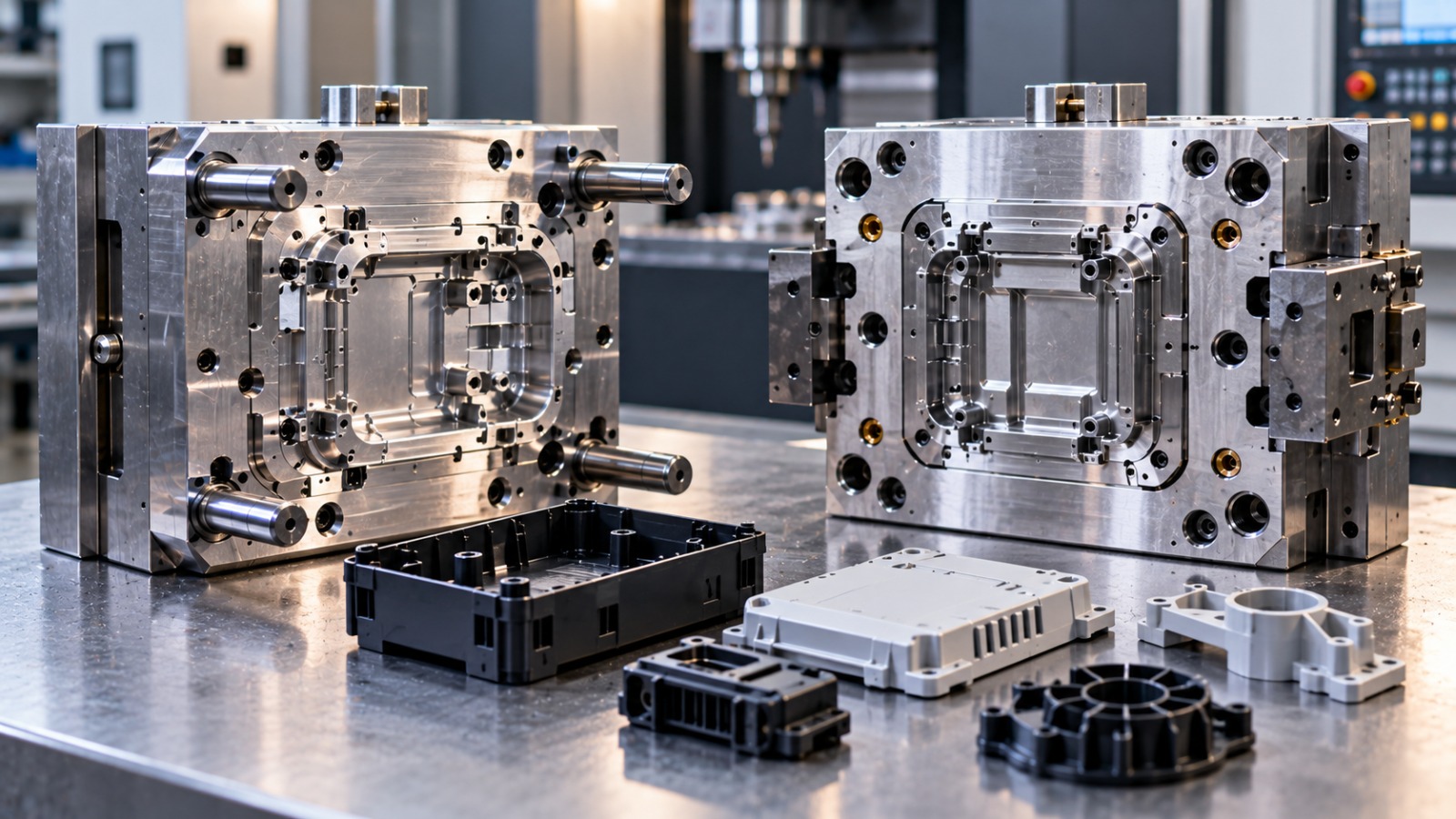
Injection mold manufacturing and design involve developing and producing specialized tools that shape molten plastic into specific component geometries. A properly designed mold helps manufacturers achieve consistent dimensions, repeatable production, and reliable product quality.
From automotive components and electronic housings to industrial equipment and consumer products, injection molds support a wide range of manufacturing applications. Understanding the mold design process and manufacturing requirements helps businesses make better decisions before starting production.
In this guide, we explore how injection molds are designed and manufactured, the different mold components, important design considerations, and the benefits of precision mold production.
What Is Injection Mold Manufacturing?
Injection mold manufacturing is the process of designing and producing a specialized tool used to manufacture plastic components through injection molding.
The mold contains precisely machined cavities that define the shape and dimensions of the finished component. During production, molten plastic enters the mold under controlled pressure. Once the material cools and solidifies, the mold opens and releases the finished part.
Injection molds are commonly manufactured using materials such as tool steel and aluminum, depending on production volume, plastic material, component complexity, and expected tool life.
The manufacturing process typically involves CAD design, engineering analysis, material selection, CNC machining, finishing, mold assembly, and testing.
What Is Injection Mold Design?
Injection mold design is the engineering process of creating a mold that can produce a plastic component according to its required dimensions, geometry, and functional specifications.
A mold designer evaluates the product design and determines how the plastic will enter, fill, cool, and exit the mold.
The design must also account for material shrinkage, wall thickness, draft angles, parting lines, cooling channels, and ejection mechanisms.
Effective mold design is important because design-related problems can affect product quality, cycle time, manufacturing costs, and overall production efficiency.
What Are the Main Components of an Injection Mold?
An injection mold contains several components that work together to shape and release the finished plastic part.
1. Cavity
The cavity forms the external shape of the plastic component. Its dimensions and surface finish influence the appearance and geometry of the finished product.
2. Core
The core forms the internal features of the component. It works with the cavity to create the required product geometry.
3. Runner System
The runner system directs molten plastic from the injection machine nozzle toward the mold cavities.
Its design affects material flow, pressure distribution, and filling performance.
4. Gate
The gate is the opening through which molten plastic enters the cavity. Gate location, size, and type influence filling behavior, weld lines, and the appearance of the finished component.
5. Cooling System
Cooling channels circulate a cooling medium through the mold to remove heat from the molten plastic.
Proper cooling helps control solidification, dimensional stability, and production cycle time.
6. Ejection System
The ejection system removes the solidified component from the mold after cooling.
It may include ejector pins, sleeves, or other mechanisms depending on the part geometry.
7. Mold Base
The mold base supports and holds the major mold components together. It provides the structural foundation for the complete tooling assembly.
What Are the Important Factors in Injection Mold Design?
A successful injection mold requires careful engineering decisions. The following factors influence mold performance and finished component quality.
Part Geometry and Complexity
The component design determines the mold’s cavity structure, core arrangement, parting line, and ejection requirements.
Complex geometries may require side actions, lifters, inserts, or specialized tooling features.
Wall Thickness
Consistent wall thickness helps promote more uniform cooling and reduce potential defects.
Significant variations in wall thickness can contribute to sink marks, warpage, and uneven solidification.
Draft Angles
Draft angles allow plastic components to release more easily from the mold.
Without suitable draft, parts may stick to the cavity or core, resulting in surface damage or ejection difficulties.
Material Shrinkage
Plastic materials shrink as they cool and solidify. Therefore, mold dimensions must account for the expected shrinkage of the selected material.
Different plastics have different shrinkage characteristics, so material selection should be considered during the design stage.
Parting Line
The parting line is where the mold’s two primary sections meet. Its position affects mold construction, part appearance, flash formation, and component release.
Gate Location and Runner Design
The gate and runner system must support appropriate plastic flow into the mold cavity.
Poor flow design may lead to incomplete filling, weld lines, air traps, or inconsistent part quality.
Cooling Channel Layout
Cooling channel placement influences how heat is removed from the mold.
An effective cooling layout helps maintain consistent temperatures and supports repeatable production cycles.
Ejection Mechanism
The ejection system must remove components without damaging their surfaces or geometry.
The placement of ejector pins and other mechanisms should account for the part’s shape, material, and structural strength.
What Are the Common Applications of CNC Metal Prototypes?
Injection mold manufacturing follows several engineering and production stages. Each stage contributes to the accuracy, functionality, and reliability of the finished mold.
Step 1: Product Design and Requirement Analysis
The process begins with the plastic component’s CAD model, technical drawings, and application requirements.
The engineering team reviews the product dimensions, geometry, material, production quantity, and quality expectations.
Step 2: Mold Design and Engineering
The mold is designed using CAD software. The design defines the cavity, core, runner system, gate, cooling channels, and ejection arrangement.
Where appropriate, mold flow analysis can help evaluate plastic filling, cooling behavior, and potential design issues before tooling production.
Step 3: Mold Material Selection
The mold material depends on production volume, plastic type, required surface finish, and expected tool life.
Common options include:
Tool Steel: Suitable for many high-volume and demanding tooling applications.
Pre-Hardened Steel: Offers a balance of machinability and strength for selected mold applications.
Aluminum: Often considered for prototypes, development tooling, and lower-volume production.
Stainless Steel: Used for specific applications where corrosion resistance and other material properties are important.
The final selection should match the project’s engineering and production requirements.
Step 4: CNC Machining
CNC machining produces the mold’s cavity, core, mold plates, and other precision features.
Depending on the design, manufacturers may use CNC milling, CNC turning, drilling, and other machining operations.
These processes help achieve the required geometry and dimensional specifications.
Step 5: EDM and Precision Finishing
Electrical Discharge Machining (EDM) may be used to create detailed features, sharp internal corners, and geometries that are difficult to produce through conventional machining.
Additional operations may include grinding, polishing, and surface finishing to achieve the required dimensions and mold surface quality.
Step 6: Mold Assembly
The manufactured mold components are assembled into a complete tooling system.
The assembly includes the core, cavity, mold base, cooling system, runner components, and ejection mechanism.
Step 7: Mold Testing and Trial Production
The completed mold is tested using an injection molding machine.
Trial production helps evaluate filling, cooling, ejection, dimensions, and surface appearance. Adjustments may be required to improve the mold’s performance.
Step 8: Final Inspection and Production Preparation
The mold and sample components are reviewed against the agreed specifications.
Once the tooling meets the required criteria, it can be prepared for regular injection molding production.
What Are the Different Types of Injection Molds?
Injection molds can be classified according to their construction, cavity arrangement, and production requirements.
Single-Cavity Mold
A single-cavity mold produces one component per molding cycle.
It is often suitable for prototypes, specialized parts, and applications where production quantities are relatively limited.
Multi-Cavity Mold
A multi-cavity mold produces multiple identical components during one molding cycle.
It can improve production output when businesses need large quantities of the same component.
Family Mold
A family mold contains multiple cavities designed to produce different but related components within one cycle.
The design requires careful consideration of cavity filling and material flow because different parts may have different geometries and filling requirements.
Two-Plate Mold
A two-plate mold uses two primary mold halves that separate along a parting line.
It is a common mold configuration for many injection molding applications.
Three-Plate Mold
A three-plate mold includes an additional plate that helps separate the runner system from the molded components.
It can support specific gating arrangements and component designs.
Hot Runner Mold
A hot runner system maintains the plastic material in a heated runner system as it moves toward the cavities.
This can reduce runner waste and support efficient production, depending on the application.
Cold Runner Mold
A cold runner system allows the plastic in the runner channels to cool and solidify along with the molded component.
The runner material is separated after ejection and may require additional handling or recycling.
Which Materials Are Commonly Used for Injection Molded Products?
Selecting the right plastic material is essential for product performance, durability, and manufacturing efficiency.
Common injection molding materials include:
ABS (Acrylonitrile Butadiene Styrene): Used for housings, enclosures, consumer products, and components requiring impact resistance.
Polypropylene (PP): A lightweight plastic commonly used for packaging, automotive components, containers, and household products.
Polyethylene (PE): Available in different grades and used for containers, covers, packaging components, and industrial products.
Polycarbonate (PC): Offers impact resistance and optical clarity in suitable applications. It is used for protective covers, transparent components, and electrical housings.
Nylon (PA): Provides useful mechanical properties for gears, bushings, connectors, and engineering components.
Polyoxymethylene (POM): Also known as acetal, it is used for precision mechanical components requiring dimensional stability and low friction.
Thermoplastic Elastomers (TPE): Used for flexible components, grips, seals, and selected consumer products.
The appropriate material depends on the component’s operating environment, mechanical requirements, temperature exposure, and intended use.
What Are the Common Applications of Injection Mold Manufacturing?
Injection mold manufacturing supports multiple industries that require consistent plastic components.
Automotive Industry
Automotive manufacturers use injection-molded components for interior trims, dashboard parts, clips, covers, connectors, and selected exterior components.
Mold design must account for dimensional accuracy, material performance, and the component’s operating environment.
Electronics and Electrical Equipment
Electronic products often require plastic housings, switch components, connectors, protective covers, and enclosures.
Injection molding supports repeatable production of these components in different sizes and configurations.
Medical Equipment
Medical equipment manufacturers use injection molding for selected housings, equipment components, connectors, and disposable products.
Medical applications may require specific material grades, cleanliness controls, validation, and regulatory compliance.
Consumer Products
Household products, storage containers, appliance components, toys, and product enclosures are commonly manufactured using injection molding.
The process supports consistent shapes and repeatable production quantities.
Industrial Machinery
Industrial applications may require plastic gears, protective covers, handles, connectors, and equipment housings.
The material and mold design must reflect the component’s mechanical and operating requirements.
Packaging Industry
Injection molding is used to produce caps, closures, containers, and selected packaging components.
Multi-cavity molds can support high production volumes for suitable designs.
What Are the Benefits of Proper Injection Mold Design and Manufacturing?
Investing in appropriate mold design and manufacturing can provide several advantages.
Consistent Product Quality
A properly designed mold helps maintain component dimensions, geometry, and surface appearance across production cycles.
Efficient Production
Suitable cavity arrangements, runner systems, and cooling channels can help improve production efficiency.
Reduced Material Waste
Appropriate gate and runner design can reduce unnecessary material usage. Hot runner systems may offer additional material-saving advantages in suitable applications.
Improved Component Accuracy
Accurate mold manufacturing helps produce components that meet specified dimensions and assembly requirements.
Better Product Design Flexibility
Mold design can accommodate different component shapes, features, and material requirements.
Long-Term Production Support
A mold designed for its intended production volume and operating conditions can support repeated manufacturing cycles. Proper maintenance is also essential to maintain performance.
Lower Risk of Production Defects
Design reviews and mold trials can help identify potential filling, cooling, ejection, and dimensional issues before regular production begins.
What Are Common Injection Molding Defects and Their Causes?
Mold design, material selection, machine settings, and processing conditions can all influence the quality of injection-molded components.
| Common defect | Possible causes |
|---|---|
| Sink marks | Uneven cooling, thick sections, or insufficient packing |
| Warpage | Uneven shrinkage or inconsistent cooling |
| Flash | Excessive injection pressure, mold damage, or poor mold closure |
| Short shots | Incomplete filling, insufficient material, or restricted flow |
| Weld lines | Meeting of separate plastic flow fronts |
| Air traps | Poor venting or unsuitable filling conditions |
| Burn marks | Trapped air or excessive localized heating |
| Ejector marks | Excessive ejection force or unsuitable ejector placement |
Identifying the underlying cause is important before making mold or process adjustments. Not every defect requires a mold redesign; some issues may be corrected through appropriate processing changes.
How Much Does Injection Mold Manufacturing Cost?
Injection mold manufacturing costs vary according to the complexity of the component, mold material, cavity count, tooling requirements, and production volume.
Important cost factors include:
Mold complexity: Complex geometries and specialized mechanisms can increase design and manufacturing costs.
Mold material: Tool steel, aluminum, and other materials have different costs and machining characteristics.
Cavity quantity: Multi-cavity molds may require additional machining and engineering work.
Machining requirements: CNC machining, EDM, grinding, and polishing affect overall tooling costs.
Cooling system: Complex cooling layouts can increase mold design and manufacturing requirements.
Surface finish: Special textures or high-quality polishing may require additional operations.
Testing and adjustments: Mold trials and design modifications can influence the final project cost.
For an accurate quotation, provide the product CAD file, technical drawings, plastic material, expected production quantity, and quality requirements.
How Do You Choose the Right Injection Mold Manufacturing Partner?
Selecting a suitable mold manufacturing partner is important for achieving reliable tooling and consistent production results.
Consider these factors before starting your project:
Design and Engineering Capabilities: Check whether the provider can review product geometry and develop an appropriate mold design.
Machining Capabilities: Confirm access to suitable CNC machining, EDM, and precision finishing processes.
Material Knowledge: Ensure the team understands both mold materials and the plastic materials used for production.
Quality Inspection: Discuss dimensional verification, mold testing, and sample approval procedures.
Production Requirements: Explain the expected component quantity, production schedule, and intended mold life.
Communication: Choose a provider that clearly discusses design requirements, manufacturing limitations, and project expectations.
A clear understanding of these factors helps businesses evaluate tooling proposals and plan their manufacturing projects more effectively.
Frequently Asked Questions About Injection Mold Manufacturing & Design
What is injection mold manufacturing?
Injection mold manufacturing is the process of designing and producing a specialized tool used to shape molten plastic into finished components. It involves mold design, material selection, CNC machining, finishing, assembly, and testing.
What is the difference between injection mold design and injection mold manufacturing?
Injection mold design involves engineering the mold structure, including its cavity, core, runner system, cooling channels, and ejection mechanism. Injection mold manufacturing involves producing and assembling these components using machining and finishing processes.
Which materials are used to manufacture injection molds?
Common mold materials include tool steel, pre-hardened steel, aluminum, and selected stainless steel grades. The choice depends on production volume, expected tool life, plastic material, and tooling requirements.
How long does injection mold manufacturing take?
The timeline depends on mold complexity, material availability, machining requirements, finishing operations, assembly, and testing. Simple molds may require less time than complex multi-cavity or specialized tooling systems.
What is the difference between a single-cavity and multi-cavity mold?
A single-cavity mold produces one component per cycle, while a multi-cavity mold produces several components during the same cycle. Multi-cavity tooling is often considered for higher production volumes.
Why is cooling system design important in injection molds?
The cooling system removes heat from the plastic material after injection. Proper cooling helps control solidification, dimensional stability, cycle time, and the risk of defects such as warpage.
What software is used for injection mold design?
CAD software is used to develop mold geometry and component designs. CAM software supports machining preparation, while specialized mold flow analysis tools can evaluate material filling and cooling behavior.
Can CNC machining be used for injection mold manufacturing?
Yes. CNC milling, CNC turning, and other machining processes are widely used to manufacture mold bases, cavities, cores, and precision mold components. EDM may also be used for detailed features that are difficult to machine conventionally.
How can injection mold defects be reduced?
Defect prevention starts with suitable product and mold design, appropriate material selection, effective cooling, proper venting, and controlled processing conditions. Mold trials and quality inspections help identify problems before regular production.
Conclusion
Injection mold manufacturing and design play an important role in producing accurate, consistent, and repeatable plastic components. From selecting suitable mold materials to developing cavity geometry, cooling systems, and ejection mechanisms, every stage contributes to the performance of the finished tooling.
A well-planned injection mold can support efficient production, reduce manufacturing issues, and help businesses maintain product quality across repeated production cycles.
Before starting a tooling project, evaluate the product design, plastic material, production volume, dimensional requirements, and expected mold life. These considerations help determine the right mold configuration and manufacturing approach.
Polymach365 supports businesses exploring precision machining and custom manufacturing solutions for industrial components and engineering requirements. Contact Polymach365 to discuss your technical drawings, component specifications, and manufacturing requirements.