
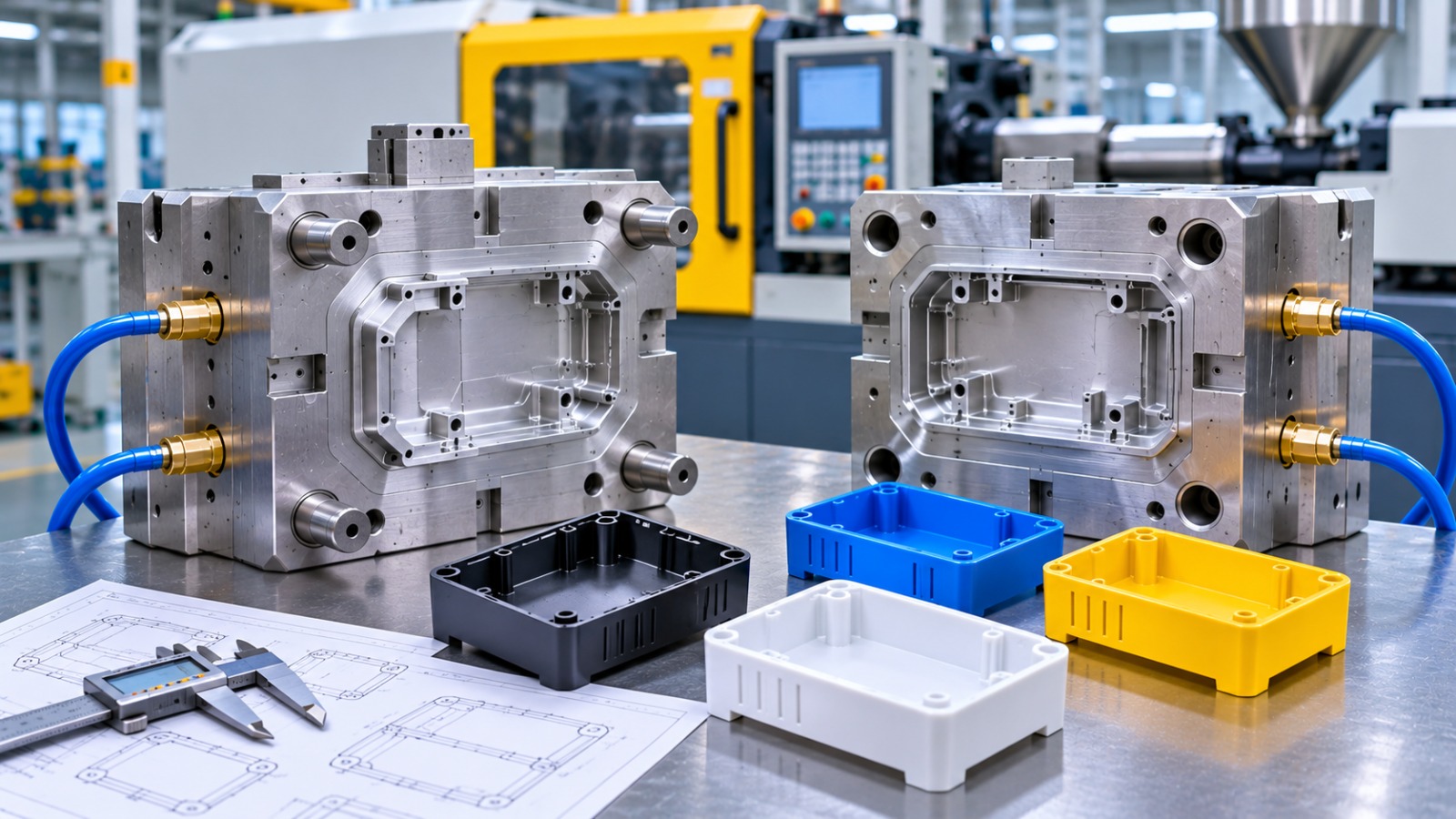
Injection Mold Manufacturing for Custom Plastic Parts
Injection mold manufacturing is an essential process for producing custom plastic components with consistent dimensions, detailed shapes, and repeatable quality. From small plastic enclosures to complex industrial components, injection molds help manufacturers produce parts that meet specific design and application requirements.
A well-manufactured injection mold supports efficient production, reliable part quality, and repeatable results. However, successful manufacturing requires careful planning, accurate mold design, suitable material selection, and proper machining processes.
In this blog, we explore how injection molds are manufactured, the key stages involved, common materials, and important factors to consider when producing custom plastic parts.
What Is Injection Mold Manufacturing?
Injection mold manufacturing is the process of designing and producing a specialised tool used to shape molten plastic into a required component. The mold contains two main sections: the core and the cavity.
During injection molding, molten plastic enters the mold cavity under pressure. The material then cools and solidifies into the desired shape. Once the component has cooled sufficiently, the mold opens and an ejection system removes the finished part.
Manufacturers use injection molds to produce plastic components in different shapes, sizes, and levels of complexity. The process is suitable for prototypes, custom components, and high-volume production, depending on the mold design and project requirements.
Key Stages of Injection Mold Manufacturing
Producing an injection mold involves several important manufacturing stages. Each stage contributes to the accuracy, functionality, and performance of the final mold.
1. Product Design and CAD Modelling
The process begins with a detailed 3D model of the plastic component. Engineers review the product geometry, wall thickness, draft angles, undercuts, and dimensional requirements.
CAD software helps create the component model and evaluate how it can be manufactured using injection molding.
Important design considerations include:
Uniform wall thickness
Suitable draft angles
Gate and runner locations
Parting line placement
Ejection system requirements
Cooling channel arrangements
A well-prepared CAD model provides the foundation for mold design and manufacturing.
2. Mold Design and Engineering
After finalising the product design, engineers develop the injection mold layout. This includes designing the core, cavity, runner system, gates, cooling channels, and ejection components.
The mold design must support proper plastic flow, controlled cooling, and smooth part removal.
Engineers also consider the required production quantity, plastic material, component geometry, and expected mold life when selecting the mold structure.
3. Material Selection for Mold Manufacturing
Choosing suitable mold material is important for durability, machinability, surface finish, and production requirements.
Common materials used in injection mold manufacturing include:
Mold Material | Common Application |
|---|---|
P20 Tool Steel | General-purpose injection molds |
H13 Tool Steel | Applications requiring heat resistance |
S7 Tool Steel | Impact-resistant mold components |
Stainless Steel | Corrosion-resistant mold applications |
Aluminium | Selected prototype and low-volume molds |
The appropriate material depends on the plastic being processed, production volume, mold complexity, and required durability.
4. CNC Machining of Mold Components
CNC machining plays an important role in producing accurate mold components. Computer-controlled machines remove material from metal blocks according to the CAD design and machining instructions.
Common manufacturing operations include:
CNC Milling: Used to create mold cavities, pockets, slots, flat surfaces, and complex profiles.
CNC Turning: Used to produce cylindrical mold components, pins, bushings, and other round features.
EDM Machining: Electrical discharge machining helps produce intricate details, sharp internal corners, and features that may be difficult to machine using conventional cutting tools.
Grinding: Used to improve dimensional accuracy and surface quality on selected mold components.
These processes help manufacture mold parts according to the required engineering specifications.
5. Mold Assembly and Fitting
Once the individual components are manufactured, they are assembled into the complete injection mold.
This stage involves fitting the core and cavity, guide pins, bushings, ejector pins, cooling connections, and other required components.
Accurate alignment is essential because poor fitting can cause flash, uneven parting lines, and other molding defects.
6. Mold Testing and Trial Production
Before regular production begins, the mold undergoes testing using an injection molding machine.
During the mold trial, engineers evaluate:
Plastic material filling
Injection pressure
Cooling performance
Part dimensions
Surface finish
Ejection performance
Potential molding defects
Any issues identified during testing can be reviewed and corrected before production approval.
Types of Injection Molds for Custom Plastic Parts
Different mold configurations are suitable for different component designs and manufacturing requirements.
Single-Cavity Molds
A single-cavity mold produces one component per injection cycle. It is suitable for selected prototypes, specialised components, and lower-volume production requirements.
Multi-Cavity Molds
Multi-cavity molds contain multiple cavities and produce several identical components during one injection cycle. They are commonly used when manufacturers need larger quantities of the same plastic part.
Family Molds
Family molds contain different cavity designs within one mold. They can produce multiple related components during a single cycle, provided the parts have compatible processing and filling requirements.
Two-Plate and Three-Plate Molds
Two-plate molds use a basic parting arrangement to separate the mold halves. Three-plate molds include an additional plate that helps separate the runner system from the molded components.
The appropriate configuration depends on part geometry, gate requirements, production volume, and mold complexity.
Common Plastic Materials Used for Injection Molding
Plastic material selection depends on the component’s mechanical properties, operating environment, appearance, and application.
Plastic Material | Key Characteristics |
|---|---|
ABS | Impact resistance and good surface finish |
Polypropylene (PP) | Lightweight and chemical resistance |
Polyethylene (PE) | Flexibility and moisture resistance |
Polycarbonate (PC) | Strength and impact resistance |
Nylon | Wear resistance and mechanical strength |
PEEK | High-performance thermal and mechanical properties |
Acetal (POM) | Dimensional stability and low friction |
Selecting the right material helps ensure that the finished component meets its intended functional requirements.
Applications of Custom Injection Molded Parts
Injection mold manufacturing supports different industries that require custom plastic components.
Automotive Industry
Automotive applications include interior trim, plastic housings, connectors, clips, brackets, and selected under-the-hood components.
Medical Equipment
Injection molding is used for selected medical equipment components, device housings, connectors, and disposable plastic parts, subject to applicable regulatory and manufacturing requirements.
Electronics Industry
Electronic products use molded enclosures, protective covers, connectors, switches, and internal plastic components.
Industrial Machinery
Industrial equipment may require custom plastic housings, protective covers, handles, mounting components, and machine accessories.
Consumer Products
Household products, packaging components, storage products, and appliance parts commonly use injection molding for repeatable plastic production.
Benefits of Professional Injection Mold Manufacturing
Properly planned injection mold manufacturing offers several advantages for custom plastic part production.
Consistent part quality: Accurate mold construction supports repeatable component dimensions and shapes.
Complex geometries: Injection molds can produce detailed features and complex plastic designs.
Production efficiency: Suitable mold configurations support efficient manufacturing cycles.
Material flexibility: Different thermoplastics can be selected according to application requirements.
Repeatable manufacturing: The same mold can produce multiple components when maintained correctly.
Reduced material waste: Appropriate mold design and process optimisation can help minimise manufacturing waste.
Factors to Consider Before Manufacturing an Injection Mold
Before starting mold manufacturing, businesses should evaluate several technical and commercial factors.
Part Geometry: Review the component shape, wall thickness, undercuts, and design complexity.
Production Quantity: Select a mold configuration suitable for the expected production volume.
Plastic Material: Consider material shrinkage, flow behaviour, strength, and temperature requirements.
Dimensional Tolerances: Identify critical dimensions and required accuracy.
Surface Finish: Define the required appearance and texture of the finished component.
Cooling Requirements: Plan cooling channels to support uniform temperature distribution.
Mold Maintenance: Consider accessibility, wear components, and maintenance requirements.
Evaluating these factors early can help reduce design changes and support smoother mold development.
Conclusion
Injection mold manufacturing combines product design, engineering, material selection, CNC machining, assembly, and testing to produce tools for custom plastic components.
Each stage influences the final part quality and manufacturing performance. Therefore, manufacturers should focus on accurate CAD modelling, suitable mold materials, precise machining, effective cooling, and proper mold testing.
With careful planning and the right manufacturing processes, injection molds can support consistent production of custom plastic parts for automotiv