
Introduction
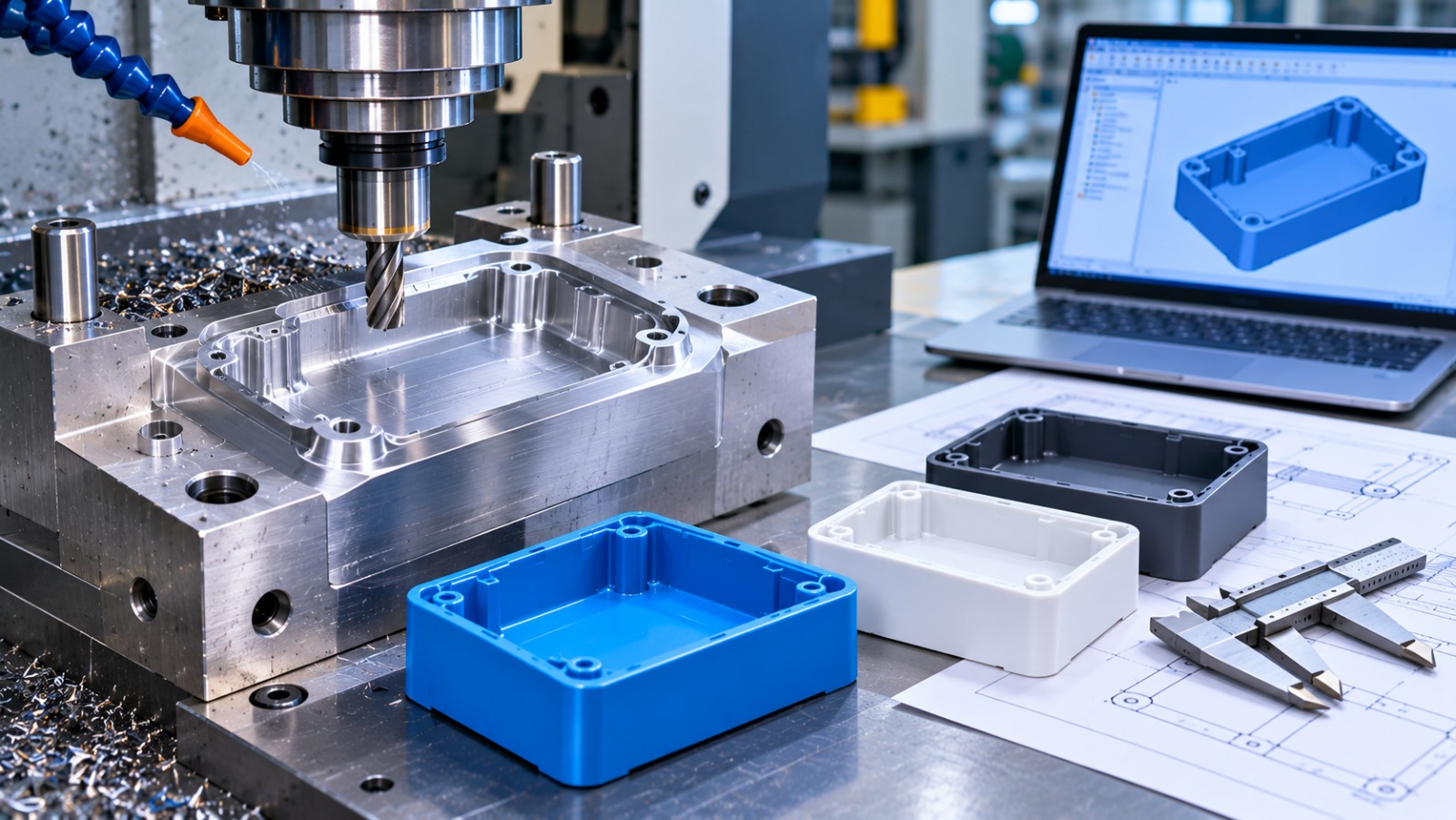
Injection mold manufacturing plays an important role in producing high-quality plastic components for various industries. However, complex mold designs, unnecessary machining operations, material selection, and production delays can increase manufacturing time and overall costs.
By improving mold design, selecting suitable materials, and using efficient CNC machining processes, manufacturers can reduce production expenses without compromising part quality. In this guide, we explore practical ways to reduce injection mold manufacturing time and cost.
1. Simplify the Mold Design
A complex mold design often requires additional machining operations, more components, and longer manufacturing time. Therefore, simplifying the design is one of the most effective ways to control costs.
Consider these improvements:
Reduce unnecessary mold features.
Avoid complex geometries wherever possible.
Use standard mold components when suitable.
Minimize undercuts and complicated side actions.
Maintain consistent wall thickness in plastic parts.
A simpler mold design can reduce machining requirements and make maintenance easier.
2. Select the Right Mold Material
Material selection directly affects mold manufacturing costs, machining time, durability, and maintenance requirements.
Different applications require different mold materials. For example:
Mold Material | Common Application |
|---|---|
P20 Tool Steel | General-purpose injection molds |
H13 Tool Steel | High-temperature and demanding applications |
S136 Stainless Steel | Corrosion-resistant mold applications |
Aluminium | Prototype and lower-volume tooling |
Choosing a suitable material based on production volume, plastic type, and expected mold life helps avoid unnecessary expenses.
3. Use Efficient CNC Machining Processes
CNC machining is an important part of injection mold manufacturing. Efficient machining strategies help reduce production time while maintaining dimensional accuracy.
Common machining processes include:
CNC Milling: Creates mold cavities, pockets, and complex surfaces.
CNC Turning: Produces cylindrical mold components and precision inserts.
EDM Machining: Helps create detailed features and complex internal geometries.
Surface Grinding: Achieves accurate dimensions and smooth mating surfaces.
Selecting the right machining process for each feature can reduce unnecessary operations and improve manufacturing efficiency.
4. Standardize Mold Components
Using standard mold components can reduce custom manufacturing requirements. Components such as guide pins, bushings, ejector pins, screws, and locating rings are available in standard sizes.
Standardization helps manufacturers:
Reduce design and engineering time.
Minimize custom machining.
Simplify mold assembly.
Improve replacement and maintenance.
Reduce overall tooling costs.
However, standard components should always meet the mold’s technical requirements.
5. Optimize the Mold Cooling System
Cooling is a major factor affecting injection molding cycle time. Poor cooling design can increase production time and create uneven shrinkage or part deformation.
To improve cooling efficiency:
Position cooling channels close to critical mold areas.
Maintain uniform cooling throughout the cavity.
Avoid unnecessary temperature differences.
Consider conformal cooling for complex geometries where practical.
Validate cooling performance during mold design.
An efficient cooling system can reduce cycle time and improve dimensional consistency.
6. Reduce Unnecessary Design Changes
Frequent design changes can delay mold manufacturing and increase engineering and machining costs.
Before starting production, review the following:
Final 3D CAD model.
Part dimensions and tolerances.
Draft angles and wall thickness.
Gate and runner locations.
Ejection requirements.
Material specifications.
Using design-for-manufacturing (DFM) reviews helps identify potential problems before machining begins.
7. Mold Material Affects Durability and Production Consistency
The core and cavity require accurate machining because they directly determine the final plastic component’s shape and dimensions.
Manufacturers can improve efficiency by:
Selecting suitable cutting tools.
Using optimized machining parameters.
Planning roughing and finishing operations.
Reducing unnecessary tool changes.
Applying suitable toolpath strategies.
Inspecting critical dimensions during machining.
These practices help reduce machining time and avoid costly rework.
8. Choose the Right Number of Mold Cavities
The number of cavities affects initial tooling investment and production efficiency.
Mold Type | Main Advantage | Cost Consideration |
|---|---|---|
Single-Cavity Mold | Lower initial tooling investment | More cycles for high-volume production |
Multi-Cavity Mold | Higher output per cycle | Higher initial tooling and design cost |
For low-volume production, a single-cavity mold may be more economical. However, multi-cavity molds can reduce the cost per part when production volumes justify the investment.
9. Perform Quality Checks During Manufacturing
Identifying defects early helps prevent expensive corrections during final mold assembly or trial production.
Important quality checks include:
Dimensional inspection.
Cavity and core alignment.
Surface finish verification.
Cooling channel inspection.
Mold fitting and assembly checks.
Trial molding and sample evaluation.
Regular inspections help reduce rework and keep the manufacturing process on schedule.
10. Plan the Manufacturing Process Properly
A well-planned manufacturing workflow reduces delays between design, machining, assembly, and testing.
A typical injection mold manufacturing workflow includes:
Review part drawings and CAD models.
Complete mold design and DFM analysis.
Select suitable mold materials.
Perform CNC machining and EDM operations.
Complete grinding and finishing.
Assemble the mold components.
Conduct mold trials and quality inspections.
Make necessary corrections before production.
Proper coordination between these stages helps avoid unnecessary manufacturing delays.
Benefits of Reducing Injection Mold Manufacturing Time and Cost
An optimized manufacturing process provides several advantages:
Lower tooling and machining expenses.
Faster mold development.
Reduced production delays.
Improved manufacturing efficiency.
Less material and machining waste.
Better consistency in plastic components.
More competitive part pricing.
How CNC Machining Supports Cost-Effective Mold Manufacturing
CNC machining helps manufacturers produce accurate mold components with controlled dimensions and repeatable machining processes. CNC milling, turning, EDM, and grinding each support different stages of mold production.
By combining suitable machining methods with optimized toolpaths, standardized components, and effective design planning, manufacturers can improve production efficiency and manage tooling costs.
Conclusion
Reducing injection mold manufacturing time and cost requires careful planning at every stage, from initial mold design to final inspection. Simplified designs, suitable mold materials, efficient CNC machining, optimized cooling systems, and standardized components can all contribute to better manufacturing efficiency.
The most effective approach is to balance initial tooling investment with long-term production requirements. This helps manufacturers achieve reliable mold performance while controlling overall manufacturing expenses.
Frequently Asked Questions (FAQs)
1. How can injection mold manufacturing costs be reduced?
Manufacturers can reduce costs by simplifying mold designs, selecting appropriate materials, using standard components, optimizing CNC machining, and minimizing design changes.
2. Does CNC machining reduce injection mold manufacturing time?
Yes. Efficient CNC milling, turning, and toolpath planning can reduce machining time while maintaining the required dimensional accuracy.
3. Which mold material is more cost-effective?
The most cost-effective material depends on production volume, plastic type, required mold life, and operating conditions. P20 steel and aluminium are commonly considered for different tooling requirements.
4. How does cooling system design affect manufacturing costs?
An efficient cooling system can reduce injection molding cycle time, improve part consistency, and help prevent defects that lead to additional production costs.
5. Is a multi-cavity mold always cheaper?
No. Multi-cavity molds generally require a higher initial investment. They become more economical when production volume is high enough to justify the additional tooling cost.
6. What is the role of DFM in injection mold manufacturing?
Design for Manufacturing (DFM) helps identify design issues before machining begins. It can reduce rework, simplify tooling, and prevent unnecessary manufacturing delays.