A Practical Guide to Turning CAD Designs into Accurate, Production-Ready Components
Modern manufacturers often need components that are designed specifically for a particular machine, product, or application. However, producing a custom component requires more than simply sending a CAD file to a CNC machine. The design, material, tolerances, machining process, quantity, and quality requirements all influence the final result.
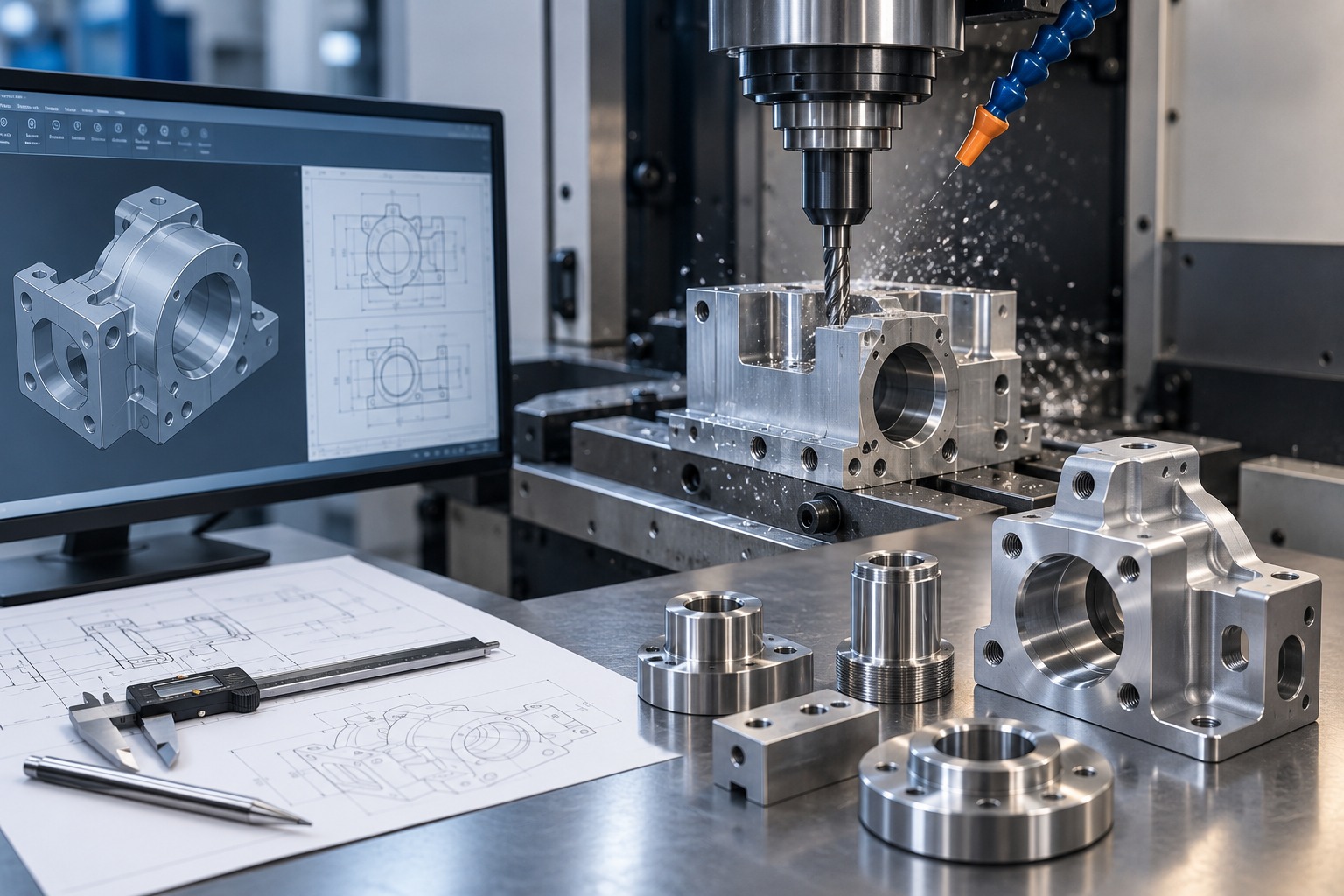
CNC machining for custom components provides a flexible way to move from an initial digital design to a functional prototype, small batch, or production-ready part. With CNC milling, CNC turning, and multi-axis machining, manufacturers can produce components with complex geometries and precise features.
What Is CNC Machining for Custom Components?
CNC machining is a subtractive manufacturing process in which computer-controlled cutting tools remove material from a solid workpiece to create the required component geometry.
Custom CNC machining is particularly useful when a component must meet specific engineering requirements rather than standard dimensions.
Custom components may include:
- Machine parts
- Brackets and housings
- Shafts and bushings
- Fixtures and tooling
- Mold components
- Replacement parts
- Prototype components
- Custom industrial components
Therefore, CNC machining can support projects ranging from one-off prototypes to repeated production requirements.
From CAD Design to CNC Production
The CNC manufacturing process starts with a digital design and progresses through several important stages.
1. Create the CAD Design
The first step is developing an accurate 3D CAD model or engineering drawing.
The design should clearly define important requirements such as:
- Overall dimensions
- Critical tolerances
- Hole sizes
- Threads
- Wall thickness
- Internal radii
- Surface finish
- Material requirements
A well-prepared design gives the manufacturer the information needed to evaluate how the component should be produced.
2. Review the Design for Manufacture
Before machining begins, the component should be reviewed from a manufacturing perspective.
This is commonly known as Design for Manufacture (DFM) .
A DFM review considers factors such as tool accessibility, tolerances, material, machining orientation, wall thickness, internal corners, and the number of required setups. As a result, potential manufacturing challenges can be identified before production begins.
3. Select the Right Material
Material selection directly affects component performance as well as machining requirements.
Common CNC materials include:
Metals
- Aluminum
- Stainless steel
- Carbon steel
- Brass
- Copper
- Titanium
- Tool steel
Engineering Plastics
- ABS
- Nylon
- Delrin
- PEEK
- Polycarbonate
- PTFE
The right material depends on factors such as strength, weight, corrosion resistance, temperature, wear, machinability, and the intended application.
Choosing the Right CNC Machining Process
Not every custom component requires the same machining process. Therefore, selecting the appropriate process is an important part of production planning.
CNC Milling
CNC milling is suitable for components with flat surfaces, pockets, slots, holes, contours, and complex profiles.
It is commonly used for:
- Machine housings
- Plates
- Braces
- Fixtures
- Tooling
- Complex mechanical components
CNC Turning
CNC turning is primarily used for rotational components.
Typical examples include:
- Shafts
- Pins
- Bushings
- Sleeves
- Rollers
- Spacers
- Threaded components
3-Axis, 4-Axis, and 5-Axis Machining
The number of machining axes can influence how efficiently complex components can be manufactured.
For example, 5-axis machining can provide access to multiple surfaces and angled features that may otherwise require several setups. However, the most advanced machining process is not automatically the most economical option. The best approach depends on the component’s geometry, tolerances, material, and production requirements.
CNC Machining for Prototypes
Custom components often begin as prototypes.
Before committing to production, engineers may need to verify:
- Dimensional accuracy
- Assembly fit
- Clearances
- Function
- Strength
- Material selection
- Surface finish
CNC machining can produce functional prototypes directly from CAD designs, allowing engineers to test a physical component and make improvements before production.
A typical development cycle is:
CAD Design → DFM Review → CNC Prototype → Testing → Design Improvements → Production
This approach can reduce the risk of moving an untested design directly into larger production quantities.
Moving from Prototype to Production
Once a prototype has been tested and approved, the next step may be low-volume or full production.
Production machining focuses more heavily on:
- Repeatability
- Dimensional consistency
- Process efficiency
- Tool life
- Inspection
- Cycle time
- Production scheduling
For some projects, low-volume CNC manufacturing provides a useful middle stage between prototyping and larger production.
Therefore, a custom component can progress through:
Prototype → Design Validation → Low-Volume Production → Process Optimization → Production
How to Reduce Custom CNC Component Costs
Custom machining does not necessarily have to mean unnecessarily high manufacturing costs.
Several design decisions can help control production costs.
Use Practical Tolerances
Specify tight tolerances only where they are functionally necessary. Extremely tight tolerances can require additional machining and inspection.
Simplify Unnecessary Features
Avoid features that do not contribute to the component’s function. Simpler geometry can reduce machining time and tooling requirements.
Reduce the Number of Setups
Where practical, design and manufacture the component to minimize repositioning.
Select a Suitable Material
Choose a material based on current performance requirements rather than automatically selecting the most expensive option.
Avoid Unnecessary Finishing
Additional surface treatments and finishing operations should be specified when they provide a functional or required aesthetic benefit.
Consequently, thoughtful design decisions can reduce manufacturing costs without compromising essential component performance.
Quality Control for Custom CNC Components
Quality control should be considered throughout the manufacturing process, not only after machining is complete.
Important quality factors include:
- Dimensional accuracy
- Tolerance compliance
- Surface finish
- Feature location
- Material specifications
- Repeatability
- Assembly fit
A typical manufacturing workflow can therefore include:
CAD File → Manufacturing Review → CNC Machining → Quality Inspection → Finished Component
Providing accurate CAD files together with material, quantity, tolerances, surface finish, and other technical requirements helps establish the appropriate manufacturing approach.
Applications of Custom CNC Components
CNC-machined custom components are used across many industries.
Common applications include:
- Automotive components
- Aerospace parts
- Robotics components
- Industrial machinery
- Automation equipment
- Medical equipment
- Tooling and fixtures
- Mold components
- Replacement machinery parts
- Product development
Because CNC machining can accommodate different materials, geometries, and production quantities, it is suitable for both specialized components and repeat production.
Why Choose Polymach365 for Custom CNC Components?
Polymach365 provides digital manufacturing solutions that connect CAD designs with CNC production.
Its CNC capabilities include:
- CNC Milling
- CNC Turning
- 3-Axis CNC Machining
- 4-Axis CNC Machining
- 5-Axis CNC Machining
- Prototype Manufacturing
- Low-Volume Production
- Custom CNC Machining
- Precision Machined Components
- Mold Components
The digital workflow is designed to simplify the journey from design to finished component:
Upload CAD File → Manufacturing Review → Quote → CNC Machining → Quality Inspection → Delivery
Frequently Asked Questions
What files are needed for custom CNC machining?
A 3D CAD model is typically the most useful starting point. Polymach365 supports formats including STEP, STL, IGES, SLDPRT, and ZIP .
Can CNC machining be used for prototypes?
Yes. CNC machining is well suited for functional prototypes because components can be manufactured directly from digital designs and evaluated before production.
Is CNC machining suitable for low-volume production?
Yes. CNC machining can support small batches as well as larger production requirements, making it useful for specialized components and pilot production.
How do I choose between CNC milling and CNC turning?
The component’s geometry is the main consideration. Milling is generally suitable for prismatic and complex-profile components, while turning is typically better suited to rotational or cylindrical components.
How can I reduce the cost of a custom CNC component?
Start with a manufacturing design, use practical tolerances, minimize unnecessary features and setups, select an appropriate material, and avoid unnecessary finishing operations.
Final Thoughts
CNC machining for custom components provides a practical path from digital design to physical production. By combining accurate CAD design, DFM principles, appropriate material selection, the right machining process, and quality control, manufacturers can produce components that meet their functional and dimensional requirements.
More importantly, CNC machining can support the complete product development journey—from prototype and design validation to low-volume manufacturing and production .
Start Your Custom CNC Component Project
Have a custom component ready for manufacturing?
Upload your CAD file and provide your material, quantity, tolerances, surface finish, and other requirements to start your CNC machining project with Polymach365.