Introduction
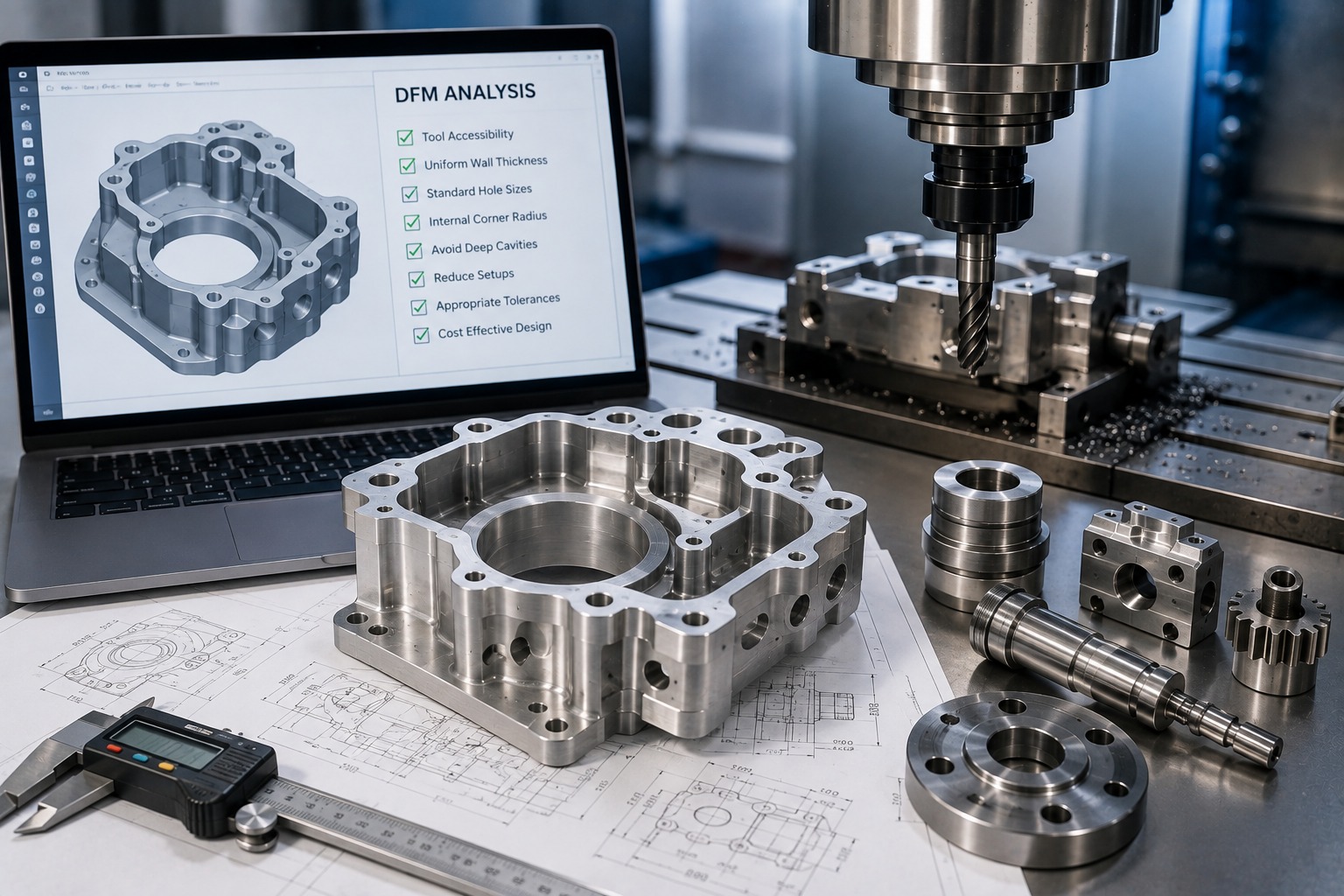
Design for Manufacturability (DFM) is an important part of CNC machining because the way a component is designed directly affects how easily, accurately, and efficiently it can be manufactured.
Part may look perfect in CAD software, but that doesn’t always mean it is practical to machine. Difficult-to-access features, unnecessarily tight tolerances, deep cavities, thin walls, and complicated setups can increase machining time and production costs.
Therefore, applying DFM principles before manufacturing begins can help engineers create parts that are easier to machine, more consistent, and more cost-effective .
At Polymach365 , we support CNC milling, CNC turning, 3-axis, 4-axis, and 5-axis machining, prototype manufacturing, low-volume production, custom CNC machining, and precision machined components. A DFM-focused approach can help connect your design requirements with a practical manufacturing process.
What Is Design for Manufacture?
Design for Manufacture means designing a component with the manufacturing process in mind.
For CNC machining, DFM considers factors such as:
- Part geometry
- Material selection
- Tolerances
- Wall thickness
- Internal corners
- Hole sizes
- Tool accessibility
- Machining orientation
- Number of setups
- Surface finish
- Production quantity
Instead of designing a component first and worrying about manufacturing later, DFM encourages engineers to consider manufacturing ability from the beginning.
As a result, potential manufacturing problems can be identified before production starts.
Why Is DFM Important for CNC Machining?
CNC machines can manufacture highly complex components. However, complexity often comes with additional manufacturing requirements.
For example, a deep and narrow cavity may require a long cutting tool. However, long tools can be more susceptible to vibration and deflection.
Similarly, extremely tight tolerances may require additional finishing operations and inspection.
Therefore, a DFM review can identify these challenges early and help engineers make practical design decisions.
1.DFM Improves CNC Machined Part Quality
One of the biggest benefits of DFM is improved manufacturing consistency.
A manufacturing design allows cutting tools to reach the required features more effectively. It can also reduce unnecessary setups and minimize difficult machining operations.
Consequently, manufacturers can achieve more predictable results.
DFM can help improve:
- Dimensional accuracy
- Repeatability
- Surface finish
- Feature consistency
- Assembly fit
- Overall part quality
Therefore, DFM is not only about reducing cost. It also contributes directly to the quality of the finished component.
2. DFM Reduces Unnecessary Tight Tolerances
Tolerances define how much a dimension can vary from its nominal value.
While tight tolerances are essential for certain functional features, applying them to every dimension can make a component unnecessarily expensive to manufacture.
Tighter tolerances may require:
- Additional machining operations
- More precise tooling
- Additional inspection
- Longer cycle times
- Specialized processes
Therefore, engineers should identify which dimensions are genuinely critical.
Better Approach
Instead of specifying extremely tight tolerances throughout the entire component, use tighter tolerances only where they affect:
- Mating components
- Bearing fits
- Sealing surfaces
- Critical alignment
- Functional movement
As a result, the part can maintain its required performance without unnecessary manufacturing complexity.
3. DFM Simplifies Part Geometry
Complex geometry can increase machining time and programming requirements.
Some complex features may also require specialized tooling or multi-axis machining.
Therefore, simplifying the geometry where possible can improve manufacturing ability.
For example, unnecessary pockets, grooves, or decorative features may increase machining time without providing a functional benefit.
A DFM review asks an important question:
Does every feature serve a purpose?
If the answer is no, removing that feature may reduce both machining time and cost.
4. DFM Improves Tool Accessibility
Cutting tools need sufficient access to the features they are machining.
Deep cavities, narrow slots, and obstructed surfaces can make tool access difficult.
Therefore, designers should consider tool accessibility while developing the CAD model.
Poor tool access can result in:
- Longer machining times
- Specialized tooling
- Additional setups
- Tool deflection
- Reduced surface quality
As a result, designing features with practical tool access can make CNC machining more efficient.
5. DFM Helps Control Internal Corner Radii
CNC milling tools are generally round.
Therefore, creating perfectly sharp internal corners is difficult with conventional milling.
Instead, internal corners normally require a radius.
Why Does This Matter?
If a design includes a very small internal corner radius, the manufacturer may need a smaller cutting tool.
However, smaller tools can require slower cutting conditions and may increase machining time.
Therefore, using the largest practical internal radius can often improve machining efficiency.
6. DFM Reduces the Number of CNC Setups
Every additional setup can add time and increase positioning requirements.
A component that requires machining from several directions may need multiple repositioning operations.
Therefore, designers should consider whether the part can be manufactured with fewer setups.
Multi-axis machining can sometimes provide better access to multiple surfaces.
However, not every component needs 5-axis machining.
Consequently, the goal should be to choose a design and machining strategy that provides the required features with an efficient number of setups.
7. DFM Helps Prevent Thin-Wall Problems
Thin walls can be difficult to machine because cutting forces may cause vibration or deformation.
Therefore, unnecessarily thin sections should be avoided when the application allows.
A stronger and more stable design can help improve:
- Machining stability
- Dimensional consistency
- Surface finish
- Part rigidity
However, the appropriate wall thickness depends on the material, geometry, part size, and machining strategy.
Therefore, wall thickness should be evaluated together with the complete component design.
8. DFM Reduces Machining Time
Machining time is an important factor in CNC production costs.
Several design decisions can increase machining time, including:
- Excessive material removal
- Deep pockets
- Very small features
- Complex toolpaths
- Tight tolerances
- Multiple setups
Therefore, simplifying the design can reduce unnecessary machining operations.
For example, reducing a deep pocket or eliminating a non-functional feature may significantly simplify the machining process.
As a result, DFM can help shorten cycle times and improve production efficiency.
9. DFM Helps Reduce Tool Wear
Tool wear can affect both quality and production costs.
Difficult-to-machine designs may require aggressive toolpaths, long cutting tools, or small-diameter tools.
These conditions can increase tool wear.
Therefore, designing parts with practical feature sizes and accessible geometry can help manufacturers use tooling more efficiently.
This can contribute to:
- Longer tool life
- More consistent dimensions
- Fewer tool changes
- Lower tooling costs
10. DFM Makes Material Selection More Practical
Material choice affects machining performance as well as final part performance.
Common CNC machining materials include:
- Aluminum
- Stainless steel
- Carbon steel
- Tool steel
- Brass
- Copper
- Titanium
- ABS
- Nylon
- Delrin
- Polycarbonate
- PEEK
For example, aluminum is commonly selected for lightweight components, while stainless steel may be chosen when strength and corrosion resistance are important.
Therefore, material selection should consider both application requirements and manufacturing ability .
11. DFM Improves Surface Finish Planning
Not every surface requires the same finish.
Some surfaces may only need a standard machined finish, while others may require additional finishing because they interact with seals, bearings, or mating components.
Therefore, surface finish requirements should be specified according to function.
Unnecessarily demanding surface finishes can increase:
- Machining time
- Finishing operations
- Inspection requirements
- Production costs
As a result, DFM encourages engineers to specify the appropriate finish rather than automatically choosing the most demanding option.
12. DFM Makes CNC Inspection Easier
Quality inspection is an essential part of precision machining.
However, inspection becomes more complicated when a design contains numerous unnecessarily tight dimensions or difficult-to-measure features.
Therefore, DFM can help identify the dimensions that actually require inspection.
Critical features may include:
- Hole locations
- Critical diameters
- Mating surfaces
- Flatness
- Position
- Overall dimensions
Consequently, a practical inspection strategy can help maintain quality without adding unnecessary measurement requirements.
DFM for CNC Milling
CNC milling is suitable for components containing pockets, holes, slots, contours, and complex profiles.
When designing a milled component, consider:
- Tool accessibility
- Internal corner radii
- Pocket depth
- Wall thickness
- Workholding
- Number of setups
Therefore, a milling-friendly design can reduce unnecessary tool changes and machining operations.
DFM for CNC Turning
CNC turning is commonly used for cylindrical components such as:
- Shafts
- Pins
- Bushings
- Sleeves
- Spacers
- Rollers
For turned components, DFM considerations can include:
- Diameter changes
- Thread geometry
- Groove dimensions
- Tool access
- Part length-to-diameter ratio
- Surface finish
Consequently, designing rotational components around practical turning operations can improve efficiency.
DFM for 5-Axis CNC Machining
5-axis machining provides greater flexibility for complex components.
It can be useful for parts with:
- Angled surfaces
- Complex contours
- Deep cavities
- Multi-sided features
- Difficult-to-access areas
However, using 5-axis machining does not automatically make every design economical.
Therefore, should determine whether the geometry genuinely benefits from multi-axis machining engineers.
In some cases, simplifying the design can allow the component to be produced using a simpler and more economical process.
DFM for Prototype Manufacturing
DFM is particularly valuable during prototype development.
A typical product development workflow is:
CAD Design → DFM Review → Prototype → Testing → Design Improvements → Production
During prototyping, engineers can identify issues related to:
- Assembly
- Fit
- Machining
- Tolerances
- Material
- Geometry
Therefore, performing a DFM review before producing the prototype can reduce unnecessary iterations.
DFM for Low-Volume and Production Machining
DFM becomes even more valuable as production quantities increase.
A small design problem may have a limited impact when producing one prototype.
However, the same problem can become expensive when producing or thousands of parts.
For example, an extra machining operation that adds a few minutes to each component can significantly increase total production time.
Therefore, optimizing manufacturing ability before production can provide greater savings as volume increases.
Common CNC DFM Mistakes to Avoid
Several design decisions can make CNC machining unnecessarily difficult.
Extremely Tight Tolerances
Do not specify tight tolerances where they are not functionally required.
Deep and Narrow Cavities
These may require long or specialized cutting tools.
Sharp Internal Corners
Small internal radius can require smaller tools.
Unnecessarily Thin Walls
Thin sections can be susceptible to deformation.
Excessive Features
Remove features that do not contribute to the component’s function.
Poor Tool Accessibility
Make sure cutting tools can reach the required surfaces.
Too Many Setups
Where practical, design components to minimize repositioning.
Therefore, reviewing these factors before manufacturing can prevent many avoidable problems.
How DFM Reduces Overall CNC Machining Costs
DFM can reduce costs through several mechanisms.
| DFM Improvement | Potential Manufacturing Benefit |
|---|---|
| Simplified geometry | Less machining time |
| Practical tolerances | Lower inspection and processing requirements |
| Better tool access | Easier machining |
| Larger practical radii | More efficient tooling |
| Fewer setups | Reduced setup time |
| Suitable wall thickness | Better machining stability |
| Appropriate surface finish | Fewer finishing operations |
| Suitable material | Better machinability |
| Optimized features | Lower cycle time |
Therefore, DFM can reduce both direct machining costs and indirect manufacturing expenses.
A Practical CNC DFM Checklist
Before sending a CAD design for machining, review the following:
Geometry
Is the design unnecessarily complex?
Tolerances
Are tight tolerances limited to critical features?
Internal Radii
Are the corner radius practical for CNC tools?
Wall Thickness
Are thin sections strong enough for machining?
Holes
Are hole sizes and depths practical?
Tool Access
Can standard cutting tools reach the required features?
Setups
Can the part be machined efficiently?
Material
Is the material suitable for both the application and machining process?
Surface Finish
Does every surface need the specified finish?
Quantity
Has the design been optimized for the intended production volume?
As a result, this checklist can help identify manufacturing challenges before they become production problems.
How Polymach365 Supports DFM-Focused CNC Manufacturing
At Polymach365 , we provide digital manufacturing solutions that connect CAD designs with CNC production.
Our capabilities include:
- CNC Milling
- CNC Turning
- 3-Axis CNC Machining
- 4-Axis CNC Machining
- 5-Axis CNC Machining
- Prototype Manufacturing
- Low-Volume Production
- Custom CNC Machining
- Precision Machined Components
- Mold Components
Our workflow can follow:
Upload CAD File → Manufacturing Review → Quote → CNC Machining → Quality Inspection → Delivery
You can provide your CAD file together with:
- Material
- Quantity
- Tolerances
- Surface finish
- Finishing requirements
- Technical specifications
Therefore, your design can be evaluated according to its manufacturing requirements before production.
Final Thoughts
Design for Manufacture is one of the most effective ways to improve CNC machined part quality while controlling production costs.
By considering tool accessibility, tolerances, internal radius, wall thickness, material, surface finish, machining orientation, and production quantity during the design stage, manufacturers can avoid many common production challenges.
More importantly, DFM does not mean making every component simple. Instead, it means creating a design that provides the required function while remaining practical to manufacture.
Therefore, whether you are developing a prototype, custom CNC component, complex machined part, low-volume batch, or production component , applying DFM principles early can help create a smoother path from CAD design to finished part.
Start Your CNC Machining Project
Have a CAD model ready for manufacturing?
Upload your CAD file and provide your material, quantity, tolerances, surface finish, and other requirements to begin your CNC machining project with Polymach365.