Introduction
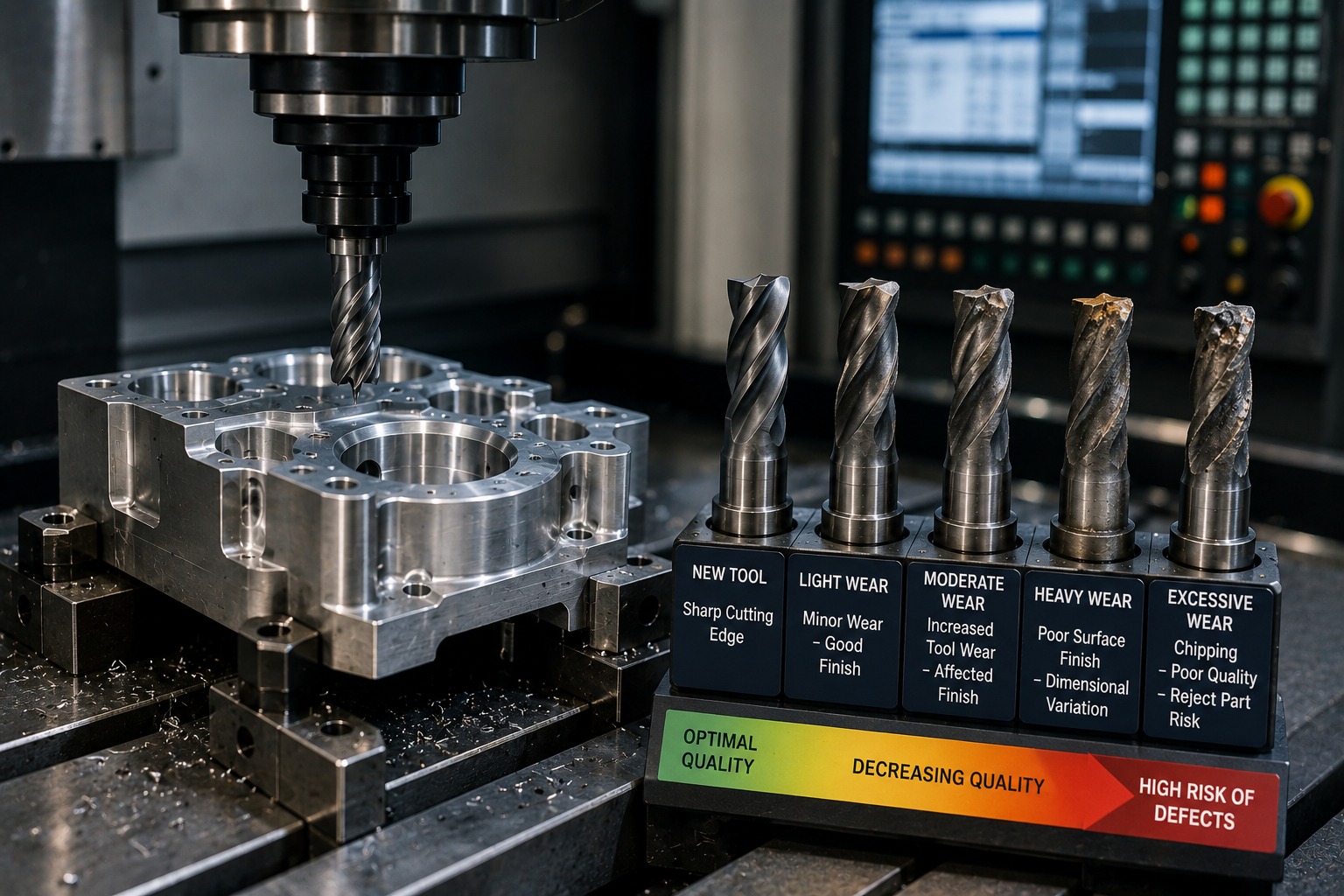
Tool wear is an unavoidable part of CNC machining. As cutting tools repeatedly remove material from a workpiece, their cutting edges gradually lose their original sharpness. If this wear is not monitored and controlled, it can affect dimensional accuracy, surface finish, tolerances, production consistency, and overall part quality .
Therefore, understanding how tool wear develops and how it affects machined components is important for manufacturers producing prototypes, custom parts, low-volume batches, and production components.
At Polymach365 , CNC milling, CNC turning, 3-axis, 4-axis, and 5-axis machining can support a wide range of manufacturing requirements. Proper tooling and process control are essential for producing consistent CNC machined parts.
What Is Tool Wear in CNC Machining?
Tool wear occurs when the cutting edge of a CNC tool gradually deteriorates during machining.
Every cutting operation exposes the tool to:
- Friction
- Heat
- Cutting forces
- Material contact
- Vibration
- Repeated machining cycles
Over time, these conditions can change the shape and sharpness of the cutting edge.
As a result, a tool that initially produces accurate components may eventually produce different results if it is not replaced or managed appropriately.
Why Does Tool Wear Matter?
Tool wear directly affects the relationship between the cutting tool and workpiece.
A sharp tool can remove material predictably. However, a worn tool may generate more heat, cutting forces, and friction.
Consequently, excessive tool wear can contribute to:
- Dimensional variation
- Poor surface finish
- Burr formation
- Chatter
- Increased cutting forces
- Longer cycle times
- Reduced productivity
- Component rejection
Therefore, monitoring tool condition is an important part of CNC quality control.
Types of Tool Wear
Different machining conditions can produce different forms of tool wear.
1. Flank Wear
Flank wear develops along the clearance face of the cutting tool.
As the flank gradually wears away, the effective cutting geometry changes.
Therefore, excessive flank wear can affect dimensional accuracy and surface quality.
2. Crater Wear
Crater wear develops on the rake face of the cutting tool where chips flow across the cutting edge.
High temperature and continuous chip contact can contribute to crater formation.
As crater wear increases, the cutting geometry can change and eventually weaken the cutting edge.
3. Chipping
Chipping occurs when small pieces of the cutting edge break away.
It can be associated with:
- Excessive cutting forces
- Hard materials
- Interrupted cuts
- Incorrect cutting parameters
- Vibration
Consequently, chipping can cause sudden changes in cutting performance.
4. Thermal Wear
High temperatures can accelerate tool degradation.
Heat can result from:
- High cutting speeds
- Excessive friction
- Poor coolant application
- Difficult-to-machine materials
- Improper cutting parameters
Therefore, controlling heat is important for maintaining tool performance.
How Tool Wear Affects Dimensional Accuracy
One of the most important effects of tool wear is dimensional variation.
As the cutting edge wears, it may no longer remove material in exactly the same way as a new tool.
For example, a worn tool may gradually change the size of:
- Holes
- Pockets
- Slots
- Diameters
- Contours
- Mating surfaces
Therefore, components produced later in a machining run may begin to move outside their specified tolerances.
This is especially important when manufacturing precision components with tight dimensional requirements.
Tool Wear and Surface Finish
Tool condition also has a significant effect on surface finish.
A sharp cutting edge generally produces a more predictable cutting action. However, a worn tool can increase friction and vibration.
As a result, the machined surface may develop:
- Rougher texture
- Visible tool marks
- Scratches
- Chatter marks
- Irregular surfaces
Therefore, surface finish should be monitored when machining components with functional or aesthetic finishing requirements.
Tool Wear and Burr Formation
Burrs are unwanted raised edges that can appear after machining.
A worn cutting edge may produce less efficient cutting and greater deformation near the edge of a feature.
Consequently, burr formation can increase.
Excessive burrs may create additional requirements for:
- Deburring
- Cleaning
- Finishing
- Inspection
Therefore, maintaining suitable tool condition can help reduce unnecessary secondary operations.
Tool Wear Can Increase Cutting Forces
As a tool becomes worn, cutting resistance can increase.
Higher cutting forces can affect both the tool and the workpiece.
They may contribute to:
- Tool deflection
- Workpiece movement
- Vibration
- Chatter
- Dimensional variation
Therefore, increasing cutting forces can be an important indication that a tool requires attention.
Tool Wear and CNC Machining Cycle Time
Tool wear can also affect productivity.
A worn tool may require:
- Lower cutting speeds
- Additional finishing passes
- More frequent adjustments
- Extra inspection
- Tool replacement
Consequently, excessive wear can increase the effective machining time per component.
For production machining, even a small increase in cycle time can become significant when multiplied across hundreds or thousands of parts.
Factors That Accelerate Tool Wear
Several factors influence how quickly a CNC cutting tool wears.
Cutting Speed
Excessive cutting speed can increase heat generation and accelerate wear.
Therefore, cutting speed should match the tool and workpiece material.
Feed Rate
An inappropriate feed rate can increase cutting forces or reduce cutting efficiency.
Depth of Cut
Heavy cuts can place greater loads on the cutting edge.
Workpiece Material
Harder materials can cause faster tool degradation.
Materials such as hardened steel and titanium may require specialized tooling and machining parameters.
Coolant
Proper coolant application can help manage heat and chip evacuation.
However, coolant selection and application should match the machining operation.
Tool Material
Carbide, coated carbide, ceramic, and other tooling materials have different performance characteristics.
Therefore, tool selection should match the application.
How to Detect Tool Wear
Manufacturers can monitor tool conditions in several ways.
Visual Inspection
Inspecting the cutting edge can reveal visible wear or chipping.
Dimensional Inspection
Measuring machined components can reveal gradual dimensional changes.
Surface Finish Inspection
Changes in surface quality may indicate deteriorating tool performance.
Cutting Sound
Changes in machining noise can sometimes indicate vibration or tool degradation.
Spindle Load
Changes in machine load may indicate increased cutting resistance.
Tool Monitoring Systems
Modern CNC equipment can use automated monitoring technologies to detect changes in machining conditions.
Therefore, combining several monitoring methods can provide better control than relying on a single indicator.
How to Prevent Excessive Tool Wear
Tool wear cannot be eliminated completely. However, manufacturers can manage it effectively.
Use the Correct Cutting Parameters
Select appropriate:
- Cutting speed
- Feed rate
- Depth of cut
- Tool engagement
Therefore, machining parameters should be matched to the tool and workpiece material.
Select Suitable Tooling
Use tools designed for the specific material and operation.
For example, a tool optimized for aluminum may not be the best choice for hardened steel.
Maintain Proper Coolant Flow
Adequate coolant or cutting fluid can help control temperature and remove chips when appropriate.
Improve Workholding
Secure workholding reduces unwanted movement and vibration.
Monitor Tool Life
Establishing tool-life limits can help prevent machining with excessively worn tools.
Consequently, planned tool replacement can be more reliable than waiting for a tool to fail.
Tool Wear in CNC Milling
CNC milling involves rotating cutting tools that remove material from a stationary workpiece.
Tool wear can affect:
- Pocket dimensions
- Slot widths
- Hole features
- Contours
- Flatness
- Surface finish
Therefore, tool condition is especially important when milling precision components with multiple features.
For complex components, appropriate tooling and machining strategies can help maintain consistent results.
Tool Wear in CNC Turning
CNC turning rotates the workpiece while cutting tools remove material.
Tool wear can affect:
- Shaft diameters
- Bore dimensions
- Thread profiles
- Grooves
- Surface finish
- Concentricity
Therefore, monitoring tool condition is particularly important when producing rotational components that require consistent diameters and fits.
Tool Wear During 5-Axis Machining
5-axis CNC machining can manufacture complex geometries from multiple directions.
However, changing tool orientation can also create different cutting conditions across the component.
Therefore, toolpath planning and tool selection are important.
For complex components, manufacturers may need to consider:
- Tool orientation
- Cutting engagement
- Tool length
- Surface curvature
- Material removal rate
As a result, proper process planning can help maintain tool performance throughout the machining operation.
How Tool Wear Affects Production Quality
In low-volume manufacturing, a worn tool may affect only a limited number of components.
However, in larger production runs, uncontrolled wear can affect many parts before the problem is detected.
Therefore, production machining requires systematic monitoring.
A quality-focused workflow can include:
Tool Setup → CNC Machining → Tool Monitoring → Dimensional Inspection → Tool Adjustment/Replacement → Continued Production
This approach helps identify changes before they create a large number of non-conforming components.
Tool Wear and CNC Machining Costs
Replacing tools has a cost. However, allowing severely worn tools to remain in production can be even more expensive.
Excessive tool wear can lead to:
- Scrap components
- Rework
- Additional inspection
- Longer machining times
- Poor surface finishes
- Production interruptions
Therefore, effective tool-life management can reduce the total cost of machining.
The goal is not simply to use a tool for as long as possible. Instead, the goal is to achieve the best balance between tool life, quality, productivity, and cost .
Tool Wear Control for Prototype and Production Machining
Tool wear matters during both prototype and production machining.
Prototype Machining
During prototyping, manufacturers may focus on quickly producing accurate parts for testing.
Therefore, tool condition is important even when producing only a few components.
Production Machining
During production, repeatability becomes even more important.
Consequently, manufacturers may establish tool-life schedules and inspection procedures to maintain consistent quality across multiple batches.
Why Quality Control Matters
Tool wear should be considered as part of the overall CNC quality-control process.
Quality control may include:
- Dimensional inspection
- Surface inspection
- Tool condition monitoring
- First-piece inspection
- In-process inspection
- Final inspection
Therefore, combining tool monitoring with part inspection provides better protection against quality problems.
How Polymach365 Supports CNC Manufacturing
At Polymach365 , we provide digital manufacturing solutions for prototypes, custom components, low-volume production, and production machining.
Our CNC capabilities include:
- CNC Milling
- CNC Turning
- 3-Axis CNC Machining
- 4-Axis CNC Machining
- 5-Axis CNC Machining
- Prototype Manufacturing
- Low-Volume Production
- Custom CNC Machining
- Precision Machined Components
- Mold Components
Our manufacturing workflow can follow:
Upload CAD File → Manufacturing Review → Quote → CNC Machining → Quality Inspection → Delivery
By combining suitable machining processes with appropriate tooling and quality checks, manufacturers can work toward consistent component quality.
Final Thoughts
Tool wear is one of the key factors that can influence CNC machined part quality.
As cutting tools wear, they can affect dimensional accuracy, surface finish, burr formation, cutting forces, cycle time, and production consistency.
Therefore, manufacturers should monitor tool condition and use appropriate cutting parameters, tooling, coolant, workholding, and inspection methods.
For prototype and production machining alike, effective tool-life management helps create a more reliable manufacturing process.
Ultimately, controlling tool wear is not simply about replacing cutting tools. It is about maintaining the right balance between machining accuracy, part quality, productivity, and manufacturing cost .
Start Your CNC Machining Project
Do you have a CAD model ready?
Upload your CAD file and provide your material, quantity, tolerances, surface finish, and other requirements to begin your CNC machining project with Polymach365.