
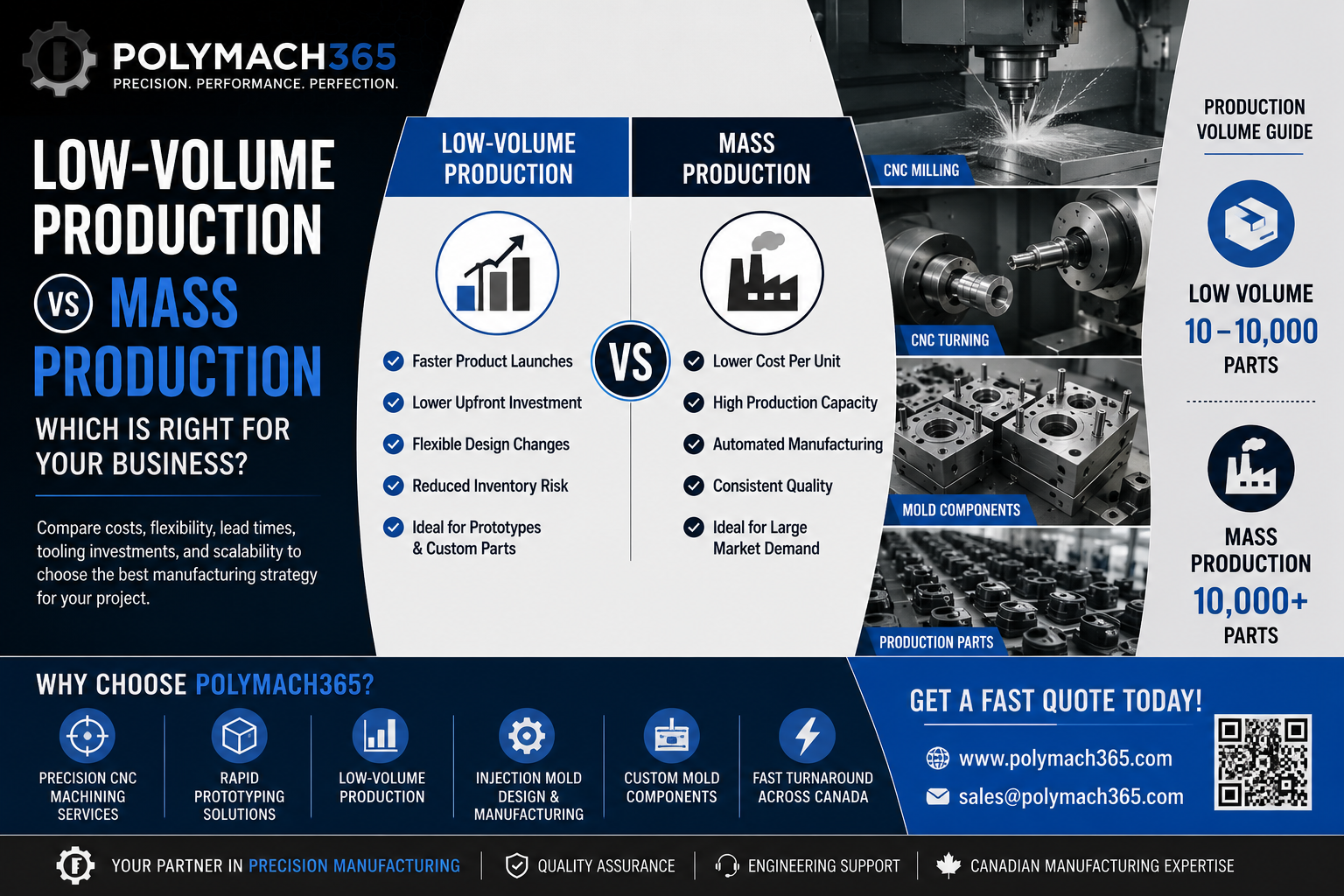
A Complete Manufacturing Guide for Canadian Businesses
In today’s competitive manufacturing industry, choosing the right production method can significantly impact your costs, product quality, inventory management, and time-to-market. Therefore, businesses must carefully evaluate whether Low-Volume Production or Mass Production best aligns with their goals.
At Polymach365, we help manufacturers, startups, and product developers across Canada select the most efficient production strategy for their unique requirements. Whether you’re launching a new product, validating market demand, or scaling an established product line, understanding the differences between low-volume and mass production is essential for long-term success.
This guide explains the advantages, challenges, and ideal applications of each manufacturing approach so you can make an informed decision.
What Is Low-Volume Production?
Low-volume production refers to manufacturing a relatively small quantity of parts or products, typically ranging from a few units to several thousand pieces. It serves as a bridge between rapid prototyping and full-scale production.
Therefore, low-volume manufacturing is ideal for businesses that need flexibility, faster design updates, and lower upfront investment.
Common Applications
✔ Product development
✔ Market testing
✔ Custom products
✔ Pilot production runs
✔ Specialized industrial components
✔ Medical and aerospace parts
As a result, companies can evaluate product performance before committing to large-scale manufacturing.
What Is Mass Production?
Mass production is the process of manufacturing large quantities of identical products using highly optimized production systems and tooling.
Because production volumes are significantly higher, manufacturers benefit from economies of scale and lower per-unit costs.
Common Applications
✔ Consumer products
✔ Automotive components
✔ Electronics manufacturing
✔ Packaging products
✔ Household goods
✔ High-demand industrial products
Consequently, mass production becomes the preferred choice when demand is stable and production volumes are high.
Key Differences Between Low-Volume Production and Mass Production
| Feature | Low-Volume Production | Mass Production |
|---|---|---|
| Production Quantity | Small to Medium | Large Scale |
| Initial Investment | Lower | Higher |
| Tooling Costs | Reduced | Significant |
| Design Flexibility | High | Limited |
| Lead Time | Faster | Longer Setup |
| Unit Cost | Higher Per Part | Lower Per Part |
| Inventory Risk | Lower | Higher |
| Product Customization | Easy | Difficult |
| Market Testing | Excellent | Limited |
Therefore, the best choice depends on your product stage, budget, and business objectives.
Benefits of Low-Volume Production
1. Lower Upfront Investment
One of the biggest advantages of low-volume production is reduced initial cost.
Because manufacturers produce fewer parts, businesses avoid large tooling investments and excessive inventory expenses.
Advantages
✔ Lower financial risk
✔ Reduced startup costs
✔ Better cash flow management
✔ Faster project approval
As a result, startups and growing businesses can enter the market more efficiently.
2. Faster Time-to-Market
Speed is often critical when launching a new product.
Low-volume manufacturing allows companies to move from design to production quickly without waiting for expensive production tooling.
Benefits Include
✔ Faster product launches
✔ Shorter development cycles
✔ Quicker market feedback
✔ Competitive advantage
Therefore, businesses can respond more rapidly to changing customer demands.
3. Greater Design Flexibility
Product designs often evolve during development.
Low-volume production makes it easier to implement design changes without significant tooling modifications or production delays.
Ideal For
- Product improvements
- Design validation
- Engineering revisions
- Market-driven modifications
Consequently, manufacturers maintain flexibility throughout the development process.
4. Reduced Inventory Risk
Producing large quantities before market validation can create significant inventory challenges.
However, low-volume production allows companies to manufacture based on actual demand.
Benefits
✔ Lower storage costs
✔ Reduced excess inventory
✔ Better inventory management
✔ Less financial exposure
As a result, businesses improve operational efficiency and reduce waste.
Benefits of Mass Production
1. Lower Cost Per Unit
The primary advantage of mass production is cost efficiency.
Because tooling, setup, and operational costs are spread across thousands of parts, the cost per unit decreases significantly.
Cost Advantages
✔ Economies of scale
✔ Lower manufacturing cost
✔ Improved profitability
✔ Higher production efficiency
Therefore, mass production becomes highly cost-effective for established products with predictable demand.
2. Consistent Product Quality
Mass production systems are designed for repeatability and consistency.
Advanced automation and process control ensure that every part meets the same quality standards.
Benefits
✔ Uniform product quality
✔ Reduced variation
✔ Improved customer satisfaction
✔ Reliable production output
Consequently, manufacturers can maintain consistency across large production runs.
3. High Production Capacity
When market demand increases, businesses need the ability to produce large quantities efficiently.
Mass production supports:
✔ Large-scale manufacturing
✔ Global distribution
✔ High-demand products
✔ Continuous production
As a result, companies can meet growing customer demand without significant production constraints.
4. Increased Automation
Mass production environments typically utilize advanced automation technologies.
Benefits Include
✔ Reduced labor costs
✔ Improved productivity
✔ Faster cycle times
✔ Consistent manufacturing quality
Therefore, automation contributes significantly to operational efficiency.
When Should You Choose Low-Volume Production?
Low-volume production is often the best solution when:
✔ Launching a New Product
Test market demand before investing in large-scale production.
✔ Developing Prototypes
Bridge the gap between prototyping and full production.
✔ Producing Custom Components
Manufacture specialized parts with unique requirements.
✔ Managing Uncertain Demand
Avoid excessive inventory and financial risk.
✔ Supporting Niche Markets
Serve specialized industries such as aerospace, medical, and industrial manufacturing.
As a result, businesses gain flexibility and reduce risk during product development.
When Should You Choose Mass Production?
Mass production is ideal when:
✔ Demand Is Consistent
High-volume sales justify larger production runs.
✔ Product Design Is Finalized
Design stability minimizes production changes.
✔ Cost Reduction Is a Priority
Large production quantities lower unit costs.
✔ Market Demand Is Proven
Customer demand supports large-scale manufacturing.
✔ Distribution Networks Are Established
Products can move efficiently through supply chains.
Consequently, businesses maximize profitability through large-scale production efficiency.
How Polymach365 Supports Both Manufacturing Approaches
At Polymach365, we understand that every project has unique production requirements. Therefore, we offer flexible manufacturing solutions that support both low-volume and production-scale manufacturing.
Our Capabilities Include:
✔ Rapid Prototyping Services
✔ Prototype Manufacturing
✔ Low-Volume Production
✔ CNC Machining Services
✔ CNC Milling & Turning
✔ 5-Axis CNC Machining
✔ Injection Mold Design Services
✔ Custom Mold Components Manufacturing
✔ Plastic Injection Molding Services
✔ Production Manufacturing Solutions
Moreover, our engineering team provides Design for Manufacturability (DFM) support to help optimize cost, quality, and production efficiency.
Industries We Serve
🚗 Automotive Manufacturing
Low-volume prototypes and production components.
✈️ Aerospace Manufacturing
Precision parts requiring tight tolerances and controlled production.
🏥 Medical Device Manufacturing
Custom and production-grade healthcare products.
💻 Electronics Industry
Rapid development and scalable manufacturing solutions.
🏭 Industrial Equipment Manufacturing
Custom machine parts and production assemblies.
🧴 Consumer Products
Product development, pilot production, and mass manufacturing.
Which Production Method Is Right for Your Business?
The answer depends on your goals, budget, and market requirements.
Choose Low-Volume Production if you need:
✔ Faster market entry
✔ Product flexibility
✔ Lower investment risk
✔ Design validation
✔ Limited production quantities
Choose Mass Production if you need:
✔ Lower unit costs
✔ High-volume manufacturing
✔ Established market demand
✔ Maximum production efficiency
✔ Long-term scalability
Therefore, understanding your product lifecycle and growth strategy is essential before selecting a manufacturing approach.
Why Choose Polymach365?
At Polymach365, we help businesses navigate every stage of product development and manufacturing.
What Sets Us Apart?
✔ Precision CNC Machining Services
✔ Rapid Prototyping Expertise
✔ Low-Volume Production Solutions
✔ Production Manufacturing Support
✔ Engineering & DFM Consultation
✔ Fast Turnaround Times
✔ Quality Inspection & Testing
✔ Canadian Manufacturing Expertise
As a result, we provide scalable manufacturing solutions that grow with your business.
Final Thoughts
Both low-volume production and mass production offer unique advantages. While low-volume manufacturing provides flexibility, speed, and reduced risk, mass production delivers cost efficiency and scalability.
The right choice depends on your product maturity, market demand, budget, and long-term business objectives.
If you’re looking for a trusted manufacturing partner in Canada, Polymach365 offers the expertise, technology, and production capabilities needed to support your project from prototype to full-scale production.
Get Started with Polymach365 Today
Upload your CAD files and discover how our manufacturing solutions can help reduce costs, improve quality, and accelerate your path to market.