Choosing the Right CNC Machining Approach for Your Project
Product development often involves several manufacturing stages. A component may begin as a single prototype and later move into small-batch or larger-scale production. Therefore, understanding the difference between prototype machining and production machining can help manufacturers choose the right process, control costs, and plan their projects more effectively.
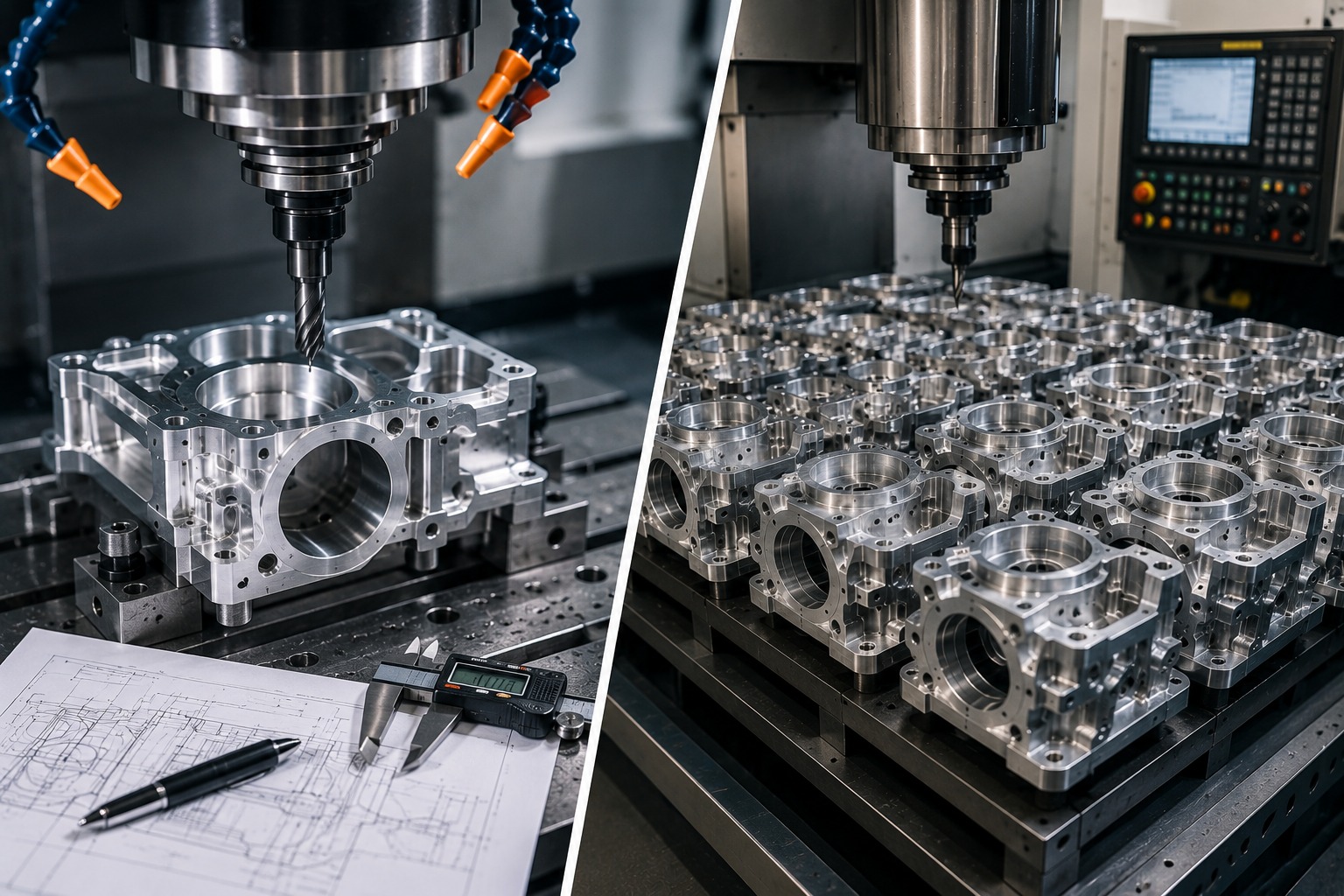
Both approaches use CNC machining technology, but their goals are different. Prototype machining focuses primarily on design validation, testing, and development , while production machining focuses on repeatability, efficiency, consistency, and manufacturing larger quantities .
At Polymach365 , we provide CNC milling, CNC turning, 3-axis, 4-axis, and 5-axis machining, prototype manufacturing, low-volume production, custom CNC machining, and precision machined components.
What is Prototype Machining?
Prototype machining is the process of manufacturing a physical component based on a CAD model or engineering drawing for testing and product development.
Instead of immediately producing a large quantity, manufacturers create one or a small number of parts to evaluate the design.
Prototype machining can help engineers test:
- Part dimensions
- Fit and assembly
- Function
- Strength
- Clearances
- Material selection
- Surface finish
- Design performance
Therefore, prototype machining provides an important step between digital design and final production.
What Is Production Machining?
Production machining focuses on manufacturing components repeatedly according to established specifications.
Once a design has been tested and approved, the manufacturing process can be optimized for producing the required quantity.
Production machining typically emphasizes:
- Repeatability
- Dimensional consistency
- Production efficiency
- Tool life
- Process control
- Quality inspection
- Cost management
As a result, production machining is better suited to projects where the same component must be manufactured consistently over multiple production runs.
Prototype Machining vs Production Machining
Although both processes use CNC equipment, their priorities can differ considerably.
| Feature | Prototype Machining | Production Machining |
|---|---|---|
| Main Purpose | Design validation | Repeatable manufacturing |
| Typical Quantity | One or a few parts | Larger quantities |
| Design Changes | Frequent | Usually controlled |
| Priority | Flexibility | Efficiency |
| Tooling | Often flexible | Optimized for production |
| Process | Development-focused | Standardized |
| Cost Focus | Development cost | Cost per part |
| Inspection | Design validation | Consistent quality control |
| Lead Time | Often prioritized | Planned production schedule |
Therefore, choosing between prototype and production machining depends largely on the development stage and required quantity.
1. Different Manufacturing Goals
The biggest difference is the purpose of manufacturing.
Prototype Machining
The objective is to answer questions such as:
Does the design work?
Does the component fit correctly?
Does the material perform as expected?
Are any design changes required?
Production Machining
The objective changes to:
Can we manufacture this component consistently?
Can we maintain the required tolerances?
Can we produce the required quantity efficiently?
Therefore, prototype machining is primarily development-focused, while production machining is manufacturing-focused.
2. Production Quantity
Quantity is another important difference.
Prototype machining may involve:
- Part 1
- 2 parts
- 5 parts
- Small prototype batches
Production machining can involve significantly larger quantities depending on the project.
However, CNC machining is also suitable for low-volume production , where manufacturers need more parts than a prototype but do not require mass production.
Therefore, there is not always a sharp boundary between prototype and production machining.
3. Design Changes
Prototype projects often involve design revisions.
After testing the first prototype, engineers may modify:
- Dimensions
- Hole locations
- Wall thickness
- Mounting features
- Geometry
- Material
- Surface finish
The next prototype can then be manufactured using the updated CAD model.
In production machining, however, the design is generally more established.
Therefore, uncontrolled design changes during production can create additional costs and process complications.
4. Tooling Strategy
Manufacturers may use standard tooling and workholding methods that allow the component to be produced quickly.
Production machining, on the other hand, may justify optimized:
- Cutting tools
- Toolpaths
- Fixtures
- Workholding
- Tool-change strategies
As a result, production machining can achieve greater efficiency when manufacturing repeated quantities.
5. Cost Considerations
Prototype machining and production machining have different cost structures.
A prototype may have a higher per-part cost because setup and programming costs are distributed across only a few components.
Production machining can reduce the average cost per component as the quantity increases.
However, higher production volumes may require additional process optimization.
Therefore, the cheapest option is not always determined by the machining price alone. You should also consider development costs, tooling, setup, inspection, finishing, and production quantity.
6. Lead Time
Prototype projects often prioritize fast development.
Engineers may need a physical part quickly so they can test and modify the design.
Production machining usually follows a planned manufacturing schedule.
The process may include:
Production Planning → Material Preparation → CNC Machining → Inspection → Finishing → Delivery
Therefore, lead time depends on the part’s complexity, material, quantity, tolerances, finishing requirements, and manufacturing process.
CNC Machining for Prototype Development
CNC machining is particularly useful for functional prototypes because it can produce parts directly from digital designs.
A typical workflow is:
CAD Design → DFM Review → Prototype Machining → Testing → Design Review
This process allows engineers to evaluate a real component rather than relying entirely on digital simulations.
Furthermore, CNC prototypes can often be manufactured from production-grade materials.
As a result, engineers can obtain a more realistic understanding of how the final component may perform.
CNC Machining for Production Manufacturing
Once the design has been validated, production machining can begin.
A production workflow may include:
Approved CAD → Process Planning → CAM Programming → CNC Machining → Inspection → Finishing → Production Delivery
At this stage, manufacturers can optimize the process for consistency and efficiency.
Important considerations include:
- Tool life
- Cycle time
- Workholding
- Material handling
- Inspection
- Repeatability
- Production scheduling
Consequently, production machining focuses on making the established process reliable over repeated manufacturing cycles.
Low-Volume Production: The Middle Ground
Some projects fail between prototyping and mass production.
For example, a manufacturer may need 20, 50, or 100 components for a specialized application.
In these situations, low-volume CNC machining can provide a practical solution.
It can support:
- Small production batches
- Pilot production
- Product validation
- Specialized equipment
- Replacement parts
- Engineering changes
Therefore, manufacturers do not always need to move directly from one prototype to high-volume production.
Prototype Machining for Product Development
Prototype machining can support several stages of product development.
Concept Validation
Create the first physical representation of the design.
Functional Testing
Test fit, movement, strength, and assembly.
Design Optimization
Identify problems and make improvements.
Pre-Production Validation
Manufacture components closer to the intended final design.
Production Preparation
Use validated designs to develop an efficient production process.
As a result, prototype machining can reduce the risk of moving an untested design directly into production.
Production Machining for Consistent Components
Production machining requires a greater focus on process consistency.
Manufacturers may monitor:
- Dimensional accuracy
- Tool wear
- Cycle time
- Material consistency
- Surface finish
- Inspection results
Therefore, process monitoring becomes increasingly important as production quantities increase.
If tool wear changes a critical dimension, for example, replacing or adjusting the tool before excessive variation occurs can help maintain part consistency.
Which materials can be used?
Both prototype and production machining can work with many materials.
Metals
- Aluminum
- Stainless steel
- Carbon steel
- Tool steel
- Brass
- Copper
- Titanium
- Alloy steel
Engineering Plastics
- ABS
- Nylon
- Delrin
- Polycarbonate
- PEEK
- PTFE
Material selection should depend on the component’s required strength, weight, temperature resistance, corrosion resistance, wear resistance, and operating environment.
Therefore, the same material may be suitable for both prototype and production machining if it meets the application requirements.
CNC Milling and Turning for Prototypes and Production
Both CNC milling and CNC turning can support prototype and production requirements.
CNC Milling
Milling is suitable for components containing:
- Pockets
- Slots
- Holes
- Flat surfaces
- Complex contours
- Mounting features
CNC Turning
Turning is suitable for rotational components such as:
- Shafts
- Pins
- Bushings
- Sleeves
- Spacers
- Rollers
Furthermore, 4-axis and 5-axis machining can provide additional flexibility for complex geometries.
Therefore, the appropriate CNC process should be selected according to the part’s geometry rather than simply its production stage.
How DFM Helps Both Processes
Design for Manufacture (DFM) is valuable during both prototype and production stages.
A DFM review can identify:
- Difficult-to-machine features
- Unnecessary tight tolerances
- Deep cavities
- Thin walls
- Tool-access problems
- Complex setups
- Material concerns
Therefore, addressing manufacturing issues early can reduce redesigns during prototyping and production problems later.
A strong workflow is:
CAD Design → DFM Review → Prototype → Testing → Design Approval → Production
When Should You Choose Prototype Machining?
Prototype machining is a good choice when:
- Your design is still being developed
- You need functional test parts
- You expect design changes
- You need only a few components
- You want to validate fit and function
- You are developing a new product
Therefore, prototype machining is generally most valuable during the early and middle stages of product development.
When Should You Choose Production Machining?
Production machining is more appropriate when:
- The design has been validated
- The geometry is established
- You need repeated quantities
- Consistent dimensions are important
- Production efficiency matters
- You need an ongoing supply of components
Consequently, production machining becomes more valuable after the design and manufacturing process has been established.
Can You Move From Prototype to Production With CNC Machining?
Yes. CNC machining can support the transition from prototype development to production.
A typical progression is:
Prototype → Design Validation → Low-Volume Production → Process Optimization → Production
This approach allows manufacturers to learn from early components and improve the process before increasing production quantities.
Therefore, working with a manufacturing partner that supports both prototyping and production can simplify the transition.
How Polymach365 Supports Prototype and Production Machining
At Polymach365 , we provide digital manufacturing solutions for prototypes, custom components, low-volume production, and production machining.
Our capabilities include:
- CNC Milling
- CNC Turning
- 3-Axis CNC Machining
- 4-Axis CNC Machining
- 5-Axis CNC Machining
- Prototype Manufacturing
- Low-Volume Production
- Custom CNC Machining
- Precision Machined Components
- Mold Components
Digital Manufacturing Workflow
Upload CAD File → Manufacturing Review → Quote → CNC Machining → Quality Inspection → Delivery
You can provide your CAD file along with the required:
- Material
- Quantity
- Tolerances
- Surface finish
- Finishing requirements
- Technical specifications
Therefore, the manufacturing approach can be evaluated according to your current project requirements.
Final Thoughts
Prototype machining and production machining serve different purposes, but both play important roles in CNC manufacturing.
Prototype machining focuses on design validation, testing, flexibility, and development , while production machining focuses on repeatability, efficiency, consistency, and quantity .
For many projects, the best approach is not to choose one or the other. Instead, manufacturers can progress from prototype machining to low-volume production and eventually to larger production quantities as the product becomes validated.
By combining CNC milling, CNC turning, multi-axis machining, DFM, appropriate materials, and quality control, manufacturers can create a more efficient path from an initial CAD concept to a finished production component.
Start Your Prototype or Production CNC Project
Do you have a CAD design ready?
Upload your CAD file and provide your material, quantity, tolerances, surface finish, and other requirements to start your prototype or production machining project with Polymach365.