Understanding Mold Components and Their Role in Injection Molding Success
In today’s manufacturing industry, injection molds are responsible for producing millions of precision plastic parts every day. However, an injection mold is much more than a simple tool. It consists of multiple precision-engineered components that work together to ensure accurate molding, smooth operation, consistent quality, and long-term durability. Therefore, understanding mold components is essential for mold makers, injection molders, product designers, and manufacturers looking to improve production efficiency and product quality.
At Polymach365, we specialize in manufacturing high-quality mold components, including core pins, cavity inserts, ejector pins, guide pins, bushings, wear plates, and custom mold parts. Our precision-engineered components help manufacturers achieve reliable performance, tighter tolerances, and longer mold life.
This guide explains what mold components are, their functions, and why they are critical for successful injection molding operations.
What Are Mold Components?
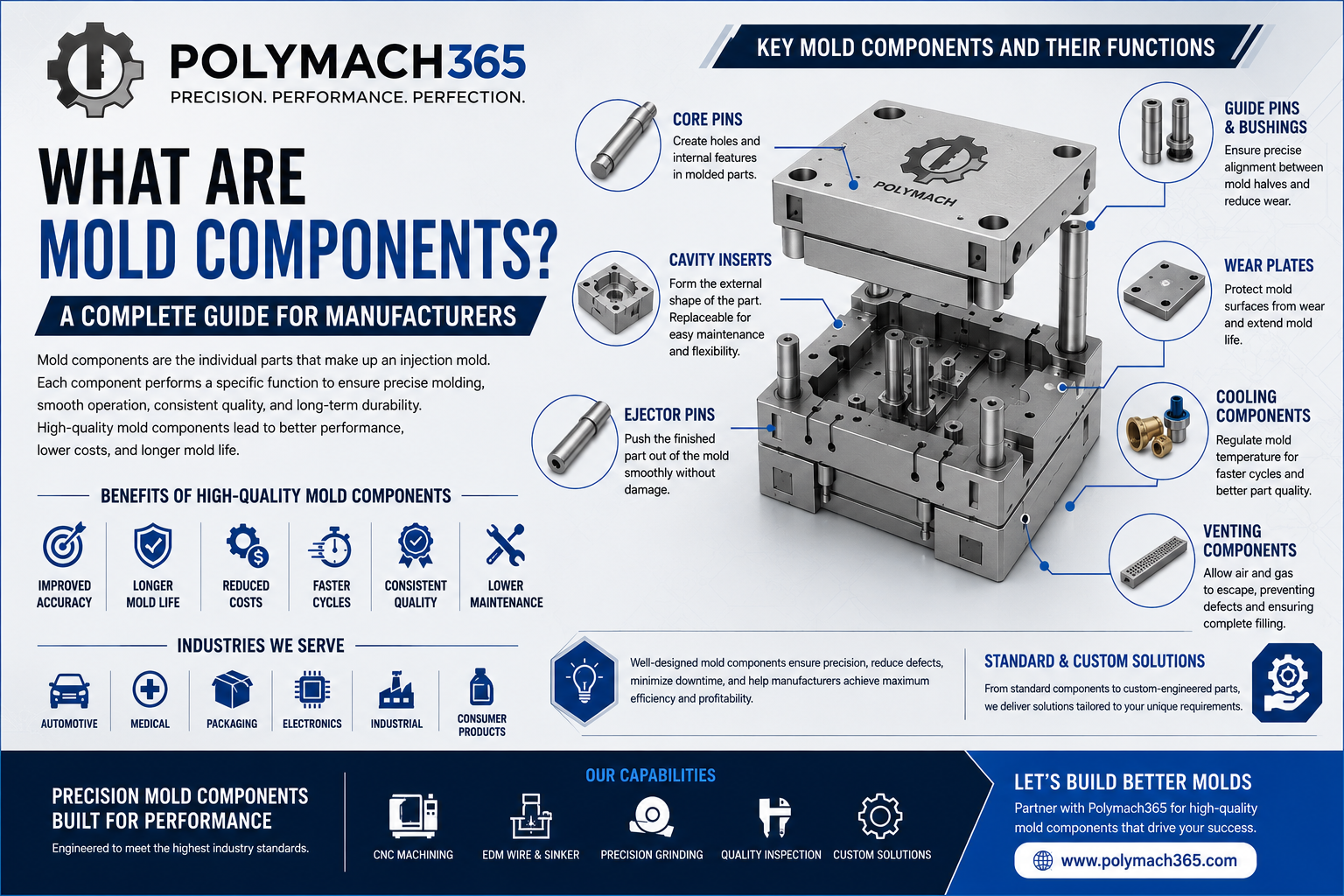
Mold components are the individual parts that make up an injection mold. Each component performs a specific function during the molding process, including shaping the part, guiding mold movement, cooling the mold, ejecting the finished product, and ensuring precise alignment. Together, these components enable consistent production and high-quality molded parts.
Without properly manufactured mold components, molds can experience alignment issues, excessive wear, part defects, and costly downtime.
Therefore, investing in high-quality mold components is essential for achieving efficient and reliable production.
Why Are Mold Components Important?
Every injection mold relies on precision components to perform correctly. Therefore, the quality of these components directly affects product quality, mold lifespan, and production efficiency.
Benefits of High-Quality Mold Components
✔ Improved dimensional accuracy
✔ Longer mold life
✔ Reduced maintenance costs
✔ Faster production cycles
✔ Consistent part quality
✔ Lower manufacturing costs
As a result, manufacturers can improve productivity while reducing operational risks.
Key Mold Components Explained
🔩 Core Pins
Core pins are precision components used to create holes, internal features, and complex geometries within molded parts. During injection molding, molten plastic flows around the core pin and forms the desired internal shape. Core pins play a critical role in maintaining dimensional accuracy and feature consistency.
Applications
- Through holes
- Blind holes
- Internal channels
- Precision features
Benefits
✔ High dimensional accuracy
✔ Improved part consistency
✔ Reduced secondary operations
⚙️ Cavity Inserts
Cavity inserts form the external shape and surface details of molded components. They are often designed as replaceable sections, allowing mold makers to modify or repair specific areas without replacing the entire mold. Inserts also simplify maintenance and support multiple product variations.
Advantages
✔ Easier mold maintenance
✔ Faster repairs
✔ Improved tooling flexibility
✔ Reduced mold replacement costs
As a result, manufacturers can extend mold life while improving production efficiency.
🔧 Ejector Pins
After a molded part cools, it must be removed from the mold safely. Ejector pins push the finished part out of the cavity without damaging its shape or surface. They are among the most widely used mold components in injection molding systems.
Benefits
✔ Reliable part ejection
✔ Reduced cycle times
✔ Improved production efficiency
✔ Lower risk of part damage
Consequently, ejector pins play a crucial role in maintaining production speed and consistency.
🛠 Guide Pins and Bushings
Guide pins and bushings ensure accurate alignment between the moving and stationary halves of the mold. Proper alignment is essential for maintaining part quality and preventing excessive wear on mold components.
Advantages
✔ Accurate mold alignment
✔ Reduced component wear
✔ Improved mold life
✔ Consistent product quality
Therefore, guide systems are essential for achieving reliable and repeatable molding performance.
⚡ Wear Plates
Wear plates protect mold surfaces that experience frequent movement and friction. They reduce wear, improve durability, and help maintain precision over extended production cycles.
Applications
- Sliding mold components
- Moving assemblies
- High-cycle molds
Benefits
✔ Increased durability
✔ Reduced maintenance
✔ Longer mold lifespan
✔ Lower repair costs
As a result, wear plates help manufacturers maximize tooling investments.
❄ Cooling Components
Cooling systems are critical because cooling often accounts for the majority of the molding cycle. Components such as cooling channels, baffles, bubblers, and thermal pins regulate mold temperature and improve cycle efficiency. Proper cooling helps prevent warpage while improving productivity.
Benefits
✔ Faster cycle times
✔ Better dimensional stability
✔ Improved part quality
✔ Reduced production costs
🌬 Venting Components
Venting systems remove trapped air and gases from the mold cavity during injection. Without proper venting, manufacturers may experience burn marks, short shots, voids, and incomplete filling. Venting components help maintain consistent molding quality.
Advantages
✔ Reduced molding defects
✔ Improved material flow
✔ Better surface finish
✔ Consistent part quality
Standard vs Custom Mold Components
Manufacturers can choose between standard mold components and custom-engineered solutions.
Standard Mold Components
Standard components are widely available and designed to fit common mold configurations.
Benefits
✔ Faster availability
✔ Lower upfront cost
✔ Proven reliability
Custom Mold Components
Custom mold components are designed specifically for unique mold applications and specialized production requirements.
Benefits
✔ Optimized performance
✔ Better fit and functionality
✔ Enhanced durability
✔ Improved production efficiency
At Polymach365, we manufacture both standard and custom mold components tailored to customer specifications.
Materials Used in Mold Components
The performance of mold components depends heavily on material selection.
Common Materials Include
- Tool Steel
- Hardened Steel
- Stainless Steel
- H13 Steel
- S7 Steel
- Carbide
- Beryllium Copper
Therefore, selecting the right material improves wear resistance, heat transfer, and component lifespan.
Industries That Rely on Mold Components
High-quality mold components support a wide range of industries across Canada.
🚗 Automotive Manufacturing
Precision components for interior, exterior, and structural applications.
🏥 Medical Device Manufacturing
High-accuracy mold components for healthcare products.
📦 Packaging Industry
Durable tooling solutions for high-volume packaging production.
💻 Electronics Manufacturing
Precision mold components for technical products and enclosures.
🧴 Consumer Products
Reliable tooling systems for everyday household products.
As a result, mold components remain essential to modern manufacturing operations.
Why Choose Polymach365 for Mold Components Manufacturing?
At Polymach365, we combine advanced CNC machining, EDM technology, precision grinding, and engineering expertise to manufacture premium mold components that meet the highest industry standards.
Our Capabilities Include:
✔ Core Pins Manufacturing
✔ Cavity Inserts Manufacturing
✔ Ejector Pins & Sleeves
✔ Guide Pins & Bushings
✔ Wear Plates
✔ Custom Mold Components
✔ CNC Machining Services
✔ Injection Mold Design Support
✔ Precision Quality Inspection
Moreover, our experienced team works closely with customers to ensure every component meets exact specifications and performance requirements.
Final Thoughts
Mold components are the foundation of every successful injection molding operation. From core pins and cavity inserts to ejector systems and guide components, each part plays a critical role in achieving product quality, production efficiency, and long-term tooling performance.
Therefore, manufacturers should invest in high-quality mold components that improve reliability, reduce maintenance, and maximize productivity.
If you are looking for a trusted partner for mold component manufacturing, Polymach365 provides the precision, quality, and engineering expertise needed to support your production goals.
Get Started with Polymach365 Today
Upload your CAD files and discover how our precision mold components can improve mold performance, reduce downtime, and increase manufacturing efficiency.