
Understanding Injection Mold Design for Modern Manufacturing
In today’s manufacturing industry, plastic products are everywhere—from automotive components and medical devices to consumer goods and electronic enclosures. However, producing these parts efficiently requires more than just an idea or a CAD model. It requires a well-engineered mold. Therefore, Injection Mold Design is one of the most critical steps in the plastic manufacturing process.
At Polymach365, we provide professional Injection Mold Design Services, helping manufacturers transform product concepts into high-performance production tools. Whether you’re developing a new product or preparing for mass production, understanding injection mold design is essential for achieving quality, consistency, and cost-effective manufacturing.
This beginner’s guide explains what injection mold design is, how it works, and why it plays a vital role in successful plastic injection molding.
What Is Injection Mold Design?
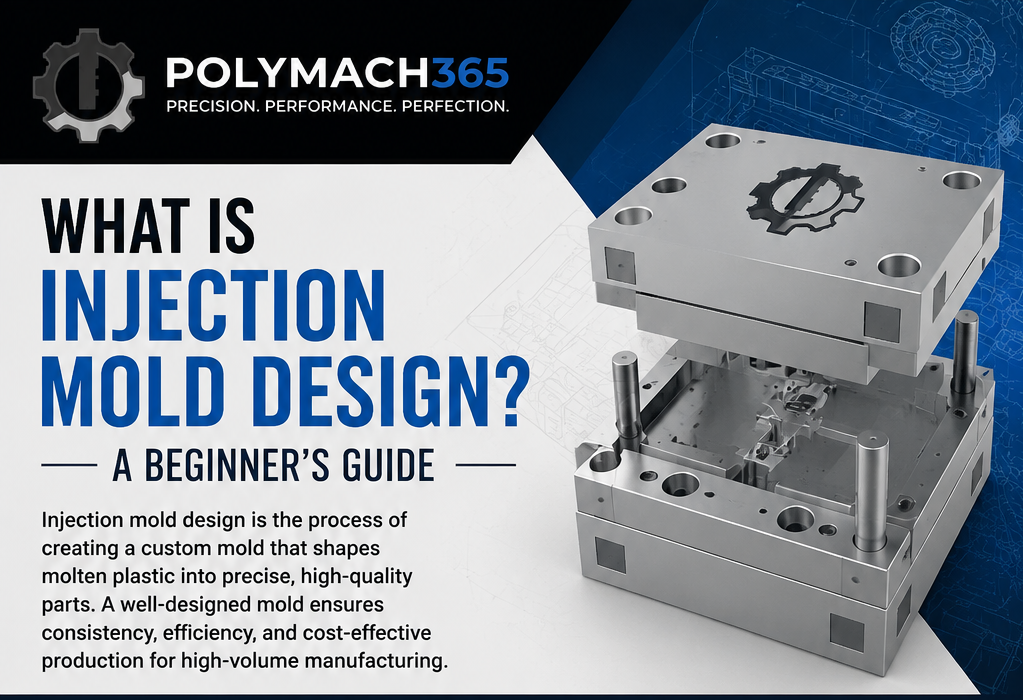
Injection mold design is the engineering process of creating a mold that shapes molten plastic into a finished product. The mold acts as a precision tool that contains the cavity and core needed to form the desired part shape. During production, molten plastic is injected into the mold cavity, cooled, and then ejected as a finished component.
Therefore, the quality of the mold directly affects the quality, accuracy, and consistency of every part produced.
A properly designed injection mold ensures:
✔ Accurate part dimensions
✔ Consistent production quality
✔ Faster cycle times
✔ Reduced manufacturing defects
✔ Longer mold life
✔ Lower production costs
As a result, manufacturers can achieve reliable, high-volume production with minimal waste.
Why Is Injection Mold Design Important?
Many manufacturing issues originate from poor mold design. Therefore, investing in professional mold design helps prevent costly production problems before they occur.
A well-designed mold can:
- Improve part quality
- Reduce cycle times
- Prevent warping and sink marks
- Minimize material waste
- Increase production efficiency
- Extend tooling lifespan
Furthermore, proper mold design reduces the risk of defects such as short shots, flash, weld lines, and warpage, which commonly occur when molds are not optimized correctly.
How Does Injection Mold Design Work?
The mold design process begins long before manufacturing starts. Therefore, engineers must carefully analyze the product design, material requirements, and production goals.
1. Product Design Review
The process starts with evaluating the 3D CAD model of the part. Engineers review dimensions, wall thickness, draft angles, ribs, bosses, and other features to ensure the design is suitable for injection molding.
As a result, potential manufacturing issues can be identified early.
2. Mold Flow Analysis
Engineers often perform mold flow simulations to understand how molten plastic will fill the cavity.
This analysis helps optimize:
- Gate locations
- Material flow
- Cooling performance
- Air venting
- Shrinkage control
Consequently, manufacturers can reduce defects and improve production efficiency.
3. Core and Cavity Design
The mold is divided into two primary sections:
Core
The core forms the internal features of the plastic component.
Cavity
The cavity forms the external shape of the part.
Together, these components create the final geometry of the molded product.
4. Cooling System Design
Efficient cooling is essential because cooling time often represents the largest portion of the molding cycle.
Therefore, mold designers strategically place cooling channels to:
✔ Maintain uniform temperatures
✔ Reduce cycle times
✔ Improve part quality
✔ Prevent warping
Proper cooling design directly improves productivity and mold performance.
5. Ejection System Design
After the plastic cools, the part must be removed safely from the mold.
Therefore, designers incorporate ejection systems such as:
- Ejector pins
- Sleeves
- Stripper plates
As a result, parts can be removed efficiently without damage.
Key Components of an Injection Mold
Understanding the main mold components helps explain how injection molds function.
🔩 Core and Cavity
These components create the final shape of the plastic part.
⚙️ Sprue, Runners, and Gates
These channels guide molten plastic from the injection machine into the mold cavity.
Sprue
The main channel that carries molten plastic into the mold.
Runner
Secondary channels that distribute material throughout the mold.
Gate
The entry point where molten plastic enters the cavity.
🛠 Guide Pins and Bushings
These components ensure precise alignment between mold halves during each production cycle.
❄ Cooling Channels
Cooling systems regulate mold temperature and improve production efficiency.
🔧 Ejection System
Ejector pins and mechanisms safely remove finished parts from the mold.
Important Design Considerations for Injection Molds
Successful mold design requires careful attention to several engineering principles.
Draft Angles
Draft angles are slight tapers added to part walls to help components release from the mold after cooling.
Without proper draft angles, parts may stick inside the mold, causing damage and production issues. Most molded parts require some degree of draft for proper ejection.
Benefits of Draft Angles
✔ Easier part ejection
✔ Reduced mold wear
✔ Improved surface quality
✔ Faster production cycles
Wall Thickness
Uniform wall thickness helps maintain consistent cooling and reduces defects.
Therefore, designers avoid sudden thickness variations whenever possible.
Benefits
✔ Reduced warpage
✔ Improved strength
✔ Better dimensional stability
✔ Faster cooling
Gate Location
Gate placement significantly affects material flow and final part quality.
Therefore, designers carefully select gate positions to:
- Minimize weld lines
- Improve filling
- Reduce stress concentrations
- Enhance cosmetic appearance
Material Selection
Different plastics behave differently during molding.
Common injection molding materials include:
- ABS
- Polypropylene (PP)
- Polycarbonate (PC)
- Nylon
- PEEK
- Acetal (Delrin)
Therefore, mold design must account for material shrinkage, flow characteristics, and cooling requirements.
Common Applications of Injection Mold Design
Injection mold design supports numerous industries across Canada.
🚗 Automotive Industry
Interior trim, housings, dashboards, clips, and functional components.
🏥 Medical Device Manufacturing
Diagnostic equipment, surgical tools, and healthcare products.
📦 Packaging Industry
Caps, containers, closures, and packaging solutions.
💻 Electronics Industry
Enclosures, connectors, and protective housings.
🧴 Consumer Products
Household items, personal care products, and retail goods.
Consequently, injection mold design remains one of the most important engineering disciplines in modern manufacturing.
Why Choose Polymach365 for Injection Mold Design Services?
At Polymach365, we combine advanced engineering expertise with modern manufacturing technologies to deliver high-performance mold designs optimized for production success.
Our Capabilities Include:
✔ Injection Mold Design Services
✔ Mold Flow Analysis
✔ Design for Manufacturability (DFM)
✔ Custom Plastic Injection Mold Manufacturing
✔ Mold Components Manufacturing
✔ CNC Machining Services
✔ Prototype Tooling
✔ Production Tooling Solutions
✔ Engineering Support & Optimization
Moreover, our team works closely with customers throughout the design and manufacturing process to ensure optimal mold performance and long-term reliability.
Final Thoughts
Injection mold design is the foundation of successful plastic manufacturing. A properly engineered mold improves product quality, reduces defects, shortens cycle times, and lowers production costs. Therefore, investing in professional mold design services is essential for any company planning to manufacture plastic components at scale.
Whether you need a prototype mold, production tooling, or complete injection mold engineering support, Polymach365 has the expertise and technology to help bring your project to life.
Get Started with Polymach365
Upload your CAD files today and discover how our Injection Mold Design Services can help you achieve faster production, superior part quality, and long-term manufacturing success.