How Much Does Injection Mold Manufacturing Cost in Canada? (2026 Pricing Guide)
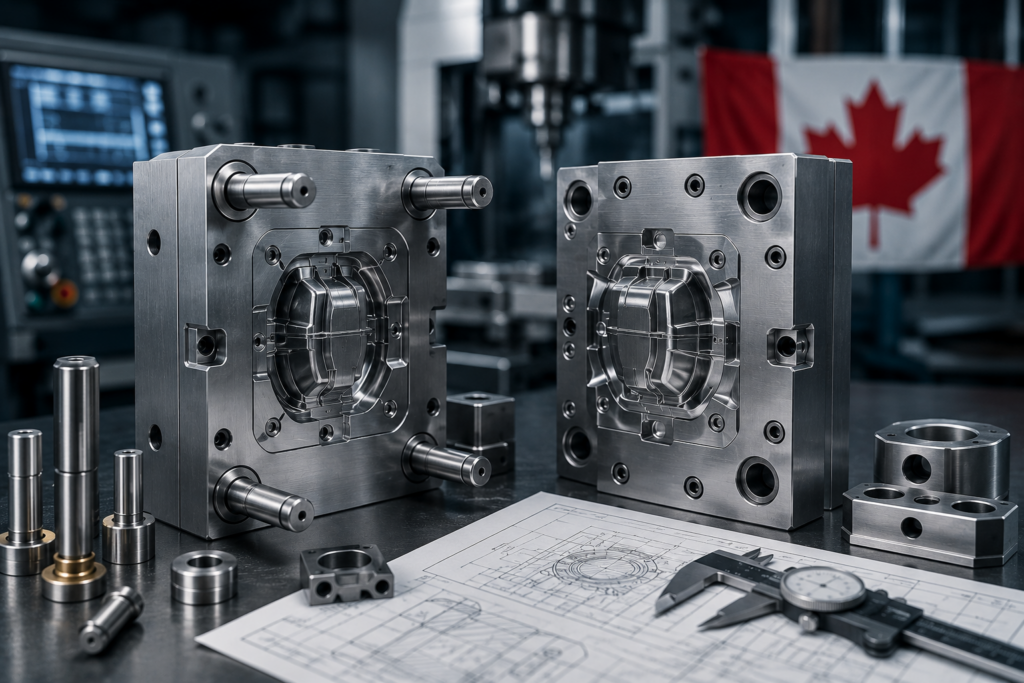
A Complete Guide to Injection Mold Costs, Factors, and Cost-Saving Tips When developing a new plastic product, one of the most important questions manufacturers ask is, “How much does injection mold manufacturing cost in Canada?” The answer depends on several factors, including mold complexity, material selection, cavity count, mold size, production volume, surface finish, and required precision. At Polymach365, we provide custom injection mold design and manufacturing services in Canada for industries such as automotive, medical, electronics, consumer products, packaging, and industrial manufacturing. Whether you need a prototype mold or a high-volume production tool, understanding the cost factors helps you plan your project and maximize your return on investment. This guide explains the average cost of injection mold manufacturing in Canada and highlights practical ways to reduce expenses while maintaining excellent quality. What Is the Average Cost of Injection Mold Manufacturing in Canada? Injection mold manufacturing costs vary based on the complexity and intended production volume. The following estimates provide a general pricing guide for 2026. Injection Mold Type Estimated Cost (CAD) Prototype Mold $2,000 – $8,000 Low-Volume Production Mold $8,000 – $20,000 Medium Production Mold $20,000 – $50,000 High-Volume Production Mold $50,000 – $150,000+ Multi-Cavity Mold $40,000 – $250,000+ These prices are estimates only. Therefore, the final cost depends on the mold design, tooling material, production requirements, and part complexity. What Factors Affect Injection Mold Manufacturing Costs? Several important factors determine the final price of an injection mold. 1. Mold Design Complexity Complex mold designs require additional engineering, machining, and assembly work. Features that increase mold costs include: Complex part geometries Undercuts Side actions Lifters Slides Thin-wall designs Tight tolerances Multiple inserts Therefore, simpler mold designs generally cost less and require shorter manufacturing times. 2. Mold Material The type of steel used significantly affects durability and price. Common Mold Materials P20 Tool Steel H13 Hardened Steel S136 Stainless Steel NAK80 Steel Aluminum (Prototype Molds) For example, aluminum molds are more affordable for prototype production, while hardened steel molds are ideal for high-volume manufacturing because they offer a much longer service life. 3. Number of Cavities A single-cavity mold produces one part per cycle, whereas multi-cavity molds manufacture several parts simultaneously. Although multi-cavity molds require a higher initial investment, they reduce the cost per part during large production runs. Consequently, manufacturers producing thousands of components often choose multi-cavity tooling. 4. Mold Size Larger molds require more raw material, machining time, and larger CNC equipment. As a result, larger molds generally cost more than smaller, simpler molds. 5. Precision Requirements Products requiring high dimensional accuracy demand additional machining, grinding, polishing, and inspection. Industries such as: Automotive Medical Devices Aerospace Electronics often require extremely tight tolerances. Therefore, precision tooling usually increases manufacturing costs. 6. Surface Finish Surface texture directly impacts tooling complexity. Common mold finishes include: Mirror Polish Matte Finish SPI Standards VDI Texture EDM Texture Although premium finishes improve product appearance, they require additional polishing and processing, increasing the overall mold cost. 7. Production Volume Production quantity plays a major role in selecting the appropriate mold design. Prototype Production Designed for product testing and design validation. Lower upfront investment. Low-Volume Production Suitable for startup products and pilot manufacturing. Moderate tooling investment. High-Volume Manufacturing Built for hundreds of thousands or even millions of parts. Higher initial cost but lower long-term production cost. As production volume increases, the cost per molded part decreases significantly. Typical Injection Mold Manufacturing Process At Polymach365, every mold follows a proven engineering workflow. Step 1 – Product Design Review Our engineers evaluate your CAD model for manufacturability. Step 2 – Mold Design We create a custom mold design optimized for performance and production efficiency. Step 3 – CNC Machining High-precision CNC milling, turning, EDM, and grinding manufacture the mold components. Step 4 – Mold Assembly All components are assembled, fitted, and inspected. Step 5 – Mold Testing Trial molding validates performance before production. Step 6 – Final Delivery The completed mold is delivered ready for production. This streamlined process ensures consistent quality, reduced lead times, and reliable performance. How to Reduce Injection Mold Manufacturing Costs Fortunately, there are several effective ways to lower tooling costs without compromising product quality. Simplify Product Design Avoid unnecessary features such as deep ribs, sharp corners, and undercuts. Simple designs reduce machining time and tooling complexity. Optimize Wall Thickness Uniform wall thickness improves mold filling while reducing machining and maintenance costs. Select the Right Mold Material Choose aluminum for prototypes and hardened steel for long-term production. This approach balances initial investment with expected production volume. Design for Manufacturability (DFM) At Polymach365, our engineering team performs Design for Manufacturability (DFM) analysis before production begins. As a result, we identify potential issues early, reduce tooling modifications, and improve manufacturing efficiency. Choose the Correct Number of Cavities A single-cavity mold may be ideal for prototypes, while multi-cavity molds deliver better value for mass production. Therefore, selecting the appropriate mold configuration helps optimize both cost and productivity. Why Choose Polymach365 for Injection Mold Manufacturing in Canada? Polymach365 combines advanced engineering, precision machining, and strict quality control to manufacture durable, high-performance injection molds. Our Services Include ✔ Injection Mold Design ✔ Custom Injection Mold Manufacturing ✔ Mold Components Manufacturing ✔ CNC Machining ✔ EDM Machining ✔ Rapid Prototyping ✔ Low-Volume Production ✔ High-Volume Manufacturing ✔ Mold Repair & Maintenance ✔ Engineering Support ✔ Quality Inspection ✔ Fast Delivery Across Canada Moreover, our experienced team ensures every mold meets your exact production requirements. Industries We Serve Our injection mold manufacturing solutions support a wide range of industries across Canada. Automotive Medical Devices Consumer Products Packaging Electronics Aerospace Industrial Equipment Electrical Components Plastic Manufacturing Consequently, businesses across multiple sectors trust Polymach365 for reliable tooling solutions. How to Get an Accurate Injection Mold Quote To receive the most accurate quotation, please provide: 3D CAD File (STEP, IGES, or SolidWorks) Product Material Annual Production Quantity Surface Finish Requirements Tolerance Specifications Expected Delivery Timeline Our engineering team will review your design and provide a detailed quotation with expert DFM recommendations. Why Manufacturers
How Much Does CNC Machining Cost in Canada? (2026 Pricing Guide)
Everything Manufacturers Need to Know Before Requesting a CNC Machining Quote When planning a manufacturing project, one of the first questions businesses ask is, “How much does CNC machining cost in Canada?” The answer depends on several factors, including material selection, part complexity, machining time, tolerances, surface finish, production volume, and lead time. At Polymach365, we provide precision CNC machining services across Canada with transparent pricing, fast turnaround times, and high-quality manufacturing solutions. Whether you need a single prototype, low-volume production, or large-scale manufacturing, understanding the cost factors can help you optimize your budget without compromising quality. In this guide, we’ll explain what affects CNC machining costs in Canada and share practical tips to help you reduce expenses while achieving outstanding results. What Is the Average Cost of CNC Machining in Canada? CNC machining costs vary depending on your project’s specifications. While every part is unique, the following estimates provide a general pricing guide for 2026. CNC Machining Service Estimated Cost (CAD) Simple Prototype Part $75 – $250 Medium Complexity Part $250 – $800 Complex Precision Part $800 – $3,500+ CNC Milling (Hourly) $80 – $180/hour CNC Turning (Hourly) $70 – $160/hour 5-Axis CNC Machining $120 – $250+/hour These figures are estimates only. Therefore, the final cost depends on your design, material, quantity, machining time, and finishing requirements. What Factors Affect CNC Machining Costs? Understanding the major cost drivers helps you design parts more efficiently and control manufacturing expenses. 1. Material Selection The material you choose has a significant impact on machining costs because different materials require different machining speeds, tooling, and cutting conditions. Common Materials Metals Aluminum Stainless Steel Carbon Steel Brass Copper Titanium Plastics ABS Delrin (Acetal) Nylon Polycarbonate PEEK PTFE For example, aluminum machines quickly and is generally more affordable, while titanium requires longer machining times and specialized tooling. Consequently, titanium parts cost considerably more than aluminum components. 2. Part Complexity Simple components with straight edges and standard features are faster to manufacture. However, complex geometries require additional machining operations, tool changes, and programming. Features that increase costs include: ✔ Deep pockets ✔ Thin walls ✔ Internal cavities ✔ Tight corners ✔ Complex contours ✔ Multi-sided machining Therefore, simplifying your design can significantly reduce manufacturing costs. 3. CNC Machine Type Different CNC machines have different operating costs. 3-Axis CNC Milling Ideal for standard components and simple geometries. Lowest machining cost. 4-Axis CNC Milling Provides greater flexibility while reducing setup time. Moderate machining cost. 5-Axis CNC Machining Perfect for highly complex parts requiring fewer setups. Higher hourly rates but often lower overall production costs because machining is completed faster. 4. Machining Time Machine time is one of the largest contributors to CNC machining costs. Longer machining times mean: More machine usage Increased labor Higher tooling wear Greater production costs Therefore, optimizing part geometry helps reduce machining hours and lowers overall pricing. 5. Production Quantity The number of parts you order directly affects the cost per unit. Prototype Production Higher cost per part because setup costs are shared across fewer components. Low-Volume Production Better pricing with reduced cost per unit. Production Manufacturing Large production runs significantly lower the unit price because setup costs are distributed across more parts. As a result, ordering larger quantities often provides substantial cost savings. 6. Tolerance Requirements Standard machining tolerances are generally less expensive than ultra-precision machining. For example: Standard tolerances require fewer machining operations. Tight tolerances demand slower machining speeds, specialized inspection, and additional quality control. Consequently, tighter tolerances increase manufacturing costs. 7. Surface Finish Requirements Surface finishing adds additional production steps. Common finishing options include: Anodizing Powder Coating Sand Blasting Bead Blasting Polishing Brushing Painting Passivation Although these finishes improve appearance and durability, they also increase production costs. How to Reduce CNC Machining Costs Fortunately, there are several ways to reduce costs without sacrificing quality. Optimize Your CAD Design Design parts with simple geometries whenever possible. Avoid unnecessary pockets and sharp internal corners. Use standard hole sizes. Reduce unnecessary machining features. As a result, machining becomes faster and more economical. Choose Cost-Effective Materials Select materials based on performance requirements rather than over-engineering your design. For many applications, aluminum provides excellent strength, machinability, and affordability. Order Larger Quantities Producing multiple parts during one setup significantly lowers the cost per component. Therefore, combining orders can improve manufacturing efficiency. Standardize Features Using common thread sizes, hole diameters, and tooling dimensions reduces machining time. Consequently, production becomes faster and less expensive. Request Design for Manufacturability (DFM) Feedback At Polymach365, we review every design before production. Our engineering team recommends improvements that reduce machining time, material waste, and manufacturing costs while maintaining part performance. Why Choose Polymach365 for Affordable CNC Machining in Canada? At Polymach365, we help manufacturers optimize quality, speed, and cost through advanced CNC machining solutions. Our CNC Services Include ✔ CNC Milling Services ✔ CNC Turning Services ✔ 5-Axis CNC Machining ✔ Rapid Prototyping ✔ Low-Volume Production ✔ Production Manufacturing ✔ Injection Mold Components ✔ Custom CNC Machining Solutions ✔ Engineering Support ✔ Quality Inspection ✔ Fast Delivery Across Canada Moreover, we provide transparent quotations with no hidden costs, allowing customers to plan projects with confidence. Industries We Serve Our CNC machining solutions support manufacturers across numerous industries. Automotive Aerospace Medical Devices Industrial Equipment Robotics Electronics Energy Consumer Products Mold & Tool Manufacturing Therefore, regardless of your industry, Polymach365 delivers precision components that meet strict quality standards. How to Get an Accurate CNC Machining Quote To receive the most accurate pricing, provide the following information: CAD File (STEP, IGES, or SolidWorks) Material Selection Quantity Required Surface Finish Requirements Tolerance Specifications Delivery Timeline Once we review your design, our engineering team provides a detailed quotation along with Design for Manufacturability (DFM) recommendations to optimize cost and production efficiency. Why Manufacturers Across Canada Trust Polymach365 Businesses choose Polymach365 because we combine precision engineering with responsive customer service. What Sets Us Apart? ✔ Precision CNC Machining ✔ Competitive Canadian Pricing ✔ Fast Turnaround Times ✔ Advanced Multi-Axis CNC Machines ✔ Experienced Engineering Team ✔ Strict Quality
3D Printing vs CNC Machining for Prototyping: Which Is Better?
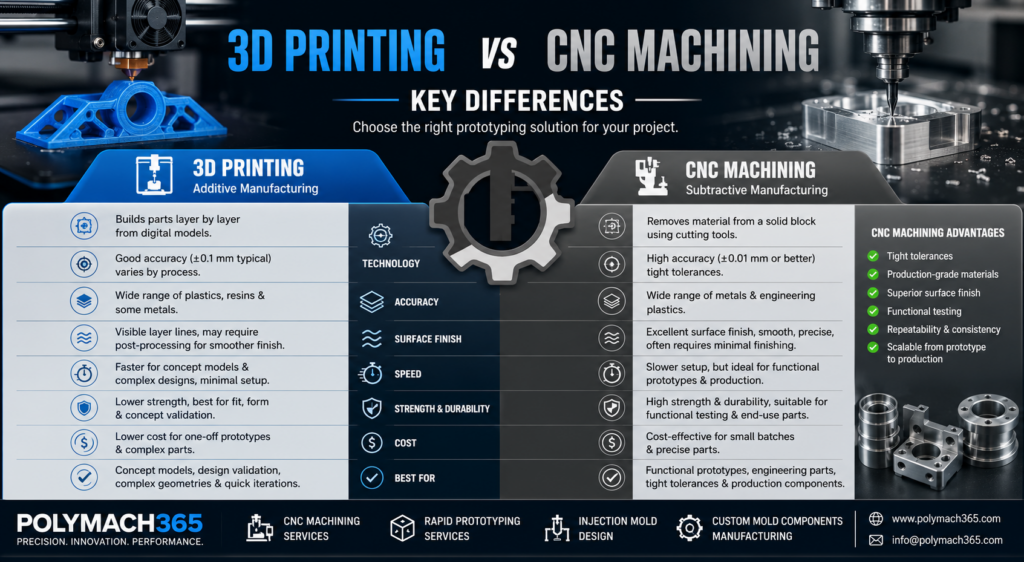
A Complete Guide for Manufacturers in Canada When developing a new product, one of the first decisions manufacturers face is choosing the right prototyping method. Two of the most popular options are 3D Printing and CNC Machining. While both technologies help transform digital designs into physical parts, they offer different advantages depending on your project requirements. At Polymach365, we provide both Rapid Prototyping Services and Precision CNC Machining Services to help businesses across Canada accelerate product development and reduce manufacturing risks. Therefore, understanding the strengths and limitations of each process is essential before selecting the best solution for your prototype. In this guide, we’ll compare 3D printing and CNC machining based on accuracy, materials, cost, speed, surface finish, and production readiness so you can make the right decision for your project. What Is 3D Printing? 3D printing, also known as additive manufacturing, creates parts layer by layer from a digital CAD model. Unlike traditional manufacturing methods, 3D printing adds material only where needed. Therefore, it allows engineers to create highly complex geometries and internal structures that would be difficult or impossible to machine. Common 3D Printing Technologies ✔ FDM (Fused Deposition Modeling) ✔ SLA (Stereolithography) ✔ SLS (Selective Laser Sintering) ✔ MJF (Multi Jet Fusion) ✔ Metal 3D Printing As a result, 3D printing has become a popular solution for concept models, design validation, and early-stage product development. What Is CNC Machining? CNC machining is a subtractive manufacturing process that removes material from a solid block using computer-controlled cutting tools. Consequently, CNC machining produces highly accurate parts with excellent mechanical properties and superior surface finishes. Common CNC Processes ✔ CNC Milling ✔ CNC Turning ✔ 5-Axis Machining ✔ Precision Drilling ✔ Multi-Axis Machining Therefore, CNC machining is widely used for functional prototypes, engineering validation, and production-ready components. 3D Printing vs CNC Machining: Key Differences Accuracy and Tolerances One of the biggest differences between the two technologies is dimensional accuracy. CNC Machining CNC machining delivers extremely tight tolerances and repeatable precision. Therefore, it is ideal for parts that require exact dimensions and assembly compatibility. Typical CNC tolerances can be significantly tighter than those achieved with most 3D printing technologies. 3D Printing While modern 3D printers offer good accuracy, layer-based manufacturing can introduce slight variations depending on the process and material used. As a result, 3D printed parts may require additional finishing for high-precision applications. Winner: CNC Machining For precision engineering and tight tolerances, CNC machining is the preferred choice. Material Selection Material performance plays a major role in prototype success. CNC Machining Materials Aluminum Stainless Steel Brass Copper Titanium ABS Delrin Nylon PEEK Because CNC machining uses production-grade materials, prototypes accurately represent final product performance. 3D Printing Materials PLA ABS PETG Nylon Resin Materials Metal Powders Although material options continue to expand, some 3D printed materials may not fully replicate the strength and durability of production-grade materials. Winner: CNC Machining For functional testing and real-world performance validation, CNC machining offers superior material options. Design Complexity This is where 3D printing often excels. 3D Printing Advantages Because parts are built layer by layer, engineers can create: ✔ Internal channels ✔ Lattice structures ✔ Organic geometries ✔ Lightweight designs ✔ Complex assemblies Therefore, 3D printing provides greater design freedom. CNC Machining Limitations CNC machining is restricted by cutting tool access and machining constraints. Consequently, some highly complex geometries may be difficult or expensive to manufacture. Winner: 3D Printing For highly complex shapes and intricate designs, 3D printing offers greater flexibility. Surface Finish Quality Surface quality is critical for many prototypes. CNC Machining CNC-machined parts generally have smoother surfaces and superior finishes directly from the machine. Therefore, they often require minimal post-processing. 3D Printing Layer lines are often visible on printed parts. As a result, sanding, polishing, or additional finishing may be required for aesthetic applications. Winner: CNC Machining For professional appearance and production-quality finishes, CNC machining delivers better results. Speed of Prototyping Speed is often a deciding factor during product development. 3D Printing Because there is minimal setup required, 3D printing can produce prototypes quickly, especially for one-off parts and design iterations. Therefore, it is excellent for rapid concept validation. CNC Machining CNC machining requires programming, tooling setup, and machine preparation. Consequently, lead times may be slightly longer for single prototypes. Winner: 3D Printing For fast design iterations and early-stage development, 3D printing is often the quickest solution. Cost Comparison Cost depends on part complexity, quantity, and material selection. 3D Printing For one-off prototypes and highly complex parts, 3D printing is often more cost-effective because there is little setup cost. CNC Machining While setup costs may be higher initially, CNC machining becomes more economical for small production runs and repeat manufacturing. Winner ✔ Single Prototype → 3D Printing ✔ Functional Prototype → CNC Machining ✔ Small Production Runs → CNC Machining Production Readiness Many manufacturers use prototypes to prepare for production. CNC Machining Because CNC machining uses production-grade materials and manufacturing processes, prototypes closely match final production parts. Therefore, engineering validation becomes more accurate. 3D Printing While excellent for concept development, some printed materials may not replicate final production performance. Consequently, additional validation may be required before manufacturing begins. Winner: CNC Machining For production-ready prototypes and engineering validation, CNC machining is the better choice. When Should You Choose 3D Printing? Choose 3D printing when you need: ✔ Rapid concept models ✔ Design validation ✔ Complex geometries ✔ Internal structures ✔ Fast design iterations ✔ Low-cost early-stage prototypes Therefore, 3D printing is ideal during the initial stages of product development. When Should You Choose CNC Machining? Choose CNC machining when you need: ✔ Tight tolerances ✔ Production-grade materials ✔ Functional testing ✔ Superior surface finishes ✔ Production-ready prototypes ✔ Small-batch manufacturing Consequently, CNC machining is often the preferred solution for engineering prototypes and market-ready products. Why Polymach365 Is Your Prototyping Partner At Polymach365, we help manufacturers select the most effective prototyping solution based on project goals, timelines, and budgets. Our Services Include: ✔ Rapid Prototyping Services ✔ CNC Milling Services ✔ CNC Turning
Low-Volume Production vs Mass Production: Which Is Right for Your Business?
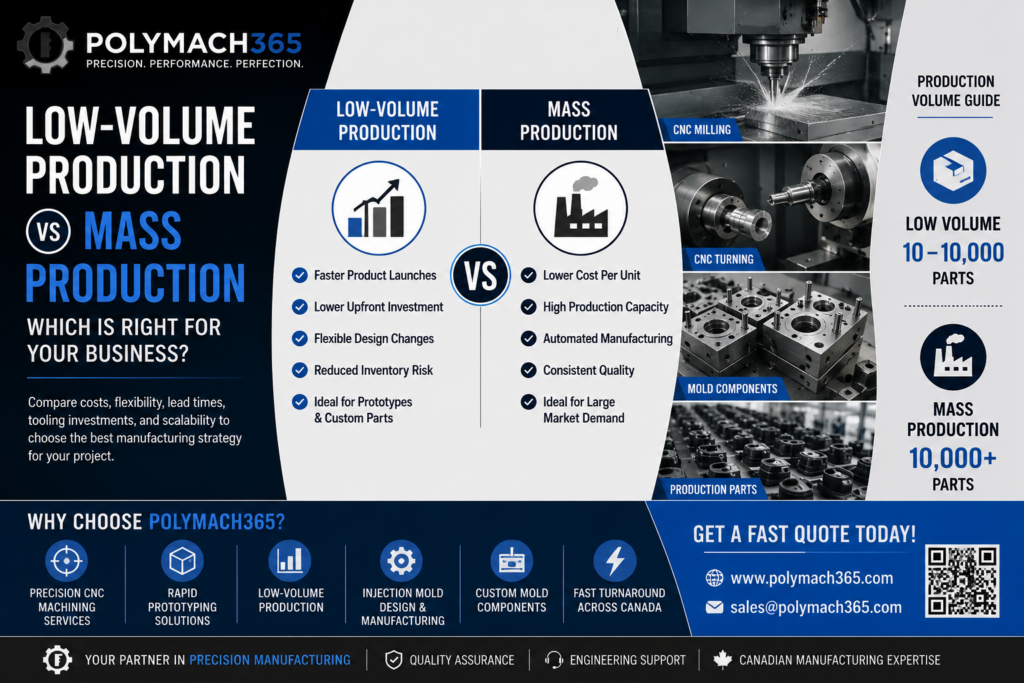
A Complete Manufacturing Guide for Canadian Businesses In today’s competitive manufacturing industry, choosing the right production method can significantly impact your costs, product quality, inventory management, and time-to-market. Therefore, businesses must carefully evaluate whether Low-Volume Production or Mass Production best aligns with their goals. At Polymach365, we help manufacturers, startups, and product developers across Canada select the most efficient production strategy for their unique requirements. Whether you’re launching a new product, validating market demand, or scaling an established product line, understanding the differences between low-volume and mass production is essential for long-term success. This guide explains the advantages, challenges, and ideal applications of each manufacturing approach so you can make an informed decision. What Is Low-Volume Production? Low-volume production refers to manufacturing a relatively small quantity of parts or products, typically ranging from a few units to several thousand pieces. It serves as a bridge between rapid prototyping and full-scale production. Therefore, low-volume manufacturing is ideal for businesses that need flexibility, faster design updates, and lower upfront investment. Common Applications ✔ Product development ✔ Market testing ✔ Custom products ✔ Pilot production runs ✔ Specialized industrial components ✔ Medical and aerospace parts As a result, companies can evaluate product performance before committing to large-scale manufacturing. What Is Mass Production? Mass production is the process of manufacturing large quantities of identical products using highly optimized production systems and tooling. Because production volumes are significantly higher, manufacturers benefit from economies of scale and lower per-unit costs. Common Applications ✔ Consumer products ✔ Automotive components ✔ Electronics manufacturing ✔ Packaging products ✔ Household goods ✔ High-demand industrial products Consequently, mass production becomes the preferred choice when demand is stable and production volumes are high. Key Differences Between Low-Volume Production and Mass Production Feature Low-Volume Production Mass Production Production Quantity Small to Medium Large Scale Initial Investment Lower Higher Tooling Costs Reduced Significant Design Flexibility High Limited Lead Time Faster Longer Setup Unit Cost Higher Per Part Lower Per Part Inventory Risk Lower Higher Product Customization Easy Difficult Market Testing Excellent Limited Therefore, the best choice depends on your product stage, budget, and business objectives. Benefits of Low-Volume Production 1. Lower Upfront Investment One of the biggest advantages of low-volume production is reduced initial cost. Because manufacturers produce fewer parts, businesses avoid large tooling investments and excessive inventory expenses. Advantages ✔ Lower financial risk ✔ Reduced startup costs ✔ Better cash flow management ✔ Faster project approval As a result, startups and growing businesses can enter the market more efficiently. 2. Faster Time-to-Market Speed is often critical when launching a new product. Low-volume manufacturing allows companies to move from design to production quickly without waiting for expensive production tooling. Benefits Include ✔ Faster product launches ✔ Shorter development cycles ✔ Quicker market feedback ✔ Competitive advantage Therefore, businesses can respond more rapidly to changing customer demands. 3. Greater Design Flexibility Product designs often evolve during development. Low-volume production makes it easier to implement design changes without significant tooling modifications or production delays. Ideal For Product improvements Design validation Engineering revisions Market-driven modifications Consequently, manufacturers maintain flexibility throughout the development process. 4. Reduced Inventory Risk Producing large quantities before market validation can create significant inventory challenges. However, low-volume production allows companies to manufacture based on actual demand. Benefits ✔ Lower storage costs ✔ Reduced excess inventory ✔ Better inventory management ✔ Less financial exposure As a result, businesses improve operational efficiency and reduce waste. Benefits of Mass Production 1. Lower Cost Per Unit The primary advantage of mass production is cost efficiency. Because tooling, setup, and operational costs are spread across thousands of parts, the cost per unit decreases significantly. Cost Advantages ✔ Economies of scale ✔ Lower manufacturing cost ✔ Improved profitability ✔ Higher production efficiency Therefore, mass production becomes highly cost-effective for established products with predictable demand. 2. Consistent Product Quality Mass production systems are designed for repeatability and consistency. Advanced automation and process control ensure that every part meets the same quality standards. Benefits ✔ Uniform product quality ✔ Reduced variation ✔ Improved customer satisfaction ✔ Reliable production output Consequently, manufacturers can maintain consistency across large production runs. 3. High Production Capacity When market demand increases, businesses need the ability to produce large quantities efficiently. Mass production supports: ✔ Large-scale manufacturing ✔ Global distribution ✔ High-demand products ✔ Continuous production As a result, companies can meet growing customer demand without significant production constraints. 4. Increased Automation Mass production environments typically utilize advanced automation technologies. Benefits Include ✔ Reduced labor costs ✔ Improved productivity ✔ Faster cycle times ✔ Consistent manufacturing quality Therefore, automation contributes significantly to operational efficiency. When Should You Choose Low-Volume Production? Low-volume production is often the best solution when: ✔ Launching a New Product Test market demand before investing in large-scale production. ✔ Developing Prototypes Bridge the gap between prototyping and full production. ✔ Producing Custom Components Manufacture specialized parts with unique requirements. ✔ Managing Uncertain Demand Avoid excessive inventory and financial risk. ✔ Supporting Niche Markets Serve specialized industries such as aerospace, medical, and industrial manufacturing. As a result, businesses gain flexibility and reduce risk during product development. When Should You Choose Mass Production? Mass production is ideal when: ✔ Demand Is Consistent High-volume sales justify larger production runs. ✔ Product Design Is Finalized Design stability minimizes production changes. ✔ Cost Reduction Is a Priority Large production quantities lower unit costs. ✔ Market Demand Is Proven Customer demand supports large-scale manufacturing. ✔ Distribution Networks Are Established Products can move efficiently through supply chains. Consequently, businesses maximize profitability through large-scale production efficiency. How Polymach365 Supports Both Manufacturing Approaches At Polymach365, we understand that every project has unique production requirements. Therefore, we offer flexible manufacturing solutions that support both low-volume and production-scale manufacturing. Our Capabilities Include: ✔ Rapid Prototyping Services ✔ Prototype Manufacturing ✔ Low-Volume Production ✔ CNC Machining Services ✔ CNC Milling & Turning ✔ 5-Axis CNC Machining ✔ Injection Mold Design Services ✔ Custom Mold Components Manufacturing ✔ Plastic Injection Molding Services ✔ Production Manufacturing Solutions Moreover,
What Are Mold Components? A Complete Guide for Manufacturers
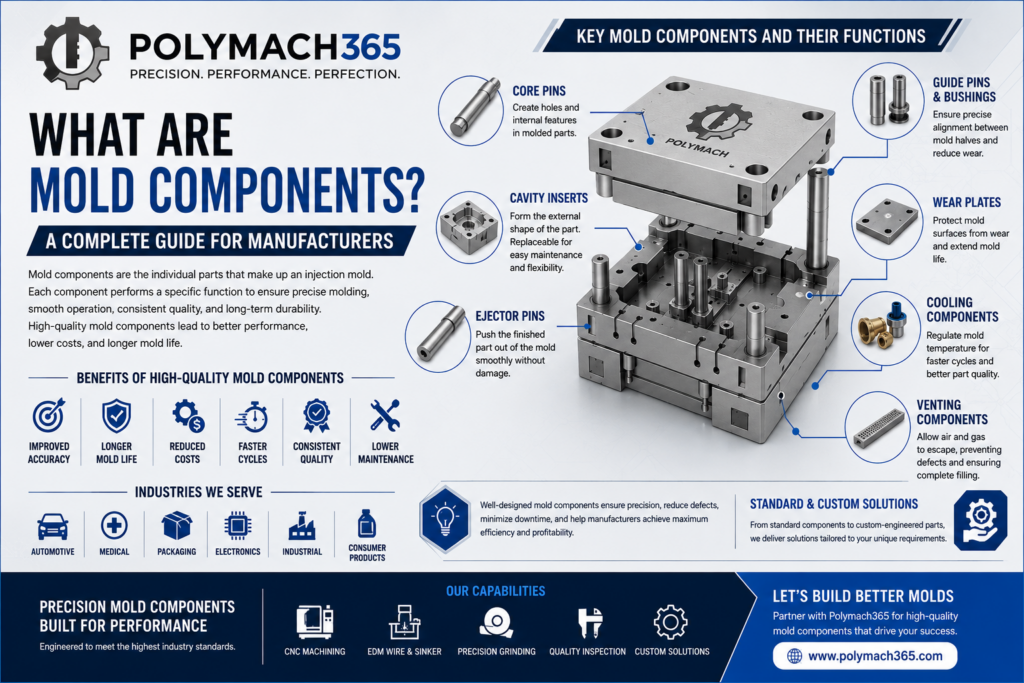
Understanding Mold Components and Their Role in Injection Molding Success In today’s manufacturing industry, injection molds are responsible for producing millions of precision plastic parts every day. However, an injection mold is much more than a simple tool. It consists of multiple precision-engineered components that work together to ensure accurate molding, smooth operation, consistent quality, and long-term durability. Therefore, understanding mold components is essential for mold makers, injection molders, product designers, and manufacturers looking to improve production efficiency and product quality. At Polymach365, we specialize in manufacturing high-quality mold components, including core pins, cavity inserts, ejector pins, guide pins, bushings, wear plates, and custom mold parts. Our precision-engineered components help manufacturers achieve reliable performance, tighter tolerances, and longer mold life. This guide explains what mold components are, their functions, and why they are critical for successful injection molding operations. What Are Mold Components? Mold components are the individual parts that make up an injection mold. Each component performs a specific function during the molding process, including shaping the part, guiding mold movement, cooling the mold, ejecting the finished product, and ensuring precise alignment. Together, these components enable consistent production and high-quality molded parts. Without properly manufactured mold components, molds can experience alignment issues, excessive wear, part defects, and costly downtime. Therefore, investing in high-quality mold components is essential for achieving efficient and reliable production. Why Are Mold Components Important? Every injection mold relies on precision components to perform correctly. Therefore, the quality of these components directly affects product quality, mold lifespan, and production efficiency. Benefits of High-Quality Mold Components ✔ Improved dimensional accuracy ✔ Longer mold life ✔ Reduced maintenance costs ✔ Faster production cycles ✔ Consistent part quality ✔ Lower manufacturing costs As a result, manufacturers can improve productivity while reducing operational risks. Key Mold Components Explained 🔩 Core Pins Core pins are precision components used to create holes, internal features, and complex geometries within molded parts. During injection molding, molten plastic flows around the core pin and forms the desired internal shape. Core pins play a critical role in maintaining dimensional accuracy and feature consistency. Applications Through holes Blind holes Internal channels Precision features Benefits ✔ High dimensional accuracy ✔ Improved part consistency ✔ Reduced secondary operations ⚙️ Cavity Inserts Cavity inserts form the external shape and surface details of molded components. They are often designed as replaceable sections, allowing mold makers to modify or repair specific areas without replacing the entire mold. Inserts also simplify maintenance and support multiple product variations. Advantages ✔ Easier mold maintenance ✔ Faster repairs ✔ Improved tooling flexibility ✔ Reduced mold replacement costs As a result, manufacturers can extend mold life while improving production efficiency. 🔧 Ejector Pins After a molded part cools, it must be removed from the mold safely. Ejector pins push the finished part out of the cavity without damaging its shape or surface. They are among the most widely used mold components in injection molding systems. Benefits ✔ Reliable part ejection ✔ Reduced cycle times ✔ Improved production efficiency ✔ Lower risk of part damage Consequently, ejector pins play a crucial role in maintaining production speed and consistency. 🛠 Guide Pins and Bushings Guide pins and bushings ensure accurate alignment between the moving and stationary halves of the mold. Proper alignment is essential for maintaining part quality and preventing excessive wear on mold components. Advantages ✔ Accurate mold alignment ✔ Reduced component wear ✔ Improved mold life ✔ Consistent product quality Therefore, guide systems are essential for achieving reliable and repeatable molding performance. ⚡ Wear Plates Wear plates protect mold surfaces that experience frequent movement and friction. They reduce wear, improve durability, and help maintain precision over extended production cycles. Applications Sliding mold components Moving assemblies High-cycle molds Benefits ✔ Increased durability ✔ Reduced maintenance ✔ Longer mold lifespan ✔ Lower repair costs As a result, wear plates help manufacturers maximize tooling investments. ❄ Cooling Components Cooling systems are critical because cooling often accounts for the majority of the molding cycle. Components such as cooling channels, baffles, bubblers, and thermal pins regulate mold temperature and improve cycle efficiency. Proper cooling helps prevent warpage while improving productivity. Benefits ✔ Faster cycle times ✔ Better dimensional stability ✔ Improved part quality ✔ Reduced production costs 🌬 Venting Components Venting systems remove trapped air and gases from the mold cavity during injection. Without proper venting, manufacturers may experience burn marks, short shots, voids, and incomplete filling. Venting components help maintain consistent molding quality. Advantages ✔ Reduced molding defects ✔ Improved material flow ✔ Better surface finish ✔ Consistent part quality Standard vs Custom Mold Components Manufacturers can choose between standard mold components and custom-engineered solutions. Standard Mold Components Standard components are widely available and designed to fit common mold configurations. Benefits ✔ Faster availability ✔ Lower upfront cost ✔ Proven reliability Custom Mold Components Custom mold components are designed specifically for unique mold applications and specialized production requirements. Benefits ✔ Optimized performance ✔ Better fit and functionality ✔ Enhanced durability ✔ Improved production efficiency At Polymach365, we manufacture both standard and custom mold components tailored to customer specifications. Materials Used in Mold Components The performance of mold components depends heavily on material selection. Common Materials Include Tool Steel Hardened Steel Stainless Steel H13 Steel S7 Steel Carbide Beryllium Copper Therefore, selecting the right material improves wear resistance, heat transfer, and component lifespan. Industries That Rely on Mold Components High-quality mold components support a wide range of industries across Canada. 🚗 Automotive Manufacturing Precision components for interior, exterior, and structural applications. 🏥 Medical Device Manufacturing High-accuracy mold components for healthcare products. 📦 Packaging Industry Durable tooling solutions for high-volume packaging production. 💻 Electronics Manufacturing Precision mold components for technical products and enclosures. 🧴 Consumer Products Reliable tooling systems for everyday household products. As a result, mold components remain essential to modern manufacturing operations. Why Choose Polymach365 for Mold Components Manufacturing? At Polymach365, we combine advanced CNC machining, EDM technology, precision grinding, and engineering expertise to manufacture premium mold components that meet
How Good Mold Design Improves Product Quality and Reduces Costs
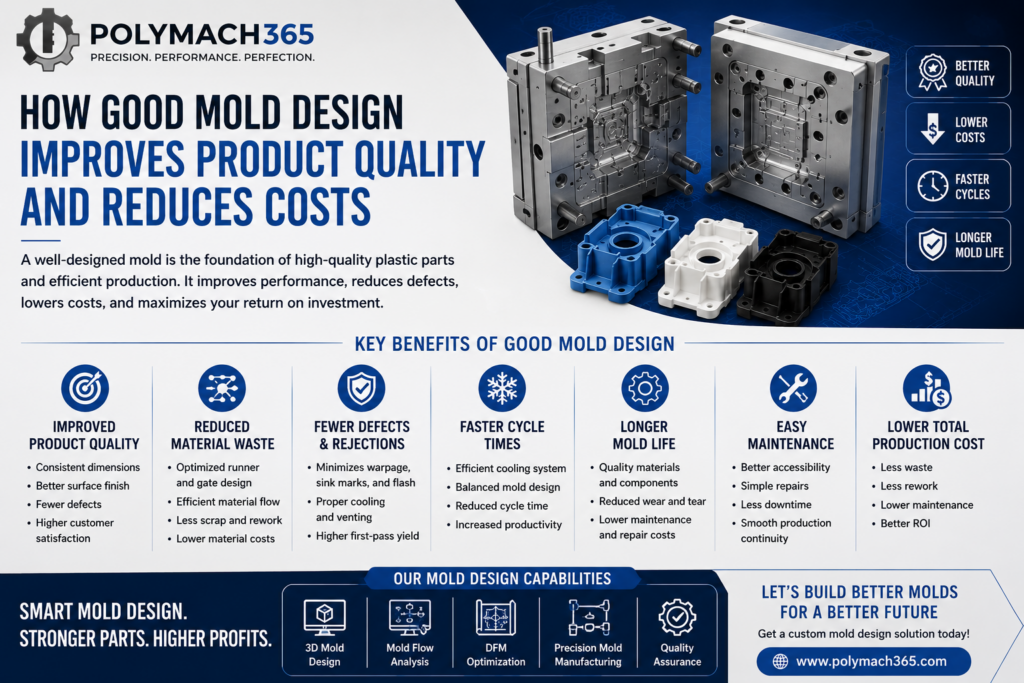
A Complete Guide for Manufacturers in Canada In today’s competitive manufacturing environment, product quality and production efficiency are critical factors for success. However, many manufacturers focus solely on production processes while overlooking one of the most important elements of plastic manufacturing—Injection Mold Design. A well-designed mold not only produces high-quality parts consistently but also reduces production costs, minimizes defects, and extends tool life. At Polymach365, we provide advanced Injection Mold Design Services and custom mold manufacturing solutions that help businesses across Canada optimize production performance and maximize return on investment. Whether you’re developing a new product or improving an existing manufacturing process, proper mold design can significantly impact your profitability and product quality. This guide explains how good mold design improves product quality while reducing overall manufacturing costs. Why Mold Design Matters in Injection Molding Injection molding is one of the most widely used manufacturing processes for producing plastic components. However, the final product is only as good as the mold used to create it. Therefore, mold design plays a critical role in determining part quality, cycle time, material usage, and production efficiency. A properly engineered mold ensures: ✔ Consistent product dimensions ✔ Efficient material flow ✔ Faster production cycles ✔ Reduced manufacturing defects ✔ Longer mold lifespan ✔ Lower operating costs As a result, manufacturers achieve better product performance and higher production efficiency. 1. Improves Product Quality and Consistency One of the biggest advantages of a well-designed mold is improved product consistency. Poor mold design often leads to: Warpage Sink marks Flash Short shots Weld lines Dimensional inaccuracies However, a properly engineered mold ensures uniform material flow, balanced cooling, and accurate cavity dimensions. Therefore, every molded part meets the same quality standards throughout production. Quality Benefits ✔ Consistent dimensions ✔ Better surface finishes ✔ Improved part strength ✔ Reduced defect rates ✔ Enhanced customer satisfaction Consequently, manufacturers spend less time dealing with quality issues and product rejections. 2. Reduces Material Waste Material costs represent a significant portion of injection molding expenses. Therefore, reducing waste directly improves profitability. A well-designed mold optimizes: Gate locations Runner systems Material flow paths Cavity filling efficiency As a result, manufacturers use less material while maintaining excellent part quality. Cost-Saving Benefits ✔ Reduced scrap rates ✔ Lower resin consumption ✔ Improved material utilization ✔ Sustainable manufacturing practices Furthermore, reducing waste contributes to both environmental and financial benefits. 3. Minimizes Production Defects Defects are expensive because they increase rework, waste, and production delays. Common molding defects include: Sink Marks Uneven cooling causes depressions on the part surface. Warpage Improper cooling creates dimensional distortion. Flash Excess material escapes between mold surfaces. Short Shots Incomplete cavity filling results in defective parts. However, proper mold design minimizes these issues through optimized cavity geometry, gate placement, cooling systems, and venting strategies. Therefore, manufacturers experience fewer quality problems and lower production costs. 4. Improves Cooling Efficiency Cooling accounts for a large percentage of the injection molding cycle. Therefore, cooling system design directly affects production speed and product quality. Effective Cooling Design Provides: ✔ Faster cycle times ✔ Consistent cooling ✔ Reduced warpage ✔ Improved dimensional stability ✔ Higher production output Consequently, manufacturers produce more parts in less time while maintaining quality standards. 5. Reduces Cycle Time Cycle time refers to the total time required to produce one molded part. A properly designed mold reduces cycle time by optimizing: Material flow Cooling performance Part ejection Mold opening and closing operations Benefits of Shorter Cycle Times ✔ Increased productivity ✔ Lower manufacturing costs ✔ Higher machine utilization ✔ Faster order fulfillment As a result, manufacturers improve profitability while increasing production capacity. 6. Extends Mold Life Injection molds are significant investments. Therefore, maximizing mold lifespan is essential for controlling long-term production costs. Good mold design incorporates: Premium tool steels Proper wear surfaces Effective cooling channels Optimized ejection systems Balanced mold construction As a result, molds experience less wear and require fewer repairs throughout their service life. Long-Term Advantages ✔ Reduced maintenance costs ✔ Fewer production interruptions ✔ Longer tooling lifespan ✔ Better return on investment Consequently, businesses reduce overall tooling expenses. 7. Improves Mold Maintenance Efficiency Every mold requires maintenance. However, poorly designed molds often increase maintenance complexity and downtime. A well-designed mold allows easier access to: Core pins Cavity inserts Ejector systems Cooling channels Wear components Therefore, maintenance teams can perform repairs and preventive maintenance more efficiently. Benefits Include ✔ Reduced downtime ✔ Faster repairs ✔ Lower maintenance costs ✔ Improved production reliability 8. Enhances Part Ejection Performance Part ejection is a critical stage of the molding process. Improper ejection design can cause: Part damage Surface defects Production interruptions However, optimized ejection systems ensure smooth and reliable part removal. Effective Ejection Design Includes: ✔ Proper ejector pin placement ✔ Balanced ejection force ✔ Reduced part stress ✔ Consistent production cycles As a result, manufacturers improve both product quality and operational efficiency. 9. Supports Faster Product Development Good mold design begins during product development. By applying Design for Manufacturability (DFM) principles early, engineers can identify potential production challenges before tooling begins. Advantages ✔ Faster design approval ✔ Reduced engineering changes ✔ Lower development costs ✔ Shorter project timelines Therefore, businesses bring products to market faster and more efficiently. 10. Lowers Total Manufacturing Costs Ultimately, every benefit of good mold design contributes to lower production costs. Because manufacturers experience: ✔ Fewer defects ✔ Reduced material waste ✔ Faster cycle times ✔ Lower maintenance expenses ✔ Extended mold life ✔ Higher productivity The total cost per part decreases significantly. Consequently, businesses improve profitability while maintaining exceptional product quality. Key Elements of Effective Mold Design At Polymach365, we focus on every critical aspect of mold engineering. Core and Cavity Optimization Ensures dimensional accuracy and consistent part quality. Advanced Cooling Systems Reduces cycle times and improves thermal performance. Precision Mold Components Enhances mold durability and operational reliability. Balanced Runner and Gate Design Promotes uniform material flow and cavity filling. Efficient Ejection Systems Supports smooth part removal and reduced downtime. Therefore, our molds are engineered for maximum performance
How Rapid Prototyping Reduces Product Development Time
A Complete Guide for Manufacturers in Canada In today’s highly competitive manufacturing environment, speed is often the difference between market leadership and missed opportunities. Therefore, companies across Canada are increasingly adopting Rapid Prototyping Services to accelerate product development, reduce engineering risks, and bring innovative products to market faster. Whether you’re developing a new consumer product, industrial component, medical device, or automotive part, rapid prototyping allows you to test, validate, and improve designs before committing to full-scale production. At Polymach365, we help manufacturers shorten development cycles through advanced CNC machining, 3D printing, and prototype manufacturing solutions. As a result, businesses can move from concept to production faster while maintaining quality, accuracy, and cost efficiency. What Is Rapid Prototyping? Rapid prototyping is a manufacturing approach that uses CAD data to quickly create physical models, functional prototypes, or pre-production parts. Instead of waiting weeks or months for traditional tooling, engineers can produce and evaluate prototypes in a matter of days. This allows teams to identify design improvements early and accelerate decision-making throughout the product development process. Therefore, rapid prototyping has become an essential tool for modern product development and innovation. Why Product Development Often Takes Too Long Traditional product development frequently involves multiple design revisions, lengthy approval processes, tooling delays, and expensive engineering changes. Common challenges include: Design errors discovered late in production Multiple prototype iterations Long tooling lead times Communication gaps between teams Costly redesigns Delayed product launches Consequently, businesses often spend significant time and money correcting issues that could have been identified earlier. Rapid prototyping helps solve these challenges by providing physical validation much earlier in the development cycle. 1. Faster Design Validation One of the biggest advantages of rapid prototyping is the ability to validate designs quickly. Instead of relying solely on digital models, engineers can physically evaluate a prototype and verify: ✔ Dimensions ✔ Fit and assembly ✔ Ergonomics ✔ Functionality ✔ Material performance As a result, design flaws become visible much earlier, reducing the likelihood of expensive modifications later in the project. 2. Reduces Design Iterations Every product undergoes revisions before reaching production. However, traditional development methods often require lengthy redesign cycles. Rapid prototyping allows engineers to test multiple versions quickly and efficiently. Therefore, design improvements can be implemented immediately. Benefits Include: Faster engineering feedback Improved design accuracy Shorter revision cycles Reduced project delays Consequently, manufacturers spend less time redesigning and more time moving toward production. 3. Accelerates Product Testing Testing is one of the most important stages of product development. Rapid prototypes allow companies to perform: Functional Testing Evaluate how the product performs under real-world conditions. Mechanical Testing Assess strength, durability, and performance. Assembly Testing Verify component compatibility and manufacturability. User Testing Collect valuable feedback from customers and stakeholders. As a result, businesses gain confidence in product performance before investing in production tooling. 4. Identifies Problems Earlier Finding problems during production is expensive and time-consuming. However, rapid prototyping helps engineers identify issues during the design phase, including: Poor fitment Weak structural areas Assembly challenges Material limitations Ergonomic concerns Therefore, teams can solve problems before they impact production schedules and budgets. Early issue identification is one of the primary reasons rapid prototyping helps reduce time-to-market. 5. Improves Team Collaboration Product development often involves multiple departments, including: Engineering Manufacturing Quality Control Marketing Sales A physical prototype provides a clear representation of the final product. Consequently, teams communicate more effectively and make decisions faster. Instead of discussing abstract CAD models, stakeholders can review and evaluate a tangible product. As a result, approval processes become faster and more efficient. 6. Speeds Up Customer and Investor Feedback Obtaining feedback early can significantly reduce development time. Rapid prototypes allow companies to: ✔ Demonstrate product concepts ✔ Validate market demand ✔ Collect customer feedback ✔ Secure investor approval ✔ Refine product features Therefore, businesses can make informed decisions before entering full production. 7. Enables Parallel Product Development Traditional manufacturing often follows a sequential process. However, rapid prototyping enables multiple development activities to occur simultaneously. For example: Engineers refine designs. Marketing teams prepare product launches. Manufacturing teams evaluate production requirements. Customers review prototypes. As a result, overall project timelines are significantly reduced. 8. Supports Agile Product Development Modern manufacturing increasingly follows agile development principles. Rapid prototyping supports this approach by enabling quick iterations, continuous improvement, and faster decision-making. Instead of waiting months between revisions, companies can test and improve products in short development cycles. Consequently, businesses respond more quickly to customer needs and changing market conditions. 9. Simplifies Transition to Production Moving from design to production can be challenging. However, prototypes manufactured using CNC machining or production-grade materials closely resemble final parts. Therefore, manufacturers can: Validate manufacturing processes Confirm material performance Optimize assembly procedures Reduce production risks As a result, the transition from prototype to production becomes faster and more predictable. 10. Reduces Time-to-Market Ultimately, rapid prototyping shortens the entire product development cycle. Because companies can: ✔ Validate designs faster ✔ Reduce engineering changes ✔ Improve communication ✔ Accelerate testing ✔ Minimize production risks Products reach the market sooner. This faster time-to-market creates a significant competitive advantage while increasing revenue opportunities. Rapid prototyping is widely used specifically because it enables faster testing, iteration, and product development. Rapid Prototyping Solutions at Polymach365 At Polymach365, we provide complete rapid prototyping and prototype manufacturing solutions for businesses across Canada. Our Capabilities Include: ✔ CNC Machining Prototypes ✔ 3D Printing Prototypes ✔ Functional Prototype Manufacturing ✔ Low-Volume Production ✔ Custom CNC Machining Solutions ✔ Prototype Tooling ✔ Product Development Support ✔ Design for Manufacturability (DFM) ✔ Engineering Consultation Moreover, our experienced engineering team helps customers optimize designs for performance, manufacturability, and cost efficiency. Industries We Serve Our rapid prototyping services support a wide range of industries. 🚗 Automotive Manufacturing Prototype components, housings, brackets, and tooling systems. ✈️ Aerospace Manufacturing High-precision prototypes for performance-critical applications. 🏥 Medical Device Manufacturing Functional prototypes for healthcare and medical products. 💻 Electronics & Technology Product enclosures, connectors, and technical assemblies. 🏭 Industrial Manufacturing Custom machine parts, automation systems, and production tooling. 🧴 Consumer
What Is Injection Mold Design? A Beginner’s Guide
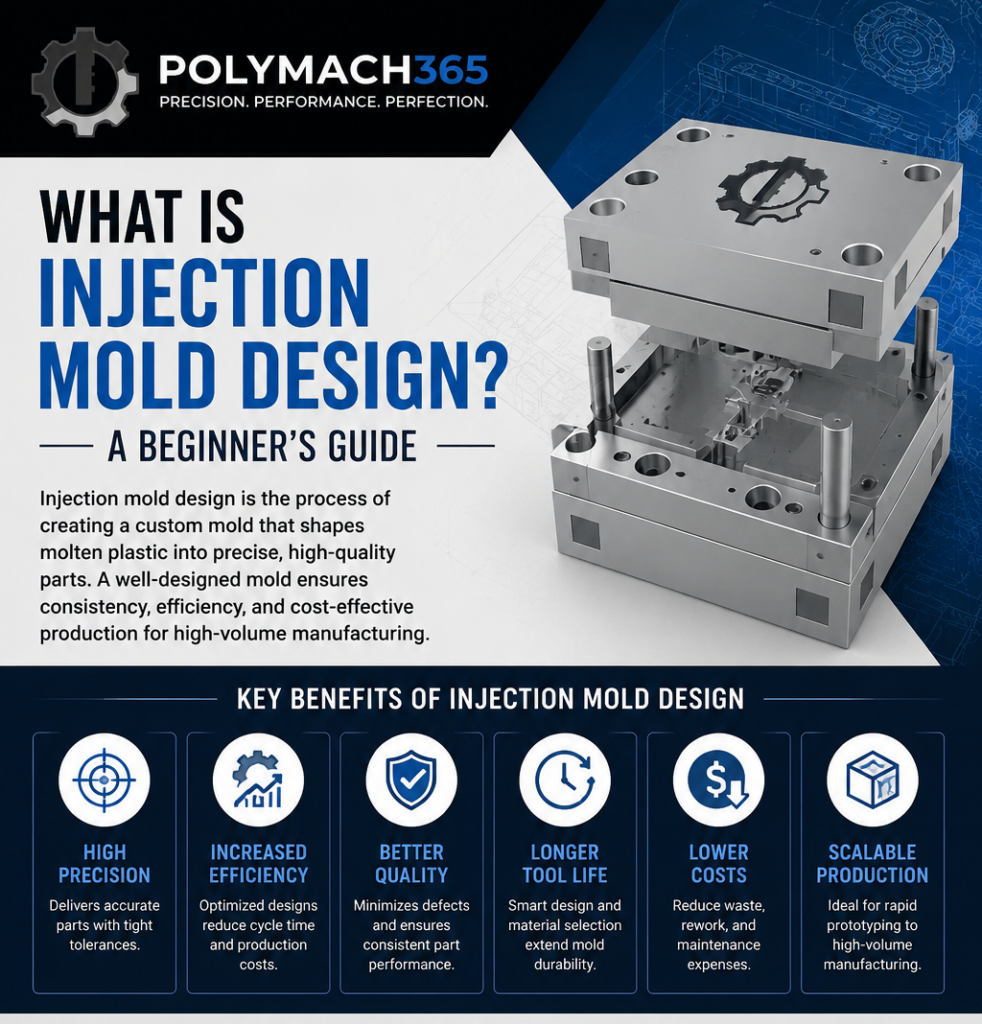
Understanding Injection Mold Design for Modern Manufacturing In today’s manufacturing industry, plastic products are everywhere—from automotive components and medical devices to consumer goods and electronic enclosures. However, producing these parts efficiently requires more than just an idea or a CAD model. It requires a well-engineered mold. Therefore, Injection Mold Design is one of the most critical steps in the plastic manufacturing process. At Polymach365, we provide professional Injection Mold Design Services, helping manufacturers transform product concepts into high-performance production tools. Whether you’re developing a new product or preparing for mass production, understanding injection mold design is essential for achieving quality, consistency, and cost-effective manufacturing. This beginner’s guide explains what injection mold design is, how it works, and why it plays a vital role in successful plastic injection molding. What Is Injection Mold Design? Injection mold design is the engineering process of creating a mold that shapes molten plastic into a finished product. The mold acts as a precision tool that contains the cavity and core needed to form the desired part shape. During production, molten plastic is injected into the mold cavity, cooled, and then ejected as a finished component. Therefore, the quality of the mold directly affects the quality, accuracy, and consistency of every part produced. A properly designed injection mold ensures: ✔ Accurate part dimensions ✔ Consistent production quality ✔ Faster cycle times ✔ Reduced manufacturing defects ✔ Longer mold life ✔ Lower production costs As a result, manufacturers can achieve reliable, high-volume production with minimal waste. Why Is Injection Mold Design Important? Many manufacturing issues originate from poor mold design. Therefore, investing in professional mold design helps prevent costly production problems before they occur. A well-designed mold can: Improve part quality Reduce cycle times Prevent warping and sink marks Minimize material waste Increase production efficiency Extend tooling lifespan Furthermore, proper mold design reduces the risk of defects such as short shots, flash, weld lines, and warpage, which commonly occur when molds are not optimized correctly. How Does Injection Mold Design Work? The mold design process begins long before manufacturing starts. Therefore, engineers must carefully analyze the product design, material requirements, and production goals. 1. Product Design Review The process starts with evaluating the 3D CAD model of the part. Engineers review dimensions, wall thickness, draft angles, ribs, bosses, and other features to ensure the design is suitable for injection molding. As a result, potential manufacturing issues can be identified early. 2. Mold Flow Analysis Engineers often perform mold flow simulations to understand how molten plastic will fill the cavity. This analysis helps optimize: Gate locations Material flow Cooling performance Air venting Shrinkage control Consequently, manufacturers can reduce defects and improve production efficiency. 3. Core and Cavity Design The mold is divided into two primary sections: Core The core forms the internal features of the plastic component. Cavity The cavity forms the external shape of the part. Together, these components create the final geometry of the molded product. 4. Cooling System Design Efficient cooling is essential because cooling time often represents the largest portion of the molding cycle. Therefore, mold designers strategically place cooling channels to: ✔ Maintain uniform temperatures ✔ Reduce cycle times ✔ Improve part quality ✔ Prevent warping Proper cooling design directly improves productivity and mold performance. 5. Ejection System Design After the plastic cools, the part must be removed safely from the mold. Therefore, designers incorporate ejection systems such as: Ejector pins Sleeves Stripper plates As a result, parts can be removed efficiently without damage. Key Components of an Injection Mold Understanding the main mold components helps explain how injection molds function. 🔩 Core and Cavity These components create the final shape of the plastic part. ⚙️ Sprue, Runners, and Gates These channels guide molten plastic from the injection machine into the mold cavity. Sprue The main channel that carries molten plastic into the mold. Runner Secondary channels that distribute material throughout the mold. Gate The entry point where molten plastic enters the cavity. 🛠 Guide Pins and Bushings These components ensure precise alignment between mold halves during each production cycle. ❄ Cooling Channels Cooling systems regulate mold temperature and improve production efficiency. 🔧 Ejection System Ejector pins and mechanisms safely remove finished parts from the mold. Important Design Considerations for Injection Molds Successful mold design requires careful attention to several engineering principles. Draft Angles Draft angles are slight tapers added to part walls to help components release from the mold after cooling. Without proper draft angles, parts may stick inside the mold, causing damage and production issues. Most molded parts require some degree of draft for proper ejection. Benefits of Draft Angles ✔ Easier part ejection ✔ Reduced mold wear ✔ Improved surface quality ✔ Faster production cycles Wall Thickness Uniform wall thickness helps maintain consistent cooling and reduces defects. Therefore, designers avoid sudden thickness variations whenever possible. Benefits ✔ Reduced warpage ✔ Improved strength ✔ Better dimensional stability ✔ Faster cooling Gate Location Gate placement significantly affects material flow and final part quality. Therefore, designers carefully select gate positions to: Minimize weld lines Improve filling Reduce stress concentrations Enhance cosmetic appearance Material Selection Different plastics behave differently during molding. Common injection molding materials include: ABS Polypropylene (PP) Polycarbonate (PC) Nylon PEEK Acetal (Delrin) Therefore, mold design must account for material shrinkage, flow characteristics, and cooling requirements. Common Applications of Injection Mold Design Injection mold design supports numerous industries across Canada. 🚗 Automotive Industry Interior trim, housings, dashboards, clips, and functional components. 🏥 Medical Device Manufacturing Diagnostic equipment, surgical tools, and healthcare products. 📦 Packaging Industry Caps, containers, closures, and packaging solutions. 💻 Electronics Industry Enclosures, connectors, and protective housings. 🧴 Consumer Products Household items, personal care products, and retail goods. Consequently, injection mold design remains one of the most important engineering disciplines in modern manufacturing. Why Choose Polymach365 for Injection Mold Design Services? At Polymach365, we combine advanced engineering expertise with modern manufacturing technologies to deliver high-performance mold designs optimized for production success. Our Capabilities Include: ✔ Injection Mold Design Services
Rapid Prototyping Services in Canada: Everything You Need to Know
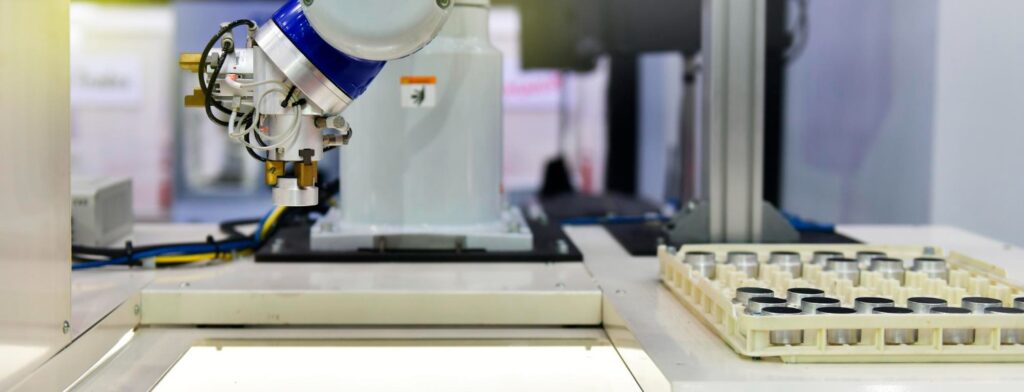
Accelerate Product Development with Professional Rapid Prototyping Solutions In today’s highly competitive manufacturing landscape, speed, innovation, and product quality are essential for success. Therefore, businesses across Canada are increasingly investing in Rapid Prototyping Services to reduce development time, lower production risks, and bring products to market faster. Whether you are developing a new consumer product, industrial component, medical device, or automotive part, rapid prototyping allows you to test, validate, and refine designs before full-scale production begins. At Polymach365, we provide advanced Rapid Prototyping Services in Canada that help manufacturers, engineers, startups, and product developers transform ideas into functional prototypes quickly and cost-effectively. From CNC machining and 3D printing to low-volume production, we deliver precision prototypes that accelerate innovation and improve product performance. What Is Rapid Prototyping? Rapid prototyping is a manufacturing process used to create physical models or functional prototypes directly from digital CAD designs. Instead of waiting weeks or months for traditional tooling and production, manufacturers can quickly produce prototype parts for testing, evaluation, and design verification. Therefore, rapid prototyping enables businesses to identify design flaws early, reduce development costs, and improve final product quality before mass production begins. Key Objectives of Rapid Prototyping ✔ Validate product designs ✔ Test functionality and performance ✔ Improve manufacturability ✔ Reduce development risks ✔ Accelerate time-to-market ✔ Gather customer feedback As a result, companies can make informed design decisions and launch products with greater confidence. Why Rapid Prototyping Is Important for Modern Manufacturing Product development is becoming increasingly complex. Therefore, manufacturers must evaluate designs quickly and efficiently before investing in production tooling. Rapid prototyping helps companies: Reduce product development cycles Minimize costly design errors Improve engineering accuracy Accelerate innovation Reduce overall manufacturing costs Furthermore, businesses that implement rapid prototyping often gain a competitive advantage because they can respond faster to market demands and customer requirements. Benefits of Rapid Prototyping Services 1. Faster Product Development Traditional product development can take months before a physical model becomes available. However, rapid prototyping significantly shortens this process. Therefore, engineers can evaluate designs within days instead of weeks. Benefits Include: ✔ Faster design validation ✔ Quicker engineering revisions ✔ Reduced project timelines ✔ Accelerated product launches As a result, companies reach the market faster and stay ahead of competitors. 2. Reduced Development Costs Design errors discovered during production can be extremely expensive. Therefore, rapid prototyping allows manufacturers to identify and correct issues early. Cost-Saving Advantages ✔ Fewer engineering changes ✔ Reduced tooling modifications ✔ Lower production risks ✔ Improved resource utilization Consequently, businesses save money throughout the product development process. 3. Improved Product Quality Physical prototypes allow engineers to test functionality, fit, assembly, and performance before manufacturing begins. Therefore, teams can optimize designs and improve product reliability. Quality Improvements ✔ Better dimensional accuracy ✔ Enhanced functionality ✔ Improved ergonomics ✔ Greater product reliability As a result, manufacturers deliver higher-quality products to customers. 4. Better Design Verification Digital models are valuable, but physical prototypes provide real-world validation. Therefore, engineers can evaluate: Form Fit Function Assembly requirements Material performance Consequently, potential issues are identified and resolved before production begins. 5. Enhanced Customer and Investor Presentations A physical prototype helps stakeholders visualize the final product more effectively than digital renderings alone. Applications Include ✔ Investor presentations ✔ Product demonstrations ✔ Marketing evaluations ✔ Customer feedback sessions As a result, businesses communicate ideas more effectively and secure project approvals faster. Rapid Prototyping Technologies Offered by Polymach365 At Polymach365, we offer multiple rapid prototyping solutions tailored to your specific project requirements. 🔩 CNC Machining Prototypes CNC machining produces highly accurate and functional prototypes using production-grade materials. Ideal For: Mechanical testing Functional validation Tight-tolerance components Metal and plastic prototypes Because CNC machining uses the same materials as production parts, it provides highly realistic testing results. 🖨️ 3D Printing Prototypes 3D printing enables rapid production of complex geometries directly from CAD files. Advantages ✔ Fast turnaround ✔ Complex designs ✔ Cost-effective iterations ✔ Design visualization Therefore, 3D printing is ideal for concept models and early-stage product development. ⚙️ Low-Volume Prototype Manufacturing After prototype approval, businesses often require small production runs before mass manufacturing. Therefore, Polymach365 provides bridge production and low-volume manufacturing solutions that help companies transition smoothly from prototype to production. Materials Available for Rapid Prototyping We manufacture prototypes using a wide range of engineering-grade materials. Metal Materials Aluminum Stainless Steel Brass Copper Tool Steel Titanium Plastic Materials ABS Nylon Delrin (Acetal) Polycarbonate PEEK PTFE As a result, customers can test products using materials that closely match final production requirements. Industries We Serve Across Canada Rapid prototyping supports a wide variety of industries. 🚗 Automotive Manufacturing Prototype components for engines, interiors, housings, and tooling systems. ✈️ Aerospace Manufacturing Precision prototypes for structural and performance-critical applications. 🏥 Medical Device Manufacturing Functional prototypes for healthcare products and medical equipment. 💻 Electronics & Technology Prototype enclosures, connectors, and technical assemblies. 🏭 Industrial Manufacturing Custom machine components, fixtures, and automation systems. 🧴 Consumer Products Product development for household, retail, and lifestyle products. How the Rapid Prototyping Process Works At Polymach365, we simplify the prototyping process to help customers move quickly from concept to reality. 1. Upload Your CAD Design Submit your 3D CAD model and project requirements. 2. Design Review & DFM Analysis Our engineering team reviews the design for manufacturability and performance optimization. 3. Material Selection We recommend the most suitable material based on functionality and testing requirements. 4. Prototype Manufacturing We manufacture your prototype using CNC machining, 3D printing, or low-volume production methods. 5. Quality Inspection & Delivery Every prototype undergoes dimensional verification before shipment. As a result, you receive high-quality prototypes ready for testing and evaluation. Why Choose Polymach365 for Rapid Prototyping Services in Canada? At Polymach365, we combine advanced manufacturing technologies with engineering expertise to help businesses accelerate product development. Our Capabilities Include: ✔ Rapid Prototyping Services ✔ CNC Machining Prototypes ✔ 3D Printing Prototypes ✔ 5-Axis CNC Machining ✔ Low-Volume Production ✔ Custom Manufacturing Solutions ✔ Engineering & DFM Support ✔ Quality Inspection & Testing ✔ Fast Turnaround Times Moreover, our streamlined
5-Axis CNC Machining vs 3-Axis Machining: Key Differences Explained
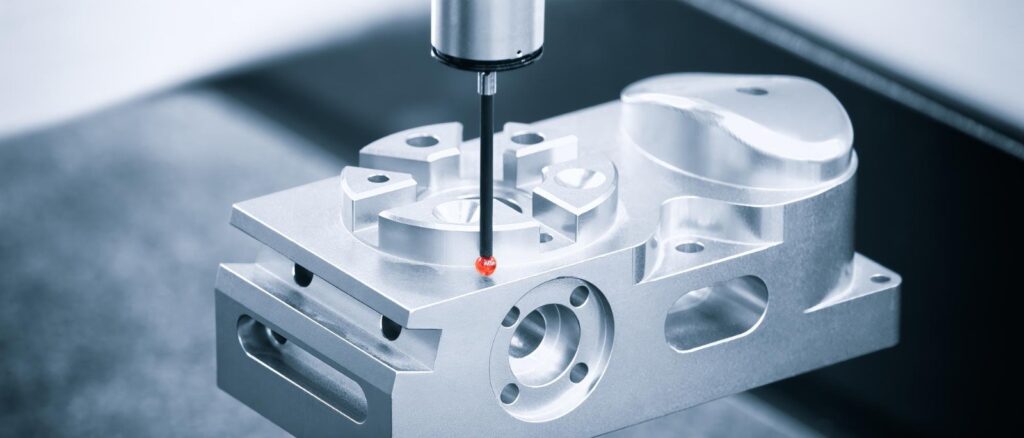
A Complete Guide for Manufacturers in Canada In today’s advanced manufacturing environment, choosing the right machining process can significantly impact product quality, production speed, and overall manufacturing costs. Therefore, understanding the differences between 5-Axis CNC Machining and 3-Axis CNC Machining is essential for engineers, product designers, and manufacturers looking to optimize production efficiency. At Polymach365, we provide both 3-axis and 5-axis CNC machining solutions for manufacturers across Canada. Whether you need rapid prototypes, low-volume production, complex aerospace components, or high-precision industrial parts, selecting the right machining technology can improve accuracy, reduce lead times, and lower overall production costs. However, many manufacturers ask the same question: Is 5-axis CNC machining always better than 3-axis machining? The answer depends on your part complexity, budget, tolerance requirements, and production goals. What Is 3-Axis CNC Machining? 3-axis CNC machining is the most common machining method used in manufacturing today. In this process, the cutting tool moves along three linear axes: X-Axis (Left to Right) Y-Axis (Front to Back) Z-Axis (Up and Down) The workpiece remains fixed while the cutting tool removes material to create the desired shape. As a result, 3-axis machining is ideal for manufacturing flat surfaces, pockets, holes, and relatively simple geometries. Common Applications of 3-Axis Machining Machine brackets Mounting plates Electronic enclosures Mold bases Industrial components Simple tooling parts Therefore, 3-axis machining remains a cost-effective solution for many manufacturing projects. What Is 5-Axis CNC Machining? 5-axis CNC machining builds upon traditional 3-axis machining by adding two additional rotational axes. These extra movements allow the cutting tool or workpiece to approach the part from multiple angles without repositioning. Additional Axes Include: A-Axis (Rotation around X-axis) B-Axis (Rotation around Y-axis) As a result, 5-axis machines can manufacture highly complex geometries, deep cavities, angled features, and intricate surfaces in a single setup. Common Applications of 5-Axis Machining Aerospace components Medical implants Turbine blades Injection mold components Automotive performance parts Complex industrial tooling Consequently, industries requiring exceptional precision and complex geometries frequently rely on 5-axis machining. Key Differences Between 3-Axis and 5-Axis CNC Machining Feature 3-Axis CNC Machining 5-Axis CNC Machining Number of Axes X, Y, Z X, Y, Z + A + B Part Complexity Simple to Moderate Highly Complex Setup Requirements Multiple Setups Single Setup Production Speed Moderate Faster for Complex Parts Precision High Extremely High Surface Finish Excellent Superior Programming Complexity Simple Advanced Machine Cost Lower Higher Ideal For Flat and Prismatic Parts Multi-Sided and Complex Parts The primary difference is that 5-axis machining allows the cutting tool to approach the workpiece from multiple angles without manual repositioning. Therefore, manufacturers can machine more features in fewer setups while improving accuracy. Advantages of 3-Axis CNC Machining Although 5-axis technology receives significant attention, 3-axis machining remains highly effective for many projects. ✔ Lower Manufacturing Costs 3-axis machines are less expensive to operate and program. Therefore, they are often the most economical choice for straightforward parts. ✔ Faster Setup for Simple Parts Because programming and fixturing are less complex, manufacturers can begin production quickly. ✔ Easier Operation 3-axis machining requires less advanced programming and machine setup expertise. Consequently, production workflows remain straightforward. ✔ Excellent for Standard Components Many industrial parts do not require multi-axis capabilities. Therefore, 3-axis machining provides an ideal balance of quality and cost. Advantages of 5-Axis CNC Machining For complex projects, 5-axis machining offers significant advantages. ✔ Machine Complex Geometries The additional rotational axes allow manufacturers to create intricate shapes, undercuts, and multi-surface features that are difficult or impossible to achieve with traditional machining. ✔ Fewer Setups A complex part that requires multiple setups on a 3-axis machine can often be completed in a single setup on a 5-axis machine. Consequently, production becomes faster and more accurate. ✔ Improved Accuracy Every time a part is repositioned, there is potential for alignment errors. Therefore, fewer setups lead to greater dimensional accuracy and consistency. ✔ Better Surface Finishes Shorter tool lengths and optimized cutting angles reduce vibration during machining. As a result, 5-axis machining often produces superior surface finishes. ✔ Reduced Production Time By machining multiple faces in a single operation, manufacturers significantly reduce non-cutting time and improve productivity. When Should You Choose 3-Axis CNC Machining? Choose 3-axis machining when your project includes: ✔ Flat surfaces ✔ Simple contours ✔ Standard industrial components ✔ Lower production budgets ✔ Basic machining requirements ✔ Low to moderate complexity parts Because of its lower operational cost, 3-axis machining remains the preferred option for many manufacturing applications. When Should You Choose 5-Axis CNC Machining? Choose 5-axis machining when your project requires: ✔ Complex geometries ✔ Tight tolerances ✔ Multi-sided machining ✔ Deep cavities ✔ Aerospace-grade precision ✔ High-performance tooling ✔ Reduced setup time ✔ Superior surface finishes Therefore, manufacturers producing advanced components often achieve greater efficiency and quality through 5-axis machining. Cost Comparison: 3-Axis vs 5-Axis Machining One common misconception is that 5-axis machining is always more expensive. While 5-axis machines require a higher initial investment and more advanced programming, they often reduce overall manufacturing costs for complex parts by eliminating multiple setups, reducing labor requirements, and minimizing errors. Conversely, 3-axis machining remains more cost-effective for simpler components. Therefore, the most cost-effective option depends on the complexity of your part rather than the machine itself. Industries That Benefit from 5-Axis CNC Machining ✈️ Aerospace Manufacturing Complex turbine blades, engine components, and structural parts require multi-axis precision. 🏥 Medical Device Manufacturing Implants and surgical instruments demand tight tolerances and exceptional surface finishes. 🚗 Automotive Manufacturing High-performance engine and transmission components benefit from advanced machining capabilities. 🏭 Industrial Manufacturing Complex molds, dies, fixtures, and tooling systems require precise multi-surface machining. Why Choose Polymach365 for CNC Machining Services in Canada? At Polymach365, we combine advanced CNC technology, engineering expertise, and digital manufacturing solutions to provide high-quality machining services for businesses across Canada. Our CNC Machining Capabilities Include: ✔ 3-Axis CNC Machining ✔ 5-Axis CNC Machining ✔ CNC Milling Services ✔ CNC Turning Services ✔ Rapid Prototyping ✔ Low-Volume Production ✔ Production Manufacturing ✔ Custom CNC Machining Solutions ✔ Engineering &