
Injection Mold Design vs Mold Manufacturing: Understanding the Difference
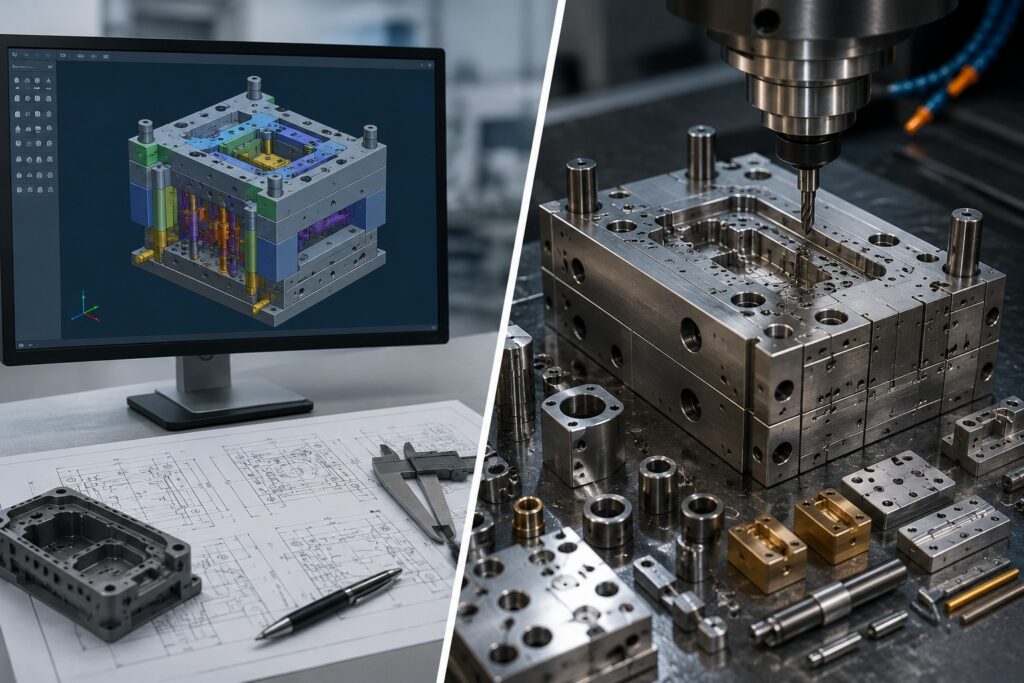
A Complete Guide for Manufacturers When developing a plastic product, many manufacturers use the terms injection mold design and injection mold manufacturing interchangeably. However, they are two different stages of the tooling process. Understanding the difference can help you plan your project, control tooling costs, reduce production risks, and achieve better molded-part quality. At Polymach365, we provide both Injection Mold Design and Injection Mold Manufacturing solutions. Our engineering process combines Design for Manufacturability (DFM), mold-flow analysis, detailed CAD design, precision CNC machining, EDM, assembly, and inspection. Therefore, customers can move from a product concept to production-ready tooling through a coordinated manufacturing workflow. Whether you are developing a prototype, launching a new plastic product, or preparing for high-volume production, understanding how mold design differs from mold manufacturing is essential. What Is Injection Mold Design? Injection mold design is the engineering stage where manufacturers determine how the mold will produce the final plastic component. Instead of immediately machining steel or aluminum, engineers first create a detailed digital representation of the complete tooling system. Therefore, mold design determines important elements such as: Core and cavity geometry Parting line Gate location Runner system Cooling channels Ejection system Mold venting Slides and lifters Mold base Inserts Mold materials Cavity configuration At Polymach365, the design process begins with your CAD files and technical requirements. Our engineers use DFM principles to optimize the part and tooling before manufacturing begins. Consequently, good mold design can prevent expensive tooling modifications later. What Is Injection Mold Manufacturing? Injection mold manufacturing is the physical production of the mold based on the approved engineering design. Once the mold design receives approval, manufacturers begin producing the actual tooling components. This stage can involve: CNC machining EDM machining Wire EDM Precision grinding Heat treatment Component assembly Hand fitting Mold testing Dimensional inspection Polymach365’s published manufacturing workflow includes project kickoff and DFM analysis, CAD tool design, mold-flow simulation, precision machining, assembly and hand fitting, and first article inspection. Injection Mold Design vs Mold Manufacturing The easiest way to understand the difference is to compare their primary purposes. Injection Mold Design Injection Mold Manufacturing Creates the tooling concept Builds the physical mold Uses CAD and engineering software Uses CNC, EDM and grinding equipment Focuses on geometry and functionality Focuses on precision production Determines gates and runners Machines the designed features Designs cooling channels Produces the cooling system Designs ejection mechanisms Manufactures and assembles ejection components Includes DFM analysis Includes machining and fitting Uses simulation for validation Uses inspection and testing Produces mold design files Produces the finished mold Therefore, both stages are equally important. A well-designed mold still requires accurate manufacturing, while precise manufacturing cannot compensate for a fundamentally poor mold design. Why Injection Mold Design Matters A mold represents a significant investment, especially for medium- and high-volume production. Therefore, manufacturers should solve potential problems during the design stage rather than after the tool has been manufactured. Part Geometry Optimization The product design directly affects mold performance. Polymach365’s mold-design process considers important factors such as wall thickness, draft angles, ribs, bosses, gate placement, and part geometry. Uniform Wall Thickness Consistent wall thickness promotes more predictable cooling. As a result, manufacturers can reduce the risk of defects such as warpage, sink marks, and internal stresses. Draft Angles Draft angles allow the molded component to separate from the cavity more easily. Consequently, proper draft design can reduce ejection problems and protect mold surfaces. Ribs and Bosses Ribs can strengthen a plastic component, while bosses can provide mounting or fastening features. However, poorly designed ribs and bosses can contribute to sink marks or other molding issues. Therefore, engineers should optimize their dimensions and placement during mold design. Gate and Runner System Design Plastic must flow through the mold before it fills the cavity. Therefore, gate location and runner design play an important role in filling performance. A suitable gating strategy can help improve: Material flow Filling balance Part appearance Cycle performance Material usage Production consistency Polymach365’s mold-design services include engineering of gating and runner systems, including consideration of hot-runner and cold-runner configurations. Consequently, selecting the correct system depends on the product design, material, production volume, and tooling requirements. Cooling System Design Cooling directly affects injection molding cycle time and dimensional stability. Therefore, engineers need to design cooling channels according to the component’s geometry and thermal requirements. An effective cooling strategy can help: Reduce cycle time Improve dimensional consistency Reduce warpage Improve production efficiency Maintain more consistent mold temperatures Polymach365 specifically identifies cooling-system engineering as an important part of its injection mold design process. Ejection System Design After the plastic component cools, the mold must release it efficiently. Therefore, engineers design suitable ejection systems based on the part’s geometry. Common ejection solutions include: Ejector pins Ejector sleeves Stripper systems Lifters Specialized ejection mechanisms As a result, proper ejection design helps prevent part damage and supports repeatable molding cycles. Mold Flow Analysis and Simulation Modern mold design can use simulation before manufacturing begins. Polymach365 uses mold-flow analysis to evaluate how molten plastic moves through the cavity and to identify potential issues such as knit lines, pressure drops, flow imbalance, and cooling inconsistencies. Therefore, simulation allows engineers to identify potential problems before they become expensive tooling problems. Consequently, manufacturers can make design improvements earlier in the development process. What Happens During Mold Manufacturing? After the design is approved, the manufacturing stage begins. Step 1: Material Preparation The appropriate mold material is selected according to production volume, wear requirements, plastic material, and expected tool life. For example, Polymach365 manufactures tooling using materials such as aluminum and hardened steel for different production requirements. Step 2: CNC Machining CNC machining produces the mold structure, cavities, pockets, holes, and other required features. Therefore, machining accuracy directly influences the final mold’s performance. Step 3: EDM Machining Some intricate features are difficult to manufacture using conventional cutting tools. Therefore, EDM can be used for suitable conductive materials and complex mold geometries. Step 4: Precision Grinding Grinding helps achieve accurate dimensions and surface finishes on appropriate mold components.
Custom Plastic Injection Molds: Everything Manufacturers Should Know
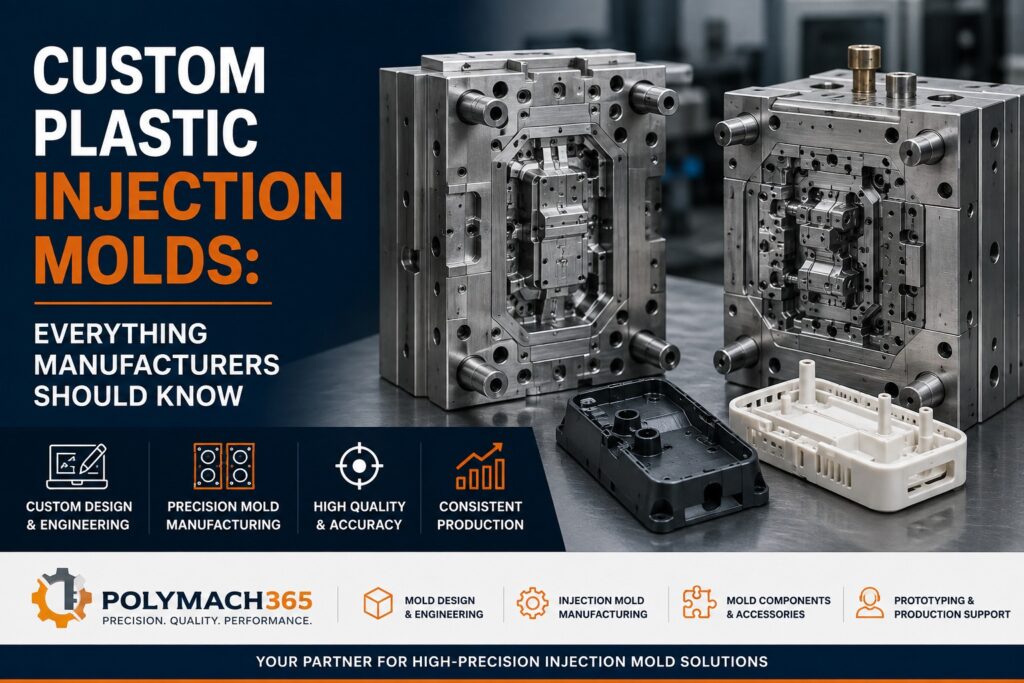
The Complete Guide to Custom Injection Mold Manufacturing for High-Quality Plastic Parts Modern manufacturing demands precision, consistency, and cost efficiency. Therefore, choosing the right custom plastic injection mold is one of the most important decisions for companies developing plastic products. A well-designed mold not only produces high-quality components but also reduces production costs, minimizes defects, and improves manufacturing efficiency over the long term. Injection molding is widely used because it delivers consistent, repeatable plastic parts at scale, although it requires higher upfront tooling investment than processes like CNC machining or 3D printing. At Polymach365, we provide Custom Plastic Injection Mold Design, Mold Manufacturing, Rapid Prototyping, Mold Components, and Production Support for manufacturers across Canada. Whether you require a prototype mold, bridge tooling, or a high-volume production mold, our engineering team delivers reliable tooling solutions that help transform innovative product ideas into production-ready components. Moreover, by combining advanced mold design, CNC machining, EDM machining, precision grinding, and quality inspection, we manufacture molds that deliver exceptional accuracy, durability, and long service life. What Is a Custom Plastic Injection Mold? A custom plastic injection mold is a precision-engineered tooling system designed specifically for manufacturing plastic components with unique shapes, sizes, and functional requirements. Unlike standard molds, custom molds are developed according to your product’s: CAD Models Engineering Drawings Material Specifications Production Volume Surface Finish Requirements Tolerance Requirements During production, molten plastic is injected into the mold cavity under pressure. After cooling, the plastic solidifies into the exact shape of the mold before the finished part is ejected. The quality of the mold directly influences part accuracy, cycle time, cosmetic appearance, and overall manufacturing efficiency. As a result, manufacturers gain complete control over product quality, repeatability, and production performance. Why Choose Custom Plastic Injection Molds? Although standard tooling may suit generic products, most manufacturers require custom molds to produce unique components with consistent quality. Superior Product Accuracy Custom molds are manufactured according to your exact design specifications. Therefore, every molded component maintains consistent dimensions and repeatability. Improved Production Efficiency Well-designed molds reduce cycle times while improving plastic flow, cooling performance, and ejection efficiency. Lower Manufacturing Costs Although custom molds require an initial investment, they significantly reduce the cost per part during medium and high-volume production. Greater Design Flexibility Custom tooling allows engineers to produce complex geometries, textured surfaces, threaded features, inserts, and intricate plastic components. Longer Mold Life High-quality tool steels, precision machining, and proper heat treatment help extend mold life while reducing maintenance requirements. Consequently, manufacturers benefit from greater productivity, improved part quality, and lower long-term production costs. Our Custom Plastic Injection Mold Capabilities At Polymach365, we manufacture precision molds for a wide variety of industrial applications. Our capabilities include: Prototype Injection Molds Production Injection Molds Multi-Cavity Molds Family Molds Hot Runner Molds Cold Runner Molds Insert Molds Overmolding Tools Precision Mold Components Mold Repair & Modification Furthermore, every project is customized according to your production goals and technical requirements. Our Injection Mold Manufacturing Process 1. Product Design Review Our engineering team evaluates your CAD files and drawings to ensure the design is optimized for injection molding. 2. Design for Manufacturability (DFM) We identify potential manufacturing challenges and recommend improvements before tooling begins. Design considerations such as wall thickness, draft angles, ribs, gate location, and cooling strategy can significantly improve manufacturability and reduce defects. 3. Mold Design Our designers create detailed 3D mold assemblies incorporating: Core & Cavity Design Cooling Channels Runner Systems Gate Design Ejection Systems Venting Systems 4. Precision Mold Manufacturing Using advanced CNC machining, EDM machining, wire cutting, and precision grinding, we manufacture each mold with exceptional accuracy. 5. Mold Assembly & Testing Every mold is assembled, tested, and inspected before production approval. 6. Production Support Once approved, the mold is ready for prototype production or full-scale manufacturing. As a result, customers receive reliable tooling that performs consistently throughout its service life. Materials Used for Injection Molds Selecting the right mold material is critical because it affects durability, wear resistance, maintenance, and production life. Common mold materials include: P20 Tool Steel H13 Tool Steel S136 Stainless Steel NAK80 Steel Aluminum Tooling Hardened Tool Steels Material selection depends on: Production Volume Plastic Resin Surface Finish Wear Resistance Product Complexity Expected Tool Life Therefore, choosing the correct tooling material helps maximize mold performance. Plastic Materials We Support Polymach365 supports tooling for many engineering plastics, including: ABS Polypropylene (PP) Polycarbonate (PC) Nylon (PA) Acetal (POM) PEEK PET PVC TPE TPU Consequently, manufacturers can produce components for diverse industrial applications. Industries We Serve Our custom plastic injection molds support manufacturers across numerous industries. Automotive Interior components, housings, clips, connectors, brackets, and functional plastic parts. Medical Devices Medical housings, laboratory equipment, diagnostic components, and precision plastic parts. Consumer Products Appliance components, household products, packaging, and electronic enclosures. Industrial Manufacturing Machine components, automation parts, equipment housings, and engineering plastics. Electronics Precision connectors, switches, covers, and electrical housings. Packaging Caps, closures, containers, and custom packaging solutions. As a result, Polymach365 supports manufacturers throughout product development and production. Key Factors That Influence Mold Quality Several engineering factors determine the performance of an injection mold. Mold Design A properly designed mold improves plastic flow, cooling efficiency, and part consistency. Cooling System Efficient cooling reduces cycle time while improving dimensional stability. Gate Design Correct gate placement minimizes weld lines, sink marks, and filling problems. Ejection System Reliable ejection protects molded parts while reducing wear on tooling. Surface Finish High-quality polishing or texturing improves cosmetic appearance and product quality. Therefore, every stage of mold development contributes to long-term manufacturing success. Benefits of Custom Plastic Injection Molds Manufacturers continue choosing custom tooling because it provides numerous advantages. High dimensional accuracy Excellent repeatability Faster production cycles Lower cost per part Superior surface finish Complex part geometries Long mold life Reduced material waste Consistent production quality Scalable manufacturing Consequently, custom injection molds remain one of the most cost-effective solutions for producing high-quality plastic components. Why Choose Polymach365? Polymach365 combines engineering expertise with advanced manufacturing technology to deliver reliable tooling solutions. Our strengths include:
Why Rapid Prototyping Is Essential for Modern Product Development
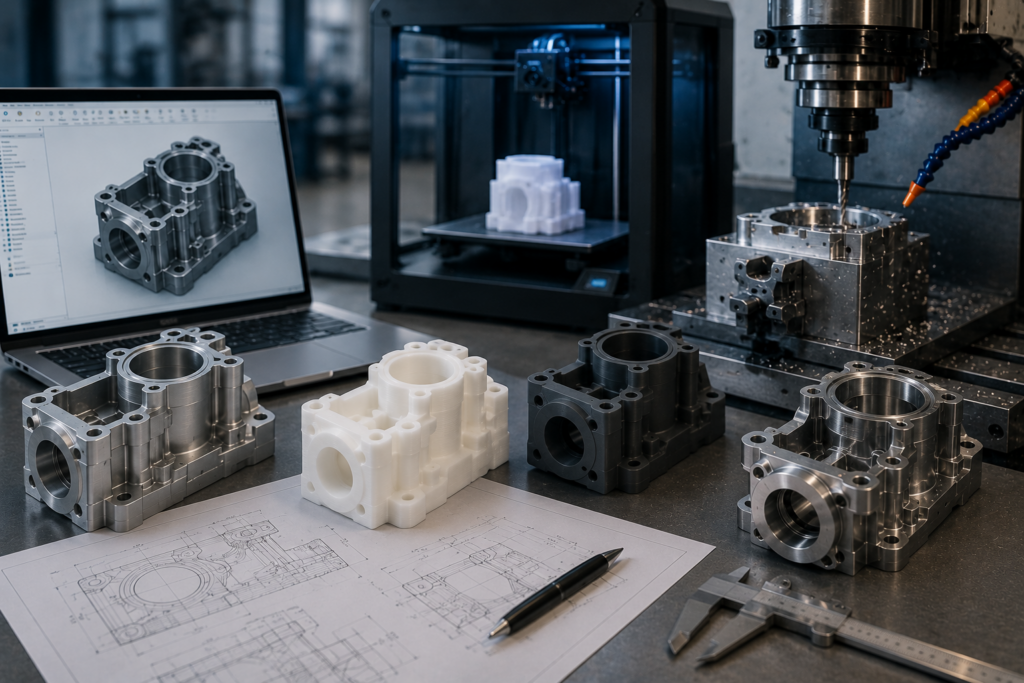
How Rapid Prototyping Helps Manufacturers Reduce Risk, Improve Designs, and Accelerate Time-to-Market Bringing a new product to market requires speed, accuracy, testing, and reliable manufacturing. However, traditional manufacturing processes can slow development when they require expensive tooling or lengthy setup. CNC machining provides manufacturers with a faster and more flexible way to turn digital designs into functional components. At Polymach365, we provide CNC machining and prototype manufacturing solutions in Canada for businesses developing custom components and new products. CNC milling, CNC turning, and 5-axis machining can help shorten development cycles, simplify design changes, and support the transition from prototype to production. Therefore, CNC machining can play an important role in helping Canadian manufacturers improve product development efficiency while maintaining precision and quality. What Is Rapid Prototyping? Rapid prototyping is the process of quickly manufacturing a physical model or functional component directly from a digital design. Depending on the product and testing requirements, manufacturers may use processes such as: CNC machining 3D printing CNC milling CNC turning 5-axis machining Prototype injection molding Low-volume manufacturing The objective is not simply to create a sample. Instead, rapid prototyping helps engineers understand how a product will look, fit, function, assemble, and perform before larger manufacturing investments begin. As a result, prototypes become an important bridge between product design and production Why Rapid Prototyping Matters in Modern Product Development Traditional product development often involved long gaps between design, tooling, testing, and manufacturing. Consequently, discovering a problem late in the process could lead to costly modifications. Rapid prototyping creates a faster feedback cycle: Design → Prototype → Test → Improve → Validate → Produce Because teams can evaluate physical parts earlier, they can make better engineering decisions before committing to final tooling or production. Furthermore, this iterative approach helps manufacturers improve product performance while shortening development cycles. 1. Rapid Prototyping Speeds Up Product Development Speed is one of the biggest advantages of rapid prototyping. Instead of waiting for complete production tooling, engineers can manufacture prototypes directly from CAD data using suitable rapid manufacturing processes. Therefore, teams can quickly evaluate their designs and move to the next development stage. For competitive industries, shorter development cycles can help businesses: Respond to market opportunities Complete engineering validation sooner Introduce new products faster Improve existing products efficiently Reduce delays between design iterations Consequently, rapid prototyping can significantly improve overall product development efficiency. 2. Identify Design Problems Before Production A CAD model may appear perfect on a computer screen. However, physical testing can reveal issues that are difficult to identify digitally. For example, a prototype may reveal: ✔ Poor component fit ✔ Assembly interference ✔ Incorrect dimensions ✔ Weak structural areas ✔ Difficult access points ✔ Unnecessary material ✔ Ergonomic problems ✔ Manufacturing challenges Finding these issues during prototyping is considerably better than discovering them after production has begun. Therefore, rapid prototyping helps reduce the financial risk associated with design errors. 3. Improve Product Quality Through Testing A successful product must perform reliably in its intended application. Rapid prototypes allow engineering teams to perform physical tests before final manufacturing. Depending on the application, engineers may evaluate: Mechanical strength Component fit Assembly performance Dimensional accuracy Movement Material behaviour Thermal performance Functional performance After testing, the design can be modified and another prototype produced. As a result, each development cycle can improve the final product. 4. Reduce Product Development Costs Rapid prototyping requires an upfront investment. However, it can prevent much larger expenses later. Changing a CAD model and producing another prototype is often significantly less expensive than modifying production tooling or correcting thousands of finished components. For example, early prototype testing can help prevent: Tooling modifications Production scrap Assembly failures Product redesigns Manufacturing delays Unnecessary material use Therefore, rapid prototyping should be viewed as a risk-reduction strategy, not simply an additional manufacturing expense. 5. Test Multiple Design Versions Product development often involves several possible design solutions. Rapid prototyping allows engineers to manufacture and compare multiple versions before selecting the final design. For example, teams may compare: Prototype A: Lightweight designPrototype B: Higher-strength designPrototype C: Lower-cost manufacturing design Engineers can then evaluate which version performs best. Consequently, design decisions can be based on physical testing rather than assumptions alone. 6. Validate Fit and Assembly Components rarely operate independently. Most products contain multiple parts that must fit together accurately. Even small dimensional errors can create assembly problems. Rapid prototyping allows manufacturers to verify: Hole alignment Fastener locations Mating surfaces Component clearances Assembly interfaces Mechanical movement Therefore, engineers can correct fitment issues before final production begins. This benefit is particularly valuable for machinery, automation systems, automotive components, electronics, and multi-part assemblies. 7. Evaluate Materials Before Final Production Material selection has a major impact on product performance. Depending on the manufacturing process, prototypes can be produced using engineering-grade materials similar to those planned for the final product. Common Metals Aluminum Stainless steel Carbon steel Brass Copper Titanium Tool steel Engineering Plastics ABS Nylon Delrin/Acetal Polycarbonate PEEK PTFE Therefore, engineers can evaluate strength, weight, durability, machinability, and other characteristics before finalizing material selection. 8. CNC Machining for Functional Rapid Prototypes While several processes can support rapid prototyping, CNC machining is particularly valuable for functional engineering prototypes. CNC machining removes material from solid stock using computer-controlled cutting tools. Key Advantages Include: ✔ High dimensional accuracy ✔ Production-grade materials ✔ Excellent mechanical properties ✔ High-quality surface finishes ✔ Tight-tolerance capability ✔ Suitable for functional testing Furthermore, CNC-machined prototypes can closely represent future production components. Therefore, engineers can perform realistic mechanical and assembly testing before scaling manufacturing. 9. 5-Axis CNC Machining for Complex Prototypes Some prototype components contain complex curves, angled surfaces, or features that are difficult to manufacture using conventional machining. In these situations, 5-axis CNC machining can provide significant advantages. Because the cutting tool can access the component from multiple directions, complex features can often be machined with fewer setups. This can provide: Better access to difficult geometries Fewer workpiece repositioning operations Improved dimensional consistency Efficient complex-part machining High-quality surface finishes Consequently, 5-axis machining can support sophisticated
How to Choose the Right Prototype Manufacturing Process
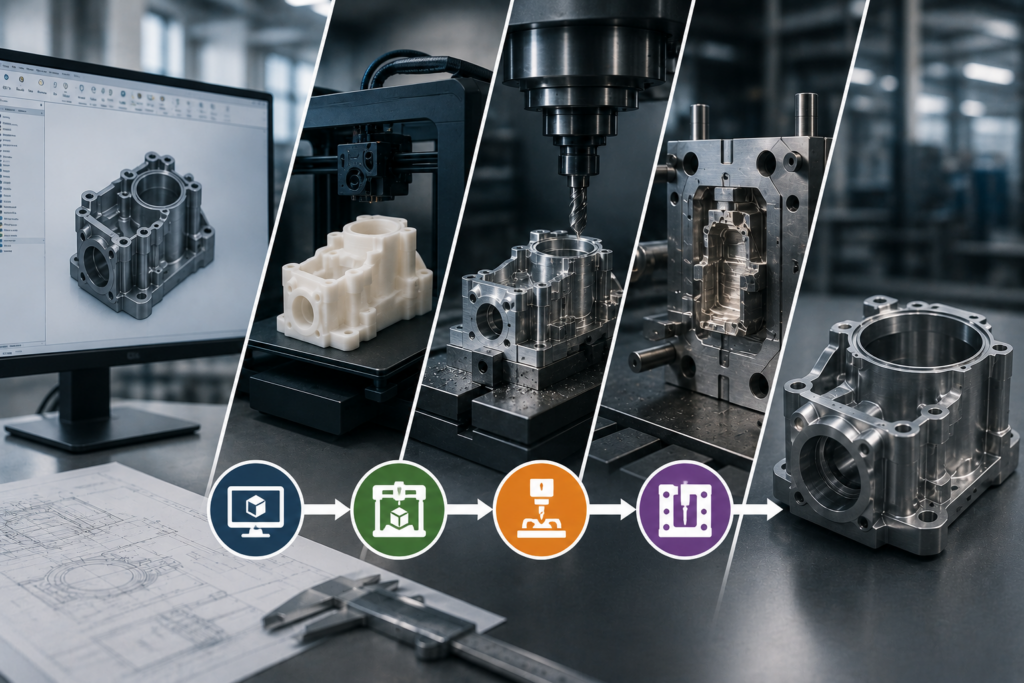
A Complete Guide to Selecting the Best Prototyping Method for Your Product Choosing the right prototype manufacturing process is an important step in successful product development. A prototype allows engineers, designers, and manufacturers to evaluate a product before committing to full-scale production. However, CNC machining, 3D printing, and prototype injection molding each offer different advantages. Therefore, the best process depends on your product design, material, dimensional accuracy, quantity, budget, testing requirements, and future production goals. At Polymach365, we support businesses with prototype manufacturing services in Canada, including CNC machining, rapid prototyping, 5-axis machining, low-volume production, and injection mold solutions. By selecting the appropriate manufacturing method early, businesses can reduce development risks, control costs, and move products toward production more efficiently. This guide explains how to choose the right prototype manufacturing process for your next project. What Is Prototype Manufacturing? Prototype manufacturing is the process of creating a physical version of a product or component before full production begins. Depending on the development stage, a prototype may be used to evaluate: Product appearance Dimensions Fit and assembly Mechanical performance Material behaviour Design feasibility User experience Manufacturing requirements Therefore, prototypes provide valuable information that digital models alone may not reveal. Moreover, engineers can identify design problems early and make improvements before investing in expensive production tooling. Why Choosing the Right Prototyping Process Matters Not every prototype serves the same purpose. For example, an early concept model may only need to demonstrate size and appearance. However, a functional engineering prototype may need production-grade materials, tight tolerances, and mechanical strength. Choosing the wrong manufacturing process can result in unnecessary expenses, inaccurate testing, or longer development cycles. The right process can help you: ✔ Reduce development costs ✔ Identify design problems earlier ✔ Improve product functionality ✔ Test suitable materials ✔ Accelerate design iterations ✔ Validate assembly requirements ✔ Prepare efficiently for production Consequently, manufacturers should define the purpose of the prototype before choosing how to manufacture it. Main Prototype Manufacturing Processes Several manufacturing technologies can be used for prototyping. However, three approaches are particularly common. 1. CNC Machining CNC machining is a subtractive manufacturing process in which computer-controlled cutting tools remove material from a solid workpiece. Common processes include: CNC milling CNC turning 3-axis machining 5-axis CNC machining Drilling Tapping Because CNC machining works with production-grade metals and engineering plastics, it is particularly suitable for functional prototypes. Advantages of CNC Machining ✔ Excellent dimensional accuracy ✔ High-quality surface finishes ✔ Production-grade materials ✔ Suitable for tight tolerances ✔ Strong functional prototypes ✔ Easy transition to low-volume production Therefore, CNC machining is an excellent choice when prototype performance needs to closely represent the final component. 2. 3D Printing 3D printing builds components layer by layer from a digital model. As a result, it can create complex shapes without many of the tooling-access restrictions associated with subtractive machining. Common additive processes include: FDM SLA SLS MJF Metal additive manufacturing Advantages of 3D Printing ✔ Fast design iterations ✔ Complex geometries ✔ Minimal tooling requirements ✔ Internal channels and structures ✔ Suitable for concept models ✔ Cost-effective for many one-off prototypes Therefore, 3D printing is often ideal during the early stages of product development. However, the dimensional accuracy, surface quality, and mechanical properties depend heavily on the printing process and material selected. 3. Prototype Injection Molding Prototype injection molding is useful when developers need molded plastic components that closely represent future production parts. The process requires a mold, although prototype tooling may use simpler or more economical approaches than long-life production molds. Advantages ✔ Production-like plastic components ✔ Consistent repeatability ✔ Suitable for larger prototype quantities ✔ Realistic material testing ✔ Useful before mass production Therefore, prototype injection molding can provide a valuable bridge between initial prototypes and high-volume plastic manufacturing. CNC Machining vs 3D Printing vs Injection Molding The following comparison can help you understand which process may suit your project. Factor CNC Machining 3D Printing Prototype Injection Molding Best Use Functional prototypes Concept & complex prototypes Production-like plastic parts Initial Tooling Low Very Low Higher Material Range Metals & plastics Process-dependent Thermoplastics Accuracy Excellent Process-dependent Excellent Surface Finish Excellent May require finishing Excellent Design Changes Easy Very Easy More difficult Low Quantities Excellent Excellent Less economical Larger Quantities Good Application-dependent Excellent Production Simulation Excellent Moderate Excellent Therefore, there is no single process that is best for every prototype. 1. Define the Purpose of Your Prototype Before selecting a manufacturing process, determine exactly what you want to learn from the prototype. Ask questions such as: Is the prototype only for visual evaluation? Does it need to fit into an assembly? Will it undergo mechanical testing? Does it need to withstand real operating conditions? Is surface appearance important? Does the prototype need production-grade material? For visual concept models, 3D printing may be sufficient. However, if you need to evaluate mechanical strength, dimensional accuracy, or functional performance, CNC machining may provide a more realistic prototype. 2. Consider Material Requirements Material selection is another major factor. CNC machining can process a broad range of engineering materials. Metals Aluminum Stainless Steel Carbon Steel Tool Steel Brass Copper Titanium Engineering Plastics ABS Nylon Delrin/Acetal Polycarbonate PEEK PTFE Therefore, CNC machining can be particularly useful when your prototype must use the same or a similar material as the final production component. Meanwhile, 3D printing provides a different range of polymers, resins, powders, and metals depending on the additive process. 3. Evaluate Dimensional Accuracy and Tolerances Some prototypes require only approximate dimensions. Others need precise mating surfaces, bearing locations, threaded features, or critical hole positions. For applications requiring tight dimensional control, precision CNC machining is often a strong option. However, specifying unnecessarily tight tolerances can increase manufacturing costs. Therefore, engineering drawings should clearly identify which dimensions are critical and which can use standard manufacturing tolerances. This approach improves both manufacturing efficiency and cost control. 4. Consider Part Geometry and Complexity Geometry can determine which manufacturing process is practical. 3D printing performs particularly well when parts contain: Internal channels Lattice structures Organic shapes
Custom CNC Machining Solutions for Complex Industrial Components
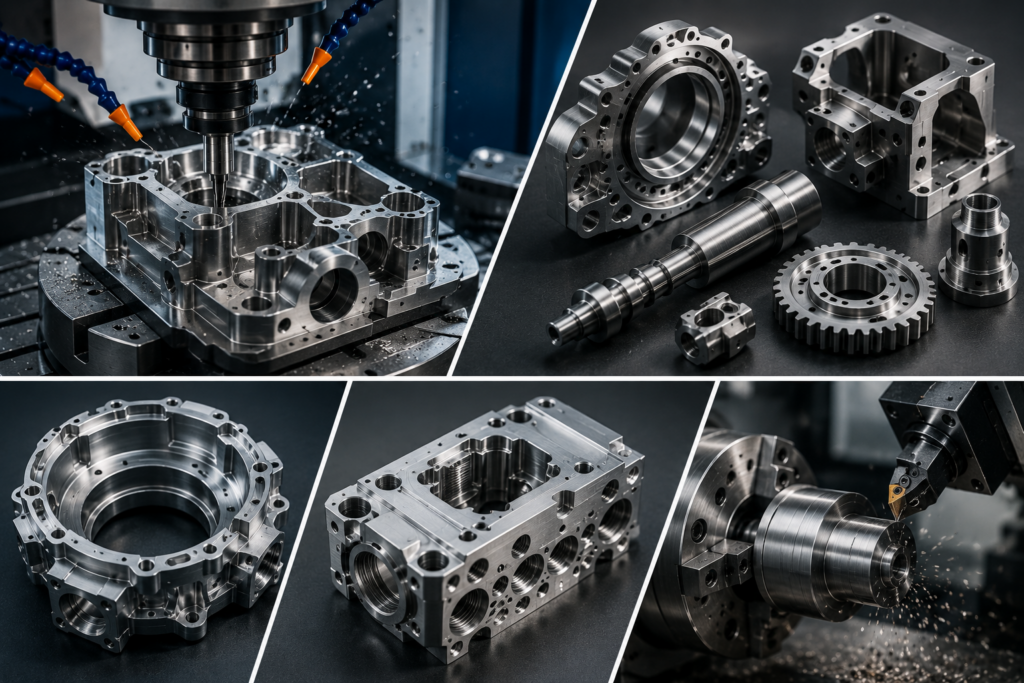
High-Precision Custom Manufacturing for Demanding Industrial Applications Modern industrial equipment depends on components that deliver accuracy, durability, and consistent performance. However, standard off-the-shelf parts cannot always meet specialized engineering requirements. Therefore, manufacturers often require custom CNC machining solutions for components with complex geometries, tight tolerances, demanding materials, or application-specific features. At Polymach365, we provide custom CNC machining solutions for complex industrial components, supporting manufacturers with precision CNC milling, CNC turning, 5-axis machining, prototype manufacturing, and low-volume production. From a single custom prototype to repeat production batches, our manufacturing approach focuses on accuracy, manufacturability, and reliable quality. Moreover, CNC machining provides the flexibility to manufacture intricate metal and plastic parts directly from CAD designs. As a result, engineers can develop specialized components without compromising their functional requirements. What Is Custom CNC Machining? Custom CNC machining is a computer-controlled manufacturing process used to produce components according to specific drawings, CAD models, tolerances, materials, and performance requirements. Unlike standard components, custom CNC parts are manufactured for a particular product, machine, assembly, or industrial application. Depending on the component, manufacturing may involve: CNC milling CNC turning 3-axis machining 4-axis machining 5-axis CNC machining Drilling and tapping Precision boring Thread machining Secondary finishing Therefore, CNC machining provides engineers with considerable flexibility when standard components cannot satisfy project requirements. Why Complex Industrial Components Require Precision Machining Industrial components often operate under challenging conditions. For example, parts may experience high loads, vibration, repeated motion, heat, pressure, or continuous operation. Consequently, dimensional errors can affect assembly, equipment performance, and component life. Precision CNC machining helps manufacturers maintain critical features such as: ✔ Hole positions ✔ Flatness ✔ Concentricity ✔ Parallelism ✔ Thread dimensions ✔ Mating surfaces ✔ Complex profiles ✔ Critical dimensions As a result, properly machined components can integrate more reliably into complex industrial assemblies. Our Custom CNC Machining Capabilities Polymach365 supports different manufacturing requirements through multiple CNC machining processes. CNC Milling Services CNC milling uses rotating cutting tools to remove material from a stationary workpiece. It is suitable for manufacturing: Machine brackets Mounting plates Housings Fixtures Tooling Mold inserts Equipment components Complex mechanical parts Moreover, CNC milling allows manufacturers to create pockets, holes, slots, contours, and precision surfaces within a single manufacturing workflow. CNC Turning Services CNC turning is ideal for producing rotational and cylindrical components. Common CNC-turned industrial parts include: Shafts Pins Bushings Sleeves Rollers Couplings Spacers Threaded components Because the workpiece rotates during machining, CNC turning can provide excellent concentricity and dimensional consistency for rotational components. 5-Axis CNC Machining for Complex Components Some industrial parts contain features that are difficult to access with conventional 3-axis machining. Therefore, 5-axis CNC machining can provide an effective solution for complex geometries. The cutting tool can approach the component from multiple directions. Consequently, manufacturers can machine several surfaces with fewer setups. Key Benefits of 5-Axis Machining ✔ Fewer machining setups ✔ Improved access to complex features ✔ Better positional consistency ✔ Reduced repositioning ✔ Efficient complex-part manufacturing ✔ High-quality surface finishes As a result, 5-axis CNC machining is valuable for sophisticated industrial components where geometry and precision are critical. Types of Complex Industrial Components We Can Support Custom CNC machining can be used for a wide range of industrial applications. Precision Housings Machined housings can include mounting holes, bearing locations, internal cavities, and precision mating surfaces. Shafts and Rotational Components Custom shafts require accurate diameters, shoulders, threads, grooves, and bearing surfaces. Jigs and Fixtures Manufacturing fixtures help improve positioning, assembly, inspection, and repeatability. Machine Components Custom plates, brackets, blocks, supports, adapters, and structural components can be manufactured according to specific equipment requirements. Mold Components Core pins, cavity inserts, mold inserts, and other precision components require controlled dimensions and high-quality surfaces. Automation Components Robotics and automated equipment often require custom mounts, grippers, brackets, housings, and mechanical interfaces. Therefore, custom CNC machining can support both new equipment development and existing industrial systems. CNC Machining for Tight-Tolerance Components Not every feature requires the same level of precision. However, bearing locations, mating surfaces, alignment features, and assembly interfaces may require tighter tolerances. Achieving these requirements may involve: Appropriate machine selection Stable workholding Suitable cutting tools Controlled machining parameters Dimensional inspection Proper material selection Therefore, clearly identifying critical tolerances on engineering drawings helps manufacturers focus precision where it matters most. This approach can also prevent unnecessary machining costs caused by applying extremely tight tolerances to non-critical features. Materials for Custom CNC Machining Material selection affects strength, weight, corrosion resistance, machinability, temperature performance, and manufacturing cost. Polymach365 supports a range of commonly used engineering materials. Metals Aluminum Aluminum provides excellent machinability and a strong strength-to-weight ratio. Therefore, it is widely used for housings, fixtures, brackets, and machine components. Stainless Steel Stainless steel provides strength and corrosion resistance. Consequently, it suits demanding industrial environments. Carbon Steel Carbon steel offers strength and durability for structural and mechanical applications. Tool Steel Tool steels are commonly selected for tooling, molds, dies, and wear-resistant components. Brass and Copper These materials provide useful electrical, thermal, and corrosion-resistant properties for specialized applications. Titanium Titanium combines strength, corrosion resistance, and low weight. However, it requires careful machining because of its material characteristics. Engineering Plastics Depending on project requirements, components may also be machined from: ABS Nylon Delrin/Acetal Polycarbonate PEEK PTFE Therefore, customers can select materials according to the mechanical and environmental requirements of the finished component. Prototype Manufacturing for Complex CNC Parts Manufacturing a prototype before committing to production can reduce development risk. A CNC-machined prototype allows engineers to evaluate: ✔ Fit ✔ Function ✔ Assembly ✔ Dimensional accuracy ✔ Material performance ✔ Mechanical behaviour If modifications are required, engineers can update the CAD model before producing additional components. Consequently, CNC prototyping provides a practical path from design validation to production. Low-Volume CNC Production Many industrial projects do not require mass production. For example, specialized machinery manufacturers may require only 10, 50, 100, or several hundred custom components. CNC machining is particularly suitable for these requirements because it does not require dedicated production molds for most parts. Therefore, low-volume CNC production
Why Online CNC Machining Services Are Transforming Manufacturing
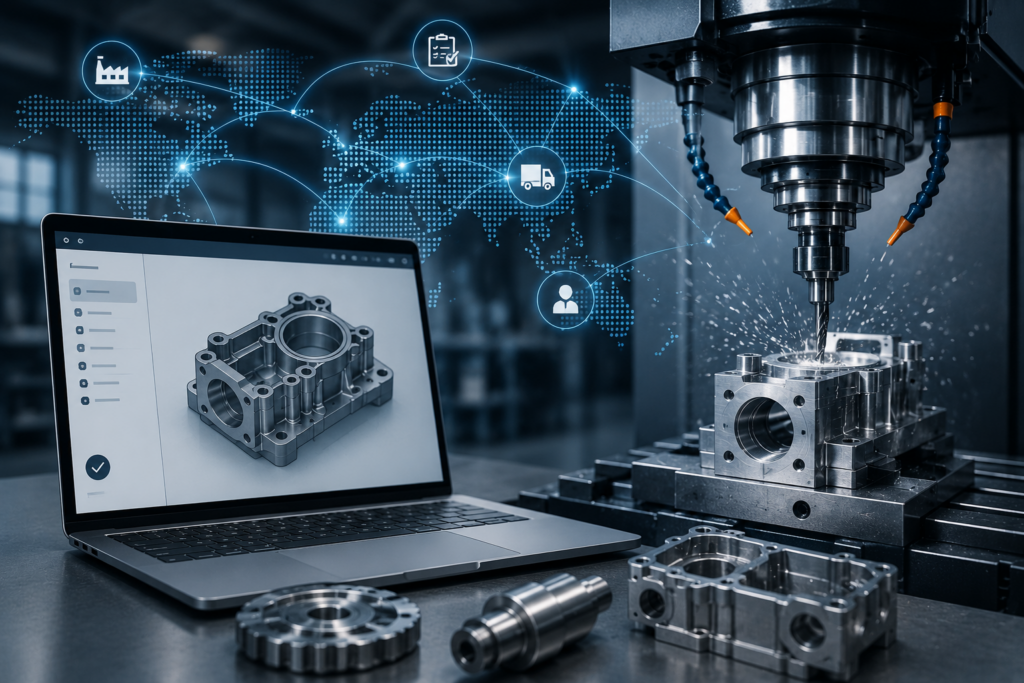
How Digital CNC Manufacturing Is Making Custom Part Production Faster, Smarter, and More Flexible Manufacturing is becoming increasingly digital. Today, engineers and product developers expect faster quotations, easier communication, flexible production volumes, and efficient ways to move from CAD design to finished components. Therefore, online CNC machining services are changing how businesses source custom-manufactured parts. Instead of relying entirely on lengthy traditional procurement processes, manufacturers can use digital workflows to submit CAD files, define project requirements, receive manufacturing feedback, and move projects toward production more efficiently. At Polymach365, we support businesses with online CNC machining services in Canada, including CNC milling, CNC turning, 5-axis machining, rapid prototyping, precision machining, and low-volume production. As a result, customers can simplify sourcing while maintaining a strong focus on part quality and manufacturability. In this guide, we explain why online CNC machining is transforming modern manufacturing and how businesses can benefit from a more connected manufacturing process. What Are Online CNC Machining Services? Online CNC machining combines precision manufacturing with a digital project workflow. Traditionally, sourcing custom-machined components could involve multiple emails, drawings, supplier discussions, and manual quotation processes. However, an online manufacturing approach simplifies many of these steps. A typical process may include: CAD File Submission → Engineering Review → DFM Feedback → Quotation → CNC Machining → Quality Inspection → Delivery Therefore, engineers can move from a digital design toward physical components through a more streamlined process. Online CNC machining can support both simple and complex projects, including prototypes, custom components, replacement parts, tooling, and production batches. Why Is Online CNC Machining Growing? Manufacturers increasingly need shorter development cycles and more flexible supply chains. At the same time, engineering teams often work across different cities, provinces, and countries. Consequently, digital manufacturing platforms can make supplier communication and project coordination easier. Online CNC machining can help businesses: Reduce quotation delays Simplify CAD file submission Access engineering feedback Compare manufacturing requirements Accelerate prototyping Manage custom production Scale quantities as demand changes Reduce unnecessary administrative work As a result, engineering teams can spend more time developing products and less time managing repetitive procurement activities. 1. Faster CNC Machining Quotations Traditional CNC quotation processes can require several rounds of communication before manufacturing begins. However, online CNC machining services simplify the initial information exchange. Customers can provide CAD files, material requirements, tolerances, quantities, and finishing specifications together. Therefore, manufacturers can evaluate the project more efficiently. A complete request typically includes: ✔ 3D CAD Model ✔ 2D Technical Drawing ✔ Material ✔ Quantity ✔ Critical Tolerances ✔ Surface Finish ✔ Required Delivery Schedule Providing complete information from the beginning can significantly reduce unnecessary quotation delays. 2. Easier CAD-to-Part Manufacturing One of the greatest advantages of digital manufacturing is the connection between CAD design and CNC production. Engineers already create components using digital CAD software. Therefore, an online CNC workflow naturally extends that process into manufacturing. Common file formats may include: STEP STP IGES IGS DXF DWG After reviewing the design, manufacturing engineers can determine suitable machining operations, tooling requirements, material selection, and production methods. Consequently, the transition from design to manufacturing becomes more efficient. 3. Design for Manufacturability Feedback A part can look correct in CAD while still being difficult or expensive to machine. For example, a design may contain extremely deep pockets, sharp internal corners, inaccessible features, thin walls, or unnecessarily tight tolerances. Therefore, Design for Manufacturability (DFM) plays an important role in online CNC machining. DFM analysis can help identify opportunities to: ✔ Simplify part geometry ✔ Improve tool accessibility ✔ Reduce machining time ✔ Select practical tolerances ✔ Minimize unnecessary setups ✔ Reduce material waste ✔ Lower manufacturing costs As a result, manufacturers can optimize components before production rather than correcting expensive problems afterward. 4. Faster Rapid Prototyping Speed is critical during product development. Engineers often need physical prototypes to evaluate fit, functionality, assembly, strength, and dimensional accuracy. However, waiting too long for prototypes can delay the entire development cycle. Online CNC machining can simplify the process of submitting prototype designs and communicating manufacturing requirements. Moreover, CNC machining allows engineers to create functional prototypes from engineering materials such as aluminum, stainless steel, brass, and engineering plastics. Therefore, companies can test realistic components before moving toward production. 5. Flexible Low-Volume Production Not every manufacturer needs thousands of components. Startups, equipment manufacturers, automation companies, and product developers may require only: 5 parts 20 parts 50 parts 100 parts Several hundred components Online CNC machining is well suited to this type of low-volume production because manufacturers can produce components without investing in dedicated molds for many applications. Consequently, businesses can manufacture according to actual demand while reducing unnecessary inventory. 6. Access to Advanced CNC Machining Capabilities A single project may require several manufacturing processes. For example, one component may require milling, while another requires turning. Meanwhile, a complex part may benefit from multi-axis machining. Online CNC manufacturing can provide access to capabilities such as: CNC Milling CNC milling uses rotating cutting tools to create pockets, holes, surfaces, slots, and complex geometries. CNC Turning CNC turning is ideal for cylindrical components such as shafts, bushings, sleeves, pins, and threaded parts. 5-Axis CNC Machining 5-axis machining allows cutting tools to approach a component from multiple directions. Therefore, manufacturers can produce complex geometries while reducing the number of setups required. As a result, customers can source different precision components through a coordinated manufacturing workflow. 7. Greater Material Flexibility Modern product development requires materials suited to specific mechanical and environmental requirements. Online CNC machining can support a broad selection of metals and engineering plastics. Common CNC Metals Aluminum Stainless Steel Carbon Steel Tool Steel Brass Copper Titanium Engineering Plastics ABS Nylon Delrin/Acetal Polycarbonate PEEK PTFE Therefore, engineers can select materials according to strength, weight, machinability, temperature resistance, chemical resistance, and application requirements. 8. Improved Cost Control Online CNC machining can also make manufacturing costs easier to evaluate. Several factors influence the cost of CNC parts, including: Raw material Component dimensions Geometry Machining time Number of setups Tolerances Quantity Inspection requirements Surface
How CNC Machining Accelerates Product Development in Canada
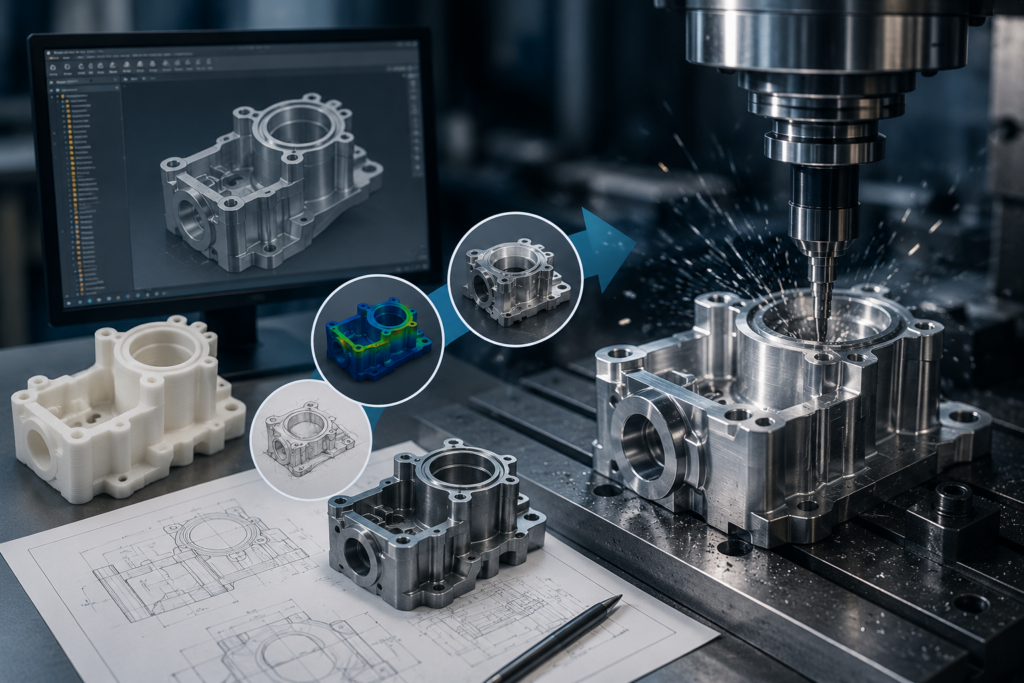
From Rapid Prototypes to Production-Ready Precision Components Bringing a new product to market requires speed, accuracy, testing, and reliable manufacturing. However, traditional manufacturing processes can slow development when they require expensive tooling or lengthy setup. CNC machining provides manufacturers with a faster and more flexible way to turn digital designs into functional components. At Polymach365, we provide CNC machining and prototype manufacturing solutions in Canada for businesses developing custom components and new products. CNC milling, CNC turning, and 5-axis machining can help shorten development cycles, simplify design changes, and support the transition from prototype to production. Therefore, CNC machining can play an important role in helping Canadian manufacturers improve product development efficiency while maintaining precision and quality. What Is CNC Machining in Product Development? CNC machining is a subtractive manufacturing process. Computer-controlled equipment removes material from a solid workpiece to produce the required geometry. Manufacturers can machine parts directly from CAD models using processes such as: CNC milling CNC turning 5-axis CNC machining Drilling and tapping Precision machining Custom CNC machining Unlike processes that require dedicated production molds, CNC machining can often begin with standard material stock and a validated design. As a result, engineers can produce prototypes and custom parts without waiting for production tooling. Why Speed Matters in Product Development Modern product development involves much more than creating a design. Engineers must prototype, test, modify, validate, and prepare components for production. Delays during any stage can increase development costs and extend time-to-market. Therefore, manufacturers need processes that allow them to move efficiently through the development cycle. CNC machining helps because engineers can quickly manufacture physical parts, evaluate them, modify the CAD model, and produce another iteration when necessary. 1. CNC Machining Enables Faster Functional Prototyping A digital model cannot always reveal how a component will perform in the real world. Physical prototypes allow engineers to test actual fit, function, strength, and assembly. CNC machining is particularly useful for functional prototype manufacturing because it can produce parts from engineering-grade materials. For example, prototypes can be manufactured from: Metals Aluminum Stainless steel Carbon steel Brass Copper Titanium Tool steel Engineering Plastics ABS Nylon Delrin/Acetal Polycarbonate PEEK PTFE Consequently, engineers can evaluate prototypes using materials that may closely represent the intended production component. 2. Design Changes Can Be Implemented Quickly Product development rarely ends with the first prototype. Engineers may discover that a hole needs repositioning, a wall needs additional thickness, or an assembly feature requires modification. With CNC machining, engineers can update the CAD model and revise the machining program rather than creating an entirely new mold. Therefore, design iterations can be easier to implement during early product development. This flexibility is particularly valuable for startups, engineering teams, and manufacturers developing innovative products. 3. CNC Machining Supports High-Precision Product Validation A prototype must accurately represent the intended design if engineers want meaningful test results. Modern CNC machining provides high dimensional accuracy and repeatability. Therefore, manufacturers can use machined prototypes to evaluate critical dimensions, mating components, mechanical performance, and assembly requirements. Precision machining is especially valuable when developing components with: Tight tolerances Precision holes Complex surfaces Critical mating features Threaded features Multi-component assemblies As a result, potential design problems can be identified before a project reaches larger-scale manufacturing. 4. No Dedicated Mold Is Required for CNC Prototypes One major advantage of CNC machining during product development is the ability to manufacture many components without first producing a dedicated mold. Injection molding can be highly efficient for high-volume plastic production. However, mold design and tooling require an upfront investment and additional development time. For early-stage prototypes, manufacturers may not yet be ready to commit to tooling. CNC machining allows teams to validate their designs first. Once the product is finalized, they can decide whether CNC production, injection molding, or another process offers the best long-term solution. 5. CNC Machining Helps Reduce Development Risk Finding a design problem after mass production begins can become expensive. Therefore, manufacturers should identify potential issues as early as possible. CNC prototypes can help engineers evaluate: Dimensional accuracy Mechanical performance Component fit Assembly compatibility Material behaviour Product functionality Design feasibility Consequently, manufacturers can make informed improvements before committing to full-scale production. 6. 5-Axis CNC Machining Accelerates Complex Part Development Complex components can require machining from several angles. Conventional machining may require multiple setups to access different surfaces. However, 5-axis CNC machining allows the cutting tool to approach the workpiece from multiple directions. This capability can provide several advantages: Fewer setups Better access to complex geometries Improved consistency Reduced repositioning Efficient machining of intricate components Excellent surface quality Therefore, 5-axis machining can be particularly effective for developing sophisticated engineering components. 7. CNC Machining Bridges Prototype and Low-Volume Production Product development does not always move directly from one prototype to mass production. Manufacturers may first require 10, 50, 100, or several hundred parts for: Field testing Engineering validation Customer evaluation Pilot production Market testing Pre-production assembly CNC machining can support this transition because the same general manufacturing approach used for prototypes can also produce low-volume batches. As a result, businesses can scale production gradually while managing inventory and financial risk. 8. Design for Manufacturability Can Improve Development Efficiency A component may look perfect in CAD but still contain features that make manufacturing unnecessarily difficult. Design for Manufacturability (DFM) helps identify these issues before production. DFM reviews may examine factors such as: Internal corner radii Hole depth Wall thickness Tool accessibility Tolerance requirements Material selection Part orientation Surface finish For example, unnecessarily tight tolerances may increase machining and inspection requirements. Likewise, deep cavities or inaccessible features can require additional operations. Therefore, early DFM feedback can reduce unnecessary complexity and support a smoother transition into manufacturing. 9. CNC Machining Provides Broad Material Flexibility Material selection can significantly influence product performance. During development, engineers may need to compare different materials based on strength, weight, corrosion resistance, thermal performance, or cost. CNC machining supports a broad range of metals and engineering plastics. Consequently, manufacturers can create several prototype versions and evaluate which material
Prototype to Production: A Complete Manufacturing Guide
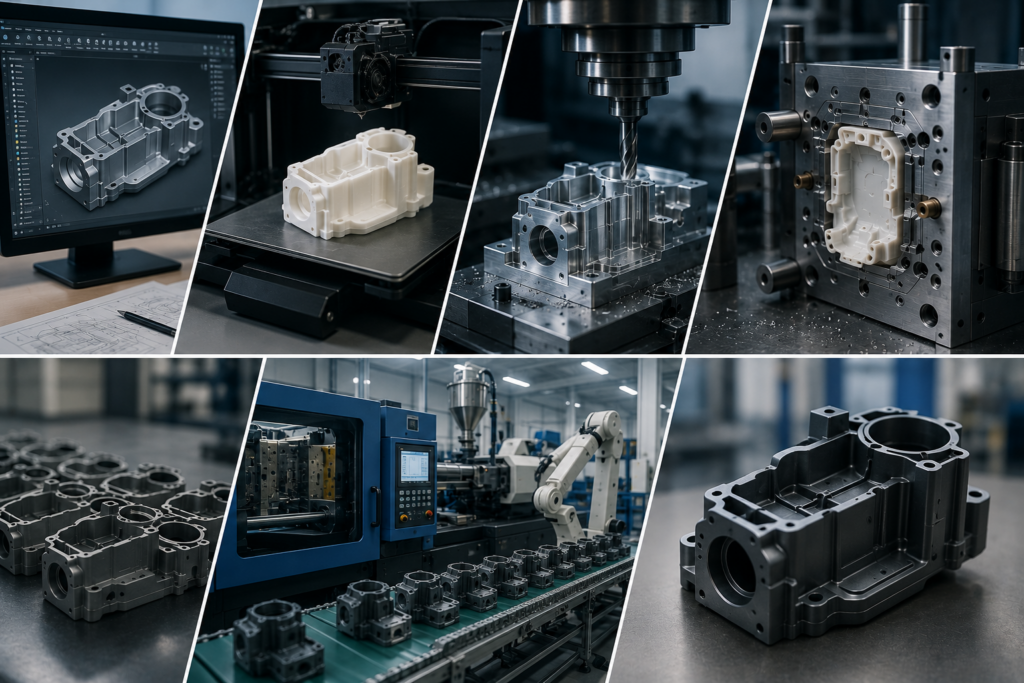
How Digital CNC Manufacturing Is Making Custom Part Production Faster, Smarter, and More Flexible Manufacturing is becoming increasingly digital. Today, engineers and product developers expect faster quotations, easier communication, flexible production volumes, and efficient ways to move from CAD design to finished components. Therefore, online CNC machining services are changing how businesses source custom-manufactured parts. Instead of relying entirely on lengthy traditional procurement processes, manufacturers can use digital workflows to submit CAD files, define project requirements, receive manufacturing feedback, and move projects toward production more efficiently. At Polymach365, we support businesses with online CNC machining services in Canada, including CNC milling, CNC turning, 5-axis machining, rapid prototyping, precision machining, and low-volume production. As a result, customers can simplify sourcing while maintaining a strong focus on part quality and manufacturability. In this guide, we explain why online CNC machining is transforming modern manufacturing and how businesses can benefit from a more connected manufacturing process. What Are Online CNC Machining Services? Online CNC machining combines precision manufacturing with a digital project workflow. Traditionally, sourcing custom-machined components could involve multiple emails, drawings, supplier discussions, and manual quotation processes. However, an online manufacturing approach simplifies many of these steps. A typical process may include: CAD File Submission → Engineering Review → DFM Feedback → Quotation → CNC Machining → Quality Inspection → Delivery Therefore, engineers can move from a digital design toward physical components through a more streamlined process. Online CNC machining can support both simple and complex projects, including prototypes, custom components, replacement parts, tooling, and production batches. Why Is Online CNC Machining Growing? Manufacturers increasingly need shorter development cycles and more flexible supply chains. At the same time, engineering teams often work across different cities, provinces, and countries. Consequently, digital manufacturing platforms can make supplier communication and project coordination easier. Online CNC machining can help businesses: Reduce quotation delays Simplify CAD file submission Access engineering feedback Compare manufacturing requirements Accelerate prototyping Manage custom production Scale quantities as demand changes Reduce unnecessary administrative work As a result, engineering teams can spend more time developing products and less time managing repetitive procurement activities. 1. Faster CNC Machining Quotations Traditional CNC quotation processes can require several rounds of communication before manufacturing begins. However, online CNC machining services simplify the initial information exchange. Customers can provide CAD files, material requirements, tolerances, quantities, and finishing specifications together. Therefore, manufacturers can evaluate the project more efficiently. A complete request typically includes: ✔ 3D CAD Model ✔ 2D Technical Drawing ✔ Material ✔ Quantity ✔ Critical Tolerances ✔ Surface Finish ✔ Required Delivery Schedule Providing complete information from the beginning can significantly reduce unnecessary quotation delays. 2. Easier CAD-to-Part Manufacturing One of the greatest advantages of digital manufacturing is the connection between CAD design and CNC production. Engineers already create components using digital CAD software. Therefore, an online CNC workflow naturally extends that process into manufacturing. Common file formats may include: STEP STP IGES IGS DXF DWG After reviewing the design, manufacturing engineers can determine suitable machining operations, tooling requirements, material selection, and production methods. Consequently, the transition from design to manufacturing becomes more efficient. 3. Design for Manufacturability Feedback A part can look correct in CAD while still being difficult or expensive to machine. For example, a design may contain extremely deep pockets, sharp internal corners, inaccessible features, thin walls, or unnecessarily tight tolerances. Therefore, Design for Manufacturability (DFM) plays an important role in online CNC machining. DFM analysis can help identify opportunities to: ✔ Simplify part geometry ✔ Improve tool accessibility ✔ Reduce machining time ✔ Select practical tolerances ✔ Minimize unnecessary setups ✔ Reduce material waste ✔ Lower manufacturing costs As a result, manufacturers can optimize components before production rather than correcting expensive problems afterward. 4. Faster Rapid Prototyping Speed is critical during product development. Engineers often need physical prototypes to evaluate fit, functionality, assembly, strength, and dimensional accuracy. However, waiting too long for prototypes can delay the entire development cycle. Online CNC machining can simplify the process of submitting prototype designs and communicating manufacturing requirements. Moreover, CNC machining allows engineers to create functional prototypes from engineering materials such as aluminum, stainless steel, brass, and engineering plastics. Therefore, companies can test realistic components before moving toward production. 5. Flexible Low-Volume Production Not every manufacturer needs thousands of components. Startups, equipment manufacturers, automation companies, and product developers may require only: 5 parts 20 parts 50 parts 100 parts Several hundred components Online CNC machining is well suited to this type of low-volume production because manufacturers can produce components without investing in dedicated molds for many applications. Consequently, businesses can manufacture according to actual demand while reducing unnecessary inventory. 6. Access to Advanced CNC Machining Capabilities A single project may require several manufacturing processes. For example, one component may require milling, while another requires turning. Meanwhile, a complex part may benefit from multi-axis machining. Online CNC manufacturing can provide access to capabilities such as: CNC Milling CNC milling uses rotating cutting tools to create pockets, holes, surfaces, slots, and complex geometries. CNC Turning CNC turning is ideal for cylindrical components such as shafts, bushings, sleeves, pins, and threaded parts. 5-Axis CNC Machining 5-axis machining allows cutting tools to approach a component from multiple directions. Therefore, manufacturers can produce complex geometries while reducing the number of setups required. As a result, customers can source different precision components through a coordinated manufacturing workflow. 7. Greater Material Flexibility Modern product development requires materials suited to specific mechanical and environmental requirements. Online CNC machining can support a broad selection of metals and engineering plastics. Common CNC Metals Aluminum Stainless Steel Carbon Steel Tool Steel Brass Copper Titanium Engineering Plastics ABS Nylon Delrin/Acetal Polycarbonate PEEK PTFE Therefore, engineers can select materials according to strength, weight, machinability, temperature resistance, chemical resistance, and application requirements. 8. Improved Cost Control Online CNC machining can also make manufacturing costs easier to evaluate. Several factors influence the cost of CNC parts, including: Raw material Component dimensions Geometry Machining time Number of setups Tolerances Quantity Inspection requirements Surface
CNC Machining vs Injection Molding: Which Manufacturing Process Should You Choose?
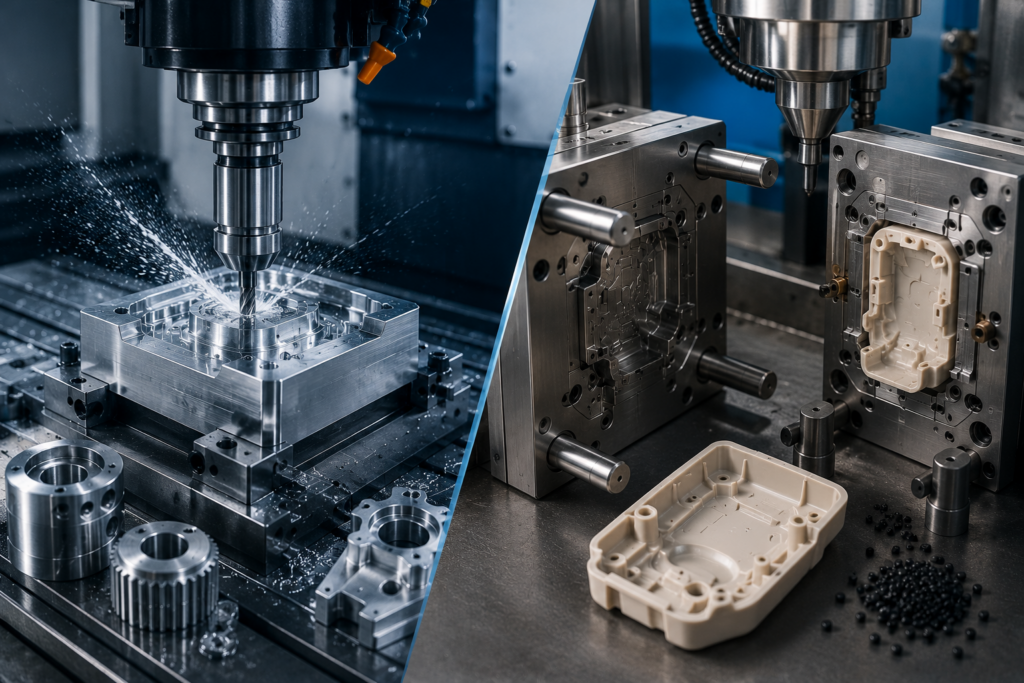
A Complete Manufacturing Guide for Canadian Businesses Selecting the right manufacturing process is one of the most important decisions when developing a new product. Two of the most widely used manufacturing methods are CNC Machining and Injection Molding. While both processes produce high-quality components, they serve different purposes depending on production volume, material requirements, complexity, and budget. At Polymach365, we provide both Precision CNC Machining Services and Injection Mold Design & Manufacturing Services across Canada. Therefore, we help manufacturers choose the most cost-effective production method for every stage of product development—from rapid prototyping to high-volume production. This guide compares CNC machining and injection molding to help you determine which process best fits your project. What Is CNC Machining? CNC (Computer Numerical Control) machining is a subtractive manufacturing process that removes material from a solid block using computer-controlled cutting tools. Therefore, CNC machining is ideal for manufacturing high-precision metal and plastic components with excellent dimensional accuracy. Common CNC Machining Processes ✔ CNC Milling ✔ CNC Turning ✔ 5-Axis CNC Machining ✔ Precision Drilling ✔ Multi-Axis Machining As a result, CNC machining is widely used for prototypes, custom parts, and low-volume production. What Is Injection Molding? Injection molding is a manufacturing process that injects molten plastic into a precision-engineered mold cavity. After cooling, the finished part is ejected and the cycle repeats. Because the same mold is used repeatedly, injection molding is ideal for producing thousands or even millions of identical plastic components. Common Applications ✔ Automotive Parts ✔ Medical Devices ✔ Consumer Products ✔ Electronic Housings ✔ Packaging Products ✔ Industrial Components Consequently, injection molding becomes highly economical for large production volumes. CNC Machining vs Injection Molding: Key Differences Feature CNC Machining Injection Molding Manufacturing Method Material Removal Plastic Injection Best For Prototypes & Low Volume High-Volume Production Initial Investment Low High (Mold Cost) Production Speed Moderate Very Fast Design Changes Easy Expensive Material Options Metals & Plastics Primarily Plastics Dimensional Accuracy Excellent Excellent Surface Finish Superior Very Good Production Quantity 1–10,000 Parts 10,000+ Parts Therefore, the right process depends on your project goals, budget, and production requirements. When Should You Choose CNC Machining? CNC machining is the preferred choice when flexibility, accuracy, and speed are essential. Ideal for Rapid Prototyping Because CNC machining requires no expensive tooling, prototypes can be manufactured quickly. As a result, engineers can validate designs before investing in production tooling. Excellent for Low-Volume Production If you only require a few parts or small production batches, CNC machining is significantly more cost-effective. Typical production quantities include: One-off Components Engineering Samples Pilot Production Low-Volume Manufacturing Therefore, CNC machining minimizes upfront investment. Superior Material Options CNC machining supports both engineering plastics and metals. Common Materials Aluminum Stainless Steel Titanium Brass Copper Carbon Steel ABS Nylon Delrin PEEK Consequently, manufacturers can select materials based on strength, durability, and application requirements. Outstanding Precision Modern CNC machines produce components with extremely tight tolerances. Therefore, industries such as aerospace, medical, robotics, and automotive rely heavily on CNC machining. When Should You Choose Injection Molding? Injection molding becomes the best option when producing large quantities of plastic components. High-Volume Manufacturing Although mold manufacturing requires a higher initial investment, production costs decrease dramatically as volumes increase. Consequently, injection molding delivers the lowest cost per part for mass production. Consistent Quality Every molded component is produced using the same precision mold. As a result, product consistency remains exceptionally high throughout long production runs. Faster Production Cycles Once the mold is completed, each molding cycle typically takes only a few seconds to a few minutes. Therefore, manufacturers can produce thousands of components every day. Lower Unit Costs While tooling costs are higher initially, the cost per component becomes extremely low during mass production. Consequently, injection molding is the preferred manufacturing method for consumer products and plastic assemblies. Cost Comparison Cost is one of the biggest factors when selecting a manufacturing process. CNC Machining Low startup cost No mold investment Higher cost per part Ideal for prototypes and low-volume production Injection Molding Higher tooling investment Lower cost per part Best for large production quantities Excellent long-term manufacturing value Therefore, CNC machining is more affordable for small projects, while injection molding becomes more economical for large production runs. Speed Comparison Production speed depends on project requirements. CNC Machining Prototype lead time: 3–7 Business Days Low-volume production: 1–3 Weeks Injection Molding Mold Manufacturing: 4–12 Weeks Production after mold completion: Thousands of parts per day Consequently, CNC machining is faster for prototypes, whereas injection molding is significantly faster for mass production. Design Flexibility CNC Machining Design changes are simple because only the CAD file needs updating. Therefore, engineers can modify designs without major additional costs. Injection Molding Once the mold has been manufactured, design changes often require expensive mold modifications. Consequently, product design should be finalized before mold production begins. Surface Finish and Accuracy Both manufacturing methods produce high-quality components. CNC Machining ✔ Superior surface finish ✔ Tight tolerances ✔ Production-grade accuracy Injection Molding ✔ Smooth cosmetic finish ✔ Excellent repeatability ✔ Consistent dimensions Therefore, both processes deliver excellent quality, depending on the application. Which Industries Use CNC Machining? Polymach365 supports manufacturers across numerous industries. Automotive Manufacturing Engine components, brackets, fixtures, and performance parts. Aerospace Precision lightweight components. Medical Devices Surgical instruments and precision assemblies. Industrial Equipment Custom machinery components. Robotics Precision automation parts. Which Industries Use Injection Molding? njection molding is commonly used for: Consumer Products Plastic housings and household products. Medical Equipment Disposable medical devices. Electronics Plastic enclosures and connectors. Packaging Caps, containers, and closures. Automotive Interior and exterior plastic components. CNC Machining vs Injection Molding: Which Should You Choose? Choose CNC Machining if you need: ✔ Rapid prototypes ✔ Low-volume production ✔ Metal components ✔ Tight tolerances ✔ Fast design modifications ✔ High precision Choose Injection Molding if you need: ✔ High-volume production ✔ Plastic components ✔ Low unit cost ✔ Consistent product quality ✔ Long-term manufacturing efficiency ✔ Mass production Therefore, your production quantity, budget, and material requirements should determine the most suitable manufacturing method. Why
How Long Does CNC Machining Take? Lead Times Explained
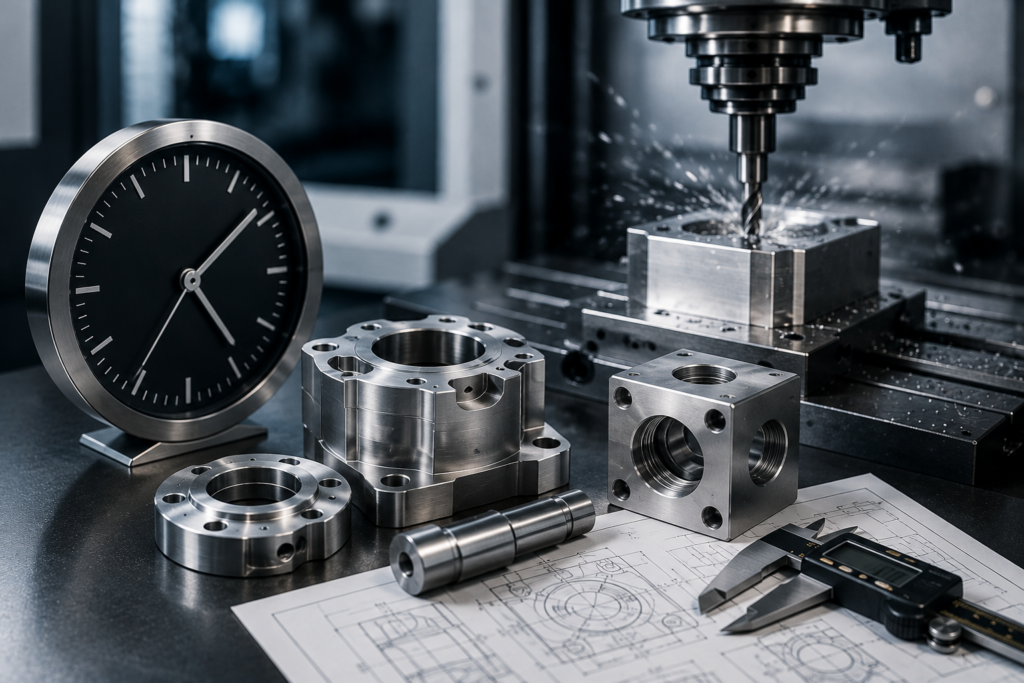
A Complete Guide for Manufacturers in Canada When planning a manufacturing project, one of the most common questions businesses ask is, “How long does CNC machining take?” The answer depends on several factors, including part complexity, material selection, production quantity, machining processes, and finishing requirements. At Polymach365, we specialize in precision CNC machining services in Canada, offering fast turnaround times without compromising quality. Whether you need a rapid prototype, custom-machined component, or high-volume production, understanding CNC machining lead times helps you plan production schedules more efficiently. In this guide, we’ll explain what affects CNC machining lead times, typical production timelines, and practical ways to speed up your manufacturing process. What Is CNC Machining Lead Time? CNC machining lead time refers to the total time required to manufacture a part from the moment your CAD file is submitted until the finished components are delivered. A typical CNC machining project includes: CAD File Review Design for Manufacturability (DFM) Analysis Material Procurement CNC Programming Machine Setup Precision Machining Quality Inspection Surface Finishing (if required) Packaging and Delivery Because each project is unique, lead times can vary depending on complexity and production requirements. Typical CNC Machining Lead Times The following estimates provide a general guideline for CNC machining projects in Canada. Project Type Typical Lead Time Prototype Parts 3–7 Business Days Simple CNC Components 5–10 Business Days Medium Complexity Parts 1–2 Weeks Complex Precision Parts 2–4 Weeks Low-Volume Production 2–5 Weeks High-Volume Manufacturing 4–8 Weeks These timelines may vary depending on material availability, machining complexity, and finishing requirements. Factors That Affect CNC Machining Lead Times Several important factors influence how quickly your parts can be manufactured. 1. Part Complexity Simple parts require fewer machining operations and shorter setup times. However, complex components often include: Deep pockets Thin walls Tight tolerances Complex contours Multi-sided machining Threaded features Consequently, intricate designs require additional machining time and increase overall lead times. 2. Material Availability Material selection significantly impacts delivery schedules. Commonly Available Materials Aluminum Mild Steel Stainless Steel Brass ABS Nylon Delrin Specialty Materials Titanium Inconel PEEK Tool Steel Standard materials are usually available immediately, while specialty materials may require additional procurement time. Therefore, choosing readily available materials can reduce overall production time. 3. CNC Machine Type The type of CNC equipment required also affects production schedules. CNC Milling Suitable for flat surfaces and complex geometries. CNC Turning Ideal for cylindrical components such as shafts and bushings. 5-Axis CNC Machining Although programming is more advanced, 5-axis machining often completes complex parts faster because multiple operations are performed in a single setup. As a result, overall lead times may actually decrease. 4. Production Quantity Quantity plays a major role in manufacturing schedules. Prototype Manufacturing Fast production with minimal setup. Low-Volume Production Requires additional machining time but maintains quick turnaround. Production Manufacturing Larger orders naturally require more machining hours, although automation improves efficiency. Consequently, production volume directly influences lead time. 5. Surface Finishing Many parts require secondary finishing operations after machining. Common finishing services include: Anodizing Powder Coating Sand Blasting Bead Blasting Polishing Passivation Painting Although these finishes improve appearance and durability, they also extend production schedules. 6. Quality Inspection Every precision component undergoes detailed dimensional inspection before shipment. Inspection may include: CMM Measurement Digital Caliper Verification Surface Finish Inspection Visual Quality Checks Functional Testing Therefore, quality assurance ensures accuracy while slightly increasing lead times. Typical CNC Machining Process Timeline At Polymach365, we follow an efficient manufacturing workflow. Step 1 – Upload Your CAD File Submit your 3D model securely. Time: Same Day Step 2 – Engineering Review Our engineers perform Design for Manufacturability (DFM) analysis and prepare your quotation. Time: 1–2 Business Days Step 3 – CNC Programming Machining programs are created and optimized for production. Time: 1 Business Day Step 4 – Precision Machining Advanced CNC milling, turning, or 5-axis machining begins. Time: 2–10 Business Days Step 5 – Quality Inspection Every component is inspected for dimensional accuracy and quality. Time: 1 Business Day Step 6 – Shipping Finished components are packaged and shipped across Canada. Time: 1–5 Business Days Because our workflow is streamlined, customers receive high-quality parts quickly and reliably. How to Reduce CNC Machining Lead Times Fortunately, there are several ways to speed up production. Optimize Your CAD Design Simple geometries reduce machining time. Avoid unnecessary pockets, sharp corners, and overly tight tolerances whenever possible. Use Standard Materials Common materials such as aluminum and stainless steel are readily available. Therefore, material sourcing delays are minimized. Order Multiple Parts Together Batch manufacturing improves efficiency and reduces setup time. Consequently, larger orders often achieve better delivery schedules. Request DFM Feedback Our engineering team reviews every design before production. As a result, we identify design improvements that reduce machining time and manufacturing costs. Plan Ahead Submitting production requirements early helps reserve machine capacity and avoid scheduling delays. Why Choose Polymach365 for Fast CNC Machining in Canada? Polymach365 combines advanced CNC technology, experienced engineers, and efficient production planning to deliver industry-leading turnaround times. Our Services Include ✔ CNC Milling Services ✔ CNC Turning Services ✔ 5-Axis CNC Machining ✔ Rapid Prototyping ✔ Low-Volume Production ✔ Production Manufacturing ✔ Injection Mold Components ✔ Engineering Support ✔ Quality Inspection ✔ Fast Delivery Across Canada Moreover, we maintain strict quality standards while meeting demanding production deadlines. Industries We Serve Our CNC machining services support manufacturers across numerous industries. Automotive Aerospace Medical Devices Industrial Equipment Robotics Electronics Energy Consumer Products Mold Manufacturing Therefore, businesses across Canada rely on Polymach365 for dependable CNC manufacturing solutions. Why Manufacturers Trust Polymach365 Our Advantages ✔ Fast CNC Machining Lead Times ✔ Precision Manufacturing ✔ Competitive Pricing ✔ Advanced CNC Equipment ✔ Skilled Engineering Team ✔ Quality Assurance ✔ Flexible Production Volumes ✔ Reliable Nationwide Delivery ✔ Excellent Customer Support As a result, manufacturers choose Polymach365 for projects that require speed, precision, and reliability. Final Thoughts The time required for CNC machining depends on your part design, material selection, production quantity, machining complexity, and finishing requirements. However, choosing an experienced manufacturing partner can significantly reduce lead