Best Materials for Mold Components in Injection Molding Applications
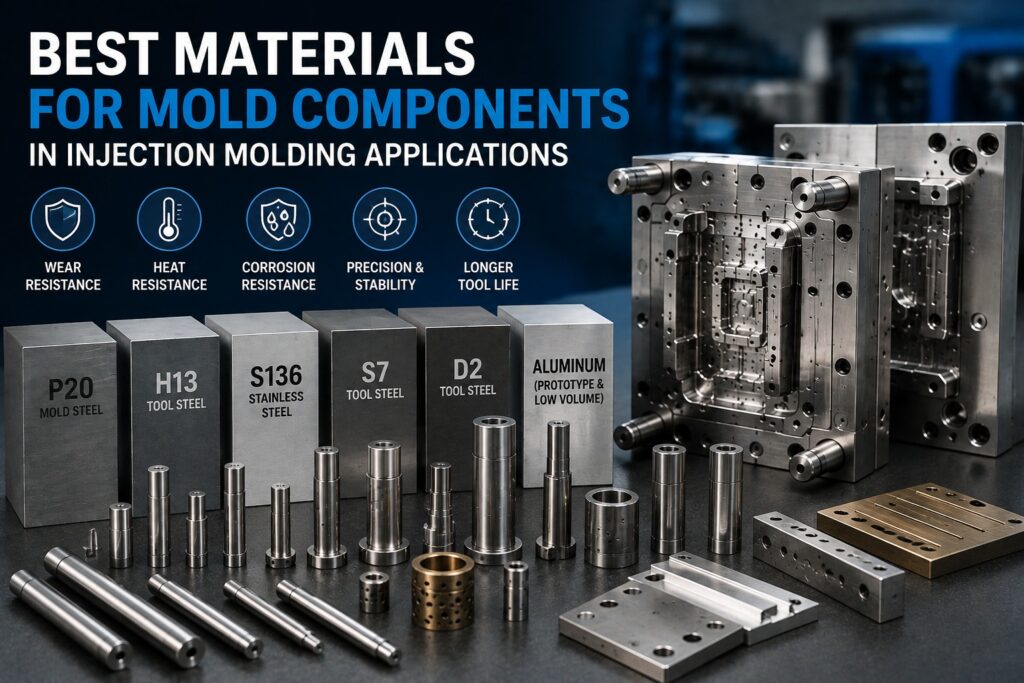
Choosing the Right Material for Precision, Durability, and Long Tool Life The performance of an injection mold depends on more than its design and machining accuracy. Material selection for mold components also plays a major role in tooling life, dimensional stability, wear resistance, surface finish, maintenance, and production consistency. Therefore, manufacturers should select mold-component materials according to the component’s function, plastic material, production volume, operating temperature, wear conditions, and required surface finish. For example, a mold designed for moderate production may use a pre-hardened P20-type mold steel, while high-volume or demanding applications may require harder or more wear- and corrosion-resistant materials. H13 is commonly used where repeated thermal cycling and heat resistance matter, while stainless mold steels are valuable where corrosion resistance and polishability are important. At Polymach365, we manufacture precision and custom mold components according to CAD files, engineering drawings, material specifications, tolerances, and application requirements. Our capabilities include CNC machining, EDM machining, precision grinding, and dimensional inspection. Why Material Selection Matters for Mold Components Injection molds repeatedly experience mechanical movement, pressure, friction, heat, cooling, and ejection forces. Consequently, the wrong material can lead to premature wear, dimensional changes, corrosion, surface damage, or frequent maintenance. The right material can help improve: Mold component durability Wear resistance Dimensional stability Surface finish Corrosion resistance Heat resistance Production consistency Mold service life Maintenance efficiency Moreover, different components experience different operating conditions. Therefore, manufacturers should not automatically use the same material for every mold component. What Should You Consider When Selecting Mold Materials? Before choosing a material, evaluate several important factors. 1. Production Volume Production volume strongly influences material selection. For lower-volume tooling, manufacturers may prioritize machinability and tooling cost. However, high-volume production requires components that can withstand repeated cycles and wear. Steel tooling is generally preferred for very high production requirements, while aluminum tooling can be attractive for lower-volume applications because it is easier and faster to machine. Therefore, expected production volume should be considered before selecting the mold-component material. 2. Wear Resistance Some mold components move continuously or experience repeated contact. For example: Guide pins Guide bushings Ejector components Slides Wear plates Core pins These components may require good wear resistance. Consequently, selecting a suitable tool steel or hardened material can help reduce premature component replacement. 3. Corrosion Resistance Certain plastics, additives, moisture, and production environments can increase corrosion risks. Therefore, corrosion-resistant stainless mold steels can be valuable for applications where surface condition and long-term tooling performance are important. Uddeholm identifies stainless mold steels such as Stavax ESR / Mirrax ESR as corrosion- and wear-resistant grades with excellent polishability for plastic molding applications. 4. Heat Resistance Injection molding involves repeated heating and cooling. Therefore, components exposed to significant thermal cycling require suitable thermal stability. H13-type hot-work tool steel is commonly associated with injection molding and die-casting applications because it maintains useful strength during repeated heating and cooling. As a result, H13 can be an excellent choice for demanding tooling applications where heat resistance is a priority. Best Materials for Injection Mold Components There is no single material that is best for every mold component. Instead, the most appropriate choice depends on the component and application. The following materials are commonly considered for injection mold tooling and components. 1. P20 Mold Steel P20 is one of the most widely recognized pre-hardened mold-steel grades for plastic injection molding. It provides a useful combination of: Machinability Toughness Strength Polishability Moderate wear resistance Cost efficiency Therefore, P20-type steels are often suitable for mold bases, mold plates, cavities, cores, and other tooling applications where moderate production requirements apply. Uddeholm’s Impax Supreme is a modified P20-type pre-hardened mold steel designed for injection molds, blow molds, and plastic extrusion dies. It is supplied in a pre-hardened condition and offers good machinability and polishing properties. Best suited for: General injection molds Mold bases Cavity blocks Core blocks Moderate production General-purpose tooling Main advantage: Good balance between machinability, toughness, performance, and cost. 2. H13 Tool Steel H13 is a hot-work tool steel frequently used for demanding tooling applications. It offers good resistance to thermal fatigue and maintains strength during repeated heating and cooling. Therefore, H13 can be suitable for: High-cycle tooling Hot runner components High-temperature applications Core components Cavity components Die-casting tooling High-wear tooling Protolabs identifies H13 as a hot-work steel suitable for injection molds and high-volume applications, while Uddeholm describes its Orvar Supreme, an improved H13-type grade, as a versatile mold and die steel with good wear resistance and polishability. Main advantage: Excellent thermal performance and good durability for demanding tooling. 3. S136 / 420-Type Stainless Mold Steel Stainless mold steels are particularly valuable when corrosion resistance and surface finish are important. Therefore, stainless grades can be considered for: Medical molds Optical components Cosmetic tooling Corrosive plastics High-polish applications Components exposed to moisture Uddeholm lists Stavax ESR and Mirrax ESR, both modified 420-type stainless mold steels, as corrosion- and wear-resistant materials with excellent polishability. Main advantage: Excellent corrosion resistance and polishability. 4. S7 Tool Steel S7 is a shock-resistant tool steel. Therefore, it can be considered for mold components that experience impact or mechanical shock. Potential applications include: Slides Inserts Wear components Heavy-duty tooling components Components exposed to impact Protolabs describes S7 as a shock-resistant steel designed to withstand repeated shock loads. Main advantage: High toughness for components exposed to impact or shock. 5. D2 Tool Steel D2 is a high-chromium tool steel known for strong wear resistance. Therefore, it can be useful where abrasion is a significant concern. Potential applications include: Wear components High-wear inserts Cutting/forming tooling Specialized mold components However, material selection should consider the complete tooling application rather than choosing D2 solely because of its high wear resistance. Main advantage: Strong wear resistance for demanding applications. 6. Aluminum for Prototype and Low-Volume Tooling Aluminum is not a direct replacement for hardened mold steel in every application. However, it can be an excellent tooling material for prototypes, development molds, and lower-volume production. Aluminum provides: Excellent machinability Faster machining Lower tooling weight Faster tooling development Lower initial
How Core Pins and Cavity Inserts Affect Mold Performance
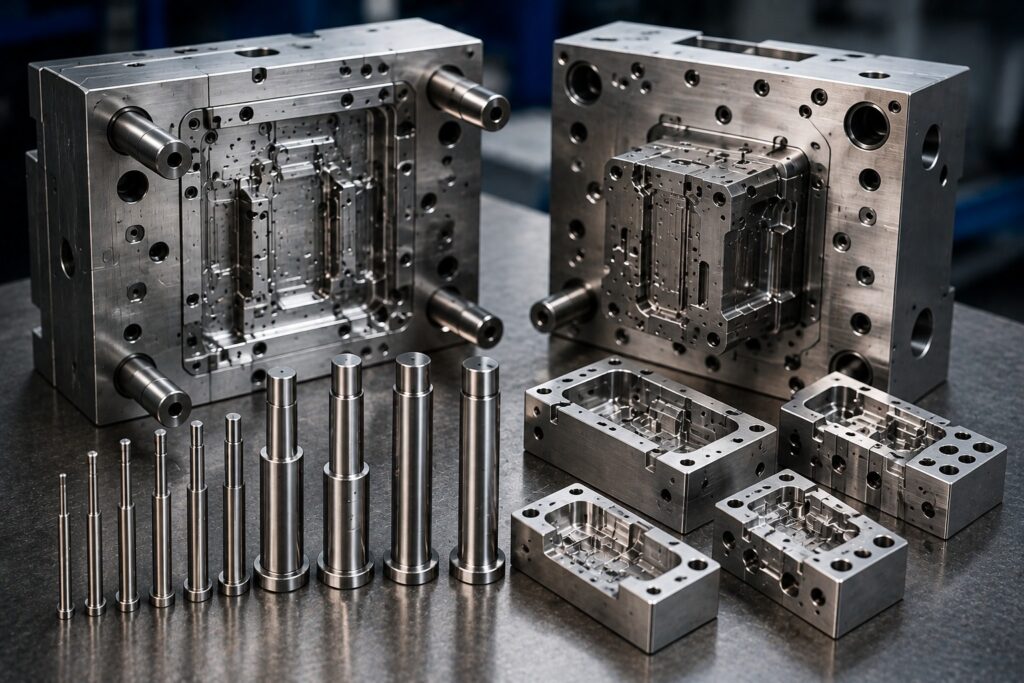
Understanding the Role of Precision Core Pins and Cavity Inserts in Injection Molding Injection mold performance depends on the accuracy, durability, and condition of its individual components. Among these components, core pins and cavity inserts play a particularly important role because they directly influence the geometry, dimensions, surface quality, and repeatability of molded parts. A core pin forms internal features such as holes, openings, and channels, while a cavity insert forms important external surfaces and details of the molded component. Therefore, even small dimensional errors, surface damage, or excessive wear can affect the final product. At Polymach365, we manufacture precision core pins, core inserts, cavity inserts, and custom mold components for injection molding and tooling applications. Our manufacturing capabilities include CNC machining, EDM machining, precision grinding, and dimensional inspection. Consequently, manufacturers can obtain components designed around their specific tooling requirements. Whether you are developing a new injection mold, maintaining production tooling, or replacing worn components, understanding how core pins and cavity inserts affect mold performance can help you make better tooling decisions. What Are Core Pins? Core pins are precision components used inside injection molds to create internal features in molded parts. Depending on the mold design, core pins can create: Holes Internal channels Openings Recesses Cylindrical features Internal profiles Specialized geometries Therefore, the dimensional accuracy of a core pin directly affects the corresponding feature in the finished plastic part. For example, if a core pin requires a specific diameter, even a small dimensional variation can affect the final hole size. As a result, precision core pins are essential for applications that require consistent internal features. What Are Cavity Inserts? Cavity inserts are removable tooling components that create external surfaces and features of molded parts. Instead of manufacturing the entire cavity as one piece, manufacturers can use inserts for specific areas of the mold. Cavity inserts can provide: Complex part geometry Replaceable tooling sections Easier mold maintenance Faster repairs Product variations Specialized surface details Therefore, cavity inserts provide both precision and flexibility within injection mold designs. When a specific cavity area becomes damaged or requires modification, manufacturers can often replace or modify the insert instead of rebuilding the complete mold. Core Pins vs Cavity Inserts Although both components are important, they perform different functions. Core Pins Cavity Inserts Create internal features Create external features Form holes and openings Form surfaces and profiles Commonly cylindrical or specialized Often shaped to match part geometry Directly influence internal dimensions Directly influence external dimensions Require high dimensional accuracy Require accurate geometry and surface finish Can be replaced when worn Can be replaced or modified for tooling changes Therefore, manufacturers should consider both components when evaluating injection mold performance. How Core Pins Affect Mold Performance 1. Core Pins Influence Internal Part Accuracy Core pins directly determine the size and geometry of internal features. Therefore, manufacturers need to control critical dimensions such as: Diameter Length Straightness Concentricity Surface finish Tip geometry A properly manufactured core pin helps produce repeatable internal features throughout the molding process. Consequently, precision core pins can contribute to better dimensional consistency. 2. Core Pin Wear Can Affect Part Quality Core pins experience repeated exposure to heat, pressure, plastic flow, and ejection forces. Over time, these conditions can cause wear. As a result, worn core pins may affect: Hole dimensions Internal geometry Surface finish Part consistency Mold performance Therefore, manufacturers should inspect core pins regularly, especially when molds operate at high production volumes. If wear exceeds acceptable limits, replacing the core pin can help restore the required tooling performance. 3. Core Pin Surface Finish Matters The surface condition of a core pin can influence the surface of the molded feature. Therefore, manufacturers should select an appropriate surface finish according to the application. A suitable surface can help support: Easier part release Consistent internal surfaces Reduced friction Better tooling performance Consequently, precision grinding and finishing can be important steps when manufacturing critical core pins. 4. Core Pin Material Influences Service Life Core pins repeatedly experience mechanical and thermal stress. Therefore, material selection should match the application. Depending on the tooling requirements, manufacturers may consider materials based on: Hardness Wear resistance Toughness Thermal stability Corrosion resistance Machinability As a result, choosing an appropriate material can help improve core-pin durability and reduce premature replacement. How Cavity Inserts Affect Mold Performance 5. Cavity Inserts Determine External Part Geometry Cavity inserts create important external surfaces and features. Therefore, their dimensional accuracy directly affects the finished molded component. A precision cavity insert can help maintain: Part dimensions Surface details Profiles Cosmetic features Repeatability Consequently, cavity insert quality plays an important role in final product quality. 6. Cavity Inserts Improve Mold Maintenance One major advantage of cavity inserts is replaceability. Instead of manufacturing the entire mold cavity as a single structure, manufacturers can isolate critical or wear-prone areas. Therefore, when an insert becomes damaged, engineers may replace only the affected component. This can provide: Faster repairs Reduced maintenance complexity Lower replacement requirements Easier tooling modifications Improved mold flexibility As a result, cavity inserts can make long-term tooling maintenance more manageable. 7. Cavity Inserts Support Product Modifications Product designs sometimes change after tooling development. For example, manufacturers may need to modify: Logos Ribs Bosses Surface features Dimensions Functional details If the affected area uses a replaceable cavity insert, engineers may be able to modify the insert rather than rebuilding the entire mold. Therefore, cavity inserts can provide valuable flexibility during product development and production 8. Cavity Insert Wear Can Affect Surface Quality Cavity surfaces directly contact the molten plastic. Therefore, surface damage or excessive wear can influence the appearance and dimensions of molded parts. Potential issues can include: Scratches Surface marks Dimensional variation Cosmetic defects Flash around damaged areas Consequently, regular inspection of cavity inserts becomes especially important for high-volume production. Core Pins and Cavity Inserts Work Together Core pins and cavity inserts do not operate independently. Instead, they work together to create the complete geometry of the molded component. For example: Cavity Insert → Forms External Geometry Core Pin
Why Precision Mold Components Are Critical for High-Volume Production
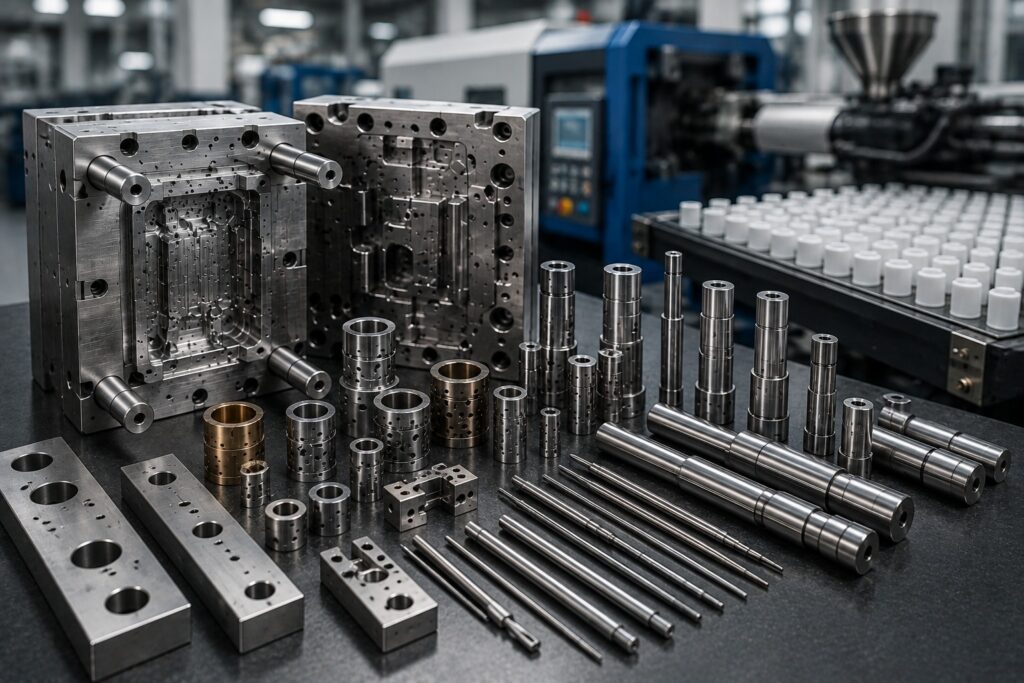
How High-Quality Mold Components Improve Accuracy, Productivity and Tool Life High-volume injection molding demands consistency. When a mold produces thousands or millions of plastic parts, even a small component problem can gradually affect part quality, production speed, maintenance requirements, and tooling life. Therefore, precision mold components play a critical role in high-volume injection molding. Components such as core pins, cavity inserts, ejector pins, guide pins, bushings, wear plates, and custom mold inserts must maintain accurate dimensions and reliable performance throughout repeated production cycles. At Polymach365, we manufacture precision and custom mold components for injection molding, tooling, mold repair, replacement applications, and specialized manufacturing requirements. Our capabilities include CNC machining, EDM machining, precision grinding, and dimensional inspection, allowing components to be manufactured according to CAD files, engineering drawings, tolerances, materials, and application requirements. As a result, manufacturers can improve mold reliability while reducing unnecessary downtime and maintenance. What Are Precision Mold Components? Precision mold components are the individual parts that work together to form, align, operate, and release plastic parts during injection molding. Common components include: Core Pins Core Inserts Cavity Inserts Ejector Pins Ejector Sleeves Guide Pins Guide Bushings Wear Plates Mold Inserts Support Components Precision Spacers Custom Tooling Components Although these components may be smaller than the complete mold, they have a major effect on tooling performance. For example, an inaccurate guide pin can affect mold alignment, while a worn ejector pin can create ejection problems. Similarly, a damaged cavity insert can directly affect the dimensions and appearance of the finished part. Therefore, precision should remain a priority when selecting components for high-volume tooling. Why Precision Matters in High-Volume Injection Molding High-volume molds operate continuously for extended periods. Consequently, mold components experience repeated: Mechanical movement Friction Heat cycles Injection pressure Ejection cycles Mold opening and closing Material exposure Over time, small imperfections or poor component fits can become larger production problems. Precision mold components help manufacturers maintain: Consistent part dimensions Reliable mold alignment Repeatable ejection Stable production cycles Better surface quality Reduced component wear Lower maintenance requirements Longer tooling life Therefore, precision components are not simply replacement parts. Instead, they form an important part of a high-volume manufacturing strategy. 1. Precision Components Improve Part Consistency High-volume production requires every molded part to meet the same specifications. Therefore, the mold must reproduce the same geometry during every production cycle. Precision cavity inserts and core components help maintain accurate part features throughout production. For example, a precision core pin can consistently create the required hole diameter, while a precision cavity insert maintains the external geometry of the component. As a result, manufacturers can achieve greater dimensional repeatability across large production runs. 2. Precision Core Pins Protect Critical Part Features Core pins create holes, channels, openings, and other internal features in molded parts. During high-volume production, these components repeatedly experience heat, pressure, and mechanical stress. Therefore, core pins must maintain their dimensions and surface condition throughout their service life. Precision core pins can provide: Accurate diameters Consistent lengths Better surface finishes Improved wear resistance Repeatable internal features Application-specific geometries Consequently, properly manufactured core pins help maintain part accuracy during extended production runs. 3. Precision Cavity Inserts Improve Product Quality Cavity inserts form important external surfaces and features of molded components. Therefore, their accuracy directly affects the final product. Precision cavity inserts can help manufacturers maintain: Accurate part dimensions Consistent surface details Repeatable product geometry Better cosmetic quality Easier mold maintenance Furthermore, interchangeable inserts can allow manufacturers to replace or modify individual tooling areas instead of rebuilding an entire mold. As a result, cavity inserts can provide both production accuracy and maintenance flexibility. 4. Precision Ejector Pins Improve Production Reliability Every molding cycle requires the finished part to leave the cavity. Therefore, ejector pins and sleeves must operate smoothly and consistently. Worn or poorly manufactured ejector components can contribute to: Part sticking Uneven ejection Ejector marks Part deformation Increased downtime Premature tooling wear In contrast, precision ejector components provide controlled and repeatable part removal. Consequently, manufacturers can maintain smoother production cycles while reducing unnecessary interruptions. 5. Precision Guide Pins Maintain Mold Alignment Guide pins and guide bushings help maintain alignment between the mold halves. This alignment becomes especially important during high-volume production because the mold opens and closes repeatedly. Therefore, accurate guide components can help reduce: Misalignment Uneven wear Friction Mold damage Parting-line problems Component stress Moreover, properly aligned mold sections help protect other precision components. As a result, guide pins and bushings contribute to overall tooling reliability. 6. Precision Components Reduce Production Downtime High-volume manufacturing depends on continuous production. Therefore, unexpected mold failures can become extremely expensive. A damaged ejector pin, worn guide bushing, or failed cavity insert can interrupt an entire production run. Precision components can reduce the risk of premature component failure when manufacturers combine them with appropriate maintenance and inspection. Furthermore, custom replacement components allow manufacturers to restore worn tooling without necessarily replacing the complete mold. Consequently, precision mold components can support greater production uptime. 7. Precision Mold Components Extend Tooling Life Injection molds represent a significant investment. Therefore, manufacturers want their tooling to remain productive for as long as possible. Precision components can help reduce unnecessary stress and wear throughout the mold. For example: Accurate Guide Components → Better Alignment Precision Ejectors → Smoother Ejection Durable Core Pins → Longer Feature Accuracy Precision Cavity Inserts → Consistent Part Geometry Wear Plates → Protection for Critical Surfaces As a result, properly selected and manufactured components can contribute to longer mold service life. 8. Wear Plates Protect High-Contact Areas High-volume molds experience repeated movement between tooling surfaces. Therefore, wear-prone areas require appropriate protection. Wear plates provide replaceable surfaces that can absorb repeated contact and movement. They can be used in: Sliding mold assemblies Moving components High-cycle tooling Contact surfaces Specialized mechanisms Consequently, replacing a worn wear plate can help protect larger and more expensive mold structures. 9. Precision Components Improve Maintenance Efficiency Maintenance becomes increasingly important as production volumes increase. Instead of waiting for components to fail, manufacturers can
Custom Mold Components vs Standard Mold Components: Which Should You Choose?
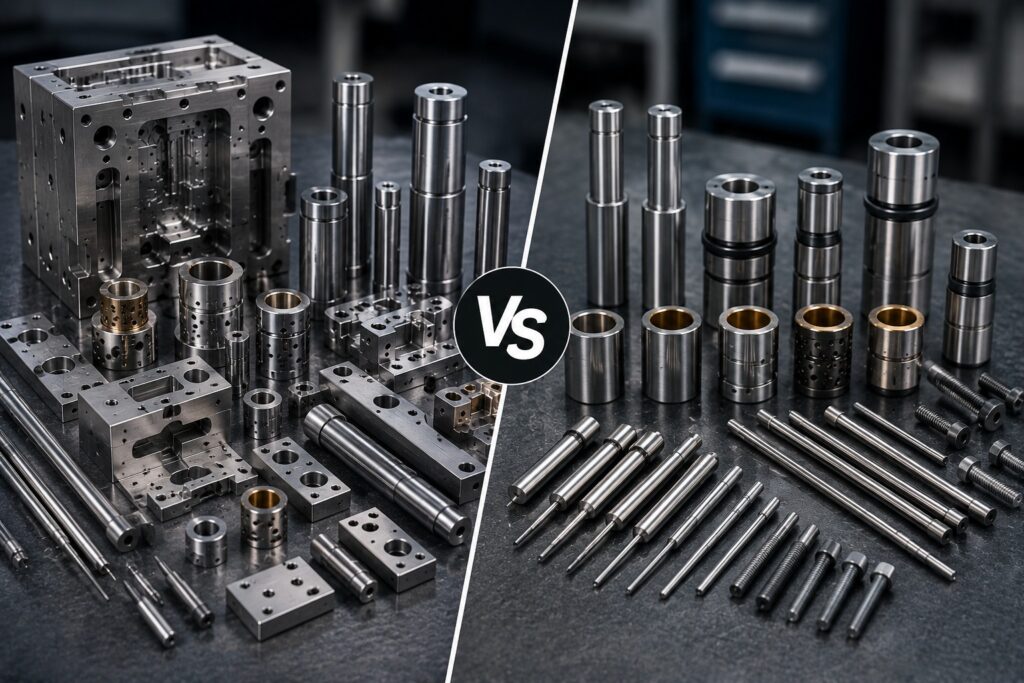
A Practical Guide to Selecting the Right Mold Components for Injection Tooling Injection molds rely on accurately manufactured components to maintain alignment, part quality, repeatability, and reliable production. Therefore, selecting between custom mold components and standard mold components is an important decision for mold manufacturers, injection molders, OEMs, and tooling engineers. Standard components can provide a cost-effective solution for common tooling requirements. However, custom mold components offer greater flexibility when a mold requires unique dimensions, complex geometries, tight tolerances, or replacement parts that are no longer available. At Polymach365, we manufacture precision mold components for injection molds, tooling systems, mold repair, prototype tooling, and specialized manufacturing applications. Our capabilities include CNC machining, EDM machining, precision grinding, and dimensional inspection, allowing us to manufacture components according to CAD files, engineering drawings, material specifications, and tolerance requirements. Therefore, the right choice depends on your mold design, production volume, component requirements, budget, and expected tooling life. What Are Standard Mold Components? Standard mold components are manufactured according to commonly used dimensions and specifications. These components are widely used in conventional injection mold designs and are available in standardized sizes. Common examples include: Standard guide pins Guide bushings Ejector pins Ejector sleeves Standard core pins Standard screws Locating components Standard mold plates Standard wear components Because manufacturers produce these components in commonly used sizes, they can often be sourced faster than fully custom parts. Consequently, standard components are particularly useful when your mold design matches established industry dimensions. What Are Custom Mold Components? Custom mold components are manufactured specifically for an individual tooling application. Instead of adapting the mold to an existing component size, engineers can manufacture the component according to the actual mold design. Custom components can include: Custom core pins Custom core inserts Cavity inserts Special ejector pins Custom ejector sleeves Guide components Wear plates Precision spacers Mold inserts Specialty tooling components Replacement mold components Therefore, custom manufacturing provides greater control over dimensions, geometry, materials, tolerances, and surface requirements. Polymach365 provides custom mold-component manufacturing based on customer CAD files and engineering specifications. Custom Mold Components vs Standard Mold Components The main difference is flexibility. Standard Mold Components Custom Mold Components Predefined dimensions Project-specific dimensions Faster sourcing Manufactured to requirement Suitable for common designs Suitable for unique designs Generally lower initial cost Cost depends on complexity Limited geometry options High geometry flexibility Easy replacement when available Ideal for specialized replacements Best for conventional tooling Best for complex or customized tooling Therefore, neither option is automatically better. Instead, the correct choice depends on the specific requirements of your mold. When Should You Choose Standard Mold Components? Standard components are often the better option when your tooling requirements are conventional. 1. Your Mold Uses Common Dimensions If your mold design already accommodates standard component dimensions, there may be little reason to manufacture a custom alternative. For example, a conventional ejector pin may be available in the required diameter and length. Therefore, a standard component can provide a practical and economical solution. 2. You Need Components Quickly Standard components are typically easier to source because they are manufactured according to established specifications. Consequently, they can be useful when a production mold requires a common replacement part quickly. 3. The Geometry Is Simple Standard components work well when the tooling does not require unusual profiles, special holes, unique lengths, or application-specific features. As a result, manufacturers can avoid unnecessary custom manufacturing costs. 4. Cost Is a Major Consideration Standard components can reduce manufacturing requirements because the component does not need to be developed from scratch. Therefore, they can be an attractive option for straightforward tooling applications. When Should You Choose Custom Mold Components? Custom components become more valuable when standard options cannot satisfy your engineering requirements. 1. Your Mold Requires Unique Dimensions Every injection mold has different geometry. Therefore, a standard component may not always provide the required length, diameter, profile, or mounting configuration. Custom manufacturing allows the component to match the actual mold design. 2. You Need Tight Tolerances Some tooling applications require highly controlled dimensions. Therefore, custom precision manufacturing can be used when standard components do not provide the required tolerance. This is particularly important for: Critical mating surfaces Precision inserts Core pins Cavity components Alignment components Specialized tooling Consequently, custom components can help maintain accurate mold assembly and performance. Custom Core Pins vs Standard Core Pins Core pins create internal holes and features within molded parts. Standard core pins are suitable when the required dimensions match commonly available sizes. However, custom core pins become useful when the mold requires: Special diameters Non-standard lengths Stepped profiles Special tip geometries Unique surface finishes Application-specific dimensions Therefore, custom core pins provide greater flexibility for specialized mold designs. Polymach365 manufactures precision core pins and core inserts for custom tooling and replacement applications. Custom Cavity Inserts vs Standard Inserts Cavity inserts form important external features of injection-molded components. Standard inserts may work well for conventional tooling designs. However, custom cavity inserts provide more flexibility when the mold contains unique geometry or requires specific engineering modifications. Custom cavity inserts can help manufacturers: Modify individual mold areas Replace damaged sections Support product variations Simplify mold maintenance Improve tooling flexibility Reduce the need to rebuild complete molds As a result, custom inserts can be particularly valuable for complex and repair-oriented tooling applications. Custom Ejector Components vs Standard Ejector Components Ejection systems remove finished parts from the mold after cooling. Standard ejector pins and sleeves can satisfy many conventional applications. However, custom ejector components may be necessary when the mold contains: Special ejection geometry Unusual dimensions Restricted installation areas Complex part features Specialized ejection requirements Therefore, selecting the correct ejector component helps support smooth and repeatable part removal. Custom Guide Pins and Bushings Guide pins and bushings maintain alignment between mold sections. Standard guide components can provide an economical solution when the mold uses conventional dimensions. However, custom guide components may be necessary when the tooling requires special dimensions, lengths, mounting arrangements, or operating conditions. Consequently, custom manufacturing allows alignment components to
How to Extend the Life of Your Injection Mold Components
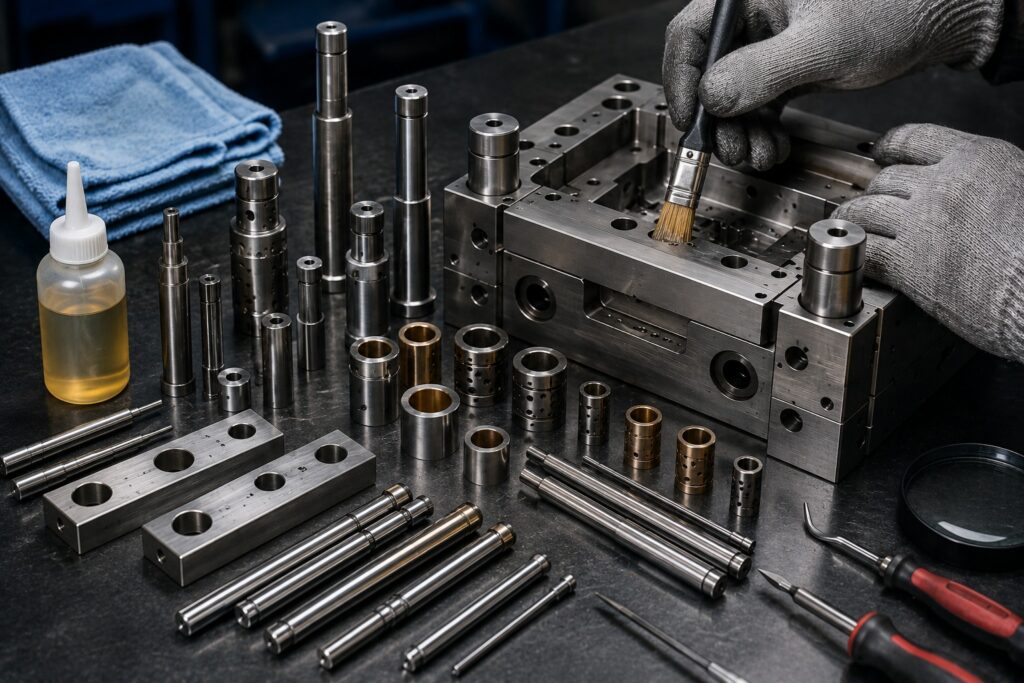
Practical Maintenance Strategies for Longer-Lasting Mold Performance Injection molds operate under repeated pressure, heat, friction, and mechanical movement. Therefore, even high-quality mold components can eventually experience wear if manufacturers do not maintain them properly. Core pins, cavity inserts, ejector pins, guide pins, bushings, wear plates, and other precision mold components all contribute to mold performance. Polymach365 manufactures these components using CNC machining, EDM, precision grinding, and inspection processes for demanding tooling applications. However, manufacturing precision components is only one part of extending mold life. Proper maintenance, lubrication, cleaning, inspection, cooling, and timely replacement are equally important. In this guide, we explain how to extend the life of injection mold components, reduce unexpected downtime, maintain part quality, and get more value from your tooling investment. Why Injection Mold Component Life Matters An injection mold contains many moving and precision-fitted components. During production, these components repeatedly operate under demanding conditions. Over time, poor maintenance can lead to: Component wear Mold misalignment Ejection problems Surface damage Dimensional variation Flash Part defects Increased downtime Higher repair costs Therefore, maintaining mold components should be part of your regular production strategy. High-quality mold components can improve dimensional accuracy, reduce maintenance requirements, and support longer tooling life. As a result, proactive maintenance can often cost significantly less than emergency mold repairs or unexpected production interruptions. 1. Perform Regular Mold Inspections Regular inspection is one of the simplest ways to extend the life of injection mold components. Instead of waiting until a component fails, inspect critical areas according to your production schedule. During inspection, check: Core pins Cavity inserts Ejector pins Ejector sleeves Guide pins Guide bushings Wear plates Slides Lifters Mold surfaces Cooling channels Venting areas Look for signs such as scratches, scoring, corrosion, deformation, unusual wear, or changes in component movement. Therefore, early inspection allows manufacturers to identify problems before they affect production. 2. Keep Mold Components Clean Contamination can accelerate wear and affect mold performance. For example, plastic residue, dust, moisture, oil buildup, and corrosion can interfere with moving components. Therefore, clean mold components according to the appropriate maintenance procedure after production runs or during scheduled maintenance. Pay particular attention to: Parting surfaces Ejector systems Guide components Slides Inserts Vents Cooling areas Consequently, regular cleaning helps maintain smooth movement and reduces the risk of contamination-related problems. 3. Use the Correct Lubrication Proper lubrication reduces friction between moving components. Guide pins, bushings, slides, ejector systems, and other moving components may require suitable lubrication depending on the mold design and operating conditions. However, more lubricant does not always mean better performance. Excessive lubrication can attract dust and contaminants, while insufficient lubrication can increase friction and wear. Therefore, use the correct lubricant and follow the tooling manufacturer’s recommended maintenance procedure. As a result, components can move more smoothly while minimizing unnecessary wear. 4. Monitor Guide Pins and Bushings Guide pins and bushings maintain alignment between the mold halves. Therefore, their condition directly affects mold accuracy and component life. Check for: Scoring Uneven wear Excessive clearance Lubrication problems Misalignment Surface damage If guide components become excessively worn, continuing production can place additional stress on other mold components. Polymach365 identifies accurate guide pins and bushings as important for mold alignment, reduced component wear, and extended tooling life. Consequently, replacing worn guide components at the appropriate time can help protect the rest of the mold. 5. Maintain Ejector Pins and Sleeves Ejector components operate repeatedly during every molding cycle. Therefore, ejector pins and sleeves can experience significant mechanical wear over long production runs. Inspect them for: Bending Scoring Wear Galling Poor movement Excessive clearance Damage to ejector holes Moreover, inspect the ejector system whenever you notice incomplete ejection, sticking parts, unusual marks, or changes in cycle performance. As a result, manufacturers can prevent small ejector problems from developing into larger tooling issues. Polymach365 manufactures standard and custom ejector pins, sleeves, stripper components, and specialty ejection systems for precision tooling applications. 6. Protect Core Pins and Cavity Inserts Core pins and cavity inserts directly create important features of molded parts. Therefore, damage or wear on these components can quickly affect product quality. Inspect core pins and inserts for: Scratches Chipping Corrosion Dimensional wear Surface damage Cracks Unusual marks Furthermore, clean these components carefully and avoid using inappropriate tools that could damage precision surfaces. If a component becomes worn beyond acceptable limits, replace or refurbish it according to the tooling requirements. Consequently, maintaining these components helps preserve part accuracy and surface quality. 7. Use Wear Plates to Protect Critical Surfaces Wear plates provide replaceable surfaces in areas exposed to repeated movement and friction. Therefore, they can protect more expensive mold structures from unnecessary wear. Wear plates are particularly useful for: Sliding assemblies Moving mold sections High-cycle tooling Contact surfaces Specialized tooling mechanisms Instead of allowing a critical mold surface to wear continuously, a properly designed wear plate can provide a controlled and replaceable wear surface. As a result, manufacturers can simplify maintenance and potentially extend the useful life of larger tooling components. 8. Maintain Proper Cooling Systems Cooling has a major influence on injection molding cycle performance and part consistency. Therefore, manufacturers should regularly monitor mold cooling systems. Check for: Blocked cooling channels Restricted water flow Scale buildup Leaks Corrosion Uneven cooling Poor cooling can increase cycle times and create dimensional or warpage problems. Polymach365’s mold-component information highlights cooling channels, baffles, bubblers, and thermal pins as components that help regulate mold temperature and improve cycle efficiency. Consequently, maintaining the cooling system can support both component longevity and production efficiency. 9. Keep Mold Vents Clear Proper venting allows trapped air and gases to escape during injection. Therefore, blocked or damaged vents can contribute to molding problems such as burn marks, short shots, voids, and incomplete filling. Regularly inspect venting areas and clean them according to your tooling maintenance procedure. As a result, proper vent maintenance can help maintain consistent filling and reduce unnecessary stress on the molding process. 10. Control Mold Operating Conditions Mold components operate within specific mechanical and thermal conditions. Therefore,
How Precision Mold Components Improve Injection Molding Performance
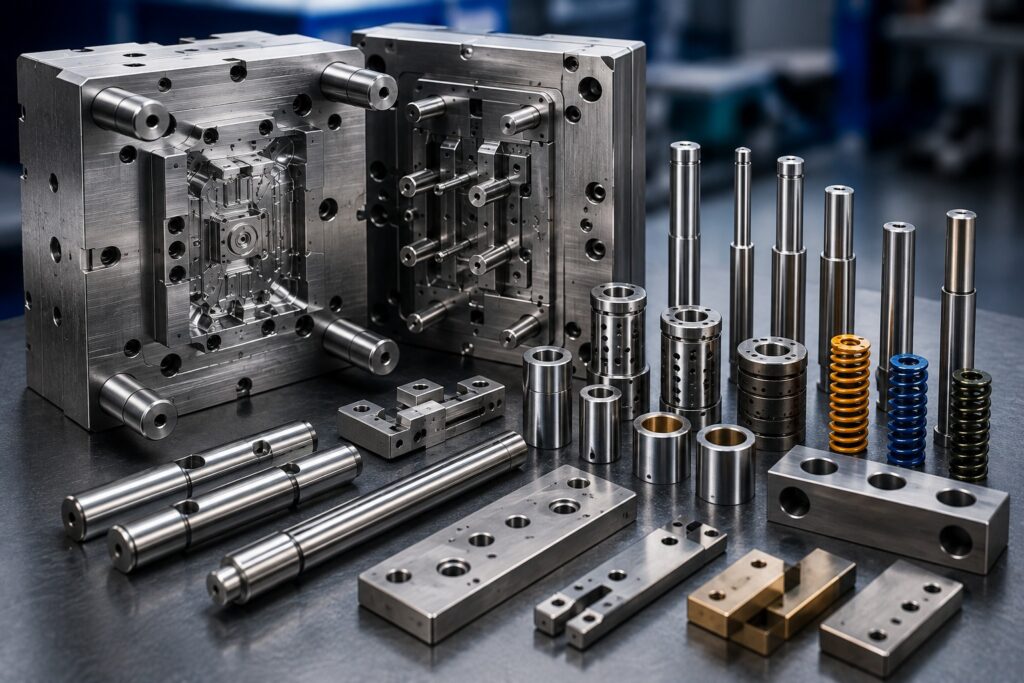
Precision Components for Better Accuracy, Faster Cycles and Longer Mold Life Injection molding depends on much more than the injection machine and plastic material. In fact, the performance of an injection mold depends heavily on the accuracy, durability, and reliability of its individual components. Therefore, precision mold components play a critical role in achieving consistent part quality, reliable mold operation, efficient production cycles, and longer tooling life. At Polymach365, we manufacture precision mold components including core pins, cavity inserts, ejector pins, ejector sleeves, guide pins, bushings, wear plates, and custom tooling components. Our manufacturing capabilities combine CNC machining, EDM, precision grinding, and dimensional inspection to produce components according to specific engineering requirements. Whether you are building a new injection mold, repairing existing tooling, replacing worn components, or improving production performance, choosing the right precision mold components can make a significant difference. What Are Precision Mold Components? Precision mold components are the individual parts that work together inside an injection mold to form, align, cool, and eject molded products. These components include: Core pins Core inserts Cavity inserts Ejector pins Ejector sleeves Guide pins Guide bushings Wear plates Mold inserts Support components Custom tooling parts Each component has a specific function. Therefore, even a relatively small dimensional error can affect the operation of the complete mold. For example, inaccurate guide components can affect mold alignment, while worn ejector pins can cause inconsistent part release. Consequently, precision manufacturing is essential for maintaining reliable injection molding performance. Polymach365’s existing mold-component content similarly identifies alignment, ejection, part accuracy, cycle time, and tooling life as areas directly influenced by component quality. Why Precision Matters in Injection Molding Injection molds repeatedly operate under pressure, heat, friction, and mechanical movement. Therefore, mold components must maintain their dimensions and functional surfaces throughout repeated production cycles. High-quality precision components can help manufacturers achieve: Better dimensional accuracy Consistent molded parts Reliable mold alignment Smooth ejection Reduced component wear Faster maintenance Longer tooling life Lower production downtime As a result, precision mold components can improve both product quality and overall manufacturing efficiency. 1. Precision Components Improve Mold Alignment Accurate mold alignment is fundamental to consistent injection molding. Guide pins and guide bushings help maintain the correct relationship between the mold halves during opening and closing. Therefore, properly manufactured guide components can help prevent: Misalignment Uneven component wear Parting-line problems Mold damage Inconsistent part dimensions Moreover, accurate alignment helps protect other mold components from unnecessary stress. As a result, precision guide pins and bushings contribute to smoother mold operation and longer tooling life. Polymach365 specifically manufactures guide pins and bushings designed for accurate alignment, reduced wear, and consistent molding performance. 2. Precision Core Pins Improve Part Accuracy Core pins create holes, channels, and other internal features within molded components. Therefore, their diameter, length, surface finish, straightness, and dimensional accuracy directly influence the finished plastic part. For example, if a core pin does not maintain the required dimensions, the resulting hole or internal feature may fall outside the required specification. Precision core pins can help provide: Accurate internal features Consistent hole dimensions Better repeatability Reduced secondary machining Improved mold performance Consequently, manufacturers should select core pins according to the actual application rather than treating them as standard interchangeable parts. 3. Precision Cavity Inserts Improve Mold Flexibility Cavity inserts create the external geometry and surface details of molded components. Because manufacturers can replace individual inserts, they can often repair or modify specific areas without rebuilding the complete mold. Therefore, precision cavity inserts can provide several advantages: Better dimensional accuracy Easier mold maintenance Faster repairs Flexible tooling modifications Reduced replacement costs Improved part consistency Furthermore, interchangeable cavity inserts can make it easier to support product variations. As a result, precision inserts can improve both tooling flexibility and long-term production efficiency. Polymach365 manufactures cavity inserts specifically for part accuracy, tooling flexibility, and maintenance efficiency. 4. Precision Ejector Pins Reduce Part Release Problems After plastic cools inside the mold, the finished component must be removed. Ejector pins push the molded part away from the cavity. Therefore, accurate ejector pins are essential for reliable and repeatable part ejection. Poorly manufactured or worn ejector components can contribute to: Uneven ejection Part deformation Surface marks Component sticking Increased downtime Premature mold wear In contrast, properly manufactured ejector pins and sleeves can support smooth and repeatable ejection. Consequently, precision ejection components help maintain production efficiency while reducing unnecessary maintenance. 5. Wear Plates Extend Mold Component Life Molds experience repeated movement and friction during production. Therefore, certain contact surfaces require protection against continuous wear. Wear plates provide replaceable surfaces that can protect critical tooling areas. They are particularly useful for: Sliding mold components Moving assemblies High-cycle tooling Wear-prone contact surfaces As a result, precision wear plates can reduce damage to more expensive mold components. Moreover, replacing a worn wear plate can be considerably more practical than repairing or replacing a larger tooling assembly. 6. Precision Components Help Maintain Consistent Cycle Performance Every injection molding cycle requires the mold to open, close, fill, cool, and eject the finished component. Therefore, each mechanical component must operate consistently. For example: Accurate Guide Components → Reliable Alignment Accurate Ejection Components → Consistent Part Release Precision Inserts → Consistent Part Geometry Effective Cooling Components → Stable Mold Temperature Consequently, precision components contribute to a more predictable molding cycle. Polymach365’s mold-component information identifies cooling and venting components as important elements for cycle efficiency and molding quality as well. 7. Precision Components Reduce Mold Maintenance Mold maintenance becomes increasingly important as production volumes increase. Repeated cycles expose tooling to mechanical movement, heat, pressure, friction, and material-related wear. Therefore, high-quality components can reduce the frequency of premature repairs. Precision manufacturing helps maintain: Accurate dimensions Proper component fit Smooth movement Reliable alignment Consistent surface conditions As a result, manufacturers can spend less time dealing with avoidable component failures. Furthermore, custom replacement components can help restore existing tooling without requiring a complete mold replacement. 8. Precision Mold Components Can Reduce Production Downtime Unexpected mold problems can interrupt production schedules. For example,
Injection Mold Design vs Mold Manufacturing: Understanding the Difference
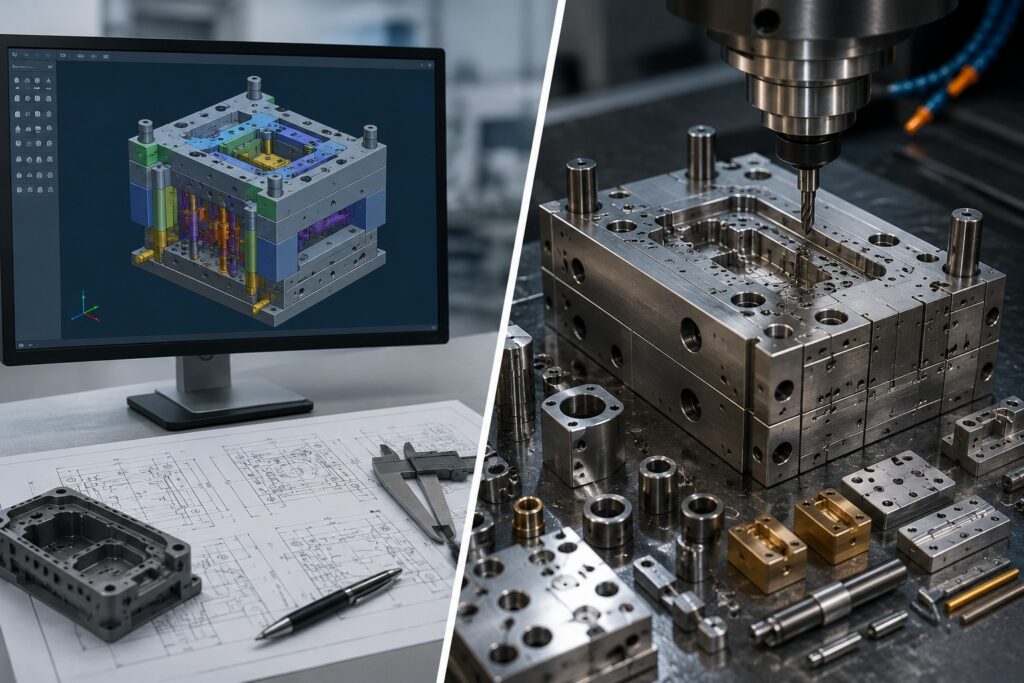
A Complete Guide for Manufacturers When developing a plastic product, many manufacturers use the terms injection mold design and injection mold manufacturing interchangeably. However, they are two different stages of the tooling process. Understanding the difference can help you plan your project, control tooling costs, reduce production risks, and achieve better molded-part quality. At Polymach365, we provide both Injection Mold Design and Injection Mold Manufacturing solutions. Our engineering process combines Design for Manufacturability (DFM), mold-flow analysis, detailed CAD design, precision CNC machining, EDM, assembly, and inspection. Therefore, customers can move from a product concept to production-ready tooling through a coordinated manufacturing workflow. Whether you are developing a prototype, launching a new plastic product, or preparing for high-volume production, understanding how mold design differs from mold manufacturing is essential. What Is Injection Mold Design? Injection mold design is the engineering stage where manufacturers determine how the mold will produce the final plastic component. Instead of immediately machining steel or aluminum, engineers first create a detailed digital representation of the complete tooling system. Therefore, mold design determines important elements such as: Core and cavity geometry Parting line Gate location Runner system Cooling channels Ejection system Mold venting Slides and lifters Mold base Inserts Mold materials Cavity configuration At Polymach365, the design process begins with your CAD files and technical requirements. Our engineers use DFM principles to optimize the part and tooling before manufacturing begins. Consequently, good mold design can prevent expensive tooling modifications later. What Is Injection Mold Manufacturing? Injection mold manufacturing is the physical production of the mold based on the approved engineering design. Once the mold design receives approval, manufacturers begin producing the actual tooling components. This stage can involve: CNC machining EDM machining Wire EDM Precision grinding Heat treatment Component assembly Hand fitting Mold testing Dimensional inspection Polymach365’s published manufacturing workflow includes project kickoff and DFM analysis, CAD tool design, mold-flow simulation, precision machining, assembly and hand fitting, and first article inspection. Injection Mold Design vs Mold Manufacturing The easiest way to understand the difference is to compare their primary purposes. Injection Mold Design Injection Mold Manufacturing Creates the tooling concept Builds the physical mold Uses CAD and engineering software Uses CNC, EDM and grinding equipment Focuses on geometry and functionality Focuses on precision production Determines gates and runners Machines the designed features Designs cooling channels Produces the cooling system Designs ejection mechanisms Manufactures and assembles ejection components Includes DFM analysis Includes machining and fitting Uses simulation for validation Uses inspection and testing Produces mold design files Produces the finished mold Therefore, both stages are equally important. A well-designed mold still requires accurate manufacturing, while precise manufacturing cannot compensate for a fundamentally poor mold design. Why Injection Mold Design Matters A mold represents a significant investment, especially for medium- and high-volume production. Therefore, manufacturers should solve potential problems during the design stage rather than after the tool has been manufactured. Part Geometry Optimization The product design directly affects mold performance. Polymach365’s mold-design process considers important factors such as wall thickness, draft angles, ribs, bosses, gate placement, and part geometry. Uniform Wall Thickness Consistent wall thickness promotes more predictable cooling. As a result, manufacturers can reduce the risk of defects such as warpage, sink marks, and internal stresses. Draft Angles Draft angles allow the molded component to separate from the cavity more easily. Consequently, proper draft design can reduce ejection problems and protect mold surfaces. Ribs and Bosses Ribs can strengthen a plastic component, while bosses can provide mounting or fastening features. However, poorly designed ribs and bosses can contribute to sink marks or other molding issues. Therefore, engineers should optimize their dimensions and placement during mold design. Gate and Runner System Design Plastic must flow through the mold before it fills the cavity. Therefore, gate location and runner design play an important role in filling performance. A suitable gating strategy can help improve: Material flow Filling balance Part appearance Cycle performance Material usage Production consistency Polymach365’s mold-design services include engineering of gating and runner systems, including consideration of hot-runner and cold-runner configurations. Consequently, selecting the correct system depends on the product design, material, production volume, and tooling requirements. Cooling System Design Cooling directly affects injection molding cycle time and dimensional stability. Therefore, engineers need to design cooling channels according to the component’s geometry and thermal requirements. An effective cooling strategy can help: Reduce cycle time Improve dimensional consistency Reduce warpage Improve production efficiency Maintain more consistent mold temperatures Polymach365 specifically identifies cooling-system engineering as an important part of its injection mold design process. Ejection System Design After the plastic component cools, the mold must release it efficiently. Therefore, engineers design suitable ejection systems based on the part’s geometry. Common ejection solutions include: Ejector pins Ejector sleeves Stripper systems Lifters Specialized ejection mechanisms As a result, proper ejection design helps prevent part damage and supports repeatable molding cycles. Mold Flow Analysis and Simulation Modern mold design can use simulation before manufacturing begins. Polymach365 uses mold-flow analysis to evaluate how molten plastic moves through the cavity and to identify potential issues such as knit lines, pressure drops, flow imbalance, and cooling inconsistencies. Therefore, simulation allows engineers to identify potential problems before they become expensive tooling problems. Consequently, manufacturers can make design improvements earlier in the development process. What Happens During Mold Manufacturing? After the design is approved, the manufacturing stage begins. Step 1: Material Preparation The appropriate mold material is selected according to production volume, wear requirements, plastic material, and expected tool life. For example, Polymach365 manufactures tooling using materials such as aluminum and hardened steel for different production requirements. Step 2: CNC Machining CNC machining produces the mold structure, cavities, pockets, holes, and other required features. Therefore, machining accuracy directly influences the final mold’s performance. Step 3: EDM Machining Some intricate features are difficult to manufacture using conventional cutting tools. Therefore, EDM can be used for suitable conductive materials and complex mold geometries. Step 4: Precision Grinding Grinding helps achieve accurate dimensions and surface finishes on appropriate mold components.
Custom Plastic Injection Molds: Everything Manufacturers Should Know
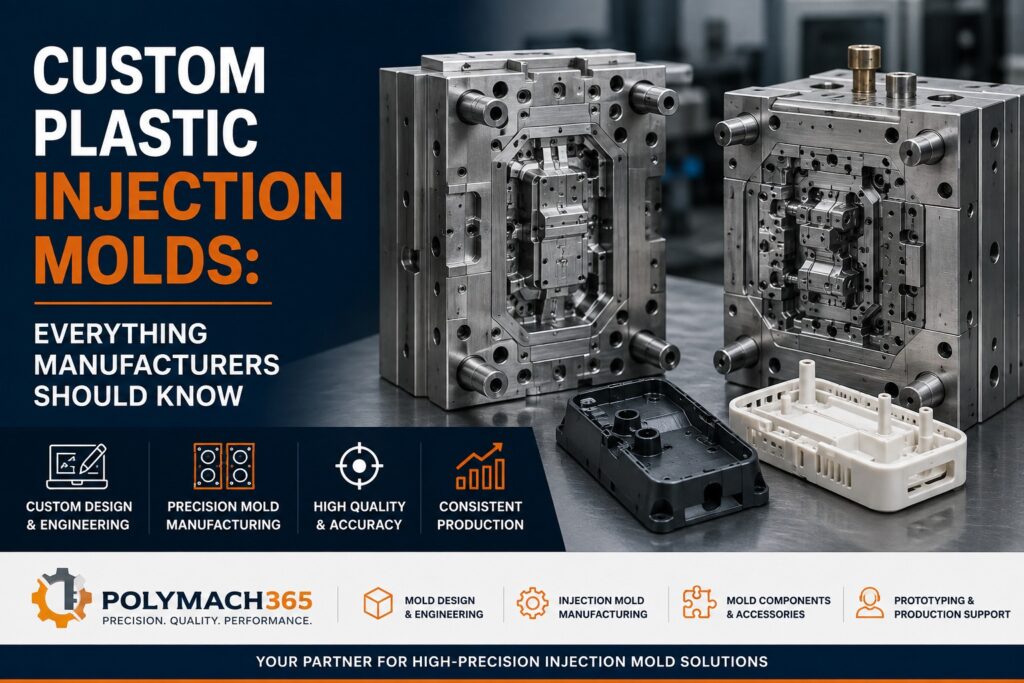
The Complete Guide to Custom Injection Mold Manufacturing for High-Quality Plastic Parts Modern manufacturing demands precision, consistency, and cost efficiency. Therefore, choosing the right custom plastic injection mold is one of the most important decisions for companies developing plastic products. A well-designed mold not only produces high-quality components but also reduces production costs, minimizes defects, and improves manufacturing efficiency over the long term. Injection molding is widely used because it delivers consistent, repeatable plastic parts at scale, although it requires higher upfront tooling investment than processes like CNC machining or 3D printing. At Polymach365, we provide Custom Plastic Injection Mold Design, Mold Manufacturing, Rapid Prototyping, Mold Components, and Production Support for manufacturers across Canada. Whether you require a prototype mold, bridge tooling, or a high-volume production mold, our engineering team delivers reliable tooling solutions that help transform innovative product ideas into production-ready components. Moreover, by combining advanced mold design, CNC machining, EDM machining, precision grinding, and quality inspection, we manufacture molds that deliver exceptional accuracy, durability, and long service life. What Is a Custom Plastic Injection Mold? A custom plastic injection mold is a precision-engineered tooling system designed specifically for manufacturing plastic components with unique shapes, sizes, and functional requirements. Unlike standard molds, custom molds are developed according to your product’s: CAD Models Engineering Drawings Material Specifications Production Volume Surface Finish Requirements Tolerance Requirements During production, molten plastic is injected into the mold cavity under pressure. After cooling, the plastic solidifies into the exact shape of the mold before the finished part is ejected. The quality of the mold directly influences part accuracy, cycle time, cosmetic appearance, and overall manufacturing efficiency. As a result, manufacturers gain complete control over product quality, repeatability, and production performance. Why Choose Custom Plastic Injection Molds? Although standard tooling may suit generic products, most manufacturers require custom molds to produce unique components with consistent quality. Superior Product Accuracy Custom molds are manufactured according to your exact design specifications. Therefore, every molded component maintains consistent dimensions and repeatability. Improved Production Efficiency Well-designed molds reduce cycle times while improving plastic flow, cooling performance, and ejection efficiency. Lower Manufacturing Costs Although custom molds require an initial investment, they significantly reduce the cost per part during medium and high-volume production. Greater Design Flexibility Custom tooling allows engineers to produce complex geometries, textured surfaces, threaded features, inserts, and intricate plastic components. Longer Mold Life High-quality tool steels, precision machining, and proper heat treatment help extend mold life while reducing maintenance requirements. Consequently, manufacturers benefit from greater productivity, improved part quality, and lower long-term production costs. Our Custom Plastic Injection Mold Capabilities At Polymach365, we manufacture precision molds for a wide variety of industrial applications. Our capabilities include: Prototype Injection Molds Production Injection Molds Multi-Cavity Molds Family Molds Hot Runner Molds Cold Runner Molds Insert Molds Overmolding Tools Precision Mold Components Mold Repair & Modification Furthermore, every project is customized according to your production goals and technical requirements. Our Injection Mold Manufacturing Process 1. Product Design Review Our engineering team evaluates your CAD files and drawings to ensure the design is optimized for injection molding. 2. Design for Manufacturability (DFM) We identify potential manufacturing challenges and recommend improvements before tooling begins. Design considerations such as wall thickness, draft angles, ribs, gate location, and cooling strategy can significantly improve manufacturability and reduce defects. 3. Mold Design Our designers create detailed 3D mold assemblies incorporating: Core & Cavity Design Cooling Channels Runner Systems Gate Design Ejection Systems Venting Systems 4. Precision Mold Manufacturing Using advanced CNC machining, EDM machining, wire cutting, and precision grinding, we manufacture each mold with exceptional accuracy. 5. Mold Assembly & Testing Every mold is assembled, tested, and inspected before production approval. 6. Production Support Once approved, the mold is ready for prototype production or full-scale manufacturing. As a result, customers receive reliable tooling that performs consistently throughout its service life. Materials Used for Injection Molds Selecting the right mold material is critical because it affects durability, wear resistance, maintenance, and production life. Common mold materials include: P20 Tool Steel H13 Tool Steel S136 Stainless Steel NAK80 Steel Aluminum Tooling Hardened Tool Steels Material selection depends on: Production Volume Plastic Resin Surface Finish Wear Resistance Product Complexity Expected Tool Life Therefore, choosing the correct tooling material helps maximize mold performance. Plastic Materials We Support Polymach365 supports tooling for many engineering plastics, including: ABS Polypropylene (PP) Polycarbonate (PC) Nylon (PA) Acetal (POM) PEEK PET PVC TPE TPU Consequently, manufacturers can produce components for diverse industrial applications. Industries We Serve Our custom plastic injection molds support manufacturers across numerous industries. Automotive Interior components, housings, clips, connectors, brackets, and functional plastic parts. Medical Devices Medical housings, laboratory equipment, diagnostic components, and precision plastic parts. Consumer Products Appliance components, household products, packaging, and electronic enclosures. Industrial Manufacturing Machine components, automation parts, equipment housings, and engineering plastics. Electronics Precision connectors, switches, covers, and electrical housings. Packaging Caps, closures, containers, and custom packaging solutions. As a result, Polymach365 supports manufacturers throughout product development and production. Key Factors That Influence Mold Quality Several engineering factors determine the performance of an injection mold. Mold Design A properly designed mold improves plastic flow, cooling efficiency, and part consistency. Cooling System Efficient cooling reduces cycle time while improving dimensional stability. Gate Design Correct gate placement minimizes weld lines, sink marks, and filling problems. Ejection System Reliable ejection protects molded parts while reducing wear on tooling. Surface Finish High-quality polishing or texturing improves cosmetic appearance and product quality. Therefore, every stage of mold development contributes to long-term manufacturing success. Benefits of Custom Plastic Injection Molds Manufacturers continue choosing custom tooling because it provides numerous advantages. High dimensional accuracy Excellent repeatability Faster production cycles Lower cost per part Superior surface finish Complex part geometries Long mold life Reduced material waste Consistent production quality Scalable manufacturing Consequently, custom injection molds remain one of the most cost-effective solutions for producing high-quality plastic components. Why Choose Polymach365? Polymach365 combines engineering expertise with advanced manufacturing technology to deliver reliable tooling solutions. Our strengths include:
Why Rapid Prototyping Is Essential for Modern Product Development
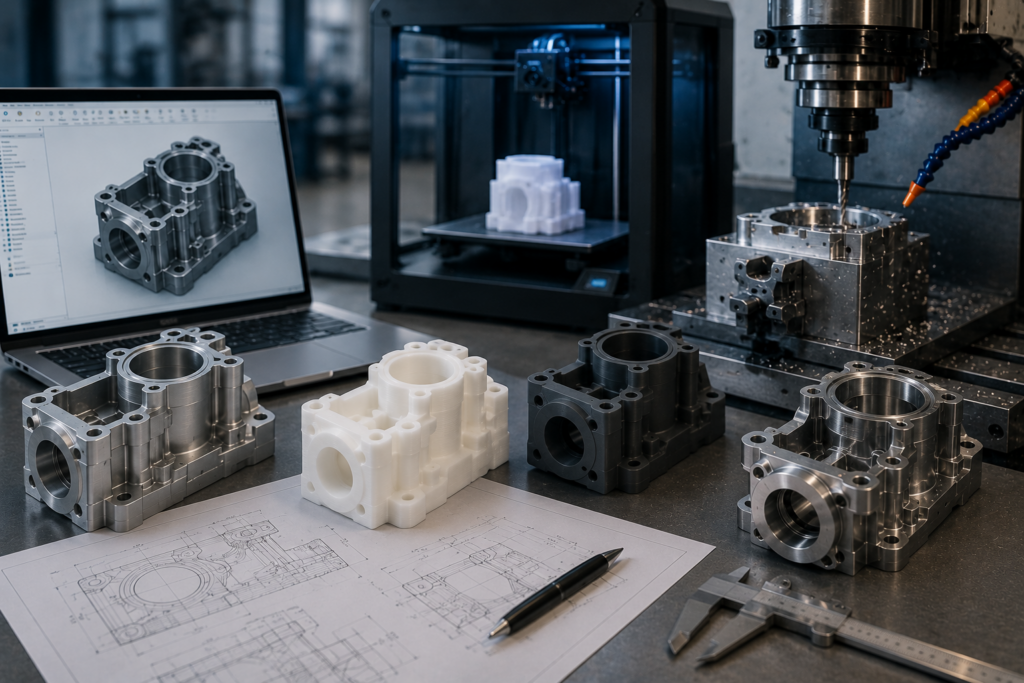
How Rapid Prototyping Helps Manufacturers Reduce Risk, Improve Designs, and Accelerate Time-to-Market Bringing a new product to market requires speed, accuracy, testing, and reliable manufacturing. However, traditional manufacturing processes can slow development when they require expensive tooling or lengthy setup. CNC machining provides manufacturers with a faster and more flexible way to turn digital designs into functional components. At Polymach365, we provide CNC machining and prototype manufacturing solutions in Canada for businesses developing custom components and new products. CNC milling, CNC turning, and 5-axis machining can help shorten development cycles, simplify design changes, and support the transition from prototype to production. Therefore, CNC machining can play an important role in helping Canadian manufacturers improve product development efficiency while maintaining precision and quality. What Is Rapid Prototyping? Rapid prototyping is the process of quickly manufacturing a physical model or functional component directly from a digital design. Depending on the product and testing requirements, manufacturers may use processes such as: CNC machining 3D printing CNC milling CNC turning 5-axis machining Prototype injection molding Low-volume manufacturing The objective is not simply to create a sample. Instead, rapid prototyping helps engineers understand how a product will look, fit, function, assemble, and perform before larger manufacturing investments begin. As a result, prototypes become an important bridge between product design and production Why Rapid Prototyping Matters in Modern Product Development Traditional product development often involved long gaps between design, tooling, testing, and manufacturing. Consequently, discovering a problem late in the process could lead to costly modifications. Rapid prototyping creates a faster feedback cycle: Design → Prototype → Test → Improve → Validate → Produce Because teams can evaluate physical parts earlier, they can make better engineering decisions before committing to final tooling or production. Furthermore, this iterative approach helps manufacturers improve product performance while shortening development cycles. 1. Rapid Prototyping Speeds Up Product Development Speed is one of the biggest advantages of rapid prototyping. Instead of waiting for complete production tooling, engineers can manufacture prototypes directly from CAD data using suitable rapid manufacturing processes. Therefore, teams can quickly evaluate their designs and move to the next development stage. For competitive industries, shorter development cycles can help businesses: Respond to market opportunities Complete engineering validation sooner Introduce new products faster Improve existing products efficiently Reduce delays between design iterations Consequently, rapid prototyping can significantly improve overall product development efficiency. 2. Identify Design Problems Before Production A CAD model may appear perfect on a computer screen. However, physical testing can reveal issues that are difficult to identify digitally. For example, a prototype may reveal: ✔ Poor component fit ✔ Assembly interference ✔ Incorrect dimensions ✔ Weak structural areas ✔ Difficult access points ✔ Unnecessary material ✔ Ergonomic problems ✔ Manufacturing challenges Finding these issues during prototyping is considerably better than discovering them after production has begun. Therefore, rapid prototyping helps reduce the financial risk associated with design errors. 3. Improve Product Quality Through Testing A successful product must perform reliably in its intended application. Rapid prototypes allow engineering teams to perform physical tests before final manufacturing. Depending on the application, engineers may evaluate: Mechanical strength Component fit Assembly performance Dimensional accuracy Movement Material behaviour Thermal performance Functional performance After testing, the design can be modified and another prototype produced. As a result, each development cycle can improve the final product. 4. Reduce Product Development Costs Rapid prototyping requires an upfront investment. However, it can prevent much larger expenses later. Changing a CAD model and producing another prototype is often significantly less expensive than modifying production tooling or correcting thousands of finished components. For example, early prototype testing can help prevent: Tooling modifications Production scrap Assembly failures Product redesigns Manufacturing delays Unnecessary material use Therefore, rapid prototyping should be viewed as a risk-reduction strategy, not simply an additional manufacturing expense. 5. Test Multiple Design Versions Product development often involves several possible design solutions. Rapid prototyping allows engineers to manufacture and compare multiple versions before selecting the final design. For example, teams may compare: Prototype A: Lightweight designPrototype B: Higher-strength designPrototype C: Lower-cost manufacturing design Engineers can then evaluate which version performs best. Consequently, design decisions can be based on physical testing rather than assumptions alone. 6. Validate Fit and Assembly Components rarely operate independently. Most products contain multiple parts that must fit together accurately. Even small dimensional errors can create assembly problems. Rapid prototyping allows manufacturers to verify: Hole alignment Fastener locations Mating surfaces Component clearances Assembly interfaces Mechanical movement Therefore, engineers can correct fitment issues before final production begins. This benefit is particularly valuable for machinery, automation systems, automotive components, electronics, and multi-part assemblies. 7. Evaluate Materials Before Final Production Material selection has a major impact on product performance. Depending on the manufacturing process, prototypes can be produced using engineering-grade materials similar to those planned for the final product. Common Metals Aluminum Stainless steel Carbon steel Brass Copper Titanium Tool steel Engineering Plastics ABS Nylon Delrin/Acetal Polycarbonate PEEK PTFE Therefore, engineers can evaluate strength, weight, durability, machinability, and other characteristics before finalizing material selection. 8. CNC Machining for Functional Rapid Prototypes While several processes can support rapid prototyping, CNC machining is particularly valuable for functional engineering prototypes. CNC machining removes material from solid stock using computer-controlled cutting tools. Key Advantages Include: ✔ High dimensional accuracy ✔ Production-grade materials ✔ Excellent mechanical properties ✔ High-quality surface finishes ✔ Tight-tolerance capability ✔ Suitable for functional testing Furthermore, CNC-machined prototypes can closely represent future production components. Therefore, engineers can perform realistic mechanical and assembly testing before scaling manufacturing. 9. 5-Axis CNC Machining for Complex Prototypes Some prototype components contain complex curves, angled surfaces, or features that are difficult to manufacture using conventional machining. In these situations, 5-axis CNC machining can provide significant advantages. Because the cutting tool can access the component from multiple directions, complex features can often be machined with fewer setups. This can provide: Better access to difficult geometries Fewer workpiece repositioning operations Improved dimensional consistency Efficient complex-part machining High-quality surface finishes Consequently, 5-axis machining can support sophisticated
How to Choose the Right Prototype Manufacturing Process
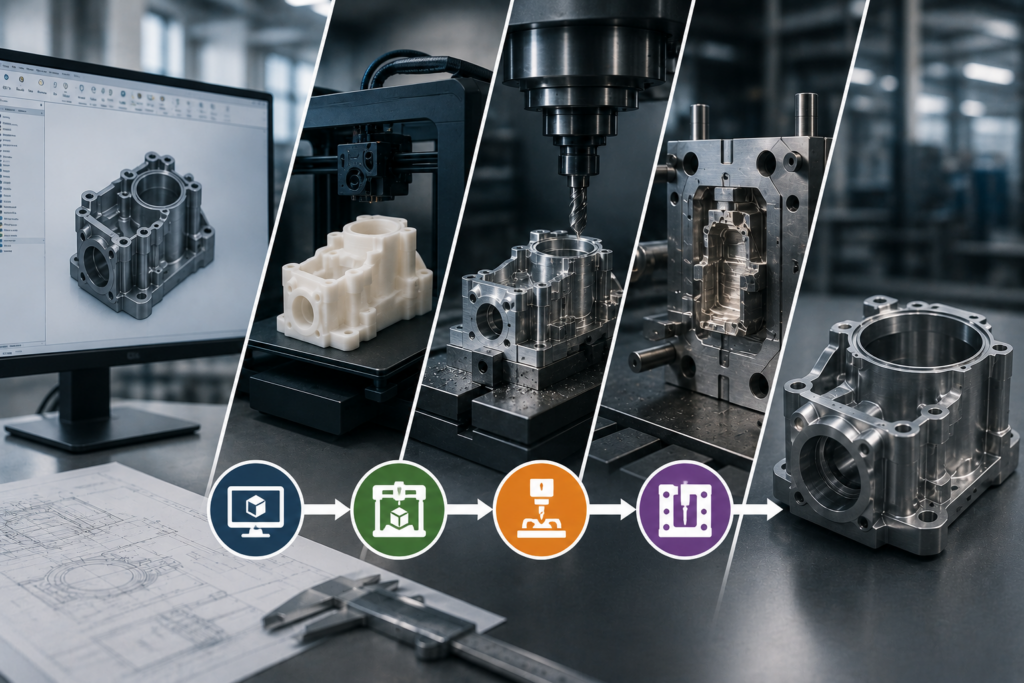
A Complete Guide to Selecting the Best Prototyping Method for Your Product Choosing the right prototype manufacturing process is an important step in successful product development. A prototype allows engineers, designers, and manufacturers to evaluate a product before committing to full-scale production. However, CNC machining, 3D printing, and prototype injection molding each offer different advantages. Therefore, the best process depends on your product design, material, dimensional accuracy, quantity, budget, testing requirements, and future production goals. At Polymach365, we support businesses with prototype manufacturing services in Canada, including CNC machining, rapid prototyping, 5-axis machining, low-volume production, and injection mold solutions. By selecting the appropriate manufacturing method early, businesses can reduce development risks, control costs, and move products toward production more efficiently. This guide explains how to choose the right prototype manufacturing process for your next project. What Is Prototype Manufacturing? Prototype manufacturing is the process of creating a physical version of a product or component before full production begins. Depending on the development stage, a prototype may be used to evaluate: Product appearance Dimensions Fit and assembly Mechanical performance Material behaviour Design feasibility User experience Manufacturing requirements Therefore, prototypes provide valuable information that digital models alone may not reveal. Moreover, engineers can identify design problems early and make improvements before investing in expensive production tooling. Why Choosing the Right Prototyping Process Matters Not every prototype serves the same purpose. For example, an early concept model may only need to demonstrate size and appearance. However, a functional engineering prototype may need production-grade materials, tight tolerances, and mechanical strength. Choosing the wrong manufacturing process can result in unnecessary expenses, inaccurate testing, or longer development cycles. The right process can help you: ✔ Reduce development costs ✔ Identify design problems earlier ✔ Improve product functionality ✔ Test suitable materials ✔ Accelerate design iterations ✔ Validate assembly requirements ✔ Prepare efficiently for production Consequently, manufacturers should define the purpose of the prototype before choosing how to manufacture it. Main Prototype Manufacturing Processes Several manufacturing technologies can be used for prototyping. However, three approaches are particularly common. 1. CNC Machining CNC machining is a subtractive manufacturing process in which computer-controlled cutting tools remove material from a solid workpiece. Common processes include: CNC milling CNC turning 3-axis machining 5-axis CNC machining Drilling Tapping Because CNC machining works with production-grade metals and engineering plastics, it is particularly suitable for functional prototypes. Advantages of CNC Machining ✔ Excellent dimensional accuracy ✔ High-quality surface finishes ✔ Production-grade materials ✔ Suitable for tight tolerances ✔ Strong functional prototypes ✔ Easy transition to low-volume production Therefore, CNC machining is an excellent choice when prototype performance needs to closely represent the final component. 2. 3D Printing 3D printing builds components layer by layer from a digital model. As a result, it can create complex shapes without many of the tooling-access restrictions associated with subtractive machining. Common additive processes include: FDM SLA SLS MJF Metal additive manufacturing Advantages of 3D Printing ✔ Fast design iterations ✔ Complex geometries ✔ Minimal tooling requirements ✔ Internal channels and structures ✔ Suitable for concept models ✔ Cost-effective for many one-off prototypes Therefore, 3D printing is often ideal during the early stages of product development. However, the dimensional accuracy, surface quality, and mechanical properties depend heavily on the printing process and material selected. 3. Prototype Injection Molding Prototype injection molding is useful when developers need molded plastic components that closely represent future production parts. The process requires a mold, although prototype tooling may use simpler or more economical approaches than long-life production molds. Advantages ✔ Production-like plastic components ✔ Consistent repeatability ✔ Suitable for larger prototype quantities ✔ Realistic material testing ✔ Useful before mass production Therefore, prototype injection molding can provide a valuable bridge between initial prototypes and high-volume plastic manufacturing. CNC Machining vs 3D Printing vs Injection Molding The following comparison can help you understand which process may suit your project. Factor CNC Machining 3D Printing Prototype Injection Molding Best Use Functional prototypes Concept & complex prototypes Production-like plastic parts Initial Tooling Low Very Low Higher Material Range Metals & plastics Process-dependent Thermoplastics Accuracy Excellent Process-dependent Excellent Surface Finish Excellent May require finishing Excellent Design Changes Easy Very Easy More difficult Low Quantities Excellent Excellent Less economical Larger Quantities Good Application-dependent Excellent Production Simulation Excellent Moderate Excellent Therefore, there is no single process that is best for every prototype. 1. Define the Purpose of Your Prototype Before selecting a manufacturing process, determine exactly what you want to learn from the prototype. Ask questions such as: Is the prototype only for visual evaluation? Does it need to fit into an assembly? Will it undergo mechanical testing? Does it need to withstand real operating conditions? Is surface appearance important? Does the prototype need production-grade material? For visual concept models, 3D printing may be sufficient. However, if you need to evaluate mechanical strength, dimensional accuracy, or functional performance, CNC machining may provide a more realistic prototype. 2. Consider Material Requirements Material selection is another major factor. CNC machining can process a broad range of engineering materials. Metals Aluminum Stainless Steel Carbon Steel Tool Steel Brass Copper Titanium Engineering Plastics ABS Nylon Delrin/Acetal Polycarbonate PEEK PTFE Therefore, CNC machining can be particularly useful when your prototype must use the same or a similar material as the final production component. Meanwhile, 3D printing provides a different range of polymers, resins, powders, and metals depending on the additive process. 3. Evaluate Dimensional Accuracy and Tolerances Some prototypes require only approximate dimensions. Others need precise mating surfaces, bearing locations, threaded features, or critical hole positions. For applications requiring tight dimensional control, precision CNC machining is often a strong option. However, specifying unnecessarily tight tolerances can increase manufacturing costs. Therefore, engineering drawings should clearly identify which dimensions are critical and which can use standard manufacturing tolerances. This approach improves both manufacturing efficiency and cost control. 4. Consider Part Geometry and Complexity Geometry can determine which manufacturing process is practical. 3D printing performs particularly well when parts contain: Internal channels Lattice structures Organic shapes