
Custom CNC Machining Solutions for Complex Industrial Components
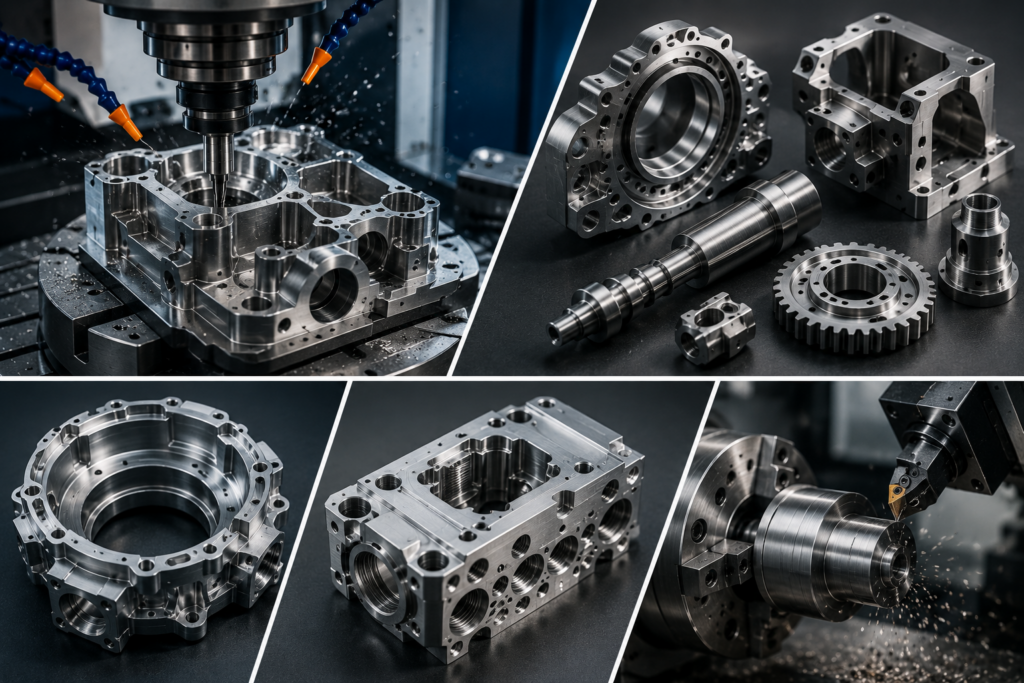
High-Precision Custom Manufacturing for Demanding Industrial Applications Modern industrial equipment depends on components that deliver accuracy, durability, and consistent performance. However, standard off-the-shelf parts cannot always meet specialized engineering requirements. Therefore, manufacturers often require custom CNC machining solutions for components with complex geometries, tight tolerances, demanding materials, or application-specific features. At Polymach365, we provide custom CNC machining solutions for complex industrial components, supporting manufacturers with precision CNC milling, CNC turning, 5-axis machining, prototype manufacturing, and low-volume production. From a single custom prototype to repeat production batches, our manufacturing approach focuses on accuracy, manufacturability, and reliable quality. Moreover, CNC machining provides the flexibility to manufacture intricate metal and plastic parts directly from CAD designs. As a result, engineers can develop specialized components without compromising their functional requirements. What Is Custom CNC Machining? Custom CNC machining is a computer-controlled manufacturing process used to produce components according to specific drawings, CAD models, tolerances, materials, and performance requirements. Unlike standard components, custom CNC parts are manufactured for a particular product, machine, assembly, or industrial application. Depending on the component, manufacturing may involve: CNC milling CNC turning 3-axis machining 4-axis machining 5-axis CNC machining Drilling and tapping Precision boring Thread machining Secondary finishing Therefore, CNC machining provides engineers with considerable flexibility when standard components cannot satisfy project requirements. Why Complex Industrial Components Require Precision Machining Industrial components often operate under challenging conditions. For example, parts may experience high loads, vibration, repeated motion, heat, pressure, or continuous operation. Consequently, dimensional errors can affect assembly, equipment performance, and component life. Precision CNC machining helps manufacturers maintain critical features such as: ✔ Hole positions ✔ Flatness ✔ Concentricity ✔ Parallelism ✔ Thread dimensions ✔ Mating surfaces ✔ Complex profiles ✔ Critical dimensions As a result, properly machined components can integrate more reliably into complex industrial assemblies. Our Custom CNC Machining Capabilities Polymach365 supports different manufacturing requirements through multiple CNC machining processes. CNC Milling Services CNC milling uses rotating cutting tools to remove material from a stationary workpiece. It is suitable for manufacturing: Machine brackets Mounting plates Housings Fixtures Tooling Mold inserts Equipment components Complex mechanical parts Moreover, CNC milling allows manufacturers to create pockets, holes, slots, contours, and precision surfaces within a single manufacturing workflow. CNC Turning Services CNC turning is ideal for producing rotational and cylindrical components. Common CNC-turned industrial parts include: Shafts Pins Bushings Sleeves Rollers Couplings Spacers Threaded components Because the workpiece rotates during machining, CNC turning can provide excellent concentricity and dimensional consistency for rotational components. 5-Axis CNC Machining for Complex Components Some industrial parts contain features that are difficult to access with conventional 3-axis machining. Therefore, 5-axis CNC machining can provide an effective solution for complex geometries. The cutting tool can approach the component from multiple directions. Consequently, manufacturers can machine several surfaces with fewer setups. Key Benefits of 5-Axis Machining ✔ Fewer machining setups ✔ Improved access to complex features ✔ Better positional consistency ✔ Reduced repositioning ✔ Efficient complex-part manufacturing ✔ High-quality surface finishes As a result, 5-axis CNC machining is valuable for sophisticated industrial components where geometry and precision are critical. Types of Complex Industrial Components We Can Support Custom CNC machining can be used for a wide range of industrial applications. Precision Housings Machined housings can include mounting holes, bearing locations, internal cavities, and precision mating surfaces. Shafts and Rotational Components Custom shafts require accurate diameters, shoulders, threads, grooves, and bearing surfaces. Jigs and Fixtures Manufacturing fixtures help improve positioning, assembly, inspection, and repeatability. Machine Components Custom plates, brackets, blocks, supports, adapters, and structural components can be manufactured according to specific equipment requirements. Mold Components Core pins, cavity inserts, mold inserts, and other precision components require controlled dimensions and high-quality surfaces. Automation Components Robotics and automated equipment often require custom mounts, grippers, brackets, housings, and mechanical interfaces. Therefore, custom CNC machining can support both new equipment development and existing industrial systems. CNC Machining for Tight-Tolerance Components Not every feature requires the same level of precision. However, bearing locations, mating surfaces, alignment features, and assembly interfaces may require tighter tolerances. Achieving these requirements may involve: Appropriate machine selection Stable workholding Suitable cutting tools Controlled machining parameters Dimensional inspection Proper material selection Therefore, clearly identifying critical tolerances on engineering drawings helps manufacturers focus precision where it matters most. This approach can also prevent unnecessary machining costs caused by applying extremely tight tolerances to non-critical features. Materials for Custom CNC Machining Material selection affects strength, weight, corrosion resistance, machinability, temperature performance, and manufacturing cost. Polymach365 supports a range of commonly used engineering materials. Metals Aluminum Aluminum provides excellent machinability and a strong strength-to-weight ratio. Therefore, it is widely used for housings, fixtures, brackets, and machine components. Stainless Steel Stainless steel provides strength and corrosion resistance. Consequently, it suits demanding industrial environments. Carbon Steel Carbon steel offers strength and durability for structural and mechanical applications. Tool Steel Tool steels are commonly selected for tooling, molds, dies, and wear-resistant components. Brass and Copper These materials provide useful electrical, thermal, and corrosion-resistant properties for specialized applications. Titanium Titanium combines strength, corrosion resistance, and low weight. However, it requires careful machining because of its material characteristics. Engineering Plastics Depending on project requirements, components may also be machined from: ABS Nylon Delrin/Acetal Polycarbonate PEEK PTFE Therefore, customers can select materials according to the mechanical and environmental requirements of the finished component. Prototype Manufacturing for Complex CNC Parts Manufacturing a prototype before committing to production can reduce development risk. A CNC-machined prototype allows engineers to evaluate: ✔ Fit ✔ Function ✔ Assembly ✔ Dimensional accuracy ✔ Material performance ✔ Mechanical behaviour If modifications are required, engineers can update the CAD model before producing additional components. Consequently, CNC prototyping provides a practical path from design validation to production. Low-Volume CNC Production Many industrial projects do not require mass production. For example, specialized machinery manufacturers may require only 10, 50, 100, or several hundred custom components. CNC machining is particularly suitable for these requirements because it does not require dedicated production molds for most parts. Therefore, low-volume CNC production
Why Online CNC Machining Services Are Transforming Manufacturing
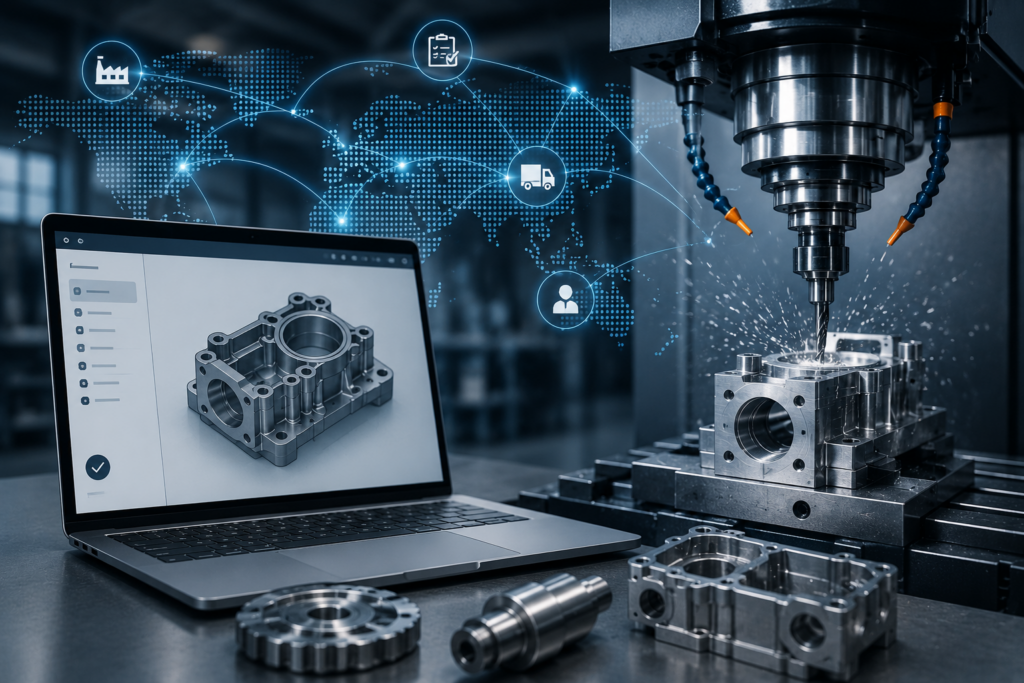
How Digital CNC Manufacturing Is Making Custom Part Production Faster, Smarter, and More Flexible Manufacturing is becoming increasingly digital. Today, engineers and product developers expect faster quotations, easier communication, flexible production volumes, and efficient ways to move from CAD design to finished components. Therefore, online CNC machining services are changing how businesses source custom-manufactured parts. Instead of relying entirely on lengthy traditional procurement processes, manufacturers can use digital workflows to submit CAD files, define project requirements, receive manufacturing feedback, and move projects toward production more efficiently. At Polymach365, we support businesses with online CNC machining services in Canada, including CNC milling, CNC turning, 5-axis machining, rapid prototyping, precision machining, and low-volume production. As a result, customers can simplify sourcing while maintaining a strong focus on part quality and manufacturability. In this guide, we explain why online CNC machining is transforming modern manufacturing and how businesses can benefit from a more connected manufacturing process. What Are Online CNC Machining Services? Online CNC machining combines precision manufacturing with a digital project workflow. Traditionally, sourcing custom-machined components could involve multiple emails, drawings, supplier discussions, and manual quotation processes. However, an online manufacturing approach simplifies many of these steps. A typical process may include: CAD File Submission → Engineering Review → DFM Feedback → Quotation → CNC Machining → Quality Inspection → Delivery Therefore, engineers can move from a digital design toward physical components through a more streamlined process. Online CNC machining can support both simple and complex projects, including prototypes, custom components, replacement parts, tooling, and production batches. Why Is Online CNC Machining Growing? Manufacturers increasingly need shorter development cycles and more flexible supply chains. At the same time, engineering teams often work across different cities, provinces, and countries. Consequently, digital manufacturing platforms can make supplier communication and project coordination easier. Online CNC machining can help businesses: Reduce quotation delays Simplify CAD file submission Access engineering feedback Compare manufacturing requirements Accelerate prototyping Manage custom production Scale quantities as demand changes Reduce unnecessary administrative work As a result, engineering teams can spend more time developing products and less time managing repetitive procurement activities. 1. Faster CNC Machining Quotations Traditional CNC quotation processes can require several rounds of communication before manufacturing begins. However, online CNC machining services simplify the initial information exchange. Customers can provide CAD files, material requirements, tolerances, quantities, and finishing specifications together. Therefore, manufacturers can evaluate the project more efficiently. A complete request typically includes: ✔ 3D CAD Model ✔ 2D Technical Drawing ✔ Material ✔ Quantity ✔ Critical Tolerances ✔ Surface Finish ✔ Required Delivery Schedule Providing complete information from the beginning can significantly reduce unnecessary quotation delays. 2. Easier CAD-to-Part Manufacturing One of the greatest advantages of digital manufacturing is the connection between CAD design and CNC production. Engineers already create components using digital CAD software. Therefore, an online CNC workflow naturally extends that process into manufacturing. Common file formats may include: STEP STP IGES IGS DXF DWG After reviewing the design, manufacturing engineers can determine suitable machining operations, tooling requirements, material selection, and production methods. Consequently, the transition from design to manufacturing becomes more efficient. 3. Design for Manufacturability Feedback A part can look correct in CAD while still being difficult or expensive to machine. For example, a design may contain extremely deep pockets, sharp internal corners, inaccessible features, thin walls, or unnecessarily tight tolerances. Therefore, Design for Manufacturability (DFM) plays an important role in online CNC machining. DFM analysis can help identify opportunities to: ✔ Simplify part geometry ✔ Improve tool accessibility ✔ Reduce machining time ✔ Select practical tolerances ✔ Minimize unnecessary setups ✔ Reduce material waste ✔ Lower manufacturing costs As a result, manufacturers can optimize components before production rather than correcting expensive problems afterward. 4. Faster Rapid Prototyping Speed is critical during product development. Engineers often need physical prototypes to evaluate fit, functionality, assembly, strength, and dimensional accuracy. However, waiting too long for prototypes can delay the entire development cycle. Online CNC machining can simplify the process of submitting prototype designs and communicating manufacturing requirements. Moreover, CNC machining allows engineers to create functional prototypes from engineering materials such as aluminum, stainless steel, brass, and engineering plastics. Therefore, companies can test realistic components before moving toward production. 5. Flexible Low-Volume Production Not every manufacturer needs thousands of components. Startups, equipment manufacturers, automation companies, and product developers may require only: 5 parts 20 parts 50 parts 100 parts Several hundred components Online CNC machining is well suited to this type of low-volume production because manufacturers can produce components without investing in dedicated molds for many applications. Consequently, businesses can manufacture according to actual demand while reducing unnecessary inventory. 6. Access to Advanced CNC Machining Capabilities A single project may require several manufacturing processes. For example, one component may require milling, while another requires turning. Meanwhile, a complex part may benefit from multi-axis machining. Online CNC manufacturing can provide access to capabilities such as: CNC Milling CNC milling uses rotating cutting tools to create pockets, holes, surfaces, slots, and complex geometries. CNC Turning CNC turning is ideal for cylindrical components such as shafts, bushings, sleeves, pins, and threaded parts. 5-Axis CNC Machining 5-axis machining allows cutting tools to approach a component from multiple directions. Therefore, manufacturers can produce complex geometries while reducing the number of setups required. As a result, customers can source different precision components through a coordinated manufacturing workflow. 7. Greater Material Flexibility Modern product development requires materials suited to specific mechanical and environmental requirements. Online CNC machining can support a broad selection of metals and engineering plastics. Common CNC Metals Aluminum Stainless Steel Carbon Steel Tool Steel Brass Copper Titanium Engineering Plastics ABS Nylon Delrin/Acetal Polycarbonate PEEK PTFE Therefore, engineers can select materials according to strength, weight, machinability, temperature resistance, chemical resistance, and application requirements. 8. Improved Cost Control Online CNC machining can also make manufacturing costs easier to evaluate. Several factors influence the cost of CNC parts, including: Raw material Component dimensions Geometry Machining time Number of setups Tolerances Quantity Inspection requirements Surface
How CNC Machining Accelerates Product Development in Canada
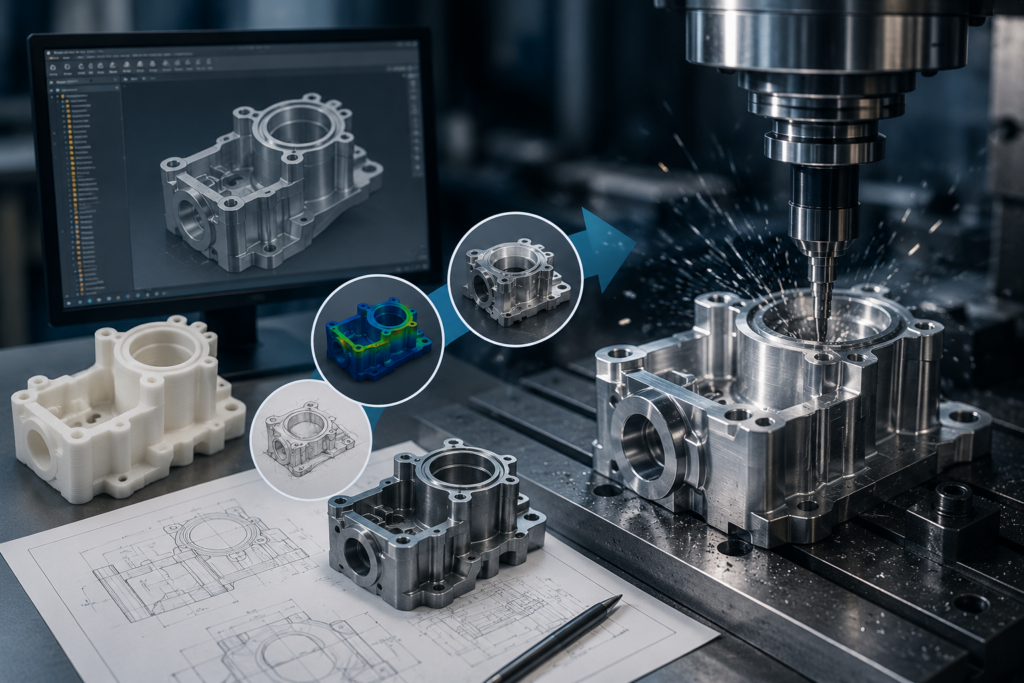
From Rapid Prototypes to Production-Ready Precision Components Bringing a new product to market requires speed, accuracy, testing, and reliable manufacturing. However, traditional manufacturing processes can slow development when they require expensive tooling or lengthy setup. CNC machining provides manufacturers with a faster and more flexible way to turn digital designs into functional components. At Polymach365, we provide CNC machining and prototype manufacturing solutions in Canada for businesses developing custom components and new products. CNC milling, CNC turning, and 5-axis machining can help shorten development cycles, simplify design changes, and support the transition from prototype to production. Therefore, CNC machining can play an important role in helping Canadian manufacturers improve product development efficiency while maintaining precision and quality. What Is CNC Machining in Product Development? CNC machining is a subtractive manufacturing process. Computer-controlled equipment removes material from a solid workpiece to produce the required geometry. Manufacturers can machine parts directly from CAD models using processes such as: CNC milling CNC turning 5-axis CNC machining Drilling and tapping Precision machining Custom CNC machining Unlike processes that require dedicated production molds, CNC machining can often begin with standard material stock and a validated design. As a result, engineers can produce prototypes and custom parts without waiting for production tooling. Why Speed Matters in Product Development Modern product development involves much more than creating a design. Engineers must prototype, test, modify, validate, and prepare components for production. Delays during any stage can increase development costs and extend time-to-market. Therefore, manufacturers need processes that allow them to move efficiently through the development cycle. CNC machining helps because engineers can quickly manufacture physical parts, evaluate them, modify the CAD model, and produce another iteration when necessary. 1. CNC Machining Enables Faster Functional Prototyping A digital model cannot always reveal how a component will perform in the real world. Physical prototypes allow engineers to test actual fit, function, strength, and assembly. CNC machining is particularly useful for functional prototype manufacturing because it can produce parts from engineering-grade materials. For example, prototypes can be manufactured from: Metals Aluminum Stainless steel Carbon steel Brass Copper Titanium Tool steel Engineering Plastics ABS Nylon Delrin/Acetal Polycarbonate PEEK PTFE Consequently, engineers can evaluate prototypes using materials that may closely represent the intended production component. 2. Design Changes Can Be Implemented Quickly Product development rarely ends with the first prototype. Engineers may discover that a hole needs repositioning, a wall needs additional thickness, or an assembly feature requires modification. With CNC machining, engineers can update the CAD model and revise the machining program rather than creating an entirely new mold. Therefore, design iterations can be easier to implement during early product development. This flexibility is particularly valuable for startups, engineering teams, and manufacturers developing innovative products. 3. CNC Machining Supports High-Precision Product Validation A prototype must accurately represent the intended design if engineers want meaningful test results. Modern CNC machining provides high dimensional accuracy and repeatability. Therefore, manufacturers can use machined prototypes to evaluate critical dimensions, mating components, mechanical performance, and assembly requirements. Precision machining is especially valuable when developing components with: Tight tolerances Precision holes Complex surfaces Critical mating features Threaded features Multi-component assemblies As a result, potential design problems can be identified before a project reaches larger-scale manufacturing. 4. No Dedicated Mold Is Required for CNC Prototypes One major advantage of CNC machining during product development is the ability to manufacture many components without first producing a dedicated mold. Injection molding can be highly efficient for high-volume plastic production. However, mold design and tooling require an upfront investment and additional development time. For early-stage prototypes, manufacturers may not yet be ready to commit to tooling. CNC machining allows teams to validate their designs first. Once the product is finalized, they can decide whether CNC production, injection molding, or another process offers the best long-term solution. 5. CNC Machining Helps Reduce Development Risk Finding a design problem after mass production begins can become expensive. Therefore, manufacturers should identify potential issues as early as possible. CNC prototypes can help engineers evaluate: Dimensional accuracy Mechanical performance Component fit Assembly compatibility Material behaviour Product functionality Design feasibility Consequently, manufacturers can make informed improvements before committing to full-scale production. 6. 5-Axis CNC Machining Accelerates Complex Part Development Complex components can require machining from several angles. Conventional machining may require multiple setups to access different surfaces. However, 5-axis CNC machining allows the cutting tool to approach the workpiece from multiple directions. This capability can provide several advantages: Fewer setups Better access to complex geometries Improved consistency Reduced repositioning Efficient machining of intricate components Excellent surface quality Therefore, 5-axis machining can be particularly effective for developing sophisticated engineering components. 7. CNC Machining Bridges Prototype and Low-Volume Production Product development does not always move directly from one prototype to mass production. Manufacturers may first require 10, 50, 100, or several hundred parts for: Field testing Engineering validation Customer evaluation Pilot production Market testing Pre-production assembly CNC machining can support this transition because the same general manufacturing approach used for prototypes can also produce low-volume batches. As a result, businesses can scale production gradually while managing inventory and financial risk. 8. Design for Manufacturability Can Improve Development Efficiency A component may look perfect in CAD but still contain features that make manufacturing unnecessarily difficult. Design for Manufacturability (DFM) helps identify these issues before production. DFM reviews may examine factors such as: Internal corner radii Hole depth Wall thickness Tool accessibility Tolerance requirements Material selection Part orientation Surface finish For example, unnecessarily tight tolerances may increase machining and inspection requirements. Likewise, deep cavities or inaccessible features can require additional operations. Therefore, early DFM feedback can reduce unnecessary complexity and support a smoother transition into manufacturing. 9. CNC Machining Provides Broad Material Flexibility Material selection can significantly influence product performance. During development, engineers may need to compare different materials based on strength, weight, corrosion resistance, thermal performance, or cost. CNC machining supports a broad range of metals and engineering plastics. Consequently, manufacturers can create several prototype versions and evaluate which material
Prototype to Production: A Complete Manufacturing Guide
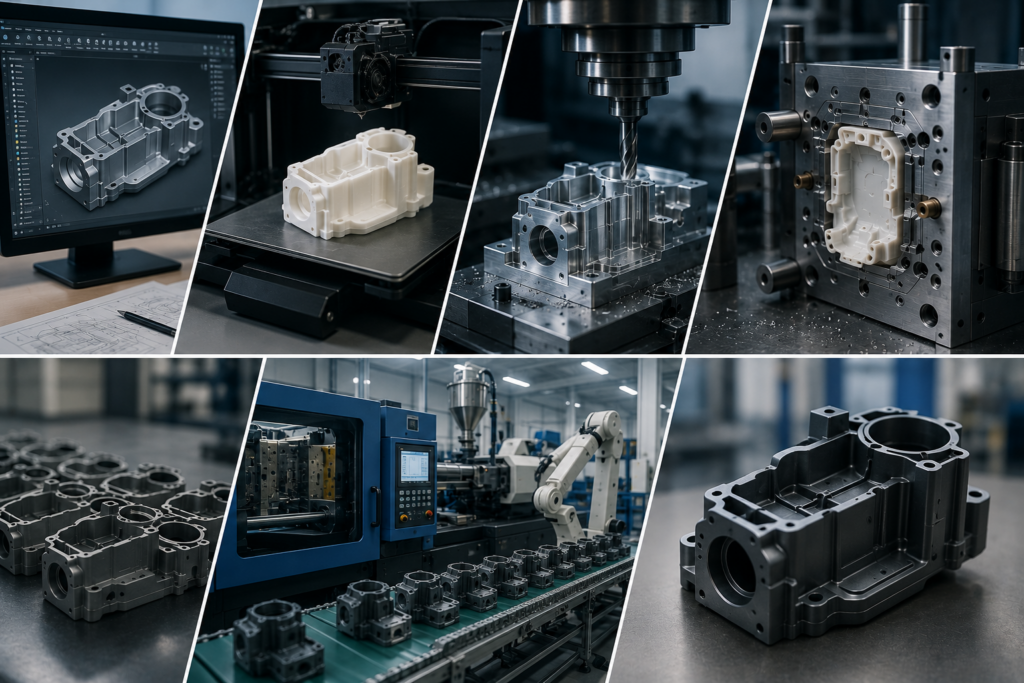
How Digital CNC Manufacturing Is Making Custom Part Production Faster, Smarter, and More Flexible Manufacturing is becoming increasingly digital. Today, engineers and product developers expect faster quotations, easier communication, flexible production volumes, and efficient ways to move from CAD design to finished components. Therefore, online CNC machining services are changing how businesses source custom-manufactured parts. Instead of relying entirely on lengthy traditional procurement processes, manufacturers can use digital workflows to submit CAD files, define project requirements, receive manufacturing feedback, and move projects toward production more efficiently. At Polymach365, we support businesses with online CNC machining services in Canada, including CNC milling, CNC turning, 5-axis machining, rapid prototyping, precision machining, and low-volume production. As a result, customers can simplify sourcing while maintaining a strong focus on part quality and manufacturability. In this guide, we explain why online CNC machining is transforming modern manufacturing and how businesses can benefit from a more connected manufacturing process. What Are Online CNC Machining Services? Online CNC machining combines precision manufacturing with a digital project workflow. Traditionally, sourcing custom-machined components could involve multiple emails, drawings, supplier discussions, and manual quotation processes. However, an online manufacturing approach simplifies many of these steps. A typical process may include: CAD File Submission → Engineering Review → DFM Feedback → Quotation → CNC Machining → Quality Inspection → Delivery Therefore, engineers can move from a digital design toward physical components through a more streamlined process. Online CNC machining can support both simple and complex projects, including prototypes, custom components, replacement parts, tooling, and production batches. Why Is Online CNC Machining Growing? Manufacturers increasingly need shorter development cycles and more flexible supply chains. At the same time, engineering teams often work across different cities, provinces, and countries. Consequently, digital manufacturing platforms can make supplier communication and project coordination easier. Online CNC machining can help businesses: Reduce quotation delays Simplify CAD file submission Access engineering feedback Compare manufacturing requirements Accelerate prototyping Manage custom production Scale quantities as demand changes Reduce unnecessary administrative work As a result, engineering teams can spend more time developing products and less time managing repetitive procurement activities. 1. Faster CNC Machining Quotations Traditional CNC quotation processes can require several rounds of communication before manufacturing begins. However, online CNC machining services simplify the initial information exchange. Customers can provide CAD files, material requirements, tolerances, quantities, and finishing specifications together. Therefore, manufacturers can evaluate the project more efficiently. A complete request typically includes: ✔ 3D CAD Model ✔ 2D Technical Drawing ✔ Material ✔ Quantity ✔ Critical Tolerances ✔ Surface Finish ✔ Required Delivery Schedule Providing complete information from the beginning can significantly reduce unnecessary quotation delays. 2. Easier CAD-to-Part Manufacturing One of the greatest advantages of digital manufacturing is the connection between CAD design and CNC production. Engineers already create components using digital CAD software. Therefore, an online CNC workflow naturally extends that process into manufacturing. Common file formats may include: STEP STP IGES IGS DXF DWG After reviewing the design, manufacturing engineers can determine suitable machining operations, tooling requirements, material selection, and production methods. Consequently, the transition from design to manufacturing becomes more efficient. 3. Design for Manufacturability Feedback A part can look correct in CAD while still being difficult or expensive to machine. For example, a design may contain extremely deep pockets, sharp internal corners, inaccessible features, thin walls, or unnecessarily tight tolerances. Therefore, Design for Manufacturability (DFM) plays an important role in online CNC machining. DFM analysis can help identify opportunities to: ✔ Simplify part geometry ✔ Improve tool accessibility ✔ Reduce machining time ✔ Select practical tolerances ✔ Minimize unnecessary setups ✔ Reduce material waste ✔ Lower manufacturing costs As a result, manufacturers can optimize components before production rather than correcting expensive problems afterward. 4. Faster Rapid Prototyping Speed is critical during product development. Engineers often need physical prototypes to evaluate fit, functionality, assembly, strength, and dimensional accuracy. However, waiting too long for prototypes can delay the entire development cycle. Online CNC machining can simplify the process of submitting prototype designs and communicating manufacturing requirements. Moreover, CNC machining allows engineers to create functional prototypes from engineering materials such as aluminum, stainless steel, brass, and engineering plastics. Therefore, companies can test realistic components before moving toward production. 5. Flexible Low-Volume Production Not every manufacturer needs thousands of components. Startups, equipment manufacturers, automation companies, and product developers may require only: 5 parts 20 parts 50 parts 100 parts Several hundred components Online CNC machining is well suited to this type of low-volume production because manufacturers can produce components without investing in dedicated molds for many applications. Consequently, businesses can manufacture according to actual demand while reducing unnecessary inventory. 6. Access to Advanced CNC Machining Capabilities A single project may require several manufacturing processes. For example, one component may require milling, while another requires turning. Meanwhile, a complex part may benefit from multi-axis machining. Online CNC manufacturing can provide access to capabilities such as: CNC Milling CNC milling uses rotating cutting tools to create pockets, holes, surfaces, slots, and complex geometries. CNC Turning CNC turning is ideal for cylindrical components such as shafts, bushings, sleeves, pins, and threaded parts. 5-Axis CNC Machining 5-axis machining allows cutting tools to approach a component from multiple directions. Therefore, manufacturers can produce complex geometries while reducing the number of setups required. As a result, customers can source different precision components through a coordinated manufacturing workflow. 7. Greater Material Flexibility Modern product development requires materials suited to specific mechanical and environmental requirements. Online CNC machining can support a broad selection of metals and engineering plastics. Common CNC Metals Aluminum Stainless Steel Carbon Steel Tool Steel Brass Copper Titanium Engineering Plastics ABS Nylon Delrin/Acetal Polycarbonate PEEK PTFE Therefore, engineers can select materials according to strength, weight, machinability, temperature resistance, chemical resistance, and application requirements. 8. Improved Cost Control Online CNC machining can also make manufacturing costs easier to evaluate. Several factors influence the cost of CNC parts, including: Raw material Component dimensions Geometry Machining time Number of setups Tolerances Quantity Inspection requirements Surface
CNC Machining vs Injection Molding: Which Manufacturing Process Should You Choose?
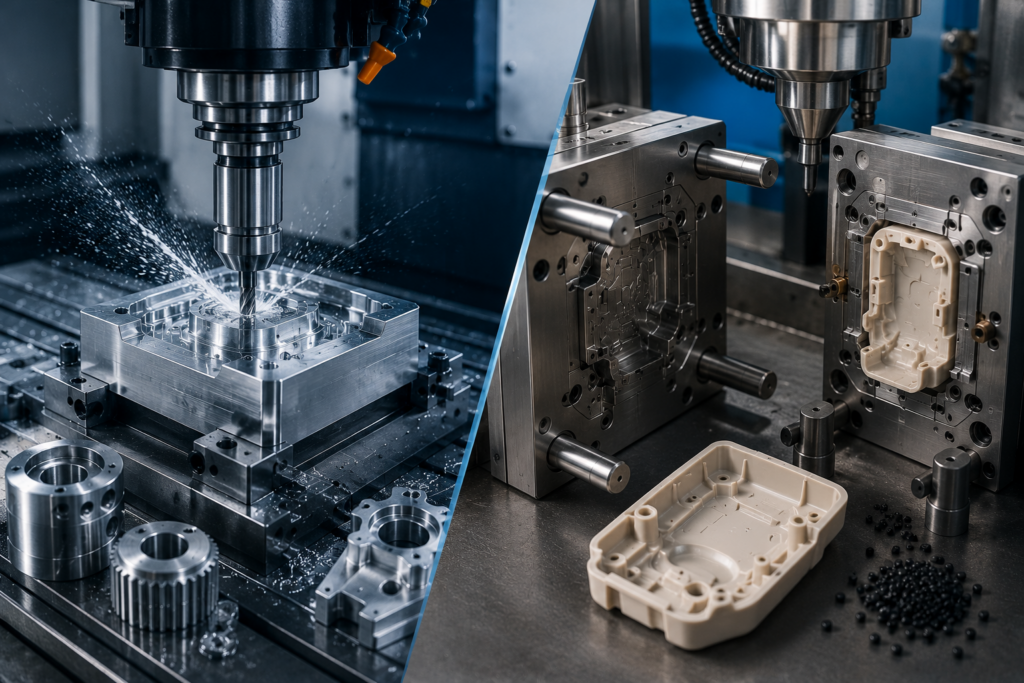
A Complete Manufacturing Guide for Canadian Businesses Selecting the right manufacturing process is one of the most important decisions when developing a new product. Two of the most widely used manufacturing methods are CNC Machining and Injection Molding. While both processes produce high-quality components, they serve different purposes depending on production volume, material requirements, complexity, and budget. At Polymach365, we provide both Precision CNC Machining Services and Injection Mold Design & Manufacturing Services across Canada. Therefore, we help manufacturers choose the most cost-effective production method for every stage of product development—from rapid prototyping to high-volume production. This guide compares CNC machining and injection molding to help you determine which process best fits your project. What Is CNC Machining? CNC (Computer Numerical Control) machining is a subtractive manufacturing process that removes material from a solid block using computer-controlled cutting tools. Therefore, CNC machining is ideal for manufacturing high-precision metal and plastic components with excellent dimensional accuracy. Common CNC Machining Processes ✔ CNC Milling ✔ CNC Turning ✔ 5-Axis CNC Machining ✔ Precision Drilling ✔ Multi-Axis Machining As a result, CNC machining is widely used for prototypes, custom parts, and low-volume production. What Is Injection Molding? Injection molding is a manufacturing process that injects molten plastic into a precision-engineered mold cavity. After cooling, the finished part is ejected and the cycle repeats. Because the same mold is used repeatedly, injection molding is ideal for producing thousands or even millions of identical plastic components. Common Applications ✔ Automotive Parts ✔ Medical Devices ✔ Consumer Products ✔ Electronic Housings ✔ Packaging Products ✔ Industrial Components Consequently, injection molding becomes highly economical for large production volumes. CNC Machining vs Injection Molding: Key Differences Feature CNC Machining Injection Molding Manufacturing Method Material Removal Plastic Injection Best For Prototypes & Low Volume High-Volume Production Initial Investment Low High (Mold Cost) Production Speed Moderate Very Fast Design Changes Easy Expensive Material Options Metals & Plastics Primarily Plastics Dimensional Accuracy Excellent Excellent Surface Finish Superior Very Good Production Quantity 1–10,000 Parts 10,000+ Parts Therefore, the right process depends on your project goals, budget, and production requirements. When Should You Choose CNC Machining? CNC machining is the preferred choice when flexibility, accuracy, and speed are essential. Ideal for Rapid Prototyping Because CNC machining requires no expensive tooling, prototypes can be manufactured quickly. As a result, engineers can validate designs before investing in production tooling. Excellent for Low-Volume Production If you only require a few parts or small production batches, CNC machining is significantly more cost-effective. Typical production quantities include: One-off Components Engineering Samples Pilot Production Low-Volume Manufacturing Therefore, CNC machining minimizes upfront investment. Superior Material Options CNC machining supports both engineering plastics and metals. Common Materials Aluminum Stainless Steel Titanium Brass Copper Carbon Steel ABS Nylon Delrin PEEK Consequently, manufacturers can select materials based on strength, durability, and application requirements. Outstanding Precision Modern CNC machines produce components with extremely tight tolerances. Therefore, industries such as aerospace, medical, robotics, and automotive rely heavily on CNC machining. When Should You Choose Injection Molding? Injection molding becomes the best option when producing large quantities of plastic components. High-Volume Manufacturing Although mold manufacturing requires a higher initial investment, production costs decrease dramatically as volumes increase. Consequently, injection molding delivers the lowest cost per part for mass production. Consistent Quality Every molded component is produced using the same precision mold. As a result, product consistency remains exceptionally high throughout long production runs. Faster Production Cycles Once the mold is completed, each molding cycle typically takes only a few seconds to a few minutes. Therefore, manufacturers can produce thousands of components every day. Lower Unit Costs While tooling costs are higher initially, the cost per component becomes extremely low during mass production. Consequently, injection molding is the preferred manufacturing method for consumer products and plastic assemblies. Cost Comparison Cost is one of the biggest factors when selecting a manufacturing process. CNC Machining Low startup cost No mold investment Higher cost per part Ideal for prototypes and low-volume production Injection Molding Higher tooling investment Lower cost per part Best for large production quantities Excellent long-term manufacturing value Therefore, CNC machining is more affordable for small projects, while injection molding becomes more economical for large production runs. Speed Comparison Production speed depends on project requirements. CNC Machining Prototype lead time: 3–7 Business Days Low-volume production: 1–3 Weeks Injection Molding Mold Manufacturing: 4–12 Weeks Production after mold completion: Thousands of parts per day Consequently, CNC machining is faster for prototypes, whereas injection molding is significantly faster for mass production. Design Flexibility CNC Machining Design changes are simple because only the CAD file needs updating. Therefore, engineers can modify designs without major additional costs. Injection Molding Once the mold has been manufactured, design changes often require expensive mold modifications. Consequently, product design should be finalized before mold production begins. Surface Finish and Accuracy Both manufacturing methods produce high-quality components. CNC Machining ✔ Superior surface finish ✔ Tight tolerances ✔ Production-grade accuracy Injection Molding ✔ Smooth cosmetic finish ✔ Excellent repeatability ✔ Consistent dimensions Therefore, both processes deliver excellent quality, depending on the application. Which Industries Use CNC Machining? Polymach365 supports manufacturers across numerous industries. Automotive Manufacturing Engine components, brackets, fixtures, and performance parts. Aerospace Precision lightweight components. Medical Devices Surgical instruments and precision assemblies. Industrial Equipment Custom machinery components. Robotics Precision automation parts. Which Industries Use Injection Molding? njection molding is commonly used for: Consumer Products Plastic housings and household products. Medical Equipment Disposable medical devices. Electronics Plastic enclosures and connectors. Packaging Caps, containers, and closures. Automotive Interior and exterior plastic components. CNC Machining vs Injection Molding: Which Should You Choose? Choose CNC Machining if you need: ✔ Rapid prototypes ✔ Low-volume production ✔ Metal components ✔ Tight tolerances ✔ Fast design modifications ✔ High precision Choose Injection Molding if you need: ✔ High-volume production ✔ Plastic components ✔ Low unit cost ✔ Consistent product quality ✔ Long-term manufacturing efficiency ✔ Mass production Therefore, your production quantity, budget, and material requirements should determine the most suitable manufacturing method. Why
How Long Does CNC Machining Take? Lead Times Explained
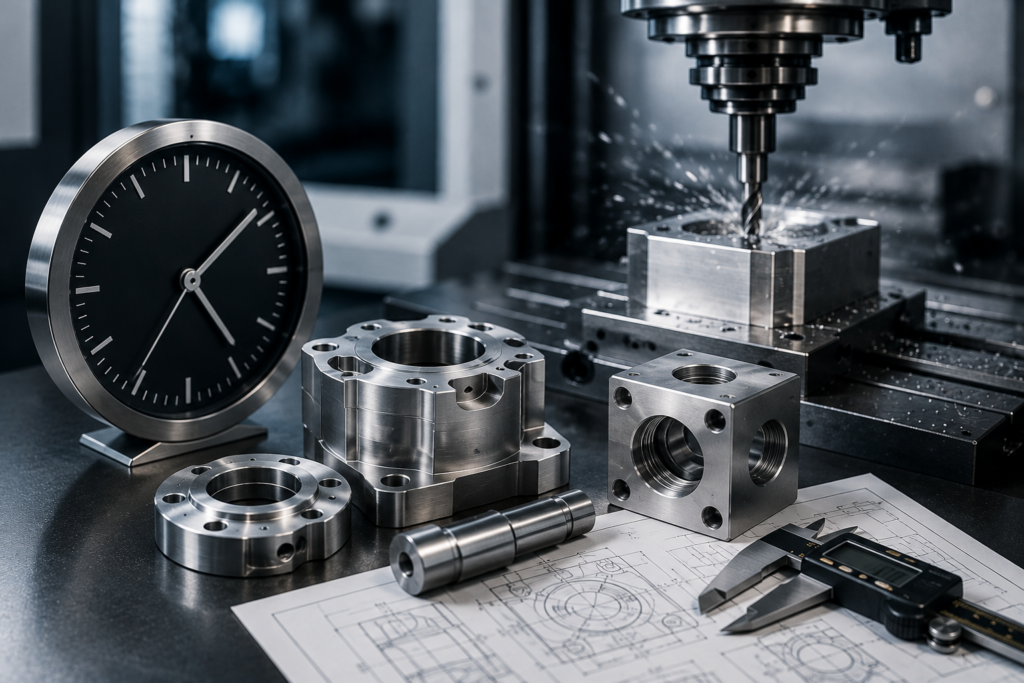
A Complete Guide for Manufacturers in Canada When planning a manufacturing project, one of the most common questions businesses ask is, “How long does CNC machining take?” The answer depends on several factors, including part complexity, material selection, production quantity, machining processes, and finishing requirements. At Polymach365, we specialize in precision CNC machining services in Canada, offering fast turnaround times without compromising quality. Whether you need a rapid prototype, custom-machined component, or high-volume production, understanding CNC machining lead times helps you plan production schedules more efficiently. In this guide, we’ll explain what affects CNC machining lead times, typical production timelines, and practical ways to speed up your manufacturing process. What Is CNC Machining Lead Time? CNC machining lead time refers to the total time required to manufacture a part from the moment your CAD file is submitted until the finished components are delivered. A typical CNC machining project includes: CAD File Review Design for Manufacturability (DFM) Analysis Material Procurement CNC Programming Machine Setup Precision Machining Quality Inspection Surface Finishing (if required) Packaging and Delivery Because each project is unique, lead times can vary depending on complexity and production requirements. Typical CNC Machining Lead Times The following estimates provide a general guideline for CNC machining projects in Canada. Project Type Typical Lead Time Prototype Parts 3–7 Business Days Simple CNC Components 5–10 Business Days Medium Complexity Parts 1–2 Weeks Complex Precision Parts 2–4 Weeks Low-Volume Production 2–5 Weeks High-Volume Manufacturing 4–8 Weeks These timelines may vary depending on material availability, machining complexity, and finishing requirements. Factors That Affect CNC Machining Lead Times Several important factors influence how quickly your parts can be manufactured. 1. Part Complexity Simple parts require fewer machining operations and shorter setup times. However, complex components often include: Deep pockets Thin walls Tight tolerances Complex contours Multi-sided machining Threaded features Consequently, intricate designs require additional machining time and increase overall lead times. 2. Material Availability Material selection significantly impacts delivery schedules. Commonly Available Materials Aluminum Mild Steel Stainless Steel Brass ABS Nylon Delrin Specialty Materials Titanium Inconel PEEK Tool Steel Standard materials are usually available immediately, while specialty materials may require additional procurement time. Therefore, choosing readily available materials can reduce overall production time. 3. CNC Machine Type The type of CNC equipment required also affects production schedules. CNC Milling Suitable for flat surfaces and complex geometries. CNC Turning Ideal for cylindrical components such as shafts and bushings. 5-Axis CNC Machining Although programming is more advanced, 5-axis machining often completes complex parts faster because multiple operations are performed in a single setup. As a result, overall lead times may actually decrease. 4. Production Quantity Quantity plays a major role in manufacturing schedules. Prototype Manufacturing Fast production with minimal setup. Low-Volume Production Requires additional machining time but maintains quick turnaround. Production Manufacturing Larger orders naturally require more machining hours, although automation improves efficiency. Consequently, production volume directly influences lead time. 5. Surface Finishing Many parts require secondary finishing operations after machining. Common finishing services include: Anodizing Powder Coating Sand Blasting Bead Blasting Polishing Passivation Painting Although these finishes improve appearance and durability, they also extend production schedules. 6. Quality Inspection Every precision component undergoes detailed dimensional inspection before shipment. Inspection may include: CMM Measurement Digital Caliper Verification Surface Finish Inspection Visual Quality Checks Functional Testing Therefore, quality assurance ensures accuracy while slightly increasing lead times. Typical CNC Machining Process Timeline At Polymach365, we follow an efficient manufacturing workflow. Step 1 – Upload Your CAD File Submit your 3D model securely. Time: Same Day Step 2 – Engineering Review Our engineers perform Design for Manufacturability (DFM) analysis and prepare your quotation. Time: 1–2 Business Days Step 3 – CNC Programming Machining programs are created and optimized for production. Time: 1 Business Day Step 4 – Precision Machining Advanced CNC milling, turning, or 5-axis machining begins. Time: 2–10 Business Days Step 5 – Quality Inspection Every component is inspected for dimensional accuracy and quality. Time: 1 Business Day Step 6 – Shipping Finished components are packaged and shipped across Canada. Time: 1–5 Business Days Because our workflow is streamlined, customers receive high-quality parts quickly and reliably. How to Reduce CNC Machining Lead Times Fortunately, there are several ways to speed up production. Optimize Your CAD Design Simple geometries reduce machining time. Avoid unnecessary pockets, sharp corners, and overly tight tolerances whenever possible. Use Standard Materials Common materials such as aluminum and stainless steel are readily available. Therefore, material sourcing delays are minimized. Order Multiple Parts Together Batch manufacturing improves efficiency and reduces setup time. Consequently, larger orders often achieve better delivery schedules. Request DFM Feedback Our engineering team reviews every design before production. As a result, we identify design improvements that reduce machining time and manufacturing costs. Plan Ahead Submitting production requirements early helps reserve machine capacity and avoid scheduling delays. Why Choose Polymach365 for Fast CNC Machining in Canada? Polymach365 combines advanced CNC technology, experienced engineers, and efficient production planning to deliver industry-leading turnaround times. Our Services Include ✔ CNC Milling Services ✔ CNC Turning Services ✔ 5-Axis CNC Machining ✔ Rapid Prototyping ✔ Low-Volume Production ✔ Production Manufacturing ✔ Injection Mold Components ✔ Engineering Support ✔ Quality Inspection ✔ Fast Delivery Across Canada Moreover, we maintain strict quality standards while meeting demanding production deadlines. Industries We Serve Our CNC machining services support manufacturers across numerous industries. Automotive Aerospace Medical Devices Industrial Equipment Robotics Electronics Energy Consumer Products Mold Manufacturing Therefore, businesses across Canada rely on Polymach365 for dependable CNC manufacturing solutions. Why Manufacturers Trust Polymach365 Our Advantages ✔ Fast CNC Machining Lead Times ✔ Precision Manufacturing ✔ Competitive Pricing ✔ Advanced CNC Equipment ✔ Skilled Engineering Team ✔ Quality Assurance ✔ Flexible Production Volumes ✔ Reliable Nationwide Delivery ✔ Excellent Customer Support As a result, manufacturers choose Polymach365 for projects that require speed, precision, and reliability. Final Thoughts The time required for CNC machining depends on your part design, material selection, production quantity, machining complexity, and finishing requirements. However, choosing an experienced manufacturing partner can significantly reduce lead
How Much Does Injection Mold Manufacturing Cost in Canada? (2026 Pricing Guide)
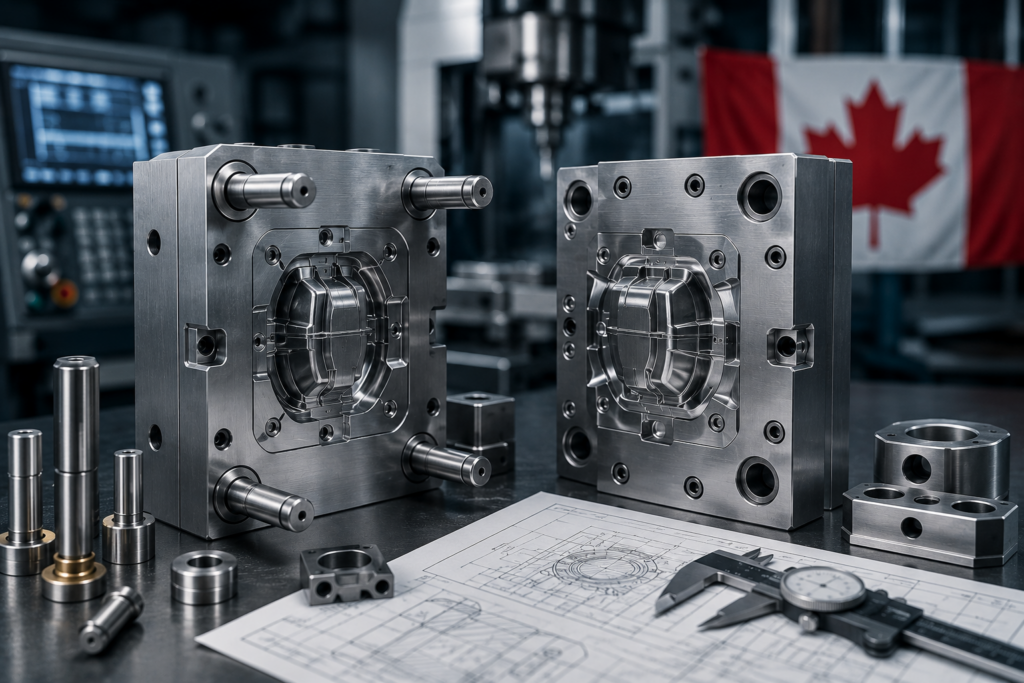
A Complete Guide to Injection Mold Costs, Factors, and Cost-Saving Tips When developing a new plastic product, one of the most important questions manufacturers ask is, “How much does injection mold manufacturing cost in Canada?” The answer depends on several factors, including mold complexity, material selection, cavity count, mold size, production volume, surface finish, and required precision. At Polymach365, we provide custom injection mold design and manufacturing services in Canada for industries such as automotive, medical, electronics, consumer products, packaging, and industrial manufacturing. Whether you need a prototype mold or a high-volume production tool, understanding the cost factors helps you plan your project and maximize your return on investment. This guide explains the average cost of injection mold manufacturing in Canada and highlights practical ways to reduce expenses while maintaining excellent quality. What Is the Average Cost of Injection Mold Manufacturing in Canada? Injection mold manufacturing costs vary based on the complexity and intended production volume. The following estimates provide a general pricing guide for 2026. Injection Mold Type Estimated Cost (CAD) Prototype Mold $2,000 – $8,000 Low-Volume Production Mold $8,000 – $20,000 Medium Production Mold $20,000 – $50,000 High-Volume Production Mold $50,000 – $150,000+ Multi-Cavity Mold $40,000 – $250,000+ These prices are estimates only. Therefore, the final cost depends on the mold design, tooling material, production requirements, and part complexity. What Factors Affect Injection Mold Manufacturing Costs? Several important factors determine the final price of an injection mold. 1. Mold Design Complexity Complex mold designs require additional engineering, machining, and assembly work. Features that increase mold costs include: Complex part geometries Undercuts Side actions Lifters Slides Thin-wall designs Tight tolerances Multiple inserts Therefore, simpler mold designs generally cost less and require shorter manufacturing times. 2. Mold Material The type of steel used significantly affects durability and price. Common Mold Materials P20 Tool Steel H13 Hardened Steel S136 Stainless Steel NAK80 Steel Aluminum (Prototype Molds) For example, aluminum molds are more affordable for prototype production, while hardened steel molds are ideal for high-volume manufacturing because they offer a much longer service life. 3. Number of Cavities A single-cavity mold produces one part per cycle, whereas multi-cavity molds manufacture several parts simultaneously. Although multi-cavity molds require a higher initial investment, they reduce the cost per part during large production runs. Consequently, manufacturers producing thousands of components often choose multi-cavity tooling. 4. Mold Size Larger molds require more raw material, machining time, and larger CNC equipment. As a result, larger molds generally cost more than smaller, simpler molds. 5. Precision Requirements Products requiring high dimensional accuracy demand additional machining, grinding, polishing, and inspection. Industries such as: Automotive Medical Devices Aerospace Electronics often require extremely tight tolerances. Therefore, precision tooling usually increases manufacturing costs. 6. Surface Finish Surface texture directly impacts tooling complexity. Common mold finishes include: Mirror Polish Matte Finish SPI Standards VDI Texture EDM Texture Although premium finishes improve product appearance, they require additional polishing and processing, increasing the overall mold cost. 7. Production Volume Production quantity plays a major role in selecting the appropriate mold design. Prototype Production Designed for product testing and design validation. Lower upfront investment. Low-Volume Production Suitable for startup products and pilot manufacturing. Moderate tooling investment. High-Volume Manufacturing Built for hundreds of thousands or even millions of parts. Higher initial cost but lower long-term production cost. As production volume increases, the cost per molded part decreases significantly. Typical Injection Mold Manufacturing Process At Polymach365, every mold follows a proven engineering workflow. Step 1 – Product Design Review Our engineers evaluate your CAD model for manufacturability. Step 2 – Mold Design We create a custom mold design optimized for performance and production efficiency. Step 3 – CNC Machining High-precision CNC milling, turning, EDM, and grinding manufacture the mold components. Step 4 – Mold Assembly All components are assembled, fitted, and inspected. Step 5 – Mold Testing Trial molding validates performance before production. Step 6 – Final Delivery The completed mold is delivered ready for production. This streamlined process ensures consistent quality, reduced lead times, and reliable performance. How to Reduce Injection Mold Manufacturing Costs Fortunately, there are several effective ways to lower tooling costs without compromising product quality. Simplify Product Design Avoid unnecessary features such as deep ribs, sharp corners, and undercuts. Simple designs reduce machining time and tooling complexity. Optimize Wall Thickness Uniform wall thickness improves mold filling while reducing machining and maintenance costs. Select the Right Mold Material Choose aluminum for prototypes and hardened steel for long-term production. This approach balances initial investment with expected production volume. Design for Manufacturability (DFM) At Polymach365, our engineering team performs Design for Manufacturability (DFM) analysis before production begins. As a result, we identify potential issues early, reduce tooling modifications, and improve manufacturing efficiency. Choose the Correct Number of Cavities A single-cavity mold may be ideal for prototypes, while multi-cavity molds deliver better value for mass production. Therefore, selecting the appropriate mold configuration helps optimize both cost and productivity. Why Choose Polymach365 for Injection Mold Manufacturing in Canada? Polymach365 combines advanced engineering, precision machining, and strict quality control to manufacture durable, high-performance injection molds. Our Services Include ✔ Injection Mold Design ✔ Custom Injection Mold Manufacturing ✔ Mold Components Manufacturing ✔ CNC Machining ✔ EDM Machining ✔ Rapid Prototyping ✔ Low-Volume Production ✔ High-Volume Manufacturing ✔ Mold Repair & Maintenance ✔ Engineering Support ✔ Quality Inspection ✔ Fast Delivery Across Canada Moreover, our experienced team ensures every mold meets your exact production requirements. Industries We Serve Our injection mold manufacturing solutions support a wide range of industries across Canada. Automotive Medical Devices Consumer Products Packaging Electronics Aerospace Industrial Equipment Electrical Components Plastic Manufacturing Consequently, businesses across multiple sectors trust Polymach365 for reliable tooling solutions. How to Get an Accurate Injection Mold Quote To receive the most accurate quotation, please provide: 3D CAD File (STEP, IGES, or SolidWorks) Product Material Annual Production Quantity Surface Finish Requirements Tolerance Specifications Expected Delivery Timeline Our engineering team will review your design and provide a detailed quotation with expert DFM recommendations. Why Manufacturers
How Much Does CNC Machining Cost in Canada? (2026 Pricing Guide)
Everything Manufacturers Need to Know Before Requesting a CNC Machining Quote When planning a manufacturing project, one of the first questions businesses ask is, “How much does CNC machining cost in Canada?” The answer depends on several factors, including material selection, part complexity, machining time, tolerances, surface finish, production volume, and lead time. At Polymach365, we provide precision CNC machining services across Canada with transparent pricing, fast turnaround times, and high-quality manufacturing solutions. Whether you need a single prototype, low-volume production, or large-scale manufacturing, understanding the cost factors can help you optimize your budget without compromising quality. In this guide, we’ll explain what affects CNC machining costs in Canada and share practical tips to help you reduce expenses while achieving outstanding results. What Is the Average Cost of CNC Machining in Canada? CNC machining costs vary depending on your project’s specifications. While every part is unique, the following estimates provide a general pricing guide for 2026. CNC Machining Service Estimated Cost (CAD) Simple Prototype Part $75 – $250 Medium Complexity Part $250 – $800 Complex Precision Part $800 – $3,500+ CNC Milling (Hourly) $80 – $180/hour CNC Turning (Hourly) $70 – $160/hour 5-Axis CNC Machining $120 – $250+/hour These figures are estimates only. Therefore, the final cost depends on your design, material, quantity, machining time, and finishing requirements. What Factors Affect CNC Machining Costs? Understanding the major cost drivers helps you design parts more efficiently and control manufacturing expenses. 1. Material Selection The material you choose has a significant impact on machining costs because different materials require different machining speeds, tooling, and cutting conditions. Common Materials Metals Aluminum Stainless Steel Carbon Steel Brass Copper Titanium Plastics ABS Delrin (Acetal) Nylon Polycarbonate PEEK PTFE For example, aluminum machines quickly and is generally more affordable, while titanium requires longer machining times and specialized tooling. Consequently, titanium parts cost considerably more than aluminum components. 2. Part Complexity Simple components with straight edges and standard features are faster to manufacture. However, complex geometries require additional machining operations, tool changes, and programming. Features that increase costs include: ✔ Deep pockets ✔ Thin walls ✔ Internal cavities ✔ Tight corners ✔ Complex contours ✔ Multi-sided machining Therefore, simplifying your design can significantly reduce manufacturing costs. 3. CNC Machine Type Different CNC machines have different operating costs. 3-Axis CNC Milling Ideal for standard components and simple geometries. Lowest machining cost. 4-Axis CNC Milling Provides greater flexibility while reducing setup time. Moderate machining cost. 5-Axis CNC Machining Perfect for highly complex parts requiring fewer setups. Higher hourly rates but often lower overall production costs because machining is completed faster. 4. Machining Time Machine time is one of the largest contributors to CNC machining costs. Longer machining times mean: More machine usage Increased labor Higher tooling wear Greater production costs Therefore, optimizing part geometry helps reduce machining hours and lowers overall pricing. 5. Production Quantity The number of parts you order directly affects the cost per unit. Prototype Production Higher cost per part because setup costs are shared across fewer components. Low-Volume Production Better pricing with reduced cost per unit. Production Manufacturing Large production runs significantly lower the unit price because setup costs are distributed across more parts. As a result, ordering larger quantities often provides substantial cost savings. 6. Tolerance Requirements Standard machining tolerances are generally less expensive than ultra-precision machining. For example: Standard tolerances require fewer machining operations. Tight tolerances demand slower machining speeds, specialized inspection, and additional quality control. Consequently, tighter tolerances increase manufacturing costs. 7. Surface Finish Requirements Surface finishing adds additional production steps. Common finishing options include: Anodizing Powder Coating Sand Blasting Bead Blasting Polishing Brushing Painting Passivation Although these finishes improve appearance and durability, they also increase production costs. How to Reduce CNC Machining Costs Fortunately, there are several ways to reduce costs without sacrificing quality. Optimize Your CAD Design Design parts with simple geometries whenever possible. Avoid unnecessary pockets and sharp internal corners. Use standard hole sizes. Reduce unnecessary machining features. As a result, machining becomes faster and more economical. Choose Cost-Effective Materials Select materials based on performance requirements rather than over-engineering your design. For many applications, aluminum provides excellent strength, machinability, and affordability. Order Larger Quantities Producing multiple parts during one setup significantly lowers the cost per component. Therefore, combining orders can improve manufacturing efficiency. Standardize Features Using common thread sizes, hole diameters, and tooling dimensions reduces machining time. Consequently, production becomes faster and less expensive. Request Design for Manufacturability (DFM) Feedback At Polymach365, we review every design before production. Our engineering team recommends improvements that reduce machining time, material waste, and manufacturing costs while maintaining part performance. Why Choose Polymach365 for Affordable CNC Machining in Canada? At Polymach365, we help manufacturers optimize quality, speed, and cost through advanced CNC machining solutions. Our CNC Services Include ✔ CNC Milling Services ✔ CNC Turning Services ✔ 5-Axis CNC Machining ✔ Rapid Prototyping ✔ Low-Volume Production ✔ Production Manufacturing ✔ Injection Mold Components ✔ Custom CNC Machining Solutions ✔ Engineering Support ✔ Quality Inspection ✔ Fast Delivery Across Canada Moreover, we provide transparent quotations with no hidden costs, allowing customers to plan projects with confidence. Industries We Serve Our CNC machining solutions support manufacturers across numerous industries. Automotive Aerospace Medical Devices Industrial Equipment Robotics Electronics Energy Consumer Products Mold & Tool Manufacturing Therefore, regardless of your industry, Polymach365 delivers precision components that meet strict quality standards. How to Get an Accurate CNC Machining Quote To receive the most accurate pricing, provide the following information: CAD File (STEP, IGES, or SolidWorks) Material Selection Quantity Required Surface Finish Requirements Tolerance Specifications Delivery Timeline Once we review your design, our engineering team provides a detailed quotation along with Design for Manufacturability (DFM) recommendations to optimize cost and production efficiency. Why Manufacturers Across Canada Trust Polymach365 Businesses choose Polymach365 because we combine precision engineering with responsive customer service. What Sets Us Apart? ✔ Precision CNC Machining ✔ Competitive Canadian Pricing ✔ Fast Turnaround Times ✔ Advanced Multi-Axis CNC Machines ✔ Experienced Engineering Team ✔ Strict Quality
3D Printing vs CNC Machining for Prototyping: Which Is Better?
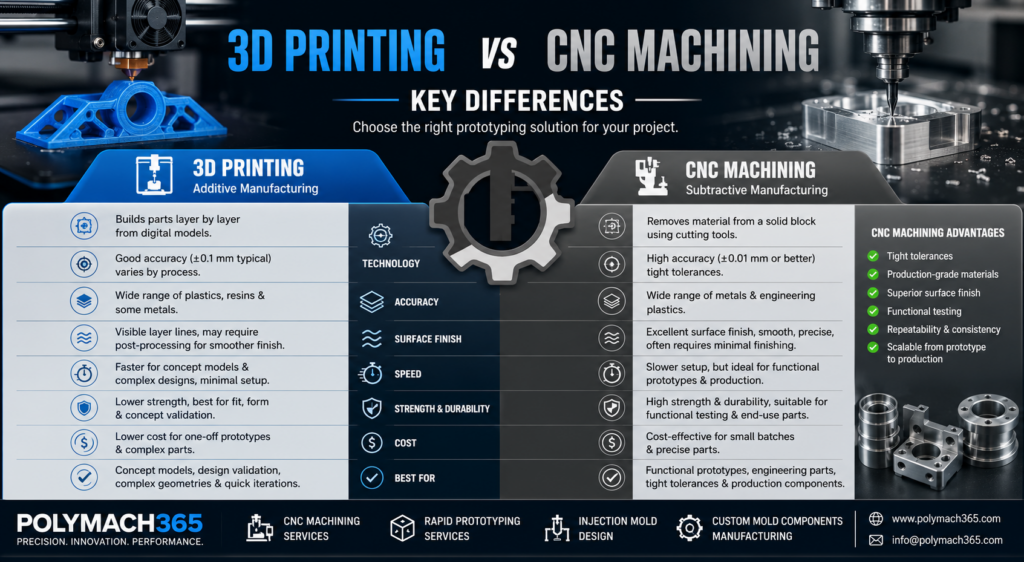
A Complete Guide for Manufacturers in Canada When developing a new product, one of the first decisions manufacturers face is choosing the right prototyping method. Two of the most popular options are 3D Printing and CNC Machining. While both technologies help transform digital designs into physical parts, they offer different advantages depending on your project requirements. At Polymach365, we provide both Rapid Prototyping Services and Precision CNC Machining Services to help businesses across Canada accelerate product development and reduce manufacturing risks. Therefore, understanding the strengths and limitations of each process is essential before selecting the best solution for your prototype. In this guide, we’ll compare 3D printing and CNC machining based on accuracy, materials, cost, speed, surface finish, and production readiness so you can make the right decision for your project. What Is 3D Printing? 3D printing, also known as additive manufacturing, creates parts layer by layer from a digital CAD model. Unlike traditional manufacturing methods, 3D printing adds material only where needed. Therefore, it allows engineers to create highly complex geometries and internal structures that would be difficult or impossible to machine. Common 3D Printing Technologies ✔ FDM (Fused Deposition Modeling) ✔ SLA (Stereolithography) ✔ SLS (Selective Laser Sintering) ✔ MJF (Multi Jet Fusion) ✔ Metal 3D Printing As a result, 3D printing has become a popular solution for concept models, design validation, and early-stage product development. What Is CNC Machining? CNC machining is a subtractive manufacturing process that removes material from a solid block using computer-controlled cutting tools. Consequently, CNC machining produces highly accurate parts with excellent mechanical properties and superior surface finishes. Common CNC Processes ✔ CNC Milling ✔ CNC Turning ✔ 5-Axis Machining ✔ Precision Drilling ✔ Multi-Axis Machining Therefore, CNC machining is widely used for functional prototypes, engineering validation, and production-ready components. 3D Printing vs CNC Machining: Key Differences Accuracy and Tolerances One of the biggest differences between the two technologies is dimensional accuracy. CNC Machining CNC machining delivers extremely tight tolerances and repeatable precision. Therefore, it is ideal for parts that require exact dimensions and assembly compatibility. Typical CNC tolerances can be significantly tighter than those achieved with most 3D printing technologies. 3D Printing While modern 3D printers offer good accuracy, layer-based manufacturing can introduce slight variations depending on the process and material used. As a result, 3D printed parts may require additional finishing for high-precision applications. Winner: CNC Machining For precision engineering and tight tolerances, CNC machining is the preferred choice. Material Selection Material performance plays a major role in prototype success. CNC Machining Materials Aluminum Stainless Steel Brass Copper Titanium ABS Delrin Nylon PEEK Because CNC machining uses production-grade materials, prototypes accurately represent final product performance. 3D Printing Materials PLA ABS PETG Nylon Resin Materials Metal Powders Although material options continue to expand, some 3D printed materials may not fully replicate the strength and durability of production-grade materials. Winner: CNC Machining For functional testing and real-world performance validation, CNC machining offers superior material options. Design Complexity This is where 3D printing often excels. 3D Printing Advantages Because parts are built layer by layer, engineers can create: ✔ Internal channels ✔ Lattice structures ✔ Organic geometries ✔ Lightweight designs ✔ Complex assemblies Therefore, 3D printing provides greater design freedom. CNC Machining Limitations CNC machining is restricted by cutting tool access and machining constraints. Consequently, some highly complex geometries may be difficult or expensive to manufacture. Winner: 3D Printing For highly complex shapes and intricate designs, 3D printing offers greater flexibility. Surface Finish Quality Surface quality is critical for many prototypes. CNC Machining CNC-machined parts generally have smoother surfaces and superior finishes directly from the machine. Therefore, they often require minimal post-processing. 3D Printing Layer lines are often visible on printed parts. As a result, sanding, polishing, or additional finishing may be required for aesthetic applications. Winner: CNC Machining For professional appearance and production-quality finishes, CNC machining delivers better results. Speed of Prototyping Speed is often a deciding factor during product development. 3D Printing Because there is minimal setup required, 3D printing can produce prototypes quickly, especially for one-off parts and design iterations. Therefore, it is excellent for rapid concept validation. CNC Machining CNC machining requires programming, tooling setup, and machine preparation. Consequently, lead times may be slightly longer for single prototypes. Winner: 3D Printing For fast design iterations and early-stage development, 3D printing is often the quickest solution. Cost Comparison Cost depends on part complexity, quantity, and material selection. 3D Printing For one-off prototypes and highly complex parts, 3D printing is often more cost-effective because there is little setup cost. CNC Machining While setup costs may be higher initially, CNC machining becomes more economical for small production runs and repeat manufacturing. Winner ✔ Single Prototype → 3D Printing ✔ Functional Prototype → CNC Machining ✔ Small Production Runs → CNC Machining Production Readiness Many manufacturers use prototypes to prepare for production. CNC Machining Because CNC machining uses production-grade materials and manufacturing processes, prototypes closely match final production parts. Therefore, engineering validation becomes more accurate. 3D Printing While excellent for concept development, some printed materials may not replicate final production performance. Consequently, additional validation may be required before manufacturing begins. Winner: CNC Machining For production-ready prototypes and engineering validation, CNC machining is the better choice. When Should You Choose 3D Printing? Choose 3D printing when you need: ✔ Rapid concept models ✔ Design validation ✔ Complex geometries ✔ Internal structures ✔ Fast design iterations ✔ Low-cost early-stage prototypes Therefore, 3D printing is ideal during the initial stages of product development. When Should You Choose CNC Machining? Choose CNC machining when you need: ✔ Tight tolerances ✔ Production-grade materials ✔ Functional testing ✔ Superior surface finishes ✔ Production-ready prototypes ✔ Small-batch manufacturing Consequently, CNC machining is often the preferred solution for engineering prototypes and market-ready products. Why Polymach365 Is Your Prototyping Partner At Polymach365, we help manufacturers select the most effective prototyping solution based on project goals, timelines, and budgets. Our Services Include: ✔ Rapid Prototyping Services ✔ CNC Milling Services ✔ CNC Turning
Low-Volume Production vs Mass Production: Which Is Right for Your Business?
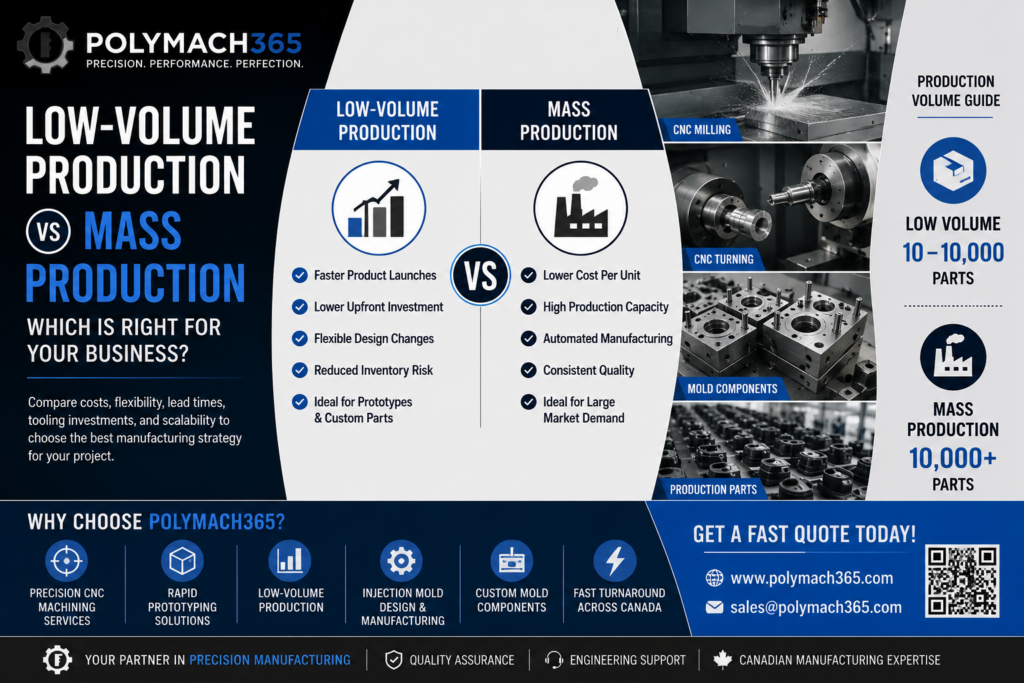
A Complete Manufacturing Guide for Canadian Businesses In today’s competitive manufacturing industry, choosing the right production method can significantly impact your costs, product quality, inventory management, and time-to-market. Therefore, businesses must carefully evaluate whether Low-Volume Production or Mass Production best aligns with their goals. At Polymach365, we help manufacturers, startups, and product developers across Canada select the most efficient production strategy for their unique requirements. Whether you’re launching a new product, validating market demand, or scaling an established product line, understanding the differences between low-volume and mass production is essential for long-term success. This guide explains the advantages, challenges, and ideal applications of each manufacturing approach so you can make an informed decision. What Is Low-Volume Production? Low-volume production refers to manufacturing a relatively small quantity of parts or products, typically ranging from a few units to several thousand pieces. It serves as a bridge between rapid prototyping and full-scale production. Therefore, low-volume manufacturing is ideal for businesses that need flexibility, faster design updates, and lower upfront investment. Common Applications ✔ Product development ✔ Market testing ✔ Custom products ✔ Pilot production runs ✔ Specialized industrial components ✔ Medical and aerospace parts As a result, companies can evaluate product performance before committing to large-scale manufacturing. What Is Mass Production? Mass production is the process of manufacturing large quantities of identical products using highly optimized production systems and tooling. Because production volumes are significantly higher, manufacturers benefit from economies of scale and lower per-unit costs. Common Applications ✔ Consumer products ✔ Automotive components ✔ Electronics manufacturing ✔ Packaging products ✔ Household goods ✔ High-demand industrial products Consequently, mass production becomes the preferred choice when demand is stable and production volumes are high. Key Differences Between Low-Volume Production and Mass Production Feature Low-Volume Production Mass Production Production Quantity Small to Medium Large Scale Initial Investment Lower Higher Tooling Costs Reduced Significant Design Flexibility High Limited Lead Time Faster Longer Setup Unit Cost Higher Per Part Lower Per Part Inventory Risk Lower Higher Product Customization Easy Difficult Market Testing Excellent Limited Therefore, the best choice depends on your product stage, budget, and business objectives. Benefits of Low-Volume Production 1. Lower Upfront Investment One of the biggest advantages of low-volume production is reduced initial cost. Because manufacturers produce fewer parts, businesses avoid large tooling investments and excessive inventory expenses. Advantages ✔ Lower financial risk ✔ Reduced startup costs ✔ Better cash flow management ✔ Faster project approval As a result, startups and growing businesses can enter the market more efficiently. 2. Faster Time-to-Market Speed is often critical when launching a new product. Low-volume manufacturing allows companies to move from design to production quickly without waiting for expensive production tooling. Benefits Include ✔ Faster product launches ✔ Shorter development cycles ✔ Quicker market feedback ✔ Competitive advantage Therefore, businesses can respond more rapidly to changing customer demands. 3. Greater Design Flexibility Product designs often evolve during development. Low-volume production makes it easier to implement design changes without significant tooling modifications or production delays. Ideal For Product improvements Design validation Engineering revisions Market-driven modifications Consequently, manufacturers maintain flexibility throughout the development process. 4. Reduced Inventory Risk Producing large quantities before market validation can create significant inventory challenges. However, low-volume production allows companies to manufacture based on actual demand. Benefits ✔ Lower storage costs ✔ Reduced excess inventory ✔ Better inventory management ✔ Less financial exposure As a result, businesses improve operational efficiency and reduce waste. Benefits of Mass Production 1. Lower Cost Per Unit The primary advantage of mass production is cost efficiency. Because tooling, setup, and operational costs are spread across thousands of parts, the cost per unit decreases significantly. Cost Advantages ✔ Economies of scale ✔ Lower manufacturing cost ✔ Improved profitability ✔ Higher production efficiency Therefore, mass production becomes highly cost-effective for established products with predictable demand. 2. Consistent Product Quality Mass production systems are designed for repeatability and consistency. Advanced automation and process control ensure that every part meets the same quality standards. Benefits ✔ Uniform product quality ✔ Reduced variation ✔ Improved customer satisfaction ✔ Reliable production output Consequently, manufacturers can maintain consistency across large production runs. 3. High Production Capacity When market demand increases, businesses need the ability to produce large quantities efficiently. Mass production supports: ✔ Large-scale manufacturing ✔ Global distribution ✔ High-demand products ✔ Continuous production As a result, companies can meet growing customer demand without significant production constraints. 4. Increased Automation Mass production environments typically utilize advanced automation technologies. Benefits Include ✔ Reduced labor costs ✔ Improved productivity ✔ Faster cycle times ✔ Consistent manufacturing quality Therefore, automation contributes significantly to operational efficiency. When Should You Choose Low-Volume Production? Low-volume production is often the best solution when: ✔ Launching a New Product Test market demand before investing in large-scale production. ✔ Developing Prototypes Bridge the gap between prototyping and full production. ✔ Producing Custom Components Manufacture specialized parts with unique requirements. ✔ Managing Uncertain Demand Avoid excessive inventory and financial risk. ✔ Supporting Niche Markets Serve specialized industries such as aerospace, medical, and industrial manufacturing. As a result, businesses gain flexibility and reduce risk during product development. When Should You Choose Mass Production? Mass production is ideal when: ✔ Demand Is Consistent High-volume sales justify larger production runs. ✔ Product Design Is Finalized Design stability minimizes production changes. ✔ Cost Reduction Is a Priority Large production quantities lower unit costs. ✔ Market Demand Is Proven Customer demand supports large-scale manufacturing. ✔ Distribution Networks Are Established Products can move efficiently through supply chains. Consequently, businesses maximize profitability through large-scale production efficiency. How Polymach365 Supports Both Manufacturing Approaches At Polymach365, we understand that every project has unique production requirements. Therefore, we offer flexible manufacturing solutions that support both low-volume and production-scale manufacturing. Our Capabilities Include: ✔ Rapid Prototyping Services ✔ Prototype Manufacturing ✔ Low-Volume Production ✔ CNC Machining Services ✔ CNC Milling & Turning ✔ 5-Axis CNC Machining ✔ Injection Mold Design Services ✔ Custom Mold Components Manufacturing ✔ Plastic Injection Molding Services ✔ Production Manufacturing Solutions Moreover,