CNC Machining for Replacement Parts: Benefits and Applications
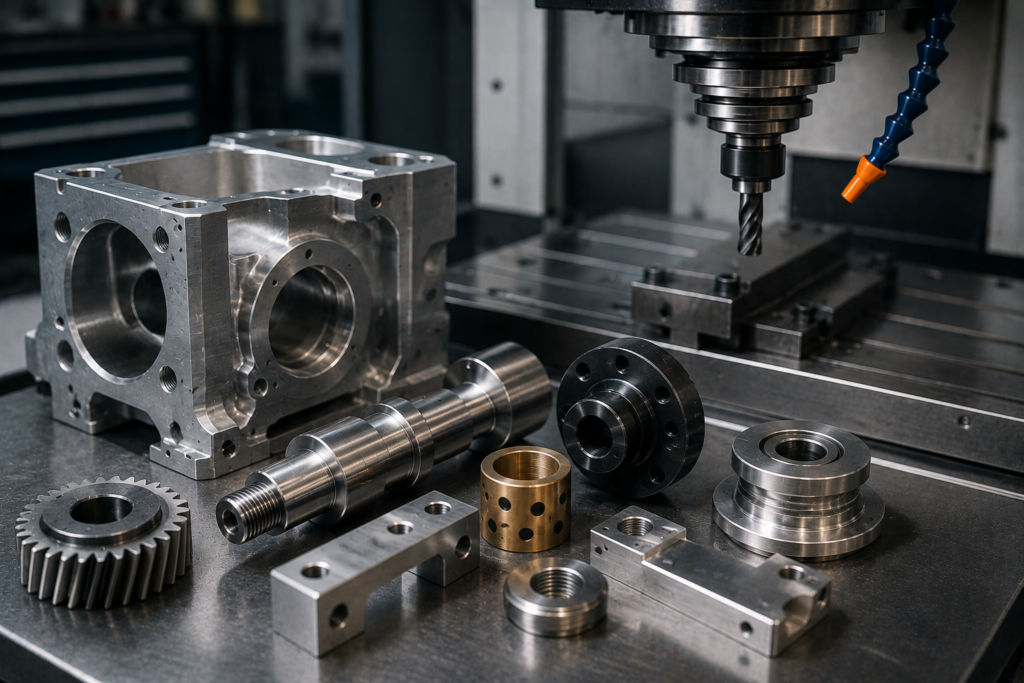
Reliable Custom Manufacturing for Replacement Components When an essential machine component fails, finding the correct replacement part quickly can be challenging. Original components may be discontinued, unavailable, difficult to source, or subject to long lead times. CNC machining for replacement parts provides manufacturers and maintenance teams with a flexible way to produce custom components according to specific dimensions and application requirements. Instead of waiting for a standard replacement to become available, businesses can manufacture a component from a CAD model, engineering drawing, existing sample, or measured specifications, depending on the project requirements. At Polymach365, we provide CNC milling, CNC turning, 3-axis, 4-axis, and 5-axis machining, prototype manufacturing, low-volume production, custom CNC parts, and precision machining solutions. These capabilities can support replacement-part requirements across industrial machinery, automation, automotive, tooling, and other applications. What Are CNC Replacement Parts? CNC replacement parts are custom-machined components manufactured to replace an original or damaged component. These parts may be required when the original component is: Worn out Damaged Discontinued Difficult to source No longer supported Available only with long lead times No longer manufactured Therefore, CNC machining can provide an alternative manufacturing route for components that are not readily available through conventional suppliers. Common CNC replacement parts include: Shafts Bushings Pins Brackets Housings Couplings Spacers Mounting plates Rollers Fixtures Machine components Custom tooling Why Use CNC Machining for Replacement Parts? CNC machining provides several advantages when a replacement component needs to match an existing part. 1. Manufacture Parts to Specific Dimensions Replacement components often need to fit directly into an existing assembly. Therefore, dimensional accuracy is particularly important. CNC machining can manufacture features such as: Precise holes Shafts Threads Slots Pockets Mounting surfaces Cylindrical features As a result, manufacturers can produce replacement components according to defined engineering specifications. 2. Reduce Equipment Downtime Unexpected component failure can interrupt production. When a critical part is unavailable, equipment may remain inactive until a replacement arrives. CNC machining can provide a manufacturing option for certain custom replacement components, helping businesses address urgent requirements more efficiently. However, actual production and delivery times depend on factors such as: Part complexity Material availability Quantity Tolerances Finishing requirements Machine availability Therefore, providing complete technical information early can help streamline the manufacturing process. 3. Manufacture Discontinued Components Older machinery may use components that are no longer produced by the original manufacturer. Replacing the entire machine simply because one component is unavailable may not be practical. Instead, a replacement component can potentially be manufactured based on available technical information. This may include: Original CAD files Engineering drawings Technical specifications Existing samples Measured dimensions Consequently, CNC machining can help extend the useful life of older equipment when suitable replacement manufacturing is technically feasible. 4. Support One-Off and Low-Volume Requirements Replacement parts are often needed in very small quantities. For example, a business may require only: One shaft Two bushings A replacement bracket A small batch of machine components CNC machining can support one-off and low-volume manufacturing without requiring large production quantities. Therefore, it can be particularly useful for specialized or infrequently replaced components. 5. Manufacture Custom Components Not every replacement component has a standard equivalent. Some machines use custom-designed parts that cannot be purchased from regular component suppliers. CNC machining allows manufacturers to reproduce components according to specific requirements. Therefore, custom machining can support replacement parts with: Unique dimensions Custom mounting patterns Special holes Complex profiles Specific materials Tight tolerances CNC Milling for Replacement Parts CNC milling is suitable for replacement components with flat surfaces, pockets, holes, slots, and complex profiles. Common replacement milled parts include: Brackets Mounting plates Machine housings Fixtures Covers Tooling components Custom mechanical parts Furthermore, 4-axis and 5-axis machining can provide access to multiple surfaces when a replacement component has more complex geometry. CNC Turning for Replacement Parts CNC turning is particularly suitable for rotational replacement components. Typical examples include: Shafts Bushings Pins Rollers Sleeves Spacers Couplings Threaded components Because the workpiece rotates during machining, CNC turning can produce consistent cylindrical features and diameters. Consequently, it can be an effective manufacturing method for many mechanical replacement components. 5-Axis CNC Machining for Complex Replacement Components Some replacement parts have features across multiple surfaces or contain difficult-to-access geometry. In suitable applications, 5-axis CNC machining can provide greater flexibility for these components. It can be useful for: Complex contours Angled surfaces Deep cavities Multi-sided components Specialized tooling Complex machine components Therefore, selecting the appropriate machining process is important when reproducing complex replacement parts. Materials for CNC Replacement Parts The replacement material should be selected according to the original component’s function and operating environment. Common CNC machining materials include: Aluminum Aluminum provides low weight and good machinability. Therefore, it can be suitable for lightweight brackets, housings, fixtures, and machine components. Stainless Steel Stainless steel offers strength and corrosion resistance. Consequently, it can be useful for components operating in demanding environments. Carbon Steel Carbon steel provides strength and durability for many industrial applications. Brass Brass offers good machinability and corrosion resistance, making it suitable for fittings, bushings, connectors, and other components. Copper Copper is useful when electrical or thermal conductivity is important. Titanium Titanium provides a high strength-to-weight ratio and corrosion resistance, although it requires appropriate machining strategies. Engineering Plastics Materials such as ABS, Nylon, Delrin, Polycarbonate, PEEK, and PTFE can be considered when low weight, electrical insulation, chemical resistance, or low friction is required. Therefore, material selection should always consider the component’s original function and operating conditions. How to Manufacture a CNC Replacement Part A typical replacement-part workflow can include several stages. Step 1: Identify the Failed Component Determine the component’s function and how it interacts with the surrounding assembly. Step 2: Collect Technical Information Provide an available: CAD file Engineering drawing Dimensions Material specification Existing component Photographs Technical requirements The more complete the information, the easier it is to establish the manufacturing requirements. Step 3: Review the Design The component can be evaluated for: Manufacturability Tolerances Material Tool access Workholding Machining process Step 4: Select the CNC Process Depending on the geometry, manufacturers may
How CNC Machining Supports Just-in-Time Manufacturing
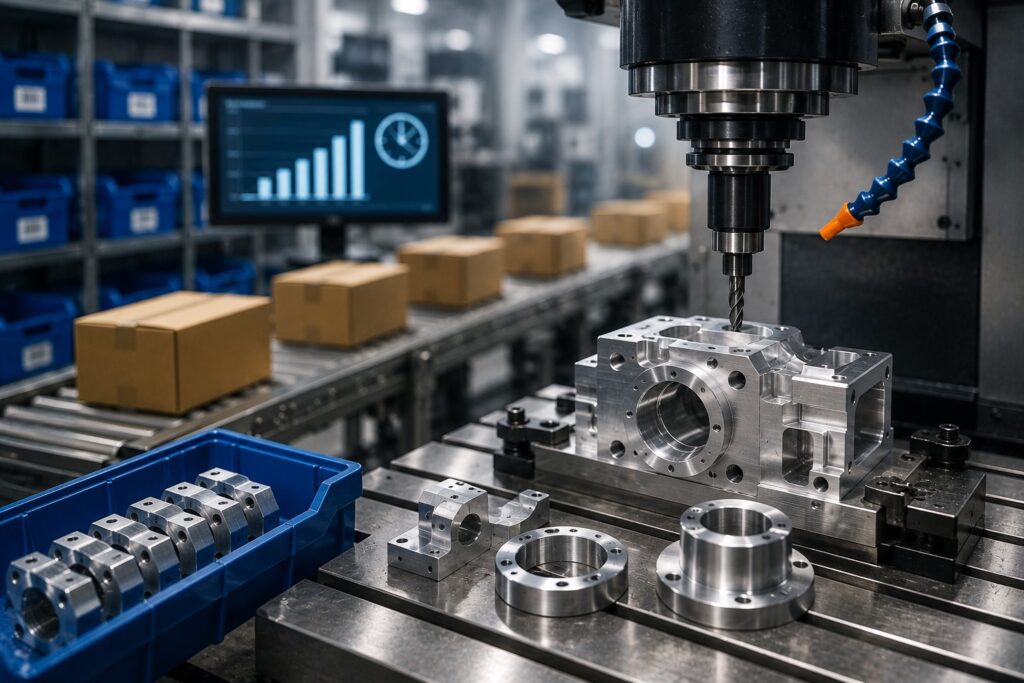
Improving Production Flexibility, Inventory Control, and Delivery Modern manufacturers constantly look for ways to reduce inventory, shorten production lead times, control costs, and respond quickly to changing customer demand. Just-in-Time (JIT) manufacturing addresses these challenges by producing components when they are needed instead of maintaining unnecessarily large inventories. CNC machining can play an important role in this approach. With digital CAD-based production, automated machining, repeatable processes, and flexible manufacturing capabilities, CNC machining allows businesses to produce custom components according to actual production requirements. At Polymach365, we provide CNC milling, CNC turning, 3-axis, 4-axis, and 5-axis machining, prototype manufacturing, low-volume production, custom CNC parts, and precision machining solutions. These capabilities can support manufacturers that need flexible production without relying on excessive component inventory. What Is Just-in-Time Manufacturing? Just-in-Time manufacturing is a production strategy in which materials and components are produced or delivered close to the time they are required. Instead of manufacturing large quantities and storing them for long periods, businesses aim to synchronize production with actual demand. A simplified JIT workflow looks like: Customer Demand → Production Planning → Component Manufacturing → Assembly → Delivery Therefore, manufacturers can reduce unnecessary inventory while maintaining a responsive production process. Why Is CNC Machining Important for JIT Manufacturing? CNC machining is well suited to flexible manufacturing because machines can produce different components by changing the digital program, tooling, and setup. Unlike processes that require dedicated tooling for every new component, CNC machining can often move between different designs using the appropriate CNC program. As a result, manufacturers can produce: Custom components Replacement parts Small batches Prototype parts Production components Machine components Tooling and fixtures Consequently, CNC machining can support production environments where component requirements change frequently. 1. Reduces the Need for Large Inventories Maintaining a large inventory of spare parts and components can tie up capital and require additional storage space. JIT manufacturing aims to reduce this dependency by producing parts closer to when they are required. CNC machining can support this approach by manufacturing components according to current production requirements. For example, instead of storing thousands of specialized replacement components, a manufacturer may maintain the digital CAD file and manufacture the required quantity when demand occurs. Therefore: Digital Inventory → Manufacturing on Demand → Reduced Physical Inventory This approach can be particularly useful for custom or low-demand components. 2. Supports Low-Volume Production JIT manufacturing does not always require large production runs. Businesses may need only a small number of components at a particular time. CNC machining is suitable for: One-off components Small batches Short production runs Replacement parts Engineering components Specialized industrial parts Therefore, manufacturers can produce closer to actual demand rather than committing to unnecessarily large quantities. 3. Shortens the Path from Design to Production Traditional manufacturing workflows can involve several stages between product design and physical production. Digital CNC manufacturing can simplify this process. A typical workflow is: CAD Design → Manufacturing Review → CNC Programming → Machining → Inspection → Delivery As a result, manufacturers can move from a digital design to a physical component through a streamlined process. This flexibility can be valuable when production schedules change unexpectedly. 4. Supports On-Demand Manufacturing One of the key principles of JIT manufacturing is producing components when they are needed. CNC machining can support on-demand production for custom and specialized components. For example, a manufacturer may require: Replacement machine parts Custom brackets Shafts Bushings Fixtures Tooling components Mold components Instead of storing every possible component, businesses can maintain the required digital designs and manufacture parts according to demand. Therefore, CNC machining can function as an important part of an on-demand manufacturing strategy. 5. Makes Production Changes Easier Manufacturing requirements can change because of: Customer orders Product modifications Engineering changes Supply chain disruptions Market demand Replacement requirements CNC machining provides flexibility because production instructions can be updated digitally. When a component design changes, manufacturers can modify the CAD model and CNC program before producing the next batch. Consequently, CNC machining can support manufacturers that need to respond quickly to engineering or production changes. 6. Supports Prototype-to-Production Manufacturing JIT manufacturing is not limited to established production parts. Product development teams also need prototypes, testing components, and small production batches. CNC machining can support the transition through: Prototype → Testing → Design Improvement → Low-Volume Production → Production Therefore, manufacturers can use CNC machining throughout different stages of product development. This can reduce the need to change manufacturing methods unnecessarily during early development. 7. Reduces Overstock and Obsolescence Excess inventory can become obsolete when: Product designs change Components are redesigned Customer requirements change Equipment is upgraded Products are discontinued JIT manufacturing reduces this risk by limiting unnecessary stock. CNC machining can support this strategy by producing specialized components closer to the time of use. As a result, manufacturers can reduce the amount of physical inventory that may become outdated. 8. Supports Custom Replacement Parts Industrial machinery often requires replacement components that are not readily available as standard products. Examples include: Shafts Bushings Brackets Couplings Mounting plates Machine components Fixtures Custom tooling When an original component becomes unavailable, CNC machining can reproduce a replacement part based on an existing drawing, CAD model, or suitable engineering specifications. Therefore, CNC machining can help manufacturers reduce equipment downtime while avoiding unnecessary stockpiling of replacement parts. 9. CNC Milling for JIT Manufacturing CNC milling is suitable for many custom components used in industrial production. Milling can manufacture: Brackets Housings Plates Fixtures Mounts Machine components Mold components Custom tooling Furthermore, CNC milling can accommodate different component geometries and production quantities. Therefore, it can support JIT manufacturing when businesses need flexible production of custom milled components. 10. CNC Turning for JIT Manufacturing CNC turning is ideal for rotational components. Common examples include: Shafts Pins Bushings Rollers Sleeves Spacers Couplings Threaded components Because CNC turning can produce different component designs through programmed machining operations, it can support production environments where demand varies. Consequently, manufacturers can produce rotational components according to actual requirements. 11. 5-Axis CNC Machining for Complex Components Some JIT
CNC Machining for Custom Metal Parts: Process, Materials, and Applications
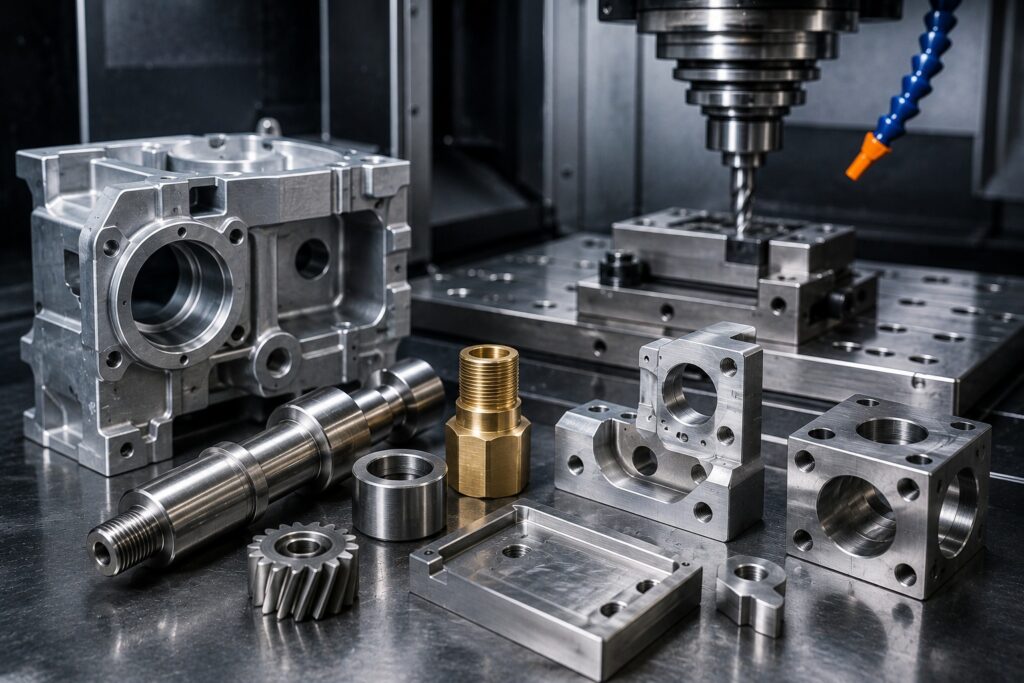
Precision CNC Manufacturing for Custom Metal Components CNC machining for custom metal parts provides manufacturers with a reliable way to produce components with precise dimensions, complex geometries, and repeatable quality. From prototypes and replacement components to low-volume production and industrial parts, CNC machining can accommodate a wide range of manufacturing requirements. Unlike standard off-the-shelf components, custom CNC machined parts are manufactured according to specific CAD models, engineering drawings, dimensions, tolerances, materials, and application requirements. At Polymach365, we provide CNC milling, CNC turning, 3-axis, 4-axis, and 5-axis machining, prototype manufacturing, low-volume production, and custom CNC machining solutions for manufacturers, engineers, and product developers. What Is CNC Machining for Custom Metal Parts? CNC machining uses computer-controlled equipment to remove material from a metal workpiece until it reaches the required shape and dimensions. The process begins with a digital CAD model. Manufacturing software converts the design into machine instructions, and CNC equipment follows the programmed toolpaths to cut the material. Therefore, CNC machining can produce custom components with features such as: Holes Slots Pockets Threads Contoured surfaces Internal cavities Mounting features Precision bores Complex profiles As a result, manufacturers can create custom metal parts that match specific functional and assembly requirements. CNC Machining Process for Custom Metal Parts Producing a custom metal component involves several important stages. 1. CAD Design The process starts with a 2D drawing or 3D CAD model containing the required dimensions and geometry. The design should include important information such as: Material Dimensions Tolerances Surface finish Thread specifications Critical features Therefore, a detailed CAD model helps establish clear manufacturing requirements. 2. Design and Manufacturing Review Before machining begins, the component should be evaluated for manufacturability. This review can identify potential issues involving: Tool accessibility Thin walls Deep pockets Internal corner radii Tight tolerances Workholding Machining orientation Consequently, addressing these issues before production can help reduce machining difficulties and unnecessary costs. 3. Material Selection The correct metal should be selected according to the component’s application. Important considerations include: Strength Weight Hardness Corrosion resistance Temperature resistance Wear resistance Machinability Cost Therefore, material selection should take place before finalizing the machining strategy. 4. CNC Programming The CAD design is converted into machine-readable instructions. The CNC program determines: Tool movement Cutting direction Spindle speed Feed rate Cutting depth Machining sequence As a result, the machine can follow a controlled and repeatable process. 5. CNC Machining The selected metal workpiece is securely positioned in the CNC machine. Depending on the component, manufacturers may use: CNC milling CNC turning 3-axis machining 4-axis machining 5-axis machining Therefore, the machining process can be selected according to the geometry and manufacturing requirements of the part. 6. Inspection and Finishing After machining, critical dimensions and features can be inspected according to the project requirements. Additional finishing processes may also be required, depending on the application. These can include: Deburring Polishing Anodizing Powder coating Plating Heat treatment Consequently, the finished component can be prepared for assembly or final application. CNC Milling for Custom Metal Parts CNC milling uses rotating cutting tools to remove material from a stationary workpiece. It is suitable for manufacturing components with: Flat surfaces Pockets Slots Holes Contours Complex profiles Multiple machined faces Common CNC Milled Parts Brackets Housings Mounting plates Fixtures Machine components Mold components Custom tooling Mechanical parts Furthermore, multi-axis milling can provide greater access to complex component geometries. CNC Turning for Custom Metal Parts CNC turning rotates the workpiece while cutting tools remove material. Therefore, it is particularly suitable for cylindrical or rotational components. Common CNC Turned Parts Shafts Pins Bushings Sleeves Spacers Rollers Couplings Threaded components Cylindrical fittings Moreover, CNC turning can provide consistent diameters and repeatable dimensions across production runs. 5-Axis CNC Machining for Complex Metal Components Some custom metal components require machining from multiple directions. Therefore, 5-axis CNC machining can be useful for complex geometries and difficult-to-access features. It is suitable for components containing: Angled surfaces Complex contours Deep cavities Multi-sided features Organic profiles Precision tooling features As a result, manufacturers can machine complex components with fewer repositioning requirements in suitable applications. Materials Used for Custom CNC Metal Parts Different applications require different metal properties. At Polymach365, common CNC machining materials include a range of metals suitable for different engineering requirements. Aluminum Aluminum is lightweight and generally easy to machine. It is commonly used for: Aerospace components Automotive parts Housings Brackets Fixtures Prototype components Therefore, aluminum is a practical choice when weight reduction and machinability are important. Stainless Steel Stainless steel provides strength and corrosion resistance. It is commonly used for: Industrial equipment Medical components Food-processing equipment Machinery Automotive parts Chemical-processing applications However, stainless steel can require appropriate tooling and cutting parameters because of its machining characteristics. Carbon Steel Carbon steel offers strength and durability and can be used for: Machine components Shafts Fixtures Brackets Industrial equipment Therefore, it can be a practical material when structural strength is a major requirement. Tool Steel Tool steel provides high hardness and wear resistance. Consequently, it is commonly considered for: Dies Tooling Mold components Fixtures Precision manufacturing components. Brass Brass provides good machinability and corrosion resistance. It can be used for: Bushings Fittings Connectors Valves Precision components Therefore, brass can be useful when machinability and corrosion resistance are both important. Copper Copper offers excellent electrical and thermal conductivity. Consequently, it is suitable for applications such as: Electrical components Connectors Heat-transfer components Specialized industrial parts Titanium Titanium provides high strength relative to its weight and excellent corrosion resistance. It is often considered for demanding applications such as: Aerospace Medical equipment High-performance engineering Specialized industrial components However, titanium requires suitable tooling and machining strategies because it can be more challenging to machine than many conventional metals. Applications of Custom CNC Metal Parts Custom CNC machining supports many industries because manufacturers can create components according to specific requirements. Automotive CNC machining can produce: Brackets Shafts Housings Fixtures Mounting components Custom tooling Therefore, CNC machining can support both vehicle development and manufacturing operations. Aerospace Aerospace components often require lightweight materials, complex geometries, and controlled dimensions. Therefore,
CNC Machining Materials: How to Select the Right Material for Your Part
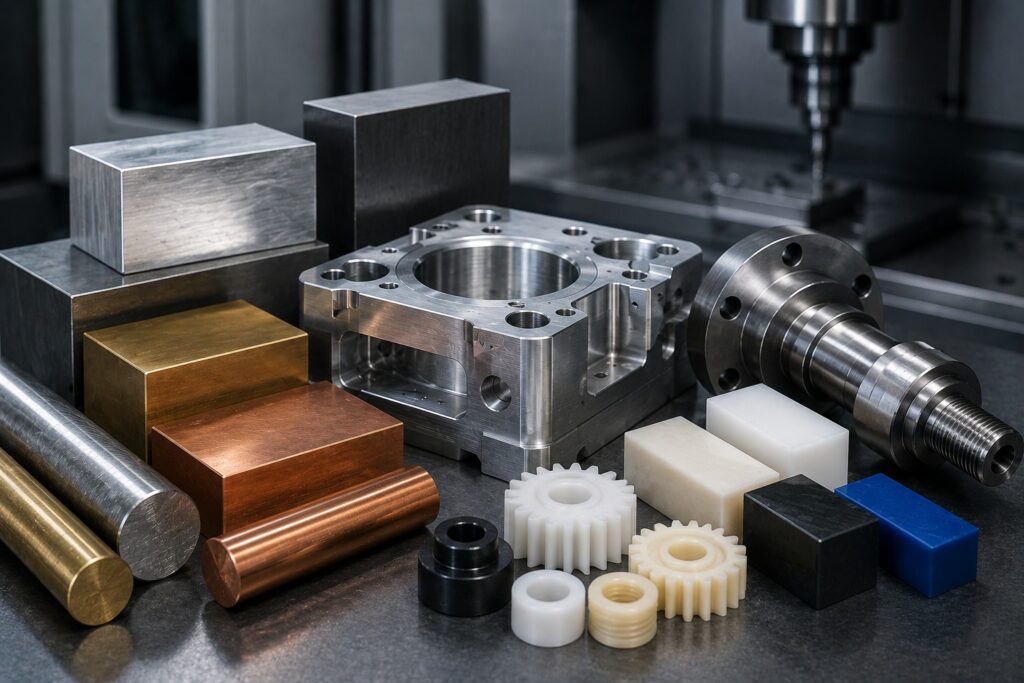
A Complete Guide to Choosing Materials for CNC Machined Components Choosing the right material is one of the most important decisions when designing a CNC machined part. Material selection affects strength, weight, durability, corrosion resistance, machinability, surface finish, cost, and overall product performance. Therefore, engineers should select a material based on the actual application rather than choosing a material simply because it is easy to machine or inexpensive. At Polymach365, we support CNC milling, CNC turning, 3-axis, 4-axis and 5-axis machining, prototype manufacturing, low-volume production, custom CNC parts, and precision machined components. Understanding the characteristics of different CNC machining materials can help you make better manufacturing decisions. Why Material Selection Matters in CNC Machining Every CNC machined component operates under different conditions. For example, an automotive component may require strength and wear resistance, while an electronic housing may prioritize lightweight construction and electrical insulation. Therefore, material selection should consider: Mechanical strength Hardness Weight Corrosion resistance Temperature resistance Wear resistance Chemical resistance Machinability Surface finish Material availability Manufacturing cost As a result, selecting the correct material can improve both part performance and manufacturing efficiency. Common CNC Machining Materials CNC machines can manufacture components from a wide range of metals and engineering plastics. Common CNC machining materials include: Metals Aluminum Stainless Steel Carbon Steel Alloy Steel Tool Steel Brass Copper Titanium Engineering Plastics ABS Nylon Delrin Polycarbonate PEEK PTFE Each material has different properties. Therefore, engineers should evaluate the material according to the requirements of the finished component. 1. Aluminum CNC Machining Aluminum is one of the most widely used materials for CNC machining. It offers a useful combination of low weight, good machinability, strength, and corrosion resistance. Advantages of Aluminum Lightweight Good machinability Good strength-to-weight ratio Corrosion resistance Suitable for complex machining Good surface finishing options Therefore, aluminum is commonly selected for: Automotive components Aerospace components Electronic housings Brackets Enclosures Fixtures Machine components Prototypes Moreover, aluminum can be an excellent choice when reducing component weight is important. 2. Stainless Steel CNC Machining Stainless steel provides strength, durability, and corrosion resistance. Therefore, it is suitable for components that operate in demanding environments. Common Applications Industrial equipment Medical components Food-processing equipment Automotive parts Machinery components Chemical-processing equipment Precision tooling However, stainless steel can require more cutting force than aluminum. Consequently, manufacturers need appropriate cutting tools and machining parameters to achieve efficient production and good surface quality. 3. Carbon Steel CNC Machining Carbon steel provides a combination of strength, durability, and cost efficiency. It can be used for: Machine components Shafts Brackets Fixtures Industrial equipment Structural components Therefore, carbon steel can be a practical choice when strength is important and the application does not require the corrosion resistance of stainless steel. 4. Tool Steel CNC Machining Tool steel is designed for applications requiring high hardness, strength, and wear resistance. It is commonly used for: Dies Tooling Mold components Cutting tools Fixtures Precision manufacturing components However, harder materials can increase machining difficulty. Therefore, manufacturers should select appropriate tooling and machining strategies when working with tool steels. 5. Brass CNC Machining Brass is known for its good machinability, corrosion resistance, and attractive appearance. Therefore, CNC-machined brass components are often used for: Fittings Bushings Connectors Valves Electrical components Decorative components Precision mechanical parts Moreover, brass can provide a good combination of machinability and functional performance. 6. Copper CNC Machining Copper provides excellent electrical and thermal conductivity. Therefore, it is commonly selected for components where heat or electrical conductivity is important. Applications include: Electrical components Heat-transfer components Connectors Busbars Specialized industrial components However, copper can present machining challenges because of its material characteristics. Consequently, tool selection and cutting parameters should be optimized for reliable results. 7. Titanium CNC Machining Titanium provides a high strength-to-weight ratio and excellent corrosion resistance. Therefore, it is commonly used in demanding applications such as: Aerospace Medical equipment High-performance engineering Chemical processing Specialized industrial components However, titanium can be more difficult to machine than many conventional materials. It can generate heat during cutting and place higher demands on cutting tools. As a result, titanium machining requires appropriate tooling, speeds, feeds, and cooling strategies. 8. ABS CNC Machining ABS is an engineering thermoplastic that combines relatively low weight with good impact resistance and machinability. Therefore, it can be useful for: Prototype housings Enclosures Consumer products Fixtures Product-development components Moreover, CNC machining ABS can provide functional prototypes without requiring injection molding tooling. 9. Nylon CNC Machining Nylon is a lightweight engineering plastic with good wear resistance and low friction characteristics. Therefore, it can be useful for: Bushings Rollers Gears Guides Spacers Mechanical components However, plastics can respond differently to heat and machining forces than metals. Consequently, manufacturers should consider thermal effects and workholding when machining nylon. 10. Delrin CNC Machining Delrin, also known as acetal, is widely used for precision plastic components. It provides: Good dimensional stability Low friction Good machinability Wear resistance Low moisture absorption compared with many other plastics Therefore, Delrin is suitable for: Bushings Gears Rollers Fixtures Mechanical components Precision plastic parts 11. PEEK CNC Machining PEEK is a high-performance engineering plastic used when components require demanding mechanical and thermal performance. Therefore, PEEK may be selected for specialized applications involving: High temperatures Chemical exposure Wear Mechanical loading Electrical insulation However, PEEK can be significantly more expensive than common engineering plastics. Consequently, it should generally be selected when its performance characteristics justify the additional material cost. Metal vs Plastic for CNC Machining One of the first decisions engineers often make is whether to manufacture a component from metal or plastic. Choose Metal When You Need: Higher mechanical strength Greater rigidity Higher temperature capability Improved wear resistance Long-term structural performance Choose Engineering Plastic When You Need: Lower weight Electrical insulation Reduced friction Corrosion resistance Lower component weight Specialized chemical resistance Therefore, the correct choice depends on the operating conditions of the component. How Machinability Affects Material Selection Machinability describes how easily a material can be cut and processed. Materials with good machinability can often provide: Faster machining Longer tool life Better surface finish Lower
What Factors Affect CNC Machining Accuracy?
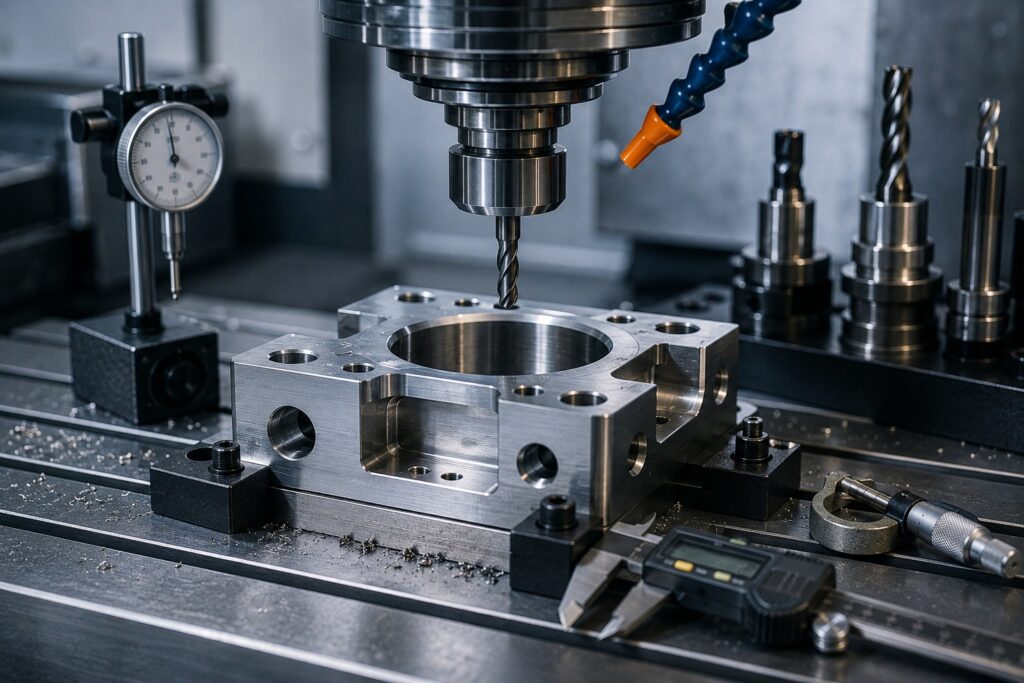
Understanding the Key Factors That Influence CNC Part Accuracy CNC machining is widely used to manufacture precision components for automotive, aerospace, medical, robotics, tooling, and industrial applications. However, achieving accurate CNC machined parts depends on more than simply using a modern CNC machine. Several factors can influence the final accuracy of a component, including machine condition, tooling, material, workholding, machining parameters, temperature, part design, programming, and inspection methods. Therefore, manufacturers must control the entire machining process to achieve consistent and reliable results. At Polymach365, we provide CNC milling, CNC turning, 3-axis, 4-axis, and 5-axis machining, prototype manufacturing, low-volume production, custom CNC parts, and precision machining solutions. Understanding the factors that affect CNC accuracy can help engineers prepare better designs and achieve more consistent manufacturing results. What Is CNC Machining Accuracy? CNC machining accuracy refers to how closely the finished component matches the dimensions and geometry specified in the original CAD model or engineering drawing. For example, if a drawing specifies a hole diameter of 20 mm, the finished hole must remain within the specified tolerance range. Accuracy can involve: Dimensional accuracy Positional accuracy Geometric accuracy Hole location Flatness Parallelism Perpendicularity Roundness Surface finish Therefore, CNC accuracy is not limited to one measurement. It involves the overall dimensional and geometric quality of the finished component. 1. CNC Machine Condition The condition of the CNC machine is one of the most important factors affecting machining accuracy. Over time, machine components can experience wear. Bearings, guideways, ball screws, spindles, and other mechanical components can gradually affect positioning and cutting performance. Common machine-related issues include: Backlash Spindle runout Guideway wear Positioning errors Vibration Poor machine alignment Therefore, regular maintenance, calibration, and machine inspection are essential for maintaining consistent accuracy. 2. Tool Wear Cutting tools gradually wear as they remove material from the workpiece. As tool wear increases, manufacturers may experience: Dimensional variation Poor surface finish Increased cutting forces Higher temperatures Burr formation Tool breakage For example, a worn cutting tool may remove slightly less material than a new tool. Consequently, the finished feature may gradually move outside the required tolerance. How to Control Tool Wear Manufacturers can improve accuracy by: Monitoring tool condition Using suitable cutting tools Setting appropriate cutting parameters Replacing worn tools Using tool-life monitoring systems As a result, proper tool management helps maintain consistent dimensions throughout production. 3. Cutting Parameters CNC machining parameters directly influence cutting forces, heat generation, tool life, and surface quality. Important parameters include: Spindle speed Feed rate Depth of cut Stepover Cutting speed Tool engagement Incorrect parameters can create excessive vibration or heat. Therefore, machining parameters should be selected according to the material, cutting tool, machine capability, and component geometry. Optimizing these parameters can improve both accuracy and production efficiency. 4. Workholding and Fixturing A workpiece must remain securely positioned during machining. If the component moves, vibrates, or deforms during cutting, its final dimensions may not meet the required specifications. Workholding problems can cause: Part movement Vibration Positioning errors Distortion Inconsistent dimensions Therefore, manufacturers should select fixtures that provide sufficient support without applying excessive clamping force. This becomes particularly important when machining thin walls, flexible materials, or complex components. 5. Material Properties Different materials behave differently during CNC machining. For example, aluminum, stainless steel, titanium, plastics, and hardened steels have different: Hardness Thermal expansion Cutting characteristics Elasticity Heat conductivity Internal stresses Therefore, material properties can directly influence machining accuracy. Some materials may deform when excessive cutting forces are applied, while others may generate significant heat during machining. Consequently, machining parameters and tooling should be adapted to the selected material. 6. Thermal Expansion Heat is naturally generated during CNC machining. The cutting tool, workpiece, spindle, and machine components can all experience temperature changes. When materials expand or contract because of temperature changes, dimensional accuracy can be affected. This becomes particularly important when manufacturing components with tight tolerances. How to Reduce Thermal Effects Manufacturers can: Control cutting parameters Use appropriate coolant Maintain stable machine temperatures Allow components to reach suitable inspection temperatures Avoid unnecessarily aggressive machining Therefore, thermal management is an important part of precision CNC machining. 7. Tool Deflection Cutting tools can bend slightly when subjected to machining forces. Tool deflection becomes more significant when: Tool overhang is excessive Cutting forces are high The tool diameter is small Deep cavities are being machined Hard materials are being cut As a result, the tool may not follow the intended toolpath exactly. How to Reduce Tool Deflection Manufacturers can: Minimize tool overhang Use more rigid tooling Reduce cutting forces Select an appropriate tool diameter Optimize cutting parameters Consequently, rigid tool setups can improve dimensional accuracy and surface finish. 8. Workpiece Deformation Some components can deform during machining because of cutting forces or internal material stresses. This is especially common with: Thin walls Thin plates Long components Flexible materials Large components Therefore, the machining strategy should account for the component’s structural characteristics. Using lighter cutting passes and suitable workholding can help reduce deformation. 9. Machine Vibration Vibration can significantly affect CNC machining accuracy. Excessive vibration can produce: Chatter marks Poor surface finish Dimensional variation Tool wear Tool breakage Common sources include: Poor workholding Excessive tool overhang Incorrect cutting parameters Machine instability Improper tooling Therefore, reducing vibration is essential when producing precision components. 10. CNC Programming and Toolpath Accuracy The CNC machine follows programmed toolpaths to manufacture the component. Programming errors can therefore affect the final part. Potential problems include: Incorrect tool offsets Wrong work coordinates Incorrect tool diameter compensation Incorrect machining sequence Programming mistakes Before production, manufacturers should verify the toolpath and machining strategy. Furthermore, simulation can help identify potential collisions and programming problems before the machine begins cutting. As a result, accurate programming contributes directly to accurate CNC machining. 11. Part Design and Geometry The design of the component itself can affect how accurately it can be machined. Features such as: Very thin walls Deep pockets Small internal radii Narrow slots Difficult-to-access surfaces Complex internal geometries may require specialized tools or additional machining setups. Therefore, engineers should consider Design
Common CNC Machining Defects and How to Prevent Them
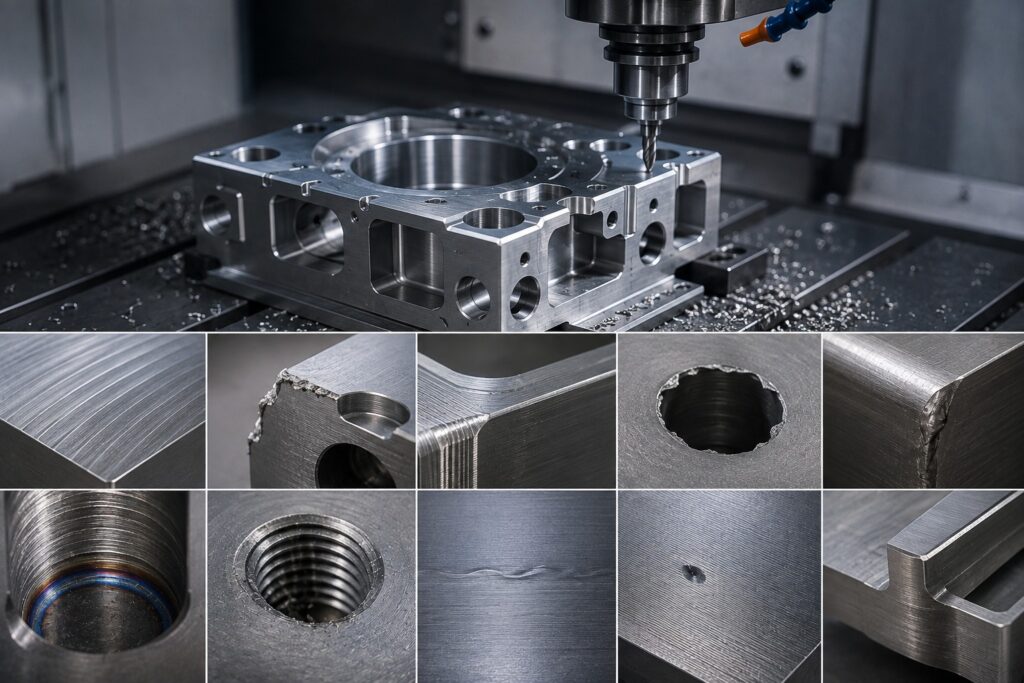
A Practical Guide to Improving CNC Machined Part Quality CNC machining delivers accurate and repeatable components for industries such as automotive, aerospace, medical, robotics, tooling, and industrial manufacturing. However, even advanced CNC equipment can produce defects when machining parameters, tooling, workholding, programming, or material conditions are not properly controlled. Common CNC machining defects can affect dimensional accuracy, surface finish, part geometry, assembly, and overall product performance. Therefore, identifying the cause of a defect early can help manufacturers reduce scrap, rework, production delays, and unnecessary costs. At Polymach365, we provide CNC milling, CNC turning, 3-axis, 4-axis and 5-axis machining, prototype manufacturing, low-volume production, custom CNC parts, and precision machining solutions. Understanding common machining problems can help engineers design and manufacture better components. What Are CNC Machining Defects? CNC machining defects are unwanted variations or imperfections that occur during the manufacturing process. They may result from: Incorrect cutting parameters Tool wear Improper workholding Machine vibration Material characteristics Programming errors Poor tool selection Excessive heat Incorrect tolerances Inadequate inspection Therefore, CNC quality control requires manufacturers to consider the complete machining process rather than focusing only on the finished component. 1. Poor Surface Finish Poor surface finish is one of the most common CNC machining defects. A machined surface may show: Visible tool marks Roughness Scratches Chatter patterns Uneven surfaces Common Causes Poor surface finish can result from: Worn cutting tools Incorrect feed rate Incorrect spindle speed Excessive cutting depth Machine vibration Poor workholding Incorrect tool geometry How to Prevent It Manufacturers can improve surface finish by: Using sharp and suitable cutting tools Optimizing cutting parameters Reducing vibration Improving workholding Selecting the appropriate toolpath Using suitable finishing passes Consequently, proper process control can produce smoother and more consistent machined surfaces. 2. Dimensional Inaccuracy Dimensional errors occur when the finished component does not meet the specified dimensions. For example, a hole may be too large, a shaft may be undersized, or a pocket may be deeper than required. Common Causes Tool wear Machine calibration issues Thermal expansion Incorrect tool offsets Programming errors Material movement Improper workholding How to Prevent It Manufacturers can reduce dimensional errors by: Checking machine calibration Verifying tool offsets Monitoring tool wear Controlling machining temperature Inspecting critical dimensions Using appropriate cutting parameters Therefore, regular measurement during production can help identify dimensional changes before they result in multiple defective parts. 3. Chatter and Vibration Chatter appears as unwanted vibration between the cutting tool, machine, workpiece, or fixture. It can produce visible marks and reduce surface quality. Common Causes Excessive cutting speed Long tool overhang Weak workholding Incorrect cutting parameters Poor machine rigidity Large cutting forces How to Prevent CNC Chatter Manufacturers can reduce chatter by: Shortening tool overhang Improving workholding Adjusting spindle speed Reducing cutting depth Using appropriate tooling Optimizing toolpaths Furthermore, selecting a more rigid setup can significantly improve machining stability. 4. Tool Wear Cutting tools gradually wear as they remove material. As tool wear increases, manufacturers may experience: Dimensional variation Poor surface finish Increased cutting forces Higher temperatures Tool breakage Reduced productivity How to Prevent Tool Wear Manufacturers should: Select the correct cutting tool Use appropriate cutting parameters Monitor tool condition Use suitable coolant or lubrication when required Replace tools at appropriate intervals Therefore, proactive tool monitoring can help maintain consistent part quality. 5. Burr Formation Burrs are small unwanted pieces of material that remain along machined edges. They commonly occur around: Holes Slots External edges Intersections Milled pockets Common Causes Burr formation can be influenced by: Tool condition Cutting direction Material properties Cutting parameters Tool geometry How to Prevent Burrs Manufacturers can reduce burrs through: Proper tool selection Optimized cutting conditions Appropriate cutting direction Edge-break specifications Deburring operations Consequently, including practical edge-break requirements in the design can simplify finishing. 6. Tool Breakage Tool breakage can cause serious production problems. A broken cutting tool can damage the workpiece, interrupt production, and potentially affect the machine. Common Causes Excessive cutting forces Incorrect feeds and speeds Excessive tool engagement Long tool overhang Poor workholding Incorrect tool selection Hard or difficult-to-machine materials Prevention To reduce tool breakage: Use appropriate tooling Optimize cutting parameters Minimize tool overhang Maintain secure workholding Monitor cutting conditions Use suitable machining strategies Therefore, matching the tool to the material and geometry is essential. 7. Thermal Deformation Heat is generated during CNC machining, particularly during aggressive cutting operations. Excessive heat can cause the workpiece or machine components to expand. As a result, the component may move outside the required dimensional tolerance. How to Prevent Thermal Problems Manufacturers can: Control cutting parameters Use appropriate coolant Allow suitable cooling time Monitor machining temperatures Avoid unnecessarily aggressive cutting This becomes especially important when manufacturing components with tight tolerances. 8. Incorrect Hole Dimensions or Positions Holes are critical features in many CNC machined components. Problems may include: Incorrect hole diameter Incorrect hole depth Misaligned holes Incorrect hole position Poor surface quality Common Causes Incorrect tool selection Tool deflection Machine positioning errors Improper workholding Tool wear Programming mistakes Prevention Manufacturers can improve hole accuracy by: Using suitable drilling tools Checking tool offsets Using reaming or boring when required Verifying hole locations Inspecting critical features Therefore, hole requirements should be clearly specified in the CAD model or engineering drawing. 9. Warping and Part Deformation Thin or flexible components can deform during machining. This is particularly important when machining: Thin walls Long components Thin plates Flexible materials Components with uneven material removal Common Causes Excessive cutting forces Poor workholding Internal material stresses Excessive heat Improper machining sequence How to Prevent Deformation Manufacturers can: Improve workholding Use lighter cutting passes Optimize machining sequences Maintain adequate wall thickness Remove material gradually Consequently, proper part design and machining strategy can reduce deformation. 10. Incorrect Surface Geometry Sometimes a component may meet its basic dimensions but still have problems with flatness, parallelism, perpendicularity, or other geometric characteristics. For example, two surfaces may have the correct dimensions but fail to remain parallel. Common Causes Poor machine setup Workpiece movement Tool deflection Thermal effects Incorrect machining sequence Inadequate inspection Prevention Manufacturers can improve
CNC Machining Design Guidelines for Better Manufacturing Results
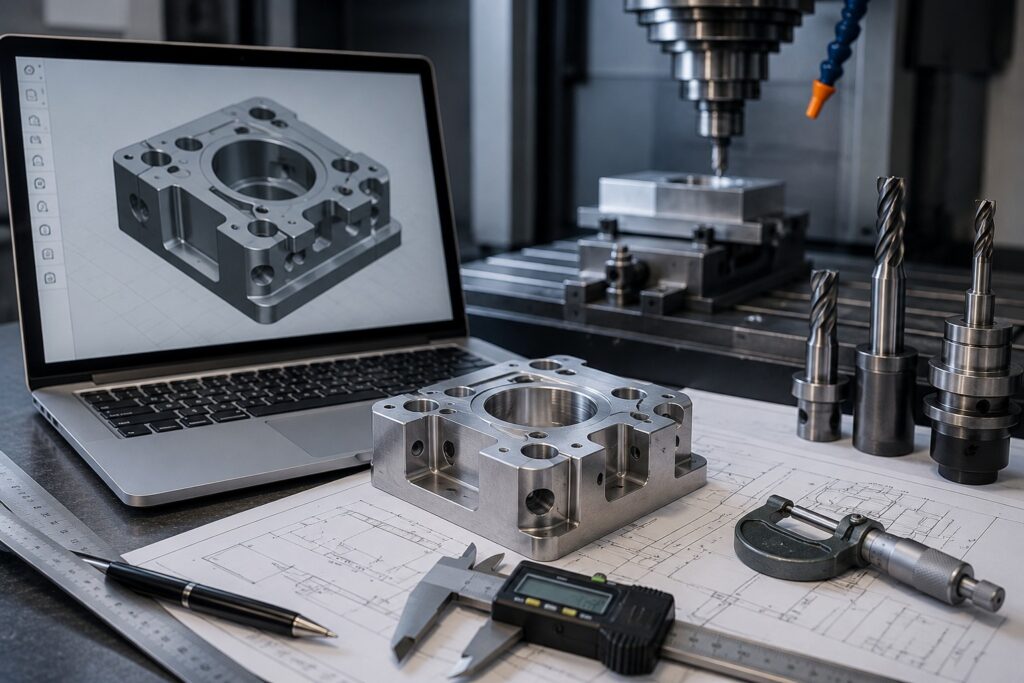
Design Smarter for Accurate, Cost-Effective CNC Machined Parts A well-designed component can make CNC machining faster, more accurate, and more cost-effective. However, even a strong CAD model can create manufacturing challenges if it contains unnecessary tight tolerances, deep cavities, thin walls, or difficult-to-machine features. Therefore, following practical CNC machining design guidelines during the product development stage can help manufacturers reduce machining time, improve part quality, and avoid unnecessary production costs. At Polymach365, we support CNC milling, CNC turning, 3-axis, 4-axis, and 5-axis machining, prototype manufacturing, low-volume production, custom CNC parts, and precision components. By considering manufacturability before production, engineers can create designs that are easier to machine and more reliable in the final application. What Is CNC Design for Manufacturing? CNC design for manufacturing, often called DFM, means designing a component with the machining process in mind. Instead of creating a part first and determining how to manufacture it later, engineers consider factors such as: Tool accessibility Material selection Part geometry Wall thickness Hole size Corner radius Machining tolerances Surface finish Workholding Production quantity As a result, CNC-friendly designs can reduce manufacturing difficulties while maintaining the required functionality. 1. Avoid Unnecessarily Tight Tolerances One of the most important CNC machining design guidelines is to specify tolerances according to actual functional requirements. Not every feature requires extremely tight dimensional control. For example, a critical bearing seat may require a tighter tolerance than a simple mounting surface. Therefore, identify critical dimensions and apply tighter tolerances only where necessary. This approach can help reduce: Machining time Inspection requirements Tooling costs Rework Production complexity Consequently, designing for realistic tolerances can improve both manufacturing efficiency and overall project cost. 2. Choose Appropriate Wall Thickness Thin walls can create machining challenges because cutting forces and heat can cause vibration or deformation. Therefore, avoid unnecessarily thin sections whenever the application allows. A stronger wall design can provide: Better rigidity Reduced vibration Improved dimensional stability Easier machining More consistent results However, the ideal wall thickness depends on the material, geometry, machining process, and application. Therefore, engineers should evaluate thin-wall features carefully before production. 3. Use Suitable Internal Corner Radii CNC cutting tools are generally cylindrical. As a result, they naturally create rounded internal corners rather than perfectly sharp inside corners. Therefore, designing internal corners with an appropriate radius can make machining easier. Instead of specifying a sharp 90-degree internal corner, consider using a radius that matches an available cutting tool. This can help: Reduce machining time Improve tool access Reduce tool wear Avoid unnecessary machining operations Improve surface quality Furthermore, larger internal radii can often allow the use of larger and more rigid cutting tools. 4. Design Holes for Standard Cutting Tools Holes are common CNC-machined features. However, unusual hole dimensions can increase tooling and machining requirements. Therefore, use standard drill sizes whenever possible. Standard holes can help manufacturers: Use readily available tooling Reduce setup time Improve production efficiency Simplify inspection Reduce machining costs For precision holes, additional operations such as reaming or boring may be appropriate. Consequently, hole design should consider both the required function and the available machining process. 5. Avoid Excessively Deep Cavities Deep pockets and cavities can be difficult to machine because cutting tools may need to extend significantly into the workpiece. Long tools can introduce: Tool deflection Vibration Reduced cutting stability Longer machining times Poorer surface finish Therefore, keep pockets as shallow as practical. If a deep cavity is necessary, discuss the geometry with your CNC machining provider before production. A suitable tool diameter, machining strategy, or multi-axis process may provide a better solution. 6. Consider Tool Accessibility A CNC machine can only cut a feature if the tool can physically reach it. Therefore, tool accessibility should be considered during CAD design. Features located inside deep pockets, narrow channels, or enclosed areas may require special tooling or additional setups. Before finalizing a design, consider: Can the cutting tool reach the feature? If the answer is no, the geometry may require a different machining strategy. Consequently, designing for tool access can reduce unnecessary setups and manufacturing complications. 7. Select the Right Material Material selection has a direct effect on machining performance. Common CNC machining materials include: Aluminum Stainless steel Carbon steel Tool steel Brass Copper Titanium ABS Nylon Delrin PEEK Polycarbonate For example, aluminum is generally lightweight and machinable, while stainless steel provides strength and corrosion resistance. Therefore, material selection should consider: Strength Weight Temperature resistance Corrosion resistance Wear resistance Machinability Application requirements Cost Choosing a material that matches the application can improve both component performance and manufacturing efficiency. 8. Keep Designs Simple Where Possible Complexity can increase machining time and production costs. Therefore, avoid adding features that do not provide a functional benefit. Simple designs can reduce: Number of setups Tool changes Programming time Machining operations Inspection requirements However, complex geometries are sometimes necessary. In these situations, 4-axis or 5-axis CNC machining can provide greater flexibility and access to multiple surfaces. As a result, the goal is not to eliminate complexity but to use it only when the application requires it. 9. Plan the Workholding Strategy Workholding keeps the component securely positioned during machining. Therefore, the design should provide enough surface area for reliable fixturing. Avoid placing critical features where clamps or fixtures could interfere with machining. Furthermore, components that require machining on multiple sides may need additional setups. Consequently, considering workholding during the design stage can improve machining stability and reduce repositioning time. 10. Consider Surface Finish Requirements Not every surface requires the same finish. Therefore, specify surface finish requirements only where they are functionally necessary. For example, a sealing surface or bearing interface may require a smoother finish than a non-functional exterior surface. Unnecessary surface-finish requirements can increase machining and finishing costs. As a result, clearly identifying functional surfaces helps manufacturers select the appropriate machining and finishing process. 11. Design Threads Carefully Threaded holes are common in CNC-machined components. When designing threads, consider: Thread size Thread depth Hole diameter Tool accessibility Material Required strength Avoid making threaded holes unnecessarily deep
CNC Machining Tolerances: What Manufacturers Need to Know
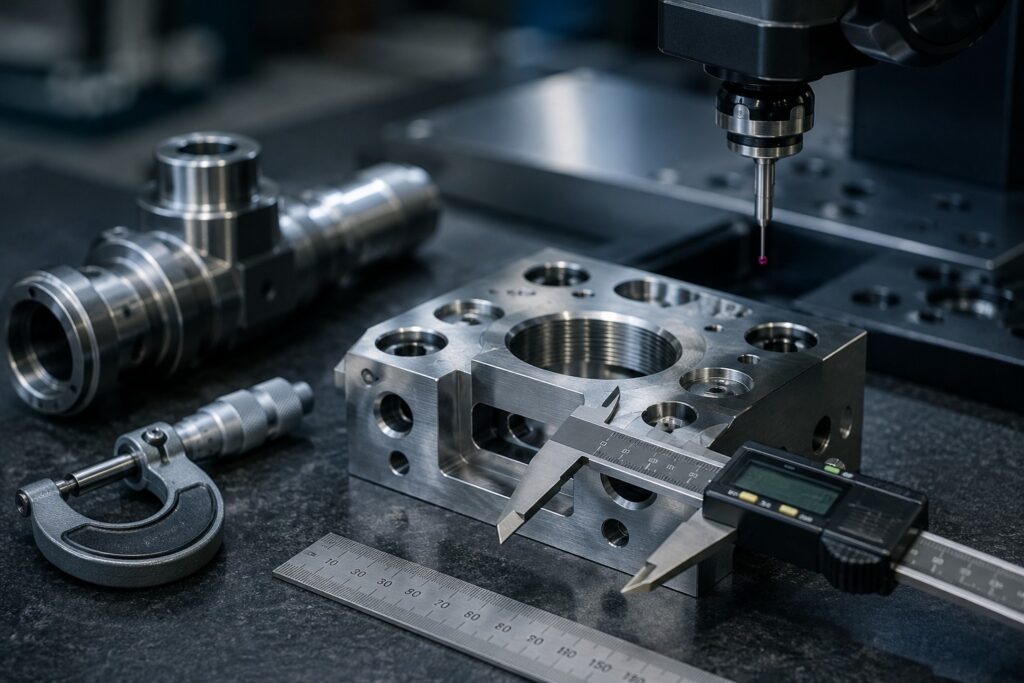
Understanding CNC Machining Tolerances for Accurate, Reliable Parts CNC machining tolerances play a critical role in the accuracy, fit, performance, and reliability of machined components. When manufacturers design a precision component, every dimension cannot simply be treated as an exact number. Manufacturing processes naturally create small variations. Therefore, engineers specify acceptable dimensional limits known as machining tolerances. Whether you are manufacturing a prototype, custom CNC component, mold component, or production part, selecting the right tolerance helps balance part performance, manufacturing complexity, production time, and cost. At Polymach365, our digital manufacturing workflow supports CNC milling, CNC turning, multi-axis machining, prototype manufacturing, low-volume production, and custom CNC machining for manufacturers and product developers. What Are CNC Machining Tolerances? A CNC machining tolerance defines the acceptable amount of variation from a specified dimension. For example, if a drawing specifies a shaft diameter of 20 mm ±0.05 mm, the acceptable diameter range is: 19.95 mm to 20.05 mm The CNC machine does not necessarily need to produce every part at exactly 20.00 mm. Instead, the finished component must remain within the specified tolerance. Therefore, tolerances allow manufacturers to define how much dimensional variation a component can accept while still performing correctly. Why Are CNC Machining Tolerances Important? The correct tolerance directly affects how components fit together and function within an assembly. For example, a shaft that fits into a bearing may require tighter dimensional control than a non-critical mounting bracket. Therefore, manufacturers should not automatically specify extremely tight tolerances for every feature. Appropriate tolerances can help achieve: Accurate component fit Reliable assembly Consistent product performance Better interchangeability Reduced manufacturing problems Controlled production costs Improved quality Reliable component functionality Consequently, tolerance selection should always consider the actual application requirements. Common Types of CNC Machining Tolerances CNC machining involves several different types of tolerances. Each one controls a different aspect of the finished component. 1. Dimensional Tolerance Dimensional tolerance controls the acceptable variation in a feature’s size. For example: 50 mm ±0.10 mm means the dimension can range from: 49.90 mm to 50.10 mm Dimensional tolerances are commonly applied to: Length Width Height Diameter Hole size Slot width Thickness Therefore, dimensional tolerance is one of the most commonly specified CNC machining tolerances. 2. Positional Tolerance Positional tolerance controls where a feature must be located relative to a reference point or datum. This is particularly important for: Bolt holes Mounting holes Connector locations Shafts Pins Assembly features For example, a component may have correctly sized holes but still fail during assembly if those holes are positioned incorrectly. Therefore, positional accuracy can be just as important as dimensional accuracy. 3. Geometric Tolerance Geometric tolerances control the shape and geometry of a component. They can control characteristics such as: Straightness Flatness Circularity Cylindricity Parallelism Perpendicularity Angularity Profile Consequently, geometric tolerances help manufacturers control the overall shape and relationship between different features. 4. Surface Finish Tolerance Surface finish describes the texture or roughness of a machined surface. Some components require smoother surfaces because they interact with: Bearings Seals Sliding components Hydraulic systems Moving assemblies However, achieving a finer surface finish may require additional machining operations or finishing processes. Therefore, surface finish requirements should be specified according to the actual application rather than automatically choosing the smoothest possible finish. What Is a Standard CNC Machining Tolerance? There is no single tolerance that applies to every CNC machined component. The achievable tolerance depends on several factors, including: Machine capability Material Part geometry Feature size Machining process Tool condition Workholding Thermal expansion Inspection method Production volume For many general CNC machining applications, manufacturers may work with tolerances around ±0.1 mm, while tighter tolerances can be achieved when the design, material, machine, tooling, and inspection process support them. However, extremely tight tolerances may require specialized processes and additional inspection. Therefore, manufacturers should discuss critical tolerance requirements before production. Factors That Affect CNC Machining Accuracy Several manufacturing factors can influence the final tolerance of a CNC machined component. Machine Capability Modern CNC machines can provide high levels of repeatability. However, machine accuracy and condition still affect the final result. Regular maintenance and calibration can help maintain machining performance. Material Selection Different materials respond differently during machining. For example, some materials can generate more heat or experience dimensional changes during machining. Therefore, material selection can influence achievable tolerances. Part Geometry Complex geometries can make tight tolerances more difficult to achieve. Deep cavities, thin walls, long features, and difficult-to-access surfaces may require additional setups or specialized tooling. Tool Wear Cutting tools gradually wear during machining. As tool wear increases, dimensional accuracy can change. Therefore, monitoring tool condition is important for maintaining consistent production. Temperature Heat generated during machining can cause thermal expansion. Consequently, temperature control becomes increasingly important when manufacturing components with tight tolerances. Workholding A component must remain securely positioned during machining. Poor workholding can cause movement, vibration, or distortion, which can affect dimensional accuracy. Tight Tolerances vs Standard Tolerances A common misconception is that tighter tolerances always produce better parts. In reality, the correct tolerance depends on the application. Standard Tolerances Standard tolerances are suitable for features where small dimensional variations do not affect functionality. They can help reduce: Machining time Inspection requirements Production complexity Manufacturing costs Tight Tolerances Tight tolerances are appropriate when precise dimensions are essential for: Interchangeable components Precision assemblies Bearings Shafts Sealing surfaces Mechanical interfaces Critical tooling components However, tighter tolerances generally require greater manufacturing control. Therefore, the best approach is to use tight tolerances only where they are necessary. How Tolerances Affect CNC Machining Costs Tolerance requirements can directly influence manufacturing costs. When a component requires extremely tight tolerances, the manufacturer may need: Additional machining operations Specialized cutting tools Multiple setups Slower machining speeds Additional inspection Temperature control More precise workholding Specialized measuring equipment As a result, unnecessary tight tolerances can increase production costs without providing additional functional benefits. Therefore, engineers should apply tighter tolerances only to critical features. CNC Milling Tolerances CNC milling is commonly used to manufacture brackets, housings, plates, fixtures, tooling, mold components, and complex mechanical
How Advanced Manufacturing Improves Product Quality and Reduces Costs
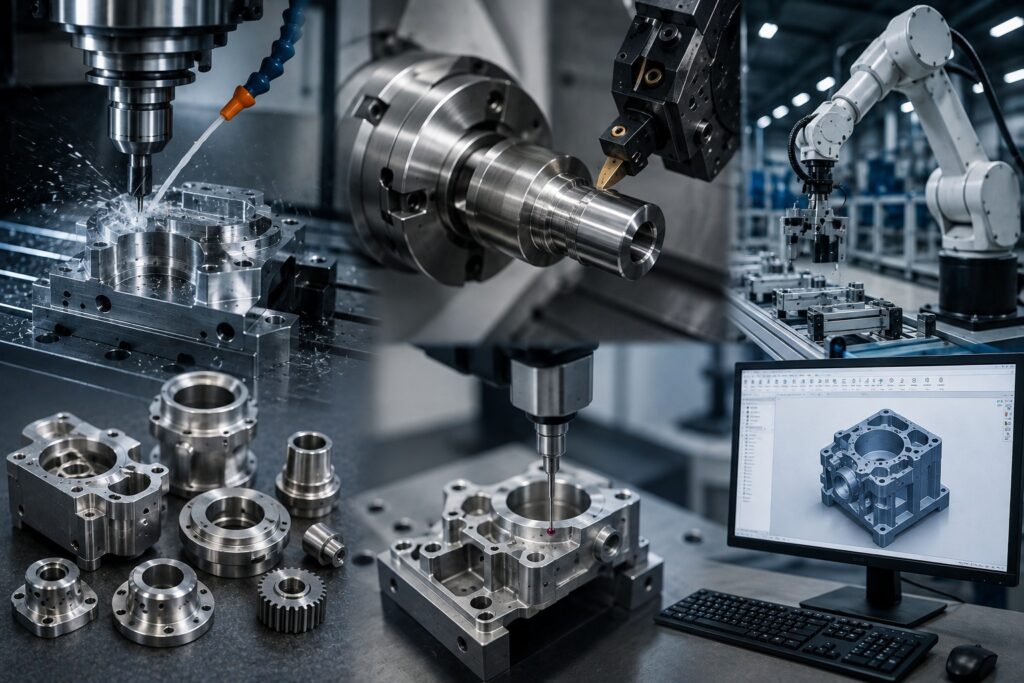
Modern Manufacturing Technologies for Better Accuracy, Efficiency, and Production Performance Manufacturers today face increasing pressure to deliver high-quality products at competitive prices. At the same time, customers expect shorter lead times, consistent quality, reliable performance, and greater customization. Therefore, manufacturers need production methods that improve efficiency without compromising product quality. Advanced manufacturing technologies help achieve this balance by combining precision machining, automation, digital design, advanced inspection, and modern production techniques. At Polymach365, we use advanced manufacturing capabilities such as CNC machining, CNC milling, CNC turning, EDM machining, precision grinding, injection mold manufacturing, mold component manufacturing, and prototype manufacturing to support demanding manufacturing projects. As a result, manufacturers can improve dimensional accuracy, reduce material waste, shorten production times, and control overall manufacturing costs. What Is Advanced Manufacturing? Advanced manufacturing refers to modern production methods that use advanced machinery, software, automation, inspection systems, and engineering processes to manufacture products more efficiently and accurately. Unlike traditional manufacturing, advanced manufacturing focuses heavily on: Precision Automation Repeatability Digital manufacturing Process optimization Quality control Production efficiency Reduced material waste For example, CNC machines can follow digital CAD/CAM instructions to produce complex components with consistent dimensions. Similarly, EDM can manufacture intricate features that may be difficult to produce through conventional machining. Therefore, advanced manufacturing provides manufacturers with greater control over the entire production process. How Advanced Manufacturing Improves Product Quality 1. Higher Dimensional Accuracy Product quality often depends on dimensional accuracy. A small dimensional variation can affect how components fit together, particularly in automotive, industrial, electronics, medical, and precision tooling applications. Advanced CNC machining allows manufacturers to produce components according to detailed CAD models and engineering drawings. Therefore, manufacturers can maintain tighter control over: Dimensions Hole locations Profiles Surface features Threads Mating surfaces Geometric relationships Consequently, improved dimensional accuracy can lead to better-fitting and more reliable products. 2. Better Production Repeatability Producing one accurate component is not enough for modern manufacturing. Manufacturers must often produce hundreds or thousands of components with consistent specifications. CNC machining and automated manufacturing processes help repeat the same programmed operations across multiple production cycles. Therefore, manufacturers can achieve greater consistency between individual parts. As a result, advanced manufacturing is particularly valuable for high-volume production and precision components. 3. Improved Surface Finish Surface quality can influence both the appearance and functionality of a component. Advanced machining processes can produce controlled surface finishes according to project requirements. For example, precision grinding can improve surface quality on suitable components, while CNC machining can create controlled profiles and finishing passes. Consequently, manufacturers can achieve surfaces that meet specific functional or aesthetic requirements. 4. Better Quality Control Advanced manufacturing does not stop at machining. Quality inspection is an important part of the manufacturing process. Manufacturers can inspect critical dimensions and compare finished components against engineering requirements. Inspection can identify issues involving: Dimensional accuracy Geometry Surface condition Hole position Component fit Manufacturing tolerances Therefore, integrating inspection into production helps identify problems before components reach the customer. 5. Consistent Complex Geometries Modern products often require complex shapes that are difficult to produce using conventional equipment. Advanced CNC machining can manufacture: Complex pockets Contoured surfaces Precision holes Slots Threads Curved profiles Multi-axis features Furthermore, EDM can produce intricate geometries in suitable conductive materials. As a result, manufacturers can produce more sophisticated components without relying entirely on multiple manual operations. How Advanced Manufacturing Reduces Costs Improving quality is only one advantage. Advanced manufacturing can also reduce manufacturing costs by improving production efficiency and reducing unnecessary waste. 6. Reduced Material Waste Traditional manufacturing processes can sometimes remove more material than necessary or require additional manual operations. Modern CNC machining uses digital manufacturing programs to control cutting operations more accurately. Therefore, manufacturers can optimize machining strategies and reduce unnecessary material removal. As a result, better process planning can contribute to lower material costs. 7. Faster Production Production speed has a direct effect on manufacturing cost. Advanced CNC equipment can perform machining operations consistently without requiring continuous manual intervention. Moreover, multi-axis machining can reduce the number of setups required for complex components. Therefore, manufacturers can potentially reduce machining time and improve production throughput. 8. Fewer Production Setups Every additional machine setup can increase: Labor time Alignment requirements Handling Inspection time Production delays Advanced machining technologies can combine multiple operations into fewer setups. For example, multi-axis CNC machining can access multiple surfaces of a component without repeatedly repositioning the workpiece. Consequently, fewer setups can improve efficiency and reduce manufacturing costs. 9. Reduced Labor Requirements Automation does not necessarily eliminate skilled workers. Instead, it allows skilled employees to focus on engineering, programming, inspection, process planning, and quality management. Meanwhile, CNC machines can perform repetitive machining operations consistently. Therefore, manufacturers can use labor more efficiently. As a result, production teams can improve productivity without relying on excessive manual operations. 10. Lower Rework and Scrap Costs Poor-quality components create additional costs. When a component fails inspection, manufacturers may need to: Rework the part Remachine the component Scrap the material Repeat production Delay delivery Advanced manufacturing and quality control help reduce these risks. Therefore, producing the component correctly the first time can reduce unnecessary production expenses. CNC Machining and Advanced Manufacturing CNC machining is one of the most important technologies in modern manufacturing. CNC milling and turning allow manufacturers to produce precision components from a wide range of materials. CNC Milling CNC milling is suitable for components requiring: Pockets Slots Holes Profiles Flat surfaces Complex geometries CNC Turning CNC turning is particularly suitable for rotational components such as: Shafts Pins Bushings Sleeves Rollers Couplings Therefore, combining CNC milling and turning capabilities allows manufacturers to support a wider range of component designs. EDM Machining for Complex Components Electrical Discharge Machining, or EDM, uses controlled electrical discharges to remove material from suitable conductive workpieces. Therefore, EDM can manufacture certain intricate features that are difficult to produce through conventional cutting. EDM is particularly useful for: Injection mold components Complex cavities Precision tooling Small features Intricate geometries Difficult-to-machine areas Consequently, EDM expands the manufacturing capabilities available for specialized components. Advanced Manufacturing for
How to Choose the Right Mold Components Supplier in Canada
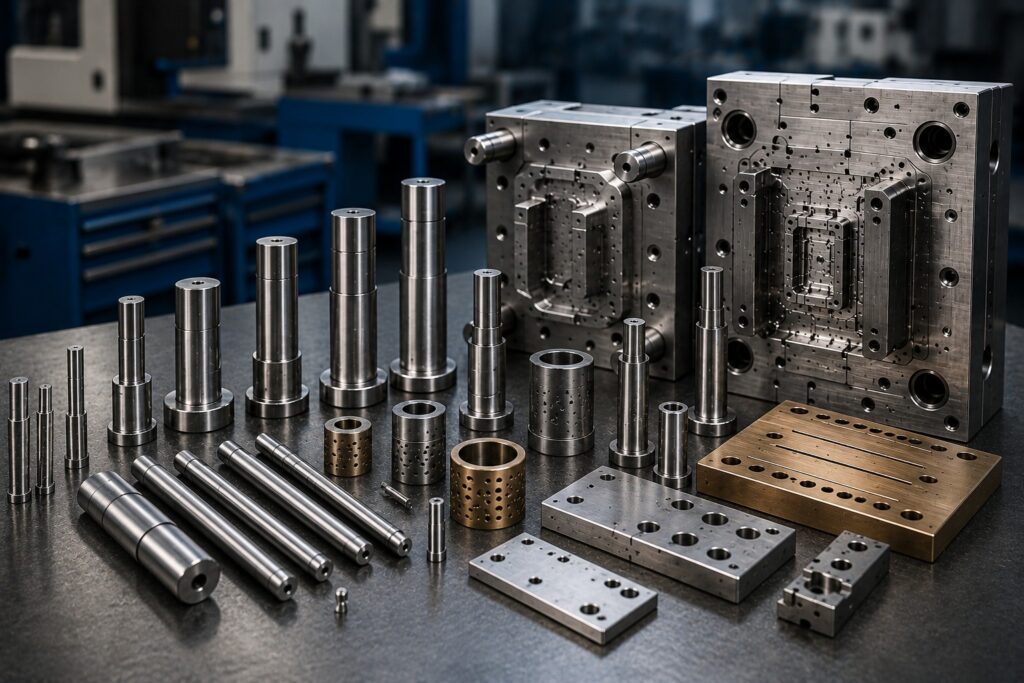
A Practical Guide for Injection Molding Manufacturers Choosing the right mold components supplier in Canada can directly affect mold accuracy, production efficiency, maintenance costs, and tooling life. Therefore, manufacturers should look beyond price when evaluating a supplier. A reliable supplier should provide the right combination of precision manufacturing, material knowledge, quality inspection, customization, engineering support, lead time, and dependable communication. At Polymach365, we manufacture precision and custom mold components for injection molding, compression molding, die-casting tooling, mold repair, prototype tooling, and production applications. Our capabilities include CNC machining, EDM machining, precision grinding, and dimensional inspection. Whether you need core pins, cavity inserts, ejector pins, ejector sleeves, guide pins, bushings, wear plates, or custom mold components, selecting the right manufacturing partner can help you achieve consistent tooling performance. Why Choosing the Right Mold Components Supplier Matters Injection molds operate under repeated pressure, heat, friction, and mechanical movement. Consequently, even a small problem with a critical component can affect the entire production process. Poor-quality or incorrectly manufactured components can contribute to: Mold misalignment Ejection problems Premature wear Part dimensional variation Surface defects Increased maintenance Production downtime Shorter mold life On the other hand, precision-manufactured components can support accurate mold assembly, reliable operation, and repeatable production. Therefore, supplier selection should be treated as an important part of your overall tooling strategy. 1. Check the Supplier’s Mold Component Experience First, determine whether the supplier actually specializes in mold components. A supplier with experience in precision tooling should understand how individual components interact within an injection mold. Look for experience with: Core pins Core inserts Cavity inserts Ejector pins Ejector sleeves Guide pins Guide bushings Wear plates Mold inserts Custom tooling components For example, Polymach365’s current mold-component offering includes these types of components and supports injection molds, compression molds, die-casting tools, and custom tooling applications. Therefore, choose a supplier whose manufacturing capabilities match your actual tooling requirements. 2. Evaluate Precision and Tolerance Capabilities Precision is one of the most important factors when choosing a mold components supplier. Mold components must fit correctly within the tooling system. Therefore, the supplier should have appropriate machining and inspection capabilities for your required tolerances. Ask the supplier: What machining processes do you use? How do you control dimensional accuracy? How are critical dimensions inspected? Can you manufacture according to customer drawings? Can you provide inspection documentation when required? Polymach365 uses CNC machining, EDM machining, precision grinding, and dimensional inspection as part of its mold-component manufacturing process. Consequently, manufacturers should evaluate both the machining process and the supplier’s inspection procedure. 3. Make Sure They Manufacture Custom Components Standard components can work well for conventional tooling. However, many molds require components with unique dimensions or geometries. Therefore, your supplier should have the ability to manufacture custom parts according to your requirements. Custom manufacturing can support: Non-standard core pins Custom cavity inserts Special ejector components Custom wear plates Replacement mold components Engineering modifications Legacy tooling Prototype tooling Polymach365 manufactures custom components based on CAD models, technical drawings, tolerances, material requirements, surface specifications, and production quantities. As a result, you can develop components around your mold instead of changing your tooling to fit a standard part. 4. Review the Available Manufacturing Technologies A good mold components supplier should have suitable manufacturing technology for both simple and complex components. CNC Machining CNC machining can produce accurate profiles, holes, pockets, surfaces, and complex geometries. Therefore, CNC machining provides flexibility for many mold-component applications. EDM Machining Electrical Discharge Machining can produce intricate features and geometries that may be difficult to create using conventional cutting tools. Consequently, EDM can expand the range of components a supplier can manufacture. Precision Grinding Grinding can help achieve accurate dimensions and high-quality surface finishes. Therefore, precision grinding is particularly useful for components where dimensional and surface requirements are critical. Dimensional Inspection Inspection verifies whether the finished component matches the approved engineering specifications. As a result, suppliers with appropriate metrology capabilities can provide greater confidence in component consistency. Polymach365 currently highlights CNC machining, EDM, precision grinding, and dimensional inspection among its manufacturing capabilities. 5. Ask About Material Selection The right mold component material depends on the application. For example, production volume, wear, temperature, corrosion, and mechanical loading can all influence material selection. Common mold-component materials may include: P20-type mold steel H13 Stainless mold steel S7 D2 Aluminum Other engineering steels and alloys Therefore, your supplier should understand why a particular material is suitable rather than simply offering the cheapest option. Ask about: Material grade Hardness Heat treatment Wear resistance Corrosion resistance Thermal requirements Material certification As a result, you can select materials according to the actual operating conditions of your mold. 6. Check Quality Control Procedures Quality control should begin before machining and continue through final inspection. A reliable supplier should have a structured process for checking critical components. Look for: Design Review → Material Verification → Machining → In-Process Inspection → Finishing → Final Inspection → Delivery Polymach365 describes a similar manufacturing workflow that includes engineering review, material selection, precision manufacturing, quality inspection, and delivery. Therefore, ask potential suppliers how they identify and control dimensional problems before components reach the customer. 7. Consider Lead Times and Delivery Reliability A low component price does not help if a delayed component stops production. Therefore, evaluate the supplier’s ability to meet your required delivery schedule. Ask about: Standard lead times Custom-component lead times Rush manufacturing options Shipping arrangements Production capacity Communication during manufacturing Canadian suppliers already compete on delivery and responsiveness. For example, Mold Parts in Ontario highlights in-house manufacturing and short lead times, while the Canadian Association of Mold Makers lists multiple Canadian mold-component suppliers. Consequently, delivery reliability should be part of your supplier evaluation—not an afterthought. 8. Look for Engineering Support A strong mold component supplier should do more than manufacture a drawing. Engineering support can help identify: Manufacturability concerns Material considerations Tolerance requirements Surface-finish requirements Component modifications Potential machining challenges Therefore, look for a supplier that reviews your requirements before production. Polymach365 states that its process begins with design review